- The paper introduces a filter-assisted SQD protocol that uses quantum filtering to engineer ground-state sparsity and lower computational resources.
- It employs MPS-based circuit encoding to optimize local two-qubit unitaries, achieving near-maximum sparsity and polynomial resource scaling.
- Experimental benchmarks on quantum hardware and the quantum Ising model validate enhanced sampling efficiency and sub-microhartree energy accuracy.
Filter-Assisted Quantum Subspace Diagonalization via Wavefunction Sparsity Engineering
Introduction and Motivation
Subspace diagonalization methods enable quantum-classical hybrid algorithms to approximate ground-state energies in many-body physics, leveraging quantum state sampling to construct effective truncated Hilbert spaces. Conventional sample-based approaches such as SQD (sample-based quantum diagonalization) and QSCI (Quantum Selected Configuration Interaction) are fundamentally limited by the trade-off between wavefunction sparsity and sampling efficiency, especially in strongly correlated regimes. This work introduces a filter-assisted SQD (FSQD) protocol, which engineers ground-state sparsity via quantum filters, transforming the Hamiltonian such that its ground state becomes strongly concentrated in the computational basis, thus reducing resource requirements.
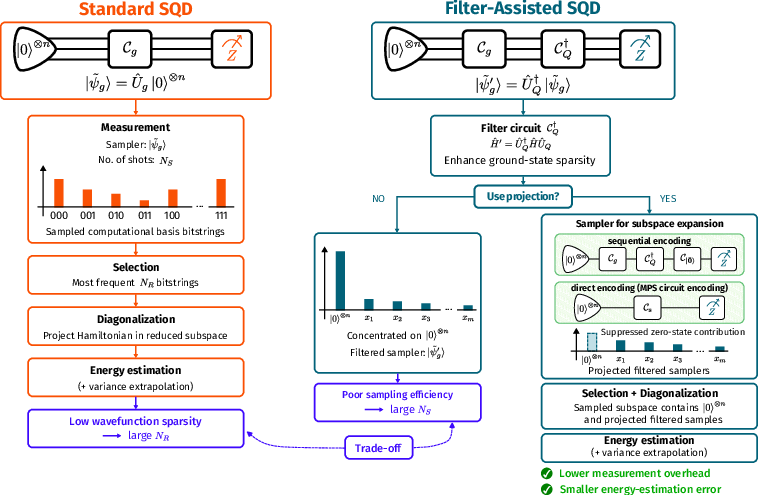
Figure 1: Schematic workflow comparison: standard SQD versus filter-assisted SQD, showing the role of a quantum filter circuit to enhance sparsity.
Quantitative Wavefunction Sparsity and Resource Scaling
Wavefunction sparsity is formally quantified by the Lorenz curve L(x) and the Gini coefficient G, capturing statistical concentration in measurement distributions across computational basis states. The authors derive explicit bounds relating the required sampled subspace dimension NR and measurement shots NS to L(x) and G. Specifically, in standard SQD, exponential or power-law scaling in (1−G)N leads to intractable resource overhead as system size n increases. However, by applying a quantum filter, FSQD reshapes the sampling distribution, ideally producing a system-size independent G and thus polynomial scaling in resources.
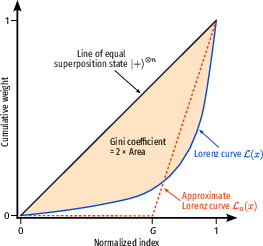
Figure 2: Lorenz curve visualization demonstrating the graphical interpretation of wavefunction sparsity and Gini coefficient.
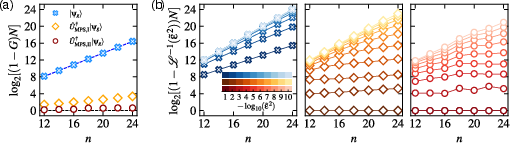
Figure 3: System-size scaling of $1-G$, with filter circuits approaching theoretical maximum sparsity as G0 increases.
MPS-Based Circuit Encoding for Quantum Filtering
The quantum filter is realized via classical tensor-network (specifically MPS) circuit encoding: an approximate ground state is computed classically and mapped to a shallow quantum circuit comprised of local two-qubit unitaries. The encoding algorithm alternates forward and backward sweeps to optimize each local unitary, maximizing overlap with the target MPS.
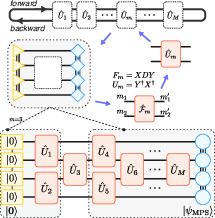
Figure 4: Diagram of the circuit-encoding bidirectional optimization sweeps over two-qubit local unitaries.
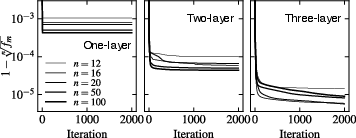
Figure 5: Optimization trajectories of infidelity per site for MPS-based circuit encoding, varying layers and system sizes.
Numerical Benchmarks: Quantum Ising Model
Benchmarking is performed on the quantum Ising chain with transverse and longitudinal fields. Classical simulations verify that, after filtering, the ground state is highly concentrated on the G1 computational basis state—enabling reduced sampled-subspace dimension and shot count at fixed target accuracy. The filtering effect is shown to be layer-dependent: more circuit layers achieve higher sparsity, pushing G2 to near-unity and lowering the scaling exponent G3 in G4.
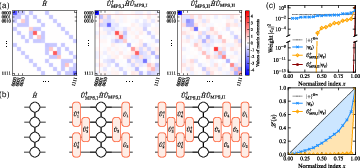
Figure 6: Hamiltonian matrices before and after filtering, showing dominance of the G5 sector.
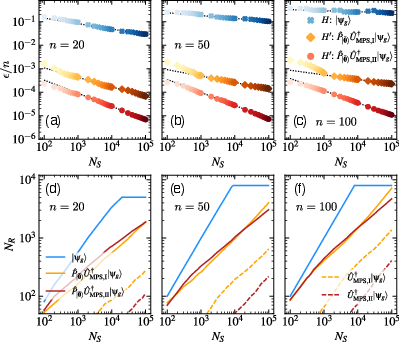
Figure 7: Energy estimation error G6 versus number of shots G7, contrasting standard SQD and FSQD.
FSQD yields estimation errors several orders of magnitude smaller than SQD at comparable G8, with decay exponents G9 (in NR0) remaining large and nearly independent of NR1. Energy-variance extrapolation further improves accuracy for filtered samplers, attaining sub-microhartree error for NR2.
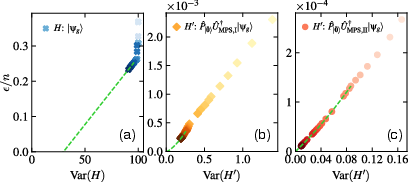
Figure 8: Energy-estimation error versus energy variance, supporting variance extrapolation for improved estimation.
Experimental Demonstration on Quantum Hardware
FSQD and SQD are implemented on IBM Quantum's Heron R2 processor. Experimental samplers include both directly filtered, sequentially projected, and directly circuit-encoded projected states. The projected sampler constructions consistently outperform standard SQD, though hardware noise and imperfect sampler preparation degrade the filter advantage at large NR3. Bitstring recovery rates and the fraction of target bitstrings indicate that hardware noise broadens the sampling distribution, but does not fundamentally alter FSQD's scaling advantage.
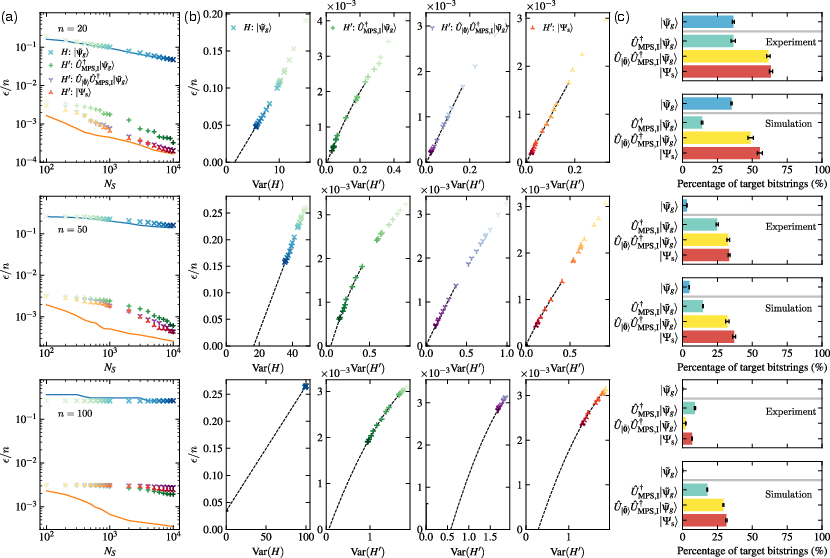
Figure 9: Hardware experimental results for 20, 50, 100 qubits comparing four sampler constructions, showing sampling efficiency and error scaling.
Implications and Future Directions
FSQD fundamentally alters the scaling bottleneck in sample-based quantum subspace diagonalization by transforming the sampling distribution, rather than relying on aggressive truncation strategies. Practically, this enables scalable quantum many-body calculations (e.g., spin systems, quantum chemistry) in regimes where conventional SQD is exponentially costly. Theoretically, the protocol connects quantum state engineering (via tensor-network encoding and filtering) directly to algorithmic resource requirements, suggesting new hybrid architectures for state preparation and error mitigation.
Future research directions include improved filter circuit ans\"atze, symmetrization and adaptive filtering for quantum chemistry, integration with classical post-processing (e.g., configuration recovery), and hardware-specific optimizations to combat noise-induced broadening.
Conclusion
Filter-assisted quantum subspace diagonalization via wavefunction sparsity engineering presents a scalable framework for quantum many-body ground-state energy estimation, validated by both classical and quantum hardware benchmarks. By tailoring the sampling distribution through classical-quantum hybrid tensor-network encoding, FSQD achieves superior sampling efficiency, weak system-size dependence, and robust accuracy in strongly correlated regimes, with clear implications for future quantum hardware and algorithm design.