Continual Learning in Modern Hopfield Networks with an Application to Diffusion Models
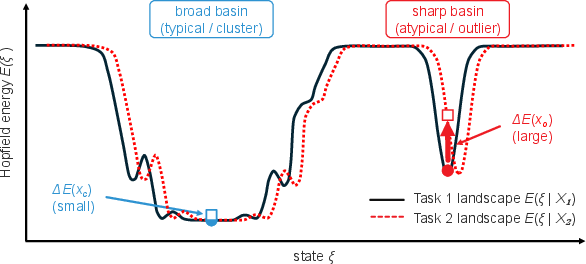
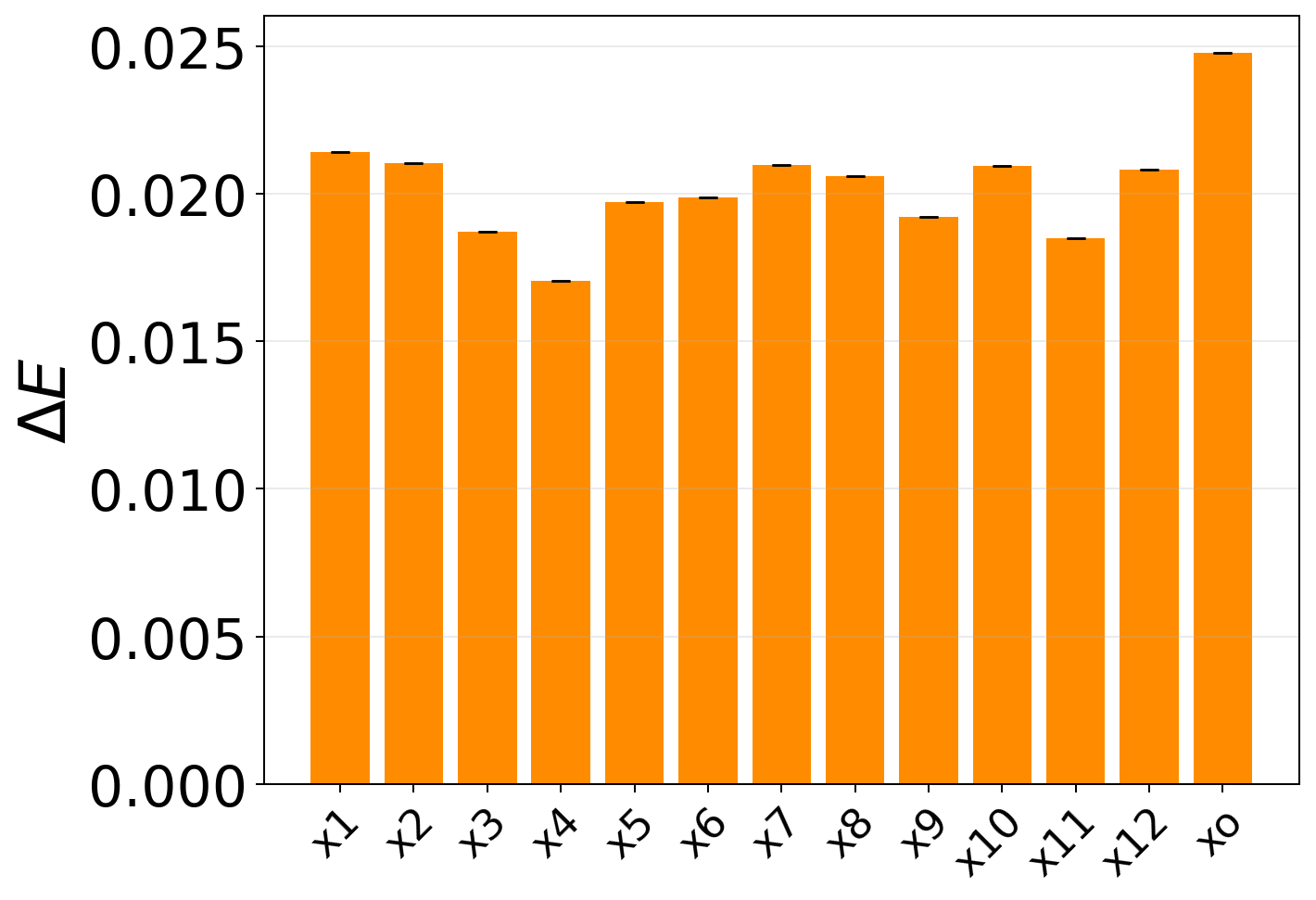
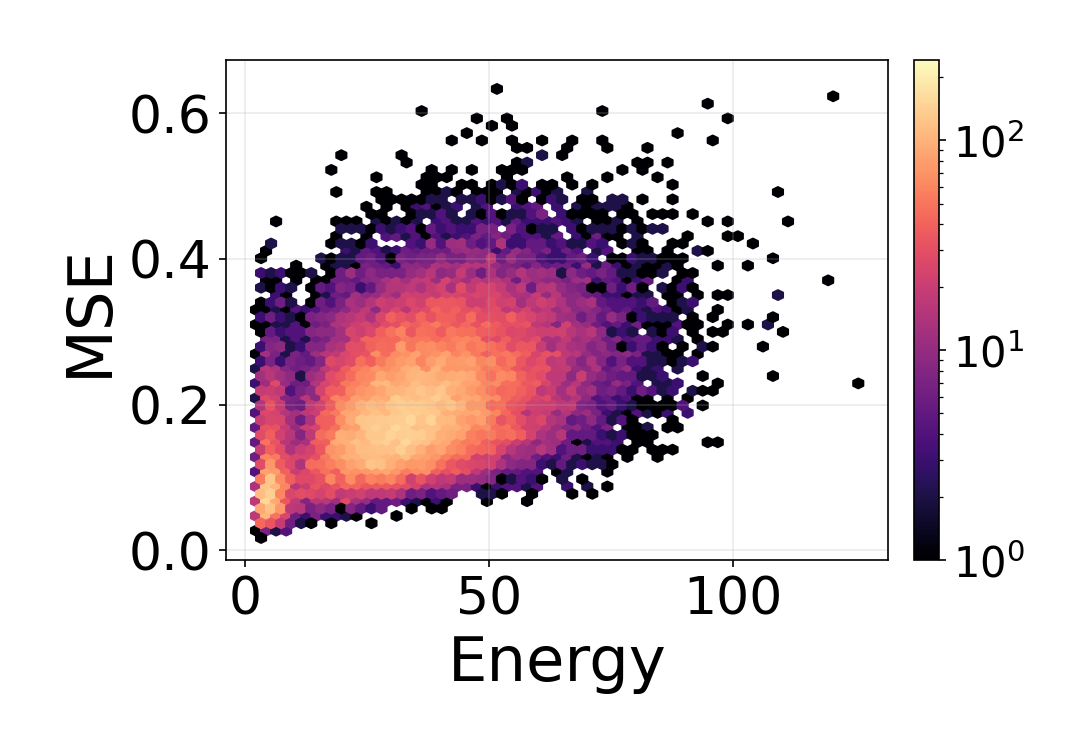
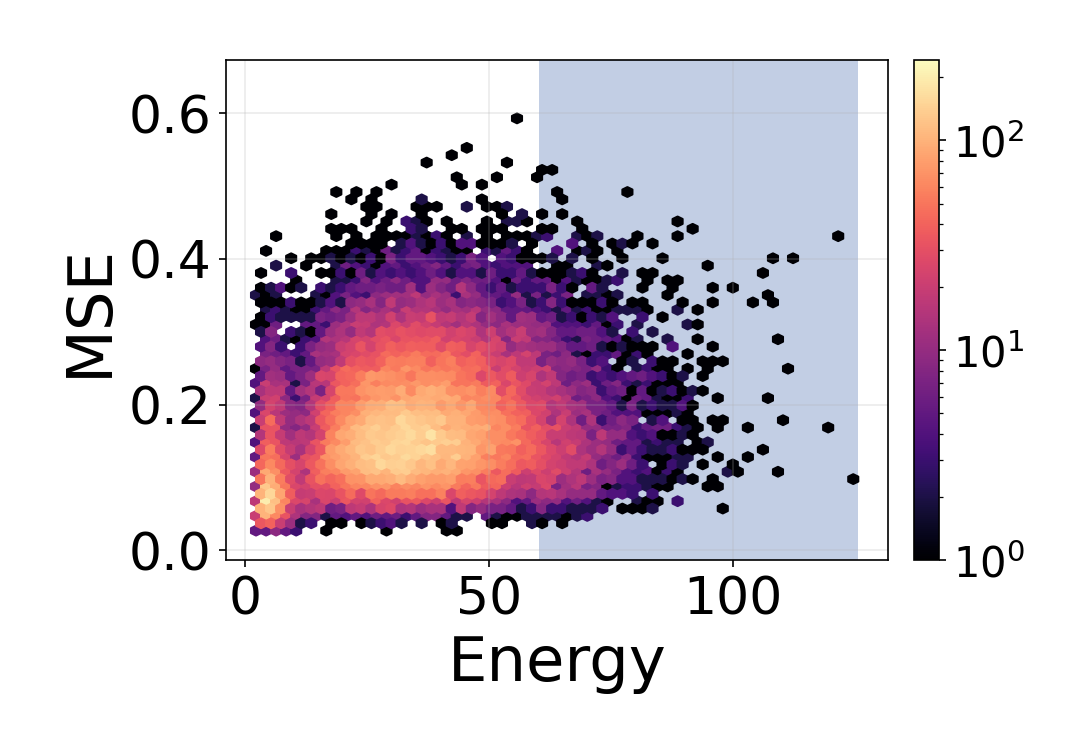
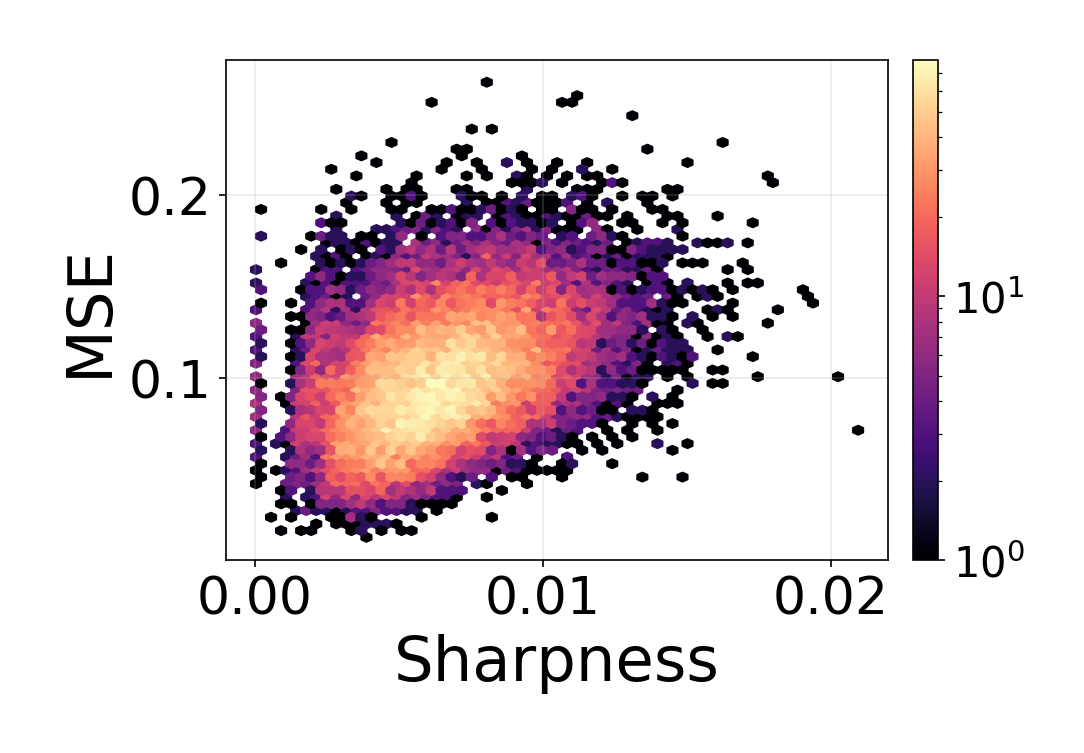
Abstract: Generative models, including diffusion models, are increasingly used as foundation models and adapted through sequential fine-tuning, making continual learning an essential problem setting. However, continual learning in such generative models remains poorly understood: after a task change, what aspects of the learned distribution are most easily lost, and what replay samples should be prioritized? We address these questions through the modern Hopfield energy. Recent links between modern Hopfield networks (MHNs) and diffusion models allow analyses in MHNs to be transferred to diffusion models. We introduce intrinsic forgetting as an increase in Hopfield energy after the task change. In tractable settings in an MHN, we prove that high-energy, outlier-like samples undergo a larger energy increase than cluster-like samples, implying that samples located in sharp, isolated basins are more forgettable. We further analyze memory replay and show that replay is particularly effective for high-energy samples, enabling an energy-based selection of replay samples. We validate these predictions in experiments on MHNs and two diffusion models under continual-learning settings: Stable Diffusion and a pixel-space DDPM. In these diffusion models, Hopfield energy tracks reconstruction-based forgetting, and replay experiments reveal energy-dependent mitigation of forgetting that is consistent with the MHN analysis.
Paper Prompts
Sign up for free to create and run prompts on this paper.
Top Community Prompts
Explain it Like I'm 14
What is this paper about?
This paper studies how generative AI models (especially diffusion models that make images) forget things when they are trained on new tasks, and how to stop that forgetting. The authors use ideas from a type of memory model called a modern Hopfield network to measure and understand forgetting inside these generative models. They introduce a simple, internal “energy” score that tells you which learned examples are most likely to be forgotten and which ones you should replay to protect them.
The big questions
The paper asks two easy-to-understand questions about continual learning (training a model on one task, then another, and so on):
- After the model switches tasks, what previously learned information is most likely to be forgotten?
- If we replay (re-show) some old examples during new training, which examples should we prioritize to best prevent forgetting?
How did they study it?
Hopfield networks and “energy landscapes”
- Think of the model’s memory as a landscape with valleys and hills:
- Valleys = places the model “likes” and remembers well (low energy).
- Hills or sharp peaks = places the model “barely” remembers or finds unusual (high energy).
- A modern Hopfield network (MHN) gives a formula for this memory “energy” at any point. It’s a numeric score the authors can compute.
Link to diffusion models
- Diffusion models slowly turn noise into pictures by following a path guided by their learned “landscape.”
- Prior research shows this path behaves a lot like moving downhill on a Hopfield-like energy landscape.
- Because of this, the Hopfield energy is a practical proxy for the diffusion model’s internal memory landscape. You can track changes in what the model remembers by tracking changes in energy.
A simple theoretical test: “clusters vs. outliers” and small task shifts
- The authors analyze a toy scenario:
- A cluster of similar memories (like many dog photos from similar angles).
- An outlier memory that’s different (like a rare, unusual dog picture).
- Then they simulate a small “task change” that slightly rotates or shifts the whole memory landscape (like moving from one dataset to a somewhat different one).
- They prove that after this shift:
- Outliers (high-energy, sharp peaks) suffer a bigger energy increase.
- Clusters (low-energy, broad valleys) are more stable and change less.
- Energy increase = the model assigns lower probability to that memory (i.e., it’s more likely to forget it). They call this “intrinsic forgetting.”
Replay analysis
- Replay means adding some old examples back into the training data during the new task.
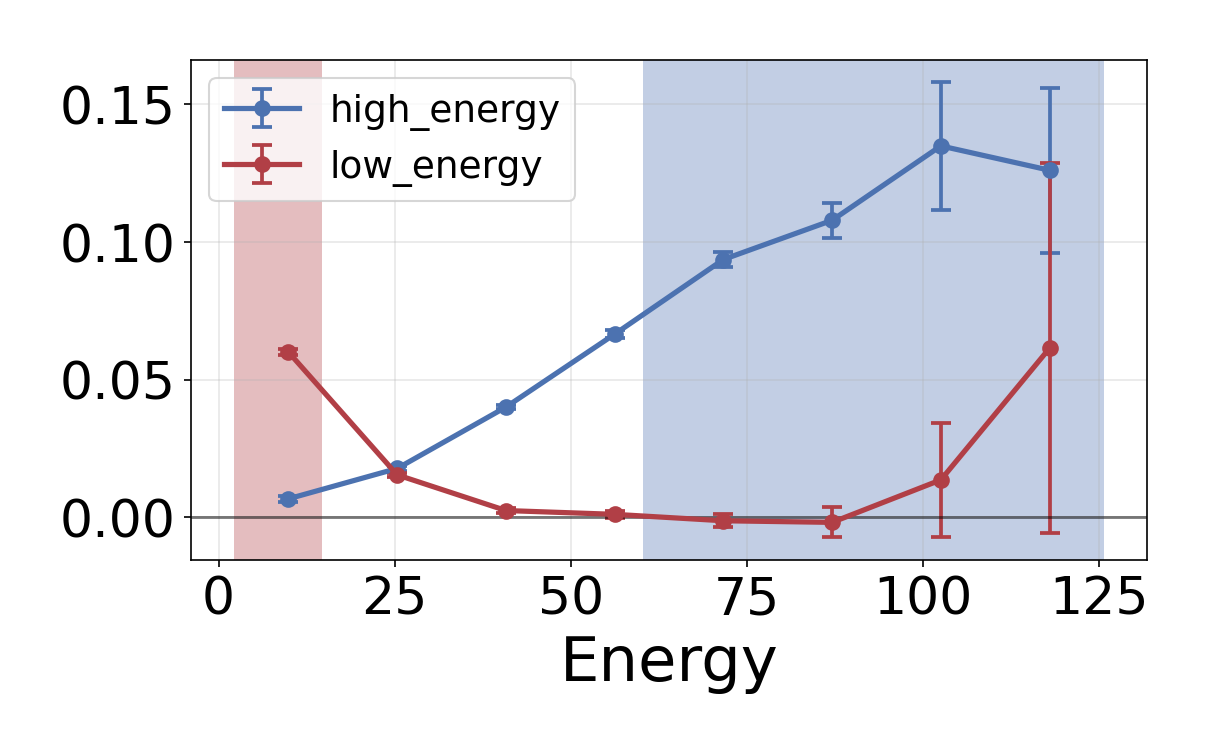
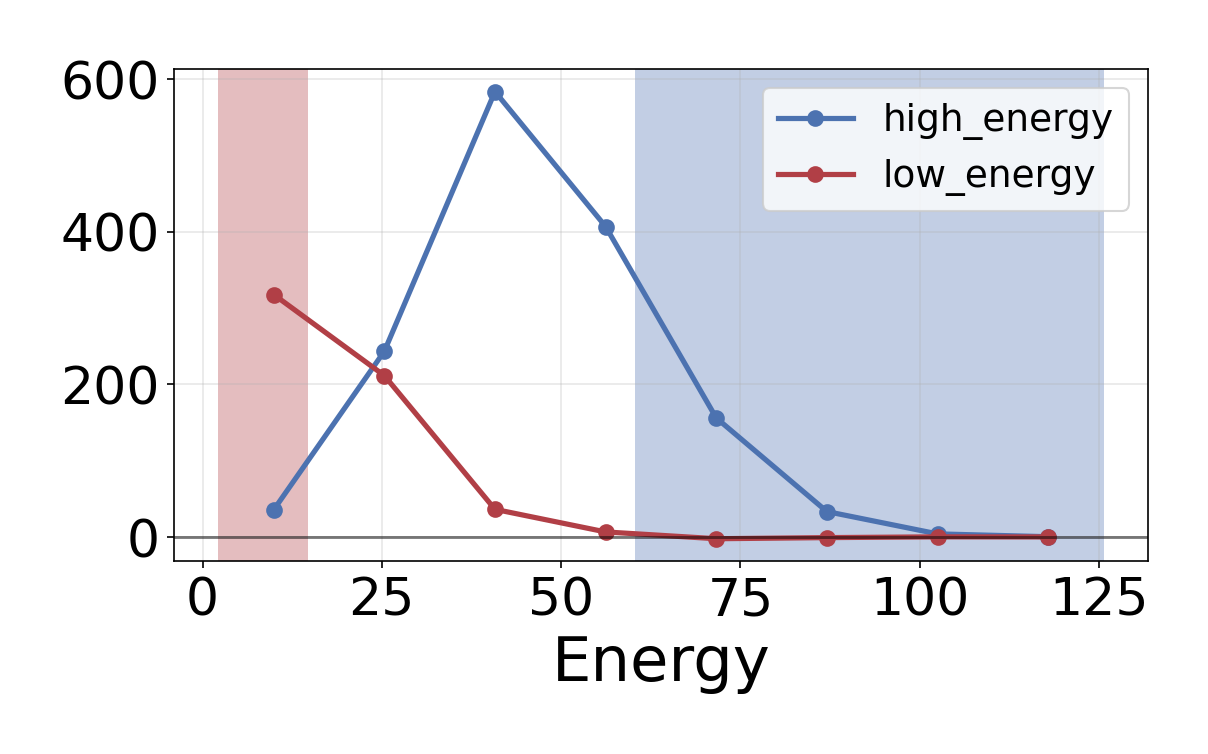
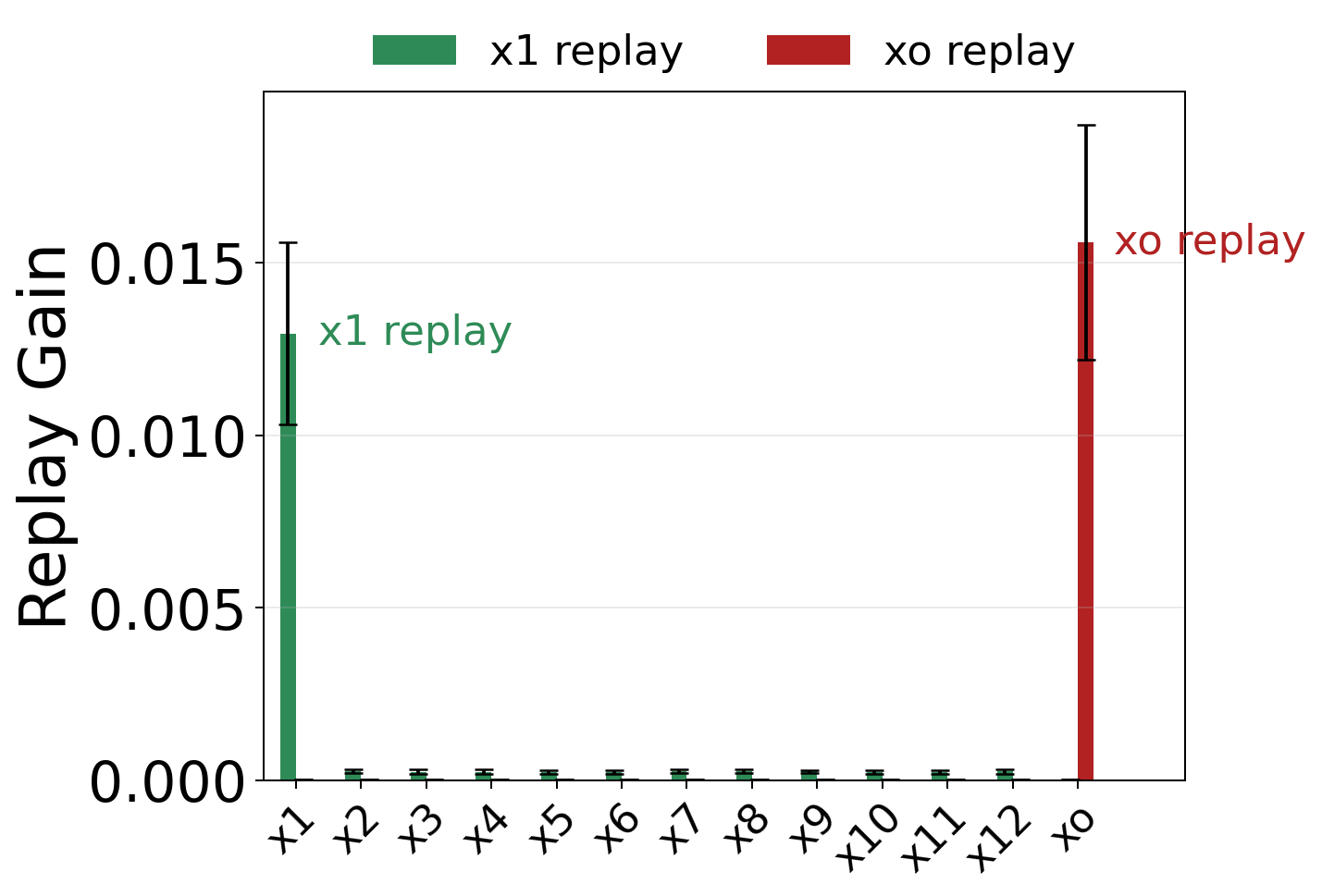
- They show mathematically that replay helps most when you replay high-energy samples (the ones most at risk of being forgotten).
- Replay of low-energy cluster examples helps too, but more broadly and less strongly per sample. Replay of high-energy outliers gives a big rescue for those specific outliers.
Experiments
- They test these ideas on:
- Modern Hopfield networks and a related trainable model (a Boltzmann-machine version).
- Two diffusion models:
- Stable Diffusion v1.5 fine-tuned on split CIFAR-10.
- A pixel-space DDPM trained from scratch on the same split.
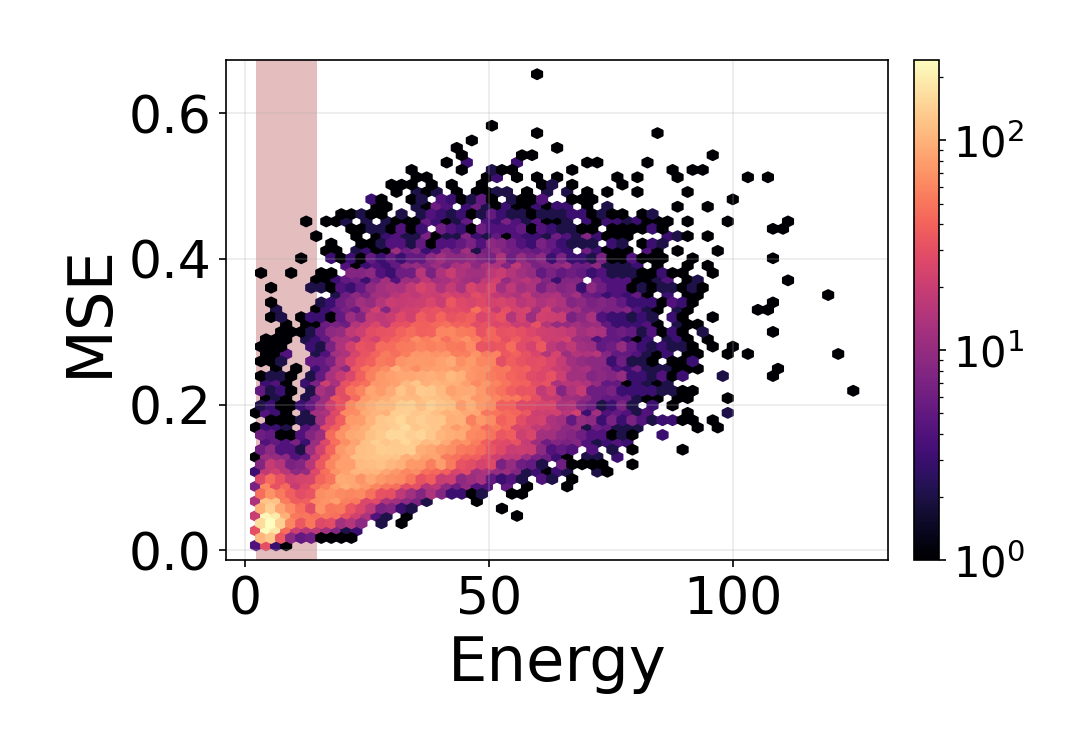
- They use a simple “reconstruction” check: corrupt a Task-1 image with noise, run the model backward to reconstruct it, and measure how close the result is to the original. Bigger error means more forgetting.
- They compare replay strategies:
- Top-K high-energy samples.
- Random samples.
- Bottom-K low-energy samples.
What did they find?
Here are the main findings, based on both theory and experiments:
- High-energy samples are more forgettable:
- Outlier-like examples (sharp peaks) get a bigger energy increase after a task change.
- In practice, those images show larger reconstruction errors after training on the new task.
- The Hopfield energy is a good internal indicator:
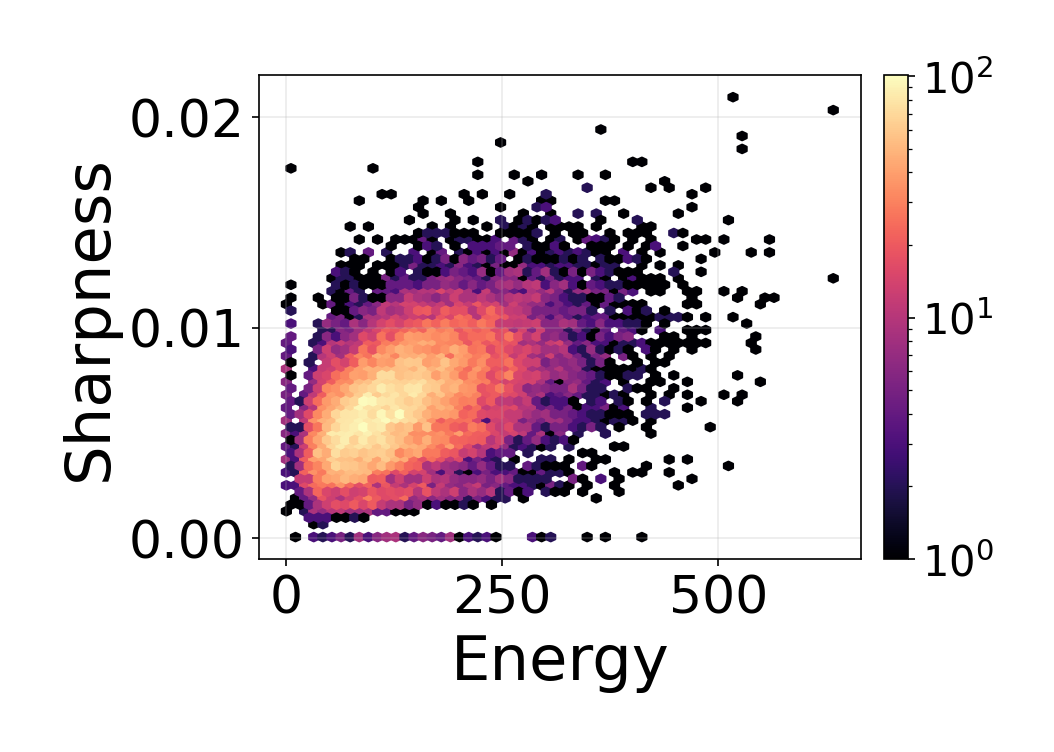
- The energy score strongly correlates with how much a sample will be forgotten.
- This works across different diffusion models (Stable Diffusion and pixel DDPM).
- Energy-guided replay works:
- Replaying high-energy samples gives a strong, focused rescue for those hard-to-remember samples.
- Replaying low-energy samples gives a weaker but broader rescue across similar, easy-to-remember samples.
- Overall, using energy to pick what to replay (top-K highest energy) beats random replay and low-energy replay.
Why it matters
- Practical guidance for continual learning in generative models:
- Instead of guessing which old samples to replay, you can compute the Hopfield energy and pick the ones with the highest energy.
- Better understanding of catastrophic forgetting:
- Forgetting is not random—outliers are at higher risk.
- The model’s internal energy landscape explains which memories are robust and which are fragile.
- Model-agnostic insight:
- The approach works in different diffusion setups, making it useful beyond one specific architecture.
Limitations and future directions
- The theory mainly covers settings with a finite number of stored memories and small shifts; real-world data is more complex.
- Actual diffusion models use big neural networks, so extra kinds of forgetting (from how the network learns) can occur.
- More tests in other domains (text, audio) and true online learning (no clear task boundaries) would strengthen the conclusions.
- Exploring richer internal signals (beyond simple energy) could improve prediction and replay choices even more.
Overall, the paper offers a clear, energy-based way to understand and reduce forgetting in generative models, giving both theoretical foundations and practical tools for better continual learning.
Knowledge Gaps
Unresolved gaps, limitations, and open questions
Below is a concise, actionable list of knowledge gaps and open questions that remain after this work.
- Generality of theory beyond the toy geometry: extend the equal-angular cluster + orthogonal outlier analysis to realistic data geometries (multiple overlapping clusters, hierarchical structure, manifold-supported data, non-orthogonal “outliers”).
- Beyond small random rotations: characterize intrinsic forgetting and replay under non-isometric domain shifts (translations, scalings, non-linear drifts, stylization) and adversarial/structured shifts, not just small random rotations.
- Large-β, finite-N assumptions: develop analyses for high-sample regimes where N scales with dimension and data lie on complex manifolds; quantify how ΔE, fixed points, and replay gains scale with N, d, and β.
- Robustness of the MHN–diffusion energy correspondence: provide rigorous conditions and error bounds for the Hopfield–diffusion energy equivalence in practical settings (discrete time, VP/VPSDE schedules, classifier-free guidance, imperfect score nets).
- Calibration of β and diffusion timestep s: derive principled procedures to select β (or s) for energy evaluation, and quantify sensitivity of energy–forgetting correlations to these choices across models and datasets.
- Reconstruction-based forgetting metric: formalize when reconstruction MSE at a chosen timestep faithfully measures forgetting; analyze dependence on timestep, noise schedule, stochastic sampling, and show theoretical links to ΔE.
- Multi-task longevity: evaluate whether energy predicts forgetting over long task sequences (more than two tasks), with task recurrence and partial overlap, and in online CL without explicit task boundaries.
- Domain and conditioning breadth: extend to non-image domains (audio, text, multimodal) and conditional diffusion (labels, text prompts), defining and validating conditional/internal energies E(x|c) or joint energies over (x, c).
- Architectural dependence: study how results change when fine-tuning additional components (e.g., VAE in latent diffusion), using different backbones, resolutions, and normalization schemes; assess representation effects (pixel vs learned latents).
- Trade-offs with new-task performance: quantify how energy-guided replay affects Task-2 quality, diversity, and fidelity (e.g., FID/precision–recall) and identify regimes that balance retention vs new-task learning.
- Replay beyond single-sample theory: generalize replay analysis to finite-size buffers and curricula, optimizing mixtures of high-energy (localized rescue) and low-energy (broad rescue) samples under memory/compute constraints.
- Scalability of energy computation: design and validate approximate energy estimators (coresets, prototypes, kernel thinning, ANN) with error guarantees; benchmark runtime/memory costs at scale.
- Privacy and storage constraints: develop energy-targeted generative replay or synthetic prototypes to protect high-energy regions when raw Task-1 data cannot be stored; evaluate retention and privacy trade-offs.
- Interaction with other CL strategies: test complementarity with regularization (e.g., Fisher/RIF), parameter-efficient tuning (LoRA, adapters), and model expansion; characterize when energy-guided replay is most beneficial.
- Causality vs correlation: design controlled interventions that alter energy while holding confounders fixed to test whether high energy causally drives forgetting, or merely correlates with rarity/hardness.
- Curvature estimation in practice: propose and validate practical estimators of local curvature (e.g., Hessian trace/spectral measures of the implicit energy) and test their predictive power for forgetting and replay benefit.
- Non-isotropic/heterogeneous norms: analyze how norm variation, anisotropic covariances, and feature normalization choices impact the energy landscape and the effectiveness of energy-guided policies.
- Hyperparameter sensitivity: systematically map sensitivity to buffer size, replay ratio, batch composition, and learning-rate schedules; provide guidelines for robust configuration across datasets/models.
- Outlier overfitting risks: assess whether prioritizing high-energy samples induces overfitting, harms calibration/robustness on inliers, or amplifies bias; propose regularizers or constraints to mitigate adverse effects.
- Linking ΔE to standard metrics: derive bounds connecting intrinsic ΔE to distributional divergences (e.g., density ratios, KL) and to continual-learning metrics (BWT/FWT) and generative metrics (FID/precision–recall).
- Online estimation of impending forgetting: develop training-time proxies (e.g., score drift, gradient norms, per-sample loss curvature) to predict ΔE without full energy recomputation or access to future task data.
- Extension to other generative families: test whether energy-based forgetting/replay principles transfer to VAEs, flows, EBMs, and autoregressive models via analogous internal-energy or score proxies.
Practical Applications
Immediate Applications
The paper’s findings enable deployable tactics for managing catastrophic forgetting in generative models (especially diffusion models) using Hopfield energy as an internal, model-native signal. Below are specific use cases and workflows that can be implemented now.
- Energy-guided replay for diffusion fine-tuning in creative industries (software, media, gaming)
- Use case: When adapting image-generation models (e.g., Stable Diffusion) to new styles or domains, prioritize high-energy (outlier-like) Task-1 samples in the replay buffer to preserve rare styles and edge cases.
- Workflow:
- Compute per-sample Hopfield energy on Task-1 images.
- Select top-K high-energy samples for replay.
- Mix replay samples into Task-2 mini-batches (e.g., 20% replay).
- Monitor reconstruction-based forgetting and energy shift ΔE.
- Tools/products: “Energy-Guided Replay Buffer” plugin for HuggingFace Diffusers or internal training pipelines; dashboards that bin per-sample forgetting vs. energy.
- Assumptions/dependencies: Access to Task-1 data (or acceptable synthetic proxies); feasible computation of log-sum-exp energy over stored memories; storage/replay allowed by data policy.
- Preserving rare disease patterns in medical image generation (healthcare)
- Use case: During continual fine-tuning for new scanners or protocols, protect rare conditions (which tend to be high energy) by prioritizing them in replay.
- Workflow:
- Compute Hopfield energy over Task-1 cases.
- Curate a replay buffer of rare/high-energy cases; augment with strong privacy controls.
- Validate with reconstruction-based forgetting and expert review.
- Tools/products: Energy-based replay module integrated into PACS-compatible training tools; secure replay buffers.
- Assumptions/dependencies: Regulatory approval for retaining/replaying prior patient data, or generation of privacy-preserving synthetic equivalents.
- Model update auditing with an internal forgetting metric (governance/MLOps)
- Use case: In model release pipelines, track which training regions (and which samples) lose probability mass after updates, without relying on external labels.
- Workflow:
- Before and after a model update, compute and log Hopfield energy and ΔE for a retained sample set.
- Flag samples with large ΔE as high-risk forgetting.
- Tools/products: “Forgetting-O-Meter” dashboards; CI/CD hooks that prevent deployment if ΔE thresholds are exceeded.
- Assumptions/dependencies: Stable energy computation protocol (consistent β, normalization, and task-specific memory sets).
- Replay budget allocation policies for edge cases (autonomous systems, robotics)
- Use case: When generating synthetic data for training perception/planning, allocate replay slots to high-energy (rare, safety-critical) scenes.
- Workflow:
- Rank historical scenes by Hopfield energy.
- Maintain a top-K buffer for continued augmentation during new scenario fine-tuning.
- Tools/products: Edge-case–aware synthetic data pipelines; energy-based sampling strategies.
- Assumptions/dependencies: Diffusion-based augmentation in use; sufficient storage and compute for energy computation on-device or offline.
- Energy-aware dataset curation (cross-industry data operations)
- Use case: Identify and protect outlier-rich subsets likely to be forgotten when a model shifts to a new domain.
- Workflow:
- Compute energy per sample or cluster.
- Ensure outlier clusters are retained/oversampled during domain transitions.
- Tools/products: Data curation tools with energy scoring; dataset “coverage reports” highlighting high-energy regions.
- Assumptions/dependencies: Access to a memory bank of Task-1 embeddings; scalable approximations for large datasets (e.g., KNN sampling, clustering).
- Parameter-efficient adaptation with robust retention (software)
- Use case: During LoRA/adapter-based fine-tuning, enrich training batches with top-K high-energy Task-1 samples to preserve critical capabilities.
- Workflow:
- Integrate energy-guided sample selection into LoRA fine-tuning loops.
- Evaluate forgetting via reconstruction error and ΔE.
- Tools/products: Training scripts that combine adapters with energy-biased batch composition.
- Assumptions/dependencies: Existing adapter pipelines; replay permissible.
- Fairness-oriented replay of minority patterns (policy/compliance)
- Use case: Protect minority styles/personas/classes (often high energy) from being marginalized by new domain updates.
- Workflow:
- Combine energy scores with sensitive-attribute tags or proxy fairness metrics where available.
- Prioritize replay of high-energy minority samples.
- Tools/products: Fairness-aware replay management; compliance reports cross-referencing energy and protected attributes.
- Assumptions/dependencies: Careful governance—avoid reinforcing biases by only preserving certain outliers; ensure ethical oversight.
- Energy-based prioritization for synthetic data generation in rare-event modeling (finance, cybersecurity, industrial maintenance)
- Use case: When updating generative models for scenario simulation (e.g., stress testing, cyber-attack simulation, rare fault synthesis), replay high-energy historical events to avoid catastrophic forgetting of tails.
- Workflow:
- Identify high-energy historical episodes.
- Replay them during adaptation to new market regimes, threat landscapes, or machinery states.
- Tools/products: Scenario simulators with energy-aware memory; stress-test dashboards showing ΔE for tail events.
- Assumptions/dependencies: Diffusion-based simulation in use; availability of representative historical data; institutionally approved retention.
- Personal and small-team model customization (daily life, SMEs)
- Use case: Artists or small businesses fine-tuning a model to a new style keep their previous brand/style by replaying a small set of their highest-energy legacy images.
- Workflow:
- Compute energy for a small archive.
- Select and replay a handful of top-energy samples during new fine-tunes.
- Tools/products: Lightweight “Keep-My-Style” plugin that auto-builds a high-energy replay buffer.
- Assumptions/dependencies: Local storage of legacy samples; simple energy estimation tools embedded in GUIs.
- Lightweight energy proxies for large-scale training (academia/industry R&D)
- Use case: For very large Task-1 sets, approximate energy via nearest-neighbor subsets or clustered centroids to enable scalable selection.
- Workflow:
- Use ANN/KNN retrieval to approximate log-sum-exp over a small neighborhood per sample.
- Validate that proxy energies preserve the monotone relation with forgetting.
- Tools/products: “Hopfield Energy Estimator” library with approximate kernels; integration with FAISS/ScaNN.
- Assumptions/dependencies: Approximation quality acceptable; calibration per domain.
Long-Term Applications
The paper’s theory suggests broader developments that require further research, scaling, or extension beyond images and controlled settings.
- Energy-regularized continual training objectives (software, academia)
- Vision: Incorporate penalties on ΔE for designated high-value samples or regions, directly training models to limit intrinsic forgetting.
- Potential products: Energy-aware optimizers or loss terms integrated into diffusion training frameworks.
- Dependencies: Efficient online energy estimation; theory for balancing regularization with adaptation.
- Generalization to other modalities (text, audio, code, multimodal)
- Vision: Extend Hopfield–diffusion energy correspondence and replay prioritization to LDMs for audio/music, video diffusion, or generative text models with diffusion-like backbones.
- Potential products: Multimodal replay schedulers prioritizing high-energy items.
- Dependencies: Confirmed correspondence and reliable energy proxies in each modality; empirical validation.
- Online/streaming continual learning without task boundaries (edge/IoT, robotics)
- Vision: Energy-driven streaming replay strategies that dynamically update buffers based on incoming data and evolving energy landscapes.
- Potential products: On-device replay managers with adaptive top-K maintenance; energy-threshold triggers for sample retention.
- Dependencies: Efficient incremental energy computation; memory and privacy constraints.
- Targeted preservation and removal (model editing)
- Vision: Use energy to steer what to preserve (replay high-energy items) and potentially what to forget (push energy up in specific regions) for content moderation or compliance (e.g., “right to be forgotten”).
- Potential products: Energy-guided model editors with “keep/remove” modes.
- Dependencies: Safe and auditable mechanisms; ethical guidelines; rigorous testing for collateral effects.
- Energy-aware active learning and data acquisition
- Vision: During dataset growth, query new data in regions whose energy signals high sharpness/forgetting risk to improve coverage and stability.
- Potential products: Data acquisition planners driven by Hopfield energy maps.
- Dependencies: Costs and benefits of acquiring rare/outlier data; evaluation protocols.
- Joint buffer design: high-energy vs. low-energy mixes
- Vision: Automated policies that balance “tall but narrow” rescue (high-energy replay) with “shallow but broad” rescue (low-energy cluster replay) according to performance targets.
- Potential products: Controllers that adapt the replay energy distribution to minimize overall forgetting under compute/storage budgets.
- Dependencies: Performance monitoring and multi-objective optimization; domain-specific trade-off tuning.
- Integration with parameter-efficient methods and distillation
- Vision: Combine energy-prioritized replay with LoRA/adapter strategies and teacher–student distillation to retain capabilities when deploying compact models.
- Potential products: Toolchains for energy-aware distillation pipelines in enterprise deployments.
- Dependencies: Distillation objectives aligned with energy metrics; validation for non-image domains.
- Regulatory toolkits and standards for continual updates (policy/compliance)
- Vision: Establish reporting standards requiring internal forgetting metrics (e.g., ΔE distributions) during model updates in regulated sectors (healthcare, finance).
- Potential products: Compliance packages that generate ΔE reports and audit trails.
- Dependencies: Policy adoption; consensus on acceptable thresholds and protocols.
- Combined OOD detection and retention planning
- Vision: Fuse energy-based OOD scoring with replay planning to preferentially retain samples that are both rare (OOD-like) and safety-critical.
- Potential products: Unified risk monitors that allocate replay/labeling resources to high-risk regions.
- Dependencies: Reliable alignment between energy and true risk; domain safety analysis.
- Theoretical scaling to manifold-rich, high-capacity regimes
- Vision: Extend analysis beyond finite, structured memories to dense manifolds and large-scale datasets; characterize energy dynamics at scale.
- Potential products: Theory-informed buffer sizing and β-scheduling tools.
- Dependencies: New theory and empirical studies; compute resources.
Notes on Assumptions and Dependencies
- Energy computation: The Hopfield energy used operationally is a log-sum-exp over Task-1 memories; scalability may require approximations (e.g., KNN subsets, clustering, sampling). Choice of β and normalization matters.
- Data access: Many applications assume replaying historical samples. If retention is disallowed, consider synthetic replay from teacher models or privacy-preserving surrogates.
- Domain scope: Empirical validation is on images (Stable Diffusion v1.5 and pixel-space DDPM). Extensions to other modalities require establishing reliable energy proxies.
- Additional forgetting modes: The method quantifies intrinsic forgetting due to distribution shift. Practical forgetting from optimization/capacity limits may persist; combine with other CL techniques (e.g., regularization, adapters).
- Ethics and fairness: High-energy samples may correspond to minority or sensitive groups. Use governance to ensure replay policies promote fairness and do not inadvertently entrench biases.
Glossary
- attractor-like behavior: Tendency of dynamics to move toward and remain near stable equilibria (attractors) in state space. "with attractor-like behavior toward the data manifold."
- baseline-subtracted replay gain: The improvement from replay after removing the trivial gain of duplicating a memory, used to isolate replay’s net effect. "We call ρ_{r∣k} a replay susceptibility because it is the linear response of the baseline-subtracted replay gain to the energy rise ."
- Boltzmann distribution: A probability distribution over states defined by an energy function and an inverse temperature, p ∝ exp(−βE)/Z. "Define the Boltzmann distribution of the MHN by"
- Boltzmann machine (BM): An energy-based probabilistic model trained by maximizing likelihood, here instantiated for the MHN energy. "we regard this distribution as a Boltzmann machine (BM) with a trainable weight matrix , and refer to it as MHN-BM."
- catastrophic forgetting: Abrupt loss of performance on previously learned tasks after training on new tasks in continual learning. "the mechanism of catastrophic forgetting is still poorly understood"
- DDPM (Denoising Diffusion Probabilistic Models): A class of diffusion generative models using a denoising process to sample data. "a pixel-space DDPM"
- diffusion models: Generative models that learn to reverse a noise-adding diffusion process to synthesize data. "diffusion models have become a default backbone for image generation"
- energy landscape: The scalar energy surface over states that defines basins/attractors and their sharpness or flatness. "where is an inverse-temperature parameter controlling the sharpness of the energy landscape"
- energy-based model: A model specifying an energy function whose values define (unnormalized) probabilities over states. "Diffusion models are not usually written as explicit energy-based models"
- equal-angular cluster: A set of vectors where every pair has the same cosine similarity, forming a symmetric cluster. "so is an equal-angular cluster and is the orthogonal outlier."
- fixed point: A state where the update dynamics’ gradient vanishes, indicating a stationary point (often an attractor). "its fixed points satisfy"
- Fréchet Inception Distance (FID): A metric comparing distributions of generated and real images via Gaussian statistics of deep features. "distributional metrics such as FID."
- Gaussian kernel-density estimator: A nonparametric estimator that sums Gaussian kernels centered at data points to estimate a density. "the score function of a Gaussian kernel-density estimator is exactly a Hopfield update"
- Gaussian mixture: A probability distribution composed of a sum of Gaussian components. "this Boltzmann distribution is a Gaussian mixture"
- gradient flows: Continuous-time dynamics that move in the direction of steepest descent of a potential/energy function. "backward diffusion dynamics can be read as gradient flows on an implicit log-sum-exp energy"
- Hessian: The matrix of second derivatives of the energy; its trace captures local sharpness around a point. "as measured by the Hessian trace of the energy landscape."
- Hopfield energy: The explicit energy function underlying modern Hopfield networks that defines their attractor landscape. "We introduce intrinsic forgetting as an increase in Hopfield energy after the task change."
- intrinsic forgetting: Energy-based measure of forgetting defined as the rise in Hopfield energy at a state after a task change. "We introduce intrinsic forgetting as an increase in Hopfield energy after the task change."
- inverse temperature: A parameter β controlling the sharpness/peakedness of the energy landscape and softmax weights. "where is an inverse-temperature parameter controlling the sharpness of the energy landscape"
- latent space: A compressed representation space (e.g., VAE latents) in which diffusion models like Stable Diffusion operate. "latent-space Stable Diffusion v1.5"
- log-sum-exp energy function: An energy form using log-sum-exp over pattern similarities, linking MHNs to softmax attention. "a Hopfield network with a log-sum-exp energy function corresponds to softmax attention in modern deep learning architectures."
- maximum-likelihood estimation: Parameter estimation by maximizing the likelihood of observed data under a probabilistic model. "we perform unsupervised learning of an MHN by maximum-likelihood estimation of this Boltzmann distribution."
- memory replay: Reusing samples from past tasks during training on new tasks to mitigate forgetting. "We further analyze memory replay and show that replay is particularly effective for high-energy samples"
- Modern Hopfield Networks (MHNs): Generalizations of classical Hopfield networks with higher capacity and explicit energy functions. "modern Hopfield networks (MHNs) form a family of models"
- out-of-distribution (OOD): Inputs that are statistically different from the training data distribution. "to detect out-of-distribution (OOD) samples"
- partition function: The normalizing constant Z that ensures a Boltzmann distribution sums (or integrates) to one. "where is the partition function."
- probability-flow ODE: A continuous-time deterministic formulation equivalent to the diffusion reverse process, tracking probability flow. "probability-flow ODE marginals"
- reverse process: The generative denoising dynamics that invert the forward noising diffusion to reconstruct data. "run the post-Task-2 reverse process from back to $0$"
- score function: The gradient of the log-density; in diffusion, the learned vector field guiding reverse-time sampling. "the score function of a Gaussian kernel-density estimator is exactly a Hopfield update"
- softmax attention: A weighting mechanism computing convex combinations via softmax over similarities; equivalent to MHN updates. "corresponds to softmax attention in modern deep learning architectures."

