- The paper introduces the CANE framework, which models intra-class cluster variations in LLM annotation noise for graph-based learning.
- The paper demonstrates that cluster-aware noise estimation significantly improves classification accuracy, achieving gains up to +6.05pp on benchmarks like WikiCS.
- The paper shows that probe-based noise estimation and iterative label correction offer robust performance even under reduced annotation budgets.
Cluster-Conditional Noise in LLM-Based Label-Free Node Classification
Introduction
The paper "Where LLM Annotators Fail: Label-Free Learning on Graphs with LLMs" (2605.27913) presents a detailed analysis of annotation noise in label-free node classification on text-attributed graphs (TAGs) using LLMs as annotators. The central thesis is that while prior work typically assumes LLM annotation noise is either uniform or class-conditional, in practice, LLM reliability varies sharply within classes—across regions defined by feature-space clusters. This intra-class, region-dependent noise is systematically characterized and exploited by the proposed Cluster-Aware Noise Estimation (CANE) framework, which achieves state-of-the-art label-free node classification accuracy across standard graph benchmarks.
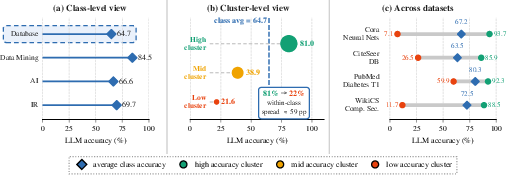
Figure 1: A single class-level accuracy hides large gaps between clusters of the same class, motivating cluster-conditional modeling of LLM reliability.
Cluster-Conditional Noise: Empirical Foundations
Extensive diagnostic analysis demonstrates that class-level aggregate accuracy statistics conceal large intra-class variations. For instance, in DBLP, the "Database" class averages 64.7% LLM annotation accuracy, but when partitioned into feature-space clusters, cluster-level accuracies range from 21.6% to 81.0%. This effect is not isolated: across diverse datasets (Cora, CiteSeer, PubMed, WikiCS, DBLP), per-cluster accuracy distributions deviate substantially from what class-conditional noise models predict. ANOVA statistics and raw within-class accuracy gaps confirm strong statistical significance and large effect sizes for local noise structure. Global or class-conditional confusion matrices systematically under-correct in the "hard" clusters—regions of low LLM reliability—where improved error modeling would yield the most benefit.
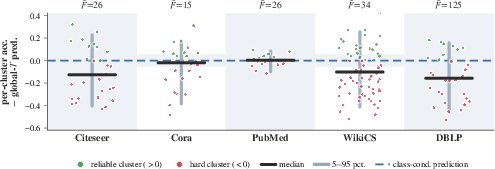
Figure 2: Per-cell deviation of true per-cluster LLM accuracy from what a global T predicts, illustrating that a global correction under-corrects the hardest clusters.
CANE: Cluster-Aware Noise Estimation Framework
CANE is specifically architected to estimate and utilize cluster-conditional LLM reliability in the absence of ground-truth labels. The pipeline proceeds as follows:
- Representative Seed Selection: Lacking supervision, a coverage-based, feature-space K-means clustering is performed (with K=2C). The densest, most central nodes per cluster are selected as seed nodes, optimizing for representativeness and high LLM annotation accuracy.
- Probe-Based Noise Estimation: A leading fraction (probe set, default ρ=0.4) of the budgeted seeds are used to estimate a three-dimensional transition tensor Tc∈[0,1]K×C×C. The diagonal Tc[k,c,c] estimates the probability that the LLM labels a class-c node in cluster 21.6%0 correctly, using neighbor agreement in both graph and feature spaces as a surrogate for annotation reliability.
- Pseudo-label Expansion: GNN is trained with early-learning regularization on the annotated seeds. Instead of a static threshold for accepting model predictions as pseudo-labels, the acceptance criterion is a function of the estimated local LLM reliability, i.e., the threshold for a class 21.6%1 in cluster 21.6%2 is adaptively increased as local reliability decreases (Equation 2 in the paper).
- Iterative Label Correction: The GNN model is retrained, and label corrections are permitted only when neighboring labels provide sufficient support, with the required support threshold again modulated by the estimated local reliability 21.6%3.
- Final Prediction: The finalized, denoised label set is used for the ultimate GNN training to yield node predictions.
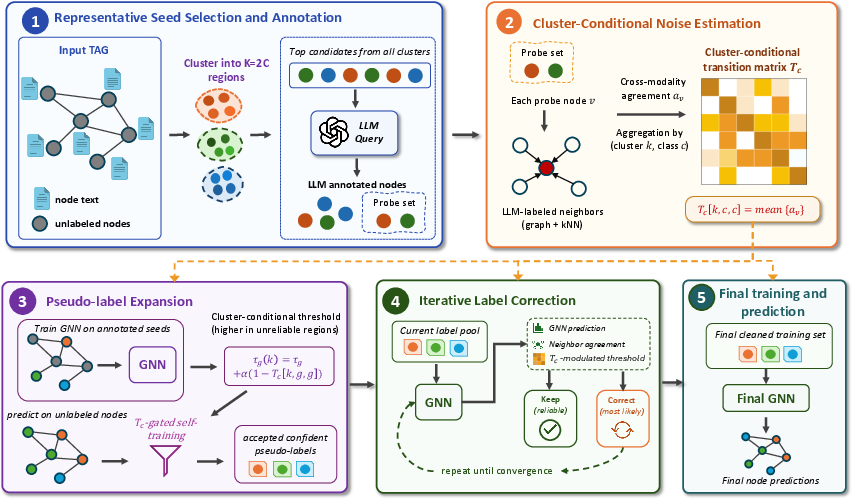
Figure 3: The CANE pipeline, depicting representative seed selection, cluster-conditional noise estimation, pseudo-label expansion, iterative label correction, and final GNN training.
Experimental Results and Analysis
CANE substantially outperforms leading label-free methods (LLM-GNN [chen2024llmgnn], DMA [sheng2025dma], LoCLE [zhang2025locle]) across five standard benchmarks (Cora, CiteSeer, PubMed, WikiCS, DBLP) and two GNN backbones (GCN, GAT). For high heterogeneity datasets (DBLP, CiteSeer, WikiCS), CANE yields the largest accuracy gains—exceeding previous state-of-the-art by up to 21.6%4pp in GAT-based WikiCS—validating the importance of cluster-conditional noise modeling.
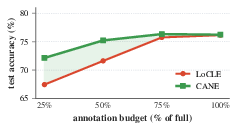
Figure 4: Budget sensitivity—CANE maintains accuracy as annotation budgets decrease, while baselines degrade much faster.
Ablation studies confirm that:
- The cluster-conditional noise model (21.6%5) is critical; collapsing it to a class-conditional matrix significantly erodes gains.
- The label-free, agreement-based 21.6%6 estimator is on par with oracle (ground-truth-based) versions, with negligible oracle headroom.
- CANE is robust to the choice of clustering, probe fraction, and annotation backbone.
- Accuracy degrades gracefully as the annotation budget is reduced, with CANE showing higher robustness than LoCLE in the low-budget regime.
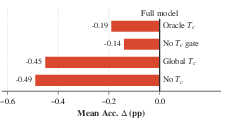
Figure 5: Mean accuracy drop from removing each component, demonstrating the importance of the cluster-conditional noise modeling.
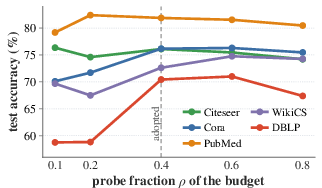
Figure 6: Probe-budget ablation showing that the noise estimate stabilizes with moderate probe effort (21.6%7).
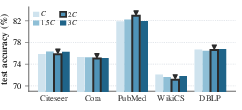
Figure 7: Sensitivity to the number of clusters 21.6%8; CANE performance is stable across a range of cluster granularities.
Implications and Future Directions
The findings establish cluster-conditional noise as the dominant failure mode of LLM annotators in label-free graph-based learning, challenging reliance on global or class-conditional error models. The proven efficacy of the cluster-aware approach suggests several immediate directions:
- Integration with Graph Structure Modification: While CANE focuses on noise modeling, combining it with graph rewiring (e.g., LoCLE's approach) may yield further improvements, especially for small or highly homophilous graphs.
- Scalability to Large, Weakly-Clustered Graphs: The current formulation relies on meaningful feature-space clusters, and performance degrades for graphs where this structure is absent (e.g., ogbn-arxiv).
- Bias and Fairness Considerations: By quantifying where LLM annotators are least reliable, practitioners gain new leverage for fairness auditing and risk assessment in automated annotation.
- Extension to Heterogeneous or Multimodal Graphs: The methodology is orthogonal to node feature enrichment from LLMs and could be fused with graph–language joint modeling for richer representations.
Conclusion
The paper systematically diagnoses and exploits the cluster-conditional nature of LLM annotation noise in large-scale, label-free node classification. The CANE framework—built on self-supervised cluster-based noise estimation—consistently improves performance over previous approaches, with gains that are tightly coupled to the granularity of local noise structure in the graph. Cluster-aware noise modeling represents an essential refinement for future LLM-assisted graph learning pipelines and offers theoretical and practical insights into the alignment between automated annotation and real network structure.