- The paper elucidates the dual structure of electric and magnetic surface charges using the S-wall operator in 4D Maxwell theory.
- The paper shows that standard large gauge transformations yield nonphysical edge modes, while modified boundary conditions render these modes physically relevant.
- The paper bridges gauge redundancies with subsystem symmetries, offering new insights into entanglement entropy and celestial holography.
Revisiting Boundary Electromagnetic Duality and Edge Modes in Maxwell Theory
Overview
The paper "Revisiting boundary electromagnetic duality and edge modes" (2605.27870) presents a comprehensive analysis of electric and magnetic surface charges and edge modes in four-dimensional Maxwell theory and QED on manifolds with finite spatial boundaries. The authors leverage the S-wall, a topological operator implementing electromagnetic duality, to elucidate the dual structure of surface charges and clarify the physical status of boundary symmetries under varied boundary conditions. The work substantially refines the canonical understanding of gauge redundancies, surface charges, and the realization (or absence) of physical boundary symmetries, with important implications for generalized symmetry, topological field theory, and the structure of subsystems in gauge theories.
Generalized Symmetry and Topological Operators
The foundation of the analysis rests on the modern perspective of generalized symmetries, particularly the notion that symmetries in gauge theory correspond to topological operators supported on suitable surfaces. In four-dimensional Maxwell theory, continuous 1-form symmetries—electric and magnetic—are generated by the shift actions on the gauge field A and its dual, respectively. These symmetries manifest through conserved 2-form currents (∗F and F), and corresponding surface charges are invariant under deformations of their supporting two-dimensional submanifolds, reflecting their topological character.
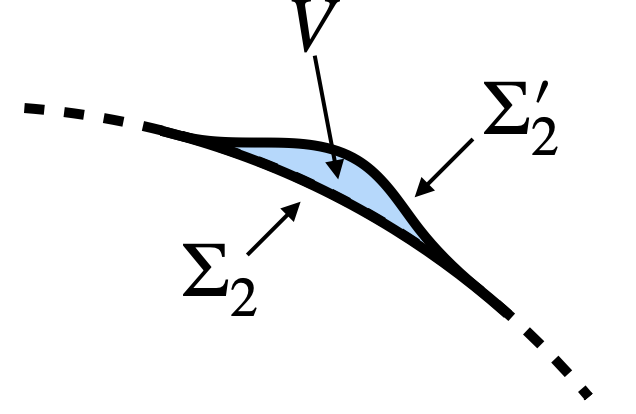
Figure 1: The deformation of a two-dimensional surface Σ2 to Σ2′ highlights the topological invariance of conserved charges in Maxwell theory.
Boundary Symmetries and S-Wall Duality
In the context of a finite boundary, the S-wall operator (a three-dimensional topological defect) is introduced to explicitly realize electromagnetic duality, facilitating the exchange between electric and magnetic quantities across regions separated by the wall. When attached to the spatial boundary, the S-wall maps Neumann (∗F∣Δ=fixed) to Dirichlet (F∣Δ=fixed) boundary conditions, and vice versa. This mechanism is crucial for understanding the emergence and duality of surface charges localized at the boundary.
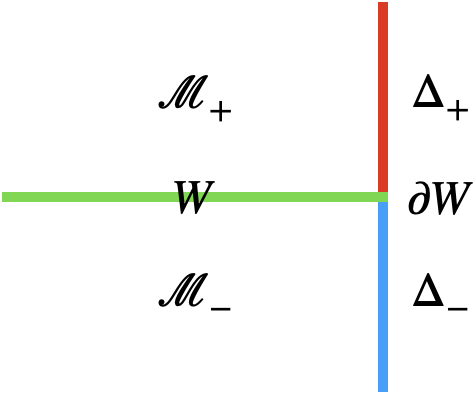
Figure 2: Insertion of the S-wall divides spacetime into two regions with distinct boundary conditions, enabling duality between electric and magnetic surface charges.
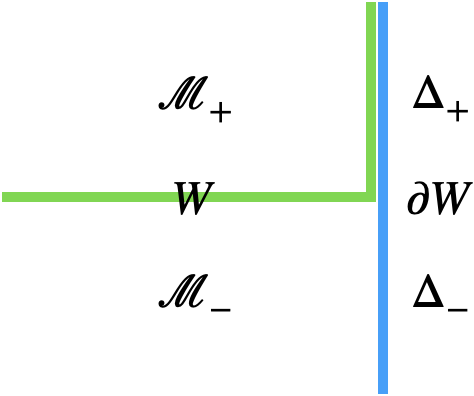
Figure 3: A bending S-wall operator extends into the spacetime, separating the regions by the wall W and tracing along the boundary Δ+ towards future infinity, encoding the duality transformation.
Under standard boundary conditions, large gauge transformations at the boundary—those not vanishing at Δ—correspond to shifts of edge modes. However, the analysis demonstrates that these transformations produce gauge redundancies rather than genuine physical boundary symmetries: the associated Noether charges either vanish or are non-dynamical, rendering the edge modes unphysical. The duality between electric and magnetic surface charges is made manifest via auxiliary boundary fields and hidden edge modes, but remains restricted to gauge redundancy in this regime.
The authors extend the analysis by introducing edge modes (boundary-localized scalar fields dressing the gauge field), which facilitate manifest gauge invariance and the description of subsystem symmetries. Nevertheless, under standard Neumann and Dirichlet conditions, shifts of these edge modes do not produce physical degrees of freedom. The situation changes when considering singular large gauge transformations, which effectively correspond to the insertion of boundary Wilson or 't Hooft loops. These insertions yield non-vanishing, physically relevant charges, highlighting the interplay between gauge theory defects and surface observables.
Modified Boundary Conditions and Physical Symmetries
A central result is established upon modifying boundary conditions—specifically, adopting "soft" or "dynamical edge mode" conditions as found in recent works [Ball:2024hqe, Araujo-Regado:2024dpr]. Under these alternative conditions, components of ∗F0 or ∗F1 at the boundary are no longer completely fixed, enabling large gauge transformations (or edge mode shifts) to become genuine physical symmetries associated with non-trivial, topological surface operators:
- In the modified Neumann case, electric surface charges generate physical boundary symmetries, and edge modes become true boundary degrees of freedom.
- In the modified Dirichlet case (the electromagnetic dual), magnetic surface charges and edge modes attain physical status.
These findings imply that the existence of boundary generalized symmetries (zero-form, higher-form) and their associated topological operators is highly contingent on boundary conditions.
Boundary Generalized Symmetry and Implications
The analysis advances the viewpoint that boundary symmetries in gauge theory should be conceived as generalized symmetries localized at the boundary, with their codimension determined by the bulk-to-boundary correspondence of supporting surfaces. The charges constructed in this work exhibit topological dependence and can be classified as subsystem symmetries in the boundary theory, bridging connections to developments in symmetry-topological field theory.
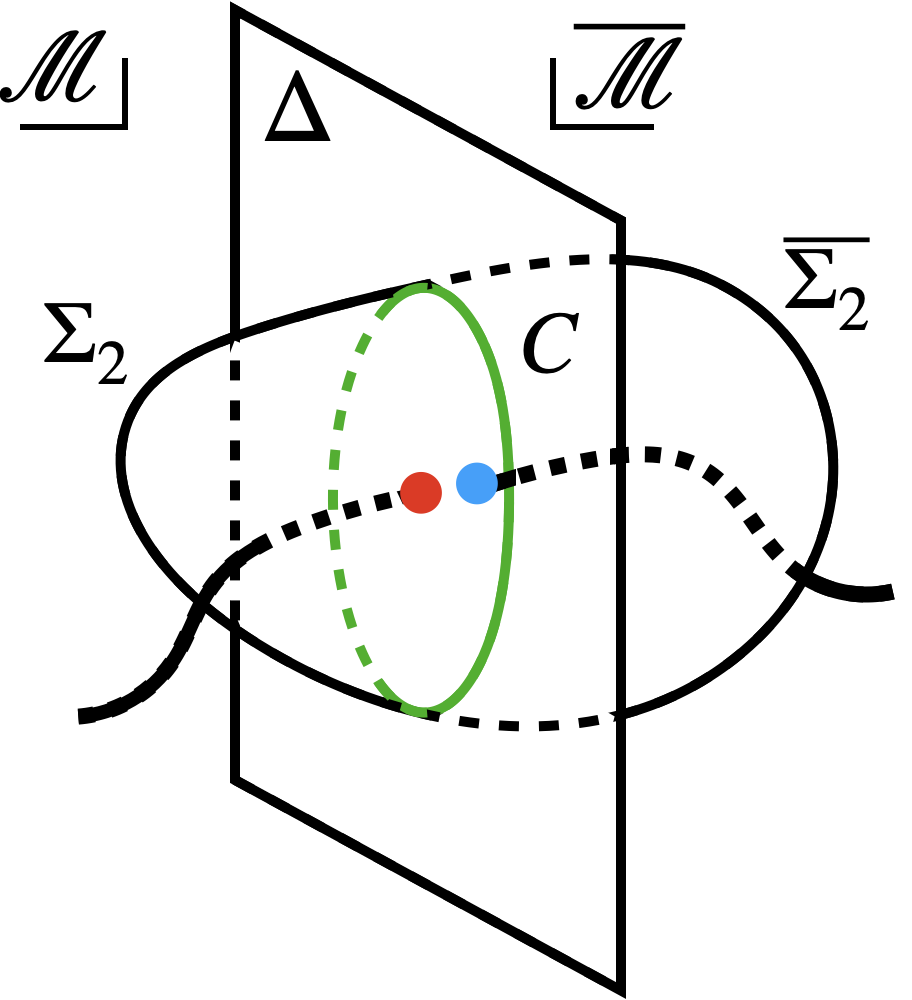
Figure 4: Boundary cutting of loop and surface operators reveals edge modes as remnants of extended bulk objects; boundary symmetry arises from the reduction of topological defects.
Practically, the results bear directly on entanglement entropy, subsystem decomposition, and celestial holography, especially concerning the ambiguity and realization of asymptotic symmetries and their algebraic structures—such as the central extension in the commutator of electric and magnetic surface charges. Theoretically, the work paves the way for a systematic classification of boundary conditions based on the generalized symmetries they support, potentially leading to refined treatments of boundary defects, nonlocal observables, and the role of edge modes in diverse gauge theories.
Conclusion
The paper rigorously dissects the distinction between gauge redundancy and physical boundary symmetry in Maxwell theory and QED with finite boundaries. By deploying the S-wall and scrutinizing the impact of boundary conditions on edge modes and surface charges, the authors assert that standard large gauge transformations do not always instantiate physical symmetries. Modified boundary conditions are necessary to elevate edge modes and surface operators to physical status, and electromagnetic duality is restored in this context. This framework yields profound implications for boundary generalized symmetries, subsystem symmetries, and the physical interpretation of conserved charges and defects in gauge theory. Further exploration is warranted regarding boundary conditions permitting simultaneous physicality of electric and magnetic surface charges and the classification of boundary generalized symmetries in gauge field theory.