- The paper introduces DSA, a backdoor attack that strategically steers poisoned samples into low-density regions to optimize attack success while preserving clean accuracy.
- It employs a bi-level optimization framework with conditional time-score matching to accurately estimate density ratios and guide sample-specific trigger placement.
- DSA demonstrates robust performance with 99–100% attack success and significant resilience against fine-tuning and pruning defenses across multiple datasets.
Density-aware Sample-specific Attack: A Technical Analysis
Motivation and Theoretical Underpinnings
The "Density-aware Sample-specific Attack" (DSA) (2605.27809) presents a principled approach for backdoor injection that fundamentally rethinks the objectives and methodology behind trigger placement in poisoned training data. Prior attacks typically operate via heuristic or input-space-constrained perturbations, failing to account for the distributional geometry of feature space. DSA formulates backdoor objective as a problem of optimally steering poisoned samples into low-density regions of the clean data distribution, derived from a mixture model analysis of poisoned versus benign learning in Bayes-optimal classifiers.
This central insight is grounded in mixture model Bayes analysis, which shows that both attack success and clean accuracy preservation are maximized when triggered, relabeled samples occupy regions of minimal clean data density. This distributional placement renders the backdoor immune to post-training fine-tuning defenses, as these rely on gradients computed from clean data support—regions where the corrective signal is absent for DSA triggers.
Bilevel Optimization and Density-Ratio Estimation
DSA operationalizes this principle via a bi-level optimization framework. The attack employs a generator ηϕ(x) that is sample-specific, conditioned per input. The outer loop optimizes trigger parameters to minimize a loss balancing attack success and clean accuracy, while the inner loop estimates the density ratio r(x)=pX(x)/pX~(x) using conditional time-score matching (CTSM) [yu2025density].
CTSM interpolates between clean and triggered distributions via variance-preserving paths, training a neural network to estimate the marginal time-score and allow accurate log density ratio recovery through integration. This approach provides a robust estimate of how far a sample is from clean data support, guiding the perturbation generator to push triggered samples into sparse regions of representation space.
The trigger optimization is regularized with cross-entropy guidance from a clean classifier to ensure attack success. Implicit differentiation is used to solve the bi-level problem, efficiently computing hypergradients for trigger updates. Score-based initialization, using the negative gradient of clean sample log-likelihood, accelerates convergence and promotes placement in low-density regimes.
Empirical Results: Robustness and Effectiveness
Comprehensive experiments benchmark DSA against representative attacks—BadNets, Blended, SSBA, WaveAttack, BppAttack, Adapt-Blend, and LIRA—across MNIST, CIFAR-10, GTSRB, and TinyImageNet datasets.
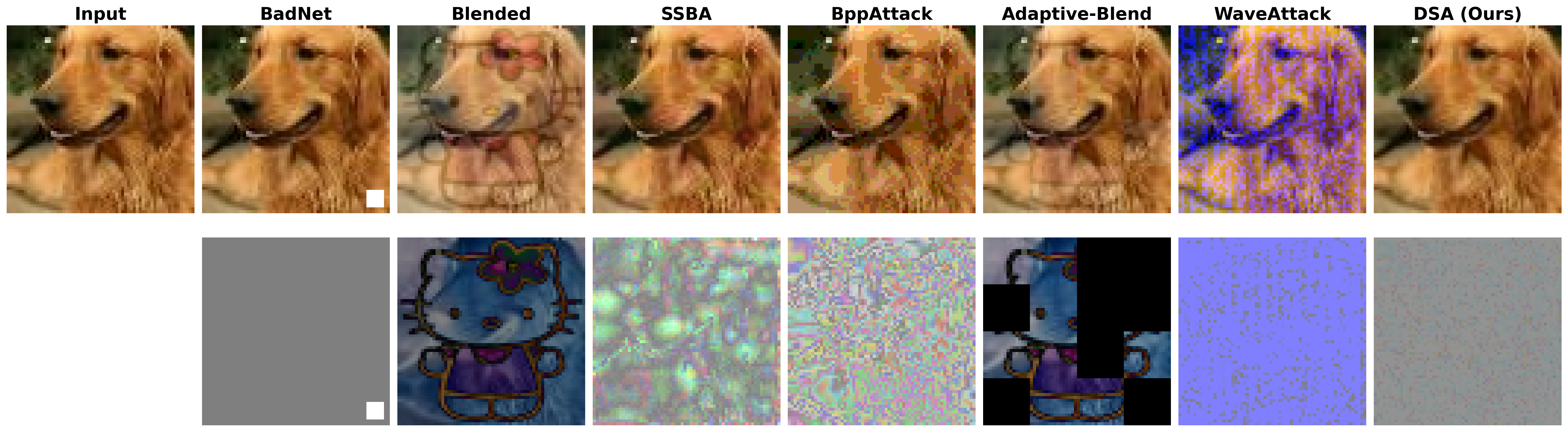
Figure 1: Comparison of examples generated by seven backdoor attacks. For each attack, the poisoned sample (top) and magnified residual (bottom) are shown, highlighting the sample-specific nature and spatial sparsity of DSA's trigger.
DSA achieves 99–100% attack success rates with minimal clean accuracy degradation. Notably, under post-training fine-tuning defenses (e.g., feature shift tuning), DSA retains 50–85 percentage points higher ASR than any baseline. On CIFAR-10, DSA maintains 60–87% ASR after defense, whereas all others are reduced to single digits or zero.
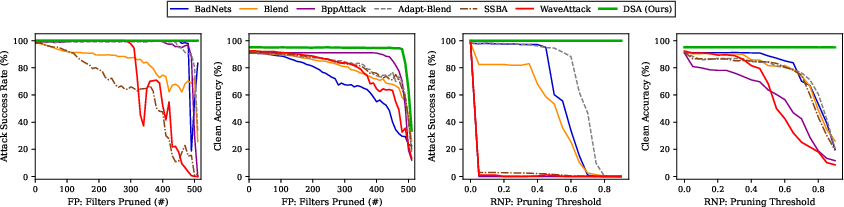
Figure 2: Performance of different backdoor attacks under pruning-based defenses. DSA demonstrates complete immunity, with zero neurons pruned across all thresholds.
Pruning-based defenses, including fine-pruning and reconstructive neuron pruning, fail entirely against DSA. The method distributes the backdoor effect throughout the model, preventing identification of any localized neurons responsible for backdoor behavior.
Detection and Interpretability Defenses
DSA is evaluated against detection-based defenses, including Neural Cleanse, STRIP, GradCAM-based interpretability, and SampDetox.
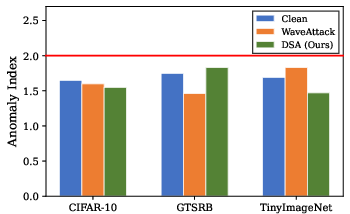
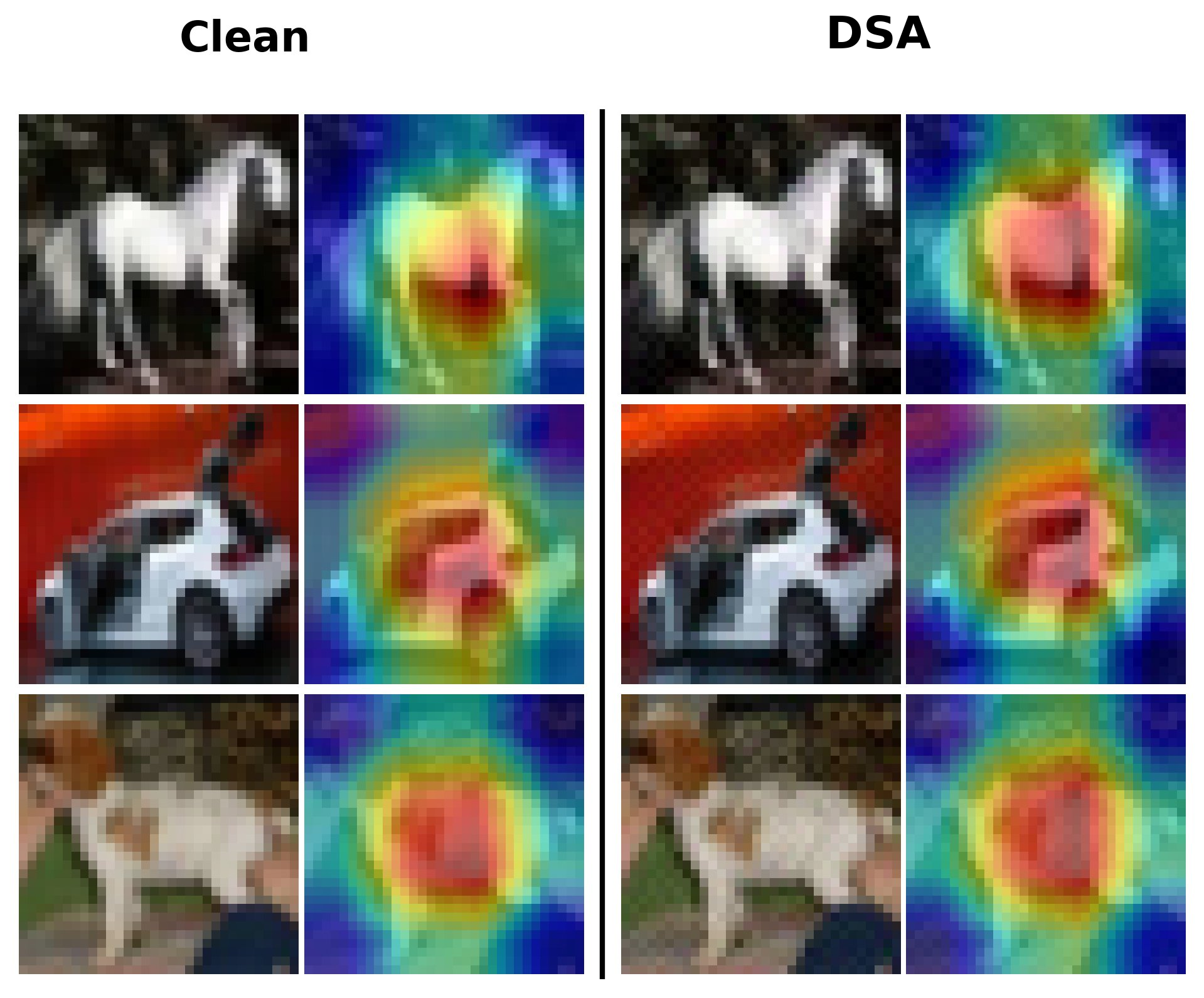
Figure 3: Robustness against Neural Cleanse. DSA evades detection by avoiding common trigger patterns and maintaining Anomaly Index below detection thresholds.
No detection method reliably identifies DSA triggers. STRIP entropy analysis reveals triggered samples are indistinguishable from clean samples by prediction entropy.
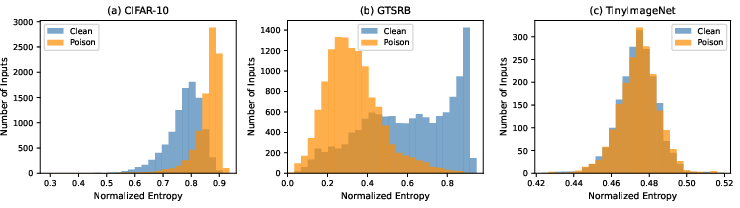
Figure 4: STRIP normalized entropy for DSA trigger samples remains high and indistinct from clean inputs, preventing detection.
GradCAM visualizations show normal attention patterns in DSA-poisoned models, implying no abnormality for interpretation-based detection.
SampDetox, which removes identified poisoned samples pre-training, leaves DSA with substantially higher residual ASR (16.97%) than all other attacks. This reinforces the difficulty of perturbation-based sample filtering when triggers are strategically placed outside the support of the clean distribution.
Practical and Theoretical Implications
DSA exposes a fundamental vulnerability in current defense paradigms—the reliance on corrective signal from clean data support. By shifting backdoor placement to low-density regions, DSA renders post-training and detection defenses ineffective. Practically, this motivates new defense strategies that operate not only within the support of the clean distribution but also reason about the geometry and sparsity of representation space where supervised information is lacking or distributed.
Theoretically, DSA demonstrates that input-space constraints are insufficient for persistent backdoor design; optimal attacks must reason about the distributional placement in latent space. The bi-level density-aware optimization is a generalization applicable to other adversarial settings where defense mechanisms rely on clean data support.
DSA's computational cost (on par with other optimizable-trigger attacks like LIRA) is offset by its scalability—once the generator is trained, poisoning any dataset is efficient.
Future Directions
- Developing defenses that incorporate generative modeling or explicit density ratio estimation to identify or neutralize low-density-region triggers.
- Extending density-aware attacks to modalities beyond vision, such as NLP or audio, where data geometry is complex and low-density regions are less easily defined.
- Formulating trigger placement criteria for multi-modal, continual, or federated learning settings, where distributional shifts or partial poisoning are likely.
Conclusion
DSA delivers a principled, distribution-based backdoor attack with sample-specific triggers optimized for placement in low-density regions of the clean data distribution. It achieves state-of-the-art robustness against both fine-tuning and pruning defenses, and its sample-specific nature undermines detection and interpretation-based mechanisms. The methodology shifts the paradigm for backdoor attack—and highlights the need for similarly distribution-aware defense strategies in future model integrity research.

