- The paper demonstrates that a cross-isotope cat state protocol achieves Heisenberg-limited scaling, significantly enhancing sensitivity in APV measurements.
- It compares multiple quantum metrological strategies, showing how entanglement and decoherence-free encoding can mitigate technical noise and systematic uncertainties.
- Simulation results indicate that hybrid protocols combining local squeezing with entangled states can accelerate data acquisition while contending with APV-specific systematics.
Entanglement-Enhanced Probing of Atomic Parity Violation: Quantum Metrological Strategies and Systematic Constraints
Background: Atomic Parity Violation and Motivation
Atomic parity violation (APV) arises from the weak neutral-current interactions mediated by the Z0 boson, introducing parity-odd observables in atomic transitions. While electromagnetic interactions dominate atomic structure and preserve parity, weak interactions induce mixing of opposite-parity electronic states—allowing otherwise forbidden electric-dipole (E1) transitions to gain a small amplitude. The primary Standard Model observable is the nuclear-spin-independent (NSI) weak charge QW, which is, to leading order, proportional to the neutron number N.
Isotope-chain APV measurements—probing a sequence of isotopes within an element—allow direct testing of the predicted QW scaling while minimizing dependence on absolute atomic-structure theory and providing sensitivity to neutron distributions, neutron skins, and potential new electron-neutron interactions. Experimentally, APV signals are orders of magnitude weaker than parity-conserving transitions, necessitating their extraction through subtle interference techniques and careful null tests.
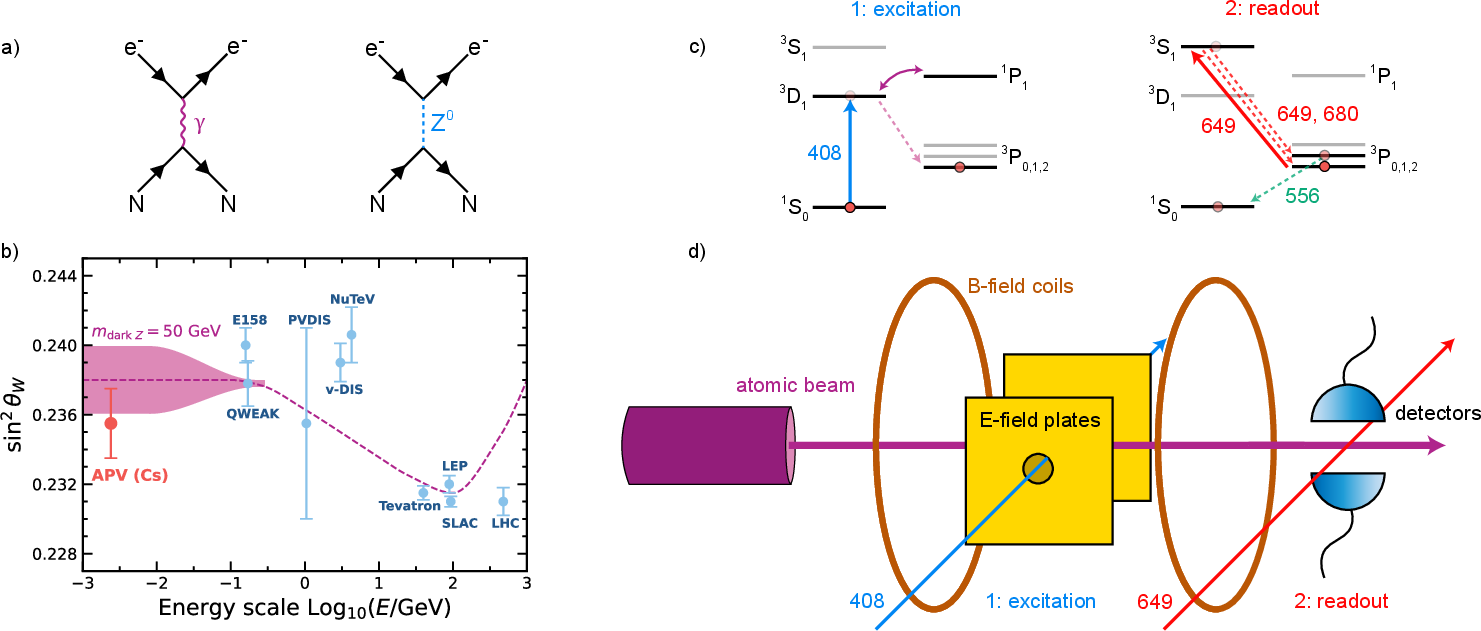
Figure 1: (a) Weak Z0-mediated electron–nucleus interactions violating parity. (b) Standard Model tests as a function of momentum transfer, with APV providing the low-energy probe.
The most precise benchmark measurement to date is the Cs 6S→7S APV experiment, combining sub-percent experimental precision with advanced many-body theory to yield definitive constraints on QW and evidence for the nuclear anapole moment. In Yb, APV effects on the 408nm 1S0→3D1 transition have been measured across multiple isotopes (170Yb, QW0Yb, QW1Yb, QW2Yb), verifying the predicted scaling and establishing stringent bounds on new electron–neutron interactions.
Molecular and ion platforms have been proposed to complement or surpass atomic beam experiments, by exploiting longer coherence times, decoherence-free (DFS) encoding, and the possibility of coherent Ramsey-based protocols. Specifically, trapped ions (BaQW3, YbQW4) and heavy polar molecules present unique opportunities for enhanced sensitivity and noise rejection through quantum control.
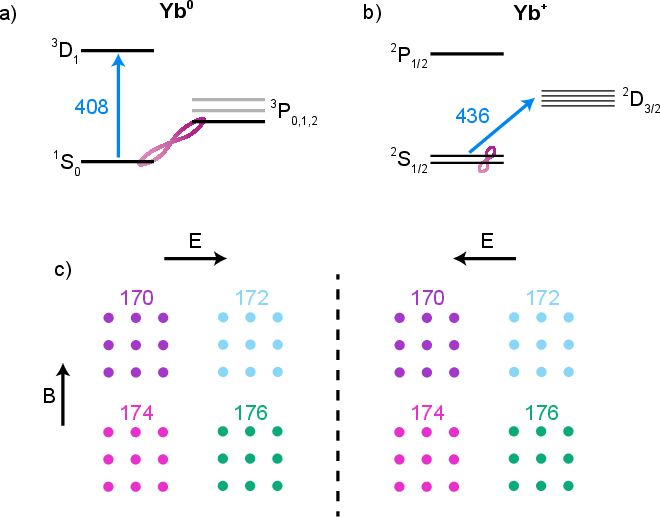
Figure 2: (a) Neutral Yb, (b) YbQW5 ion, and (c) array-based APV probing platforms supporting coherent metrology and cross-isotope entanglement.
APV as a Quantum Metrology Problem: Entangled Protocols
The core theoretical contribution is the formulation of APV isotope-chain measurement as a quantum parameter-estimation problem: Given QW6 probes distributed over several isotopes, what is the quantum protocol that most efficiently detects deviations from the Standard Model scaling of QW7?
The optimal strategy is shown to be a "cross-isotope cat state": a GHZ-type superposition entangling probes across isotopes so as to maximize sensitivity to deviations correlated with the isotope index. Mathematically, if the useful signal is the component of an isotope-dependent deviation QW8 orthogonal to the Standard Model QW9, then the maximal quantum Fisher information is attained by the cat state that aligns with this "useful" slope generator.
Further robustness against technical noise is achieved by proposing protocols within a DFS, where each isotope species is encoded in paired reversals (e.g., opposite electric fields) such that common-mode (magnetic, scalar light-shift) noise is rejected, while retaining the reversal-odd parity-violating phase shift.
Extensive simulations compare the following protocols:
- Standard Quantum Limit (SQL): Independent, classical averaging over isotopes.
- Spin-Squeezed Subarrays: Each isotope subarray is squeezed for improved projection noise.
- Same-Isotope Cat: GHZ states within each isotope, combined classically.
- Cross-Isotope Cat: Global GHZ superposition across all isotopes, matched to the useful slope.
- Noisy Cross-Isotope Cat: Incorporating realistic loss, gate infidelity, and decoherence.
Results indicate that in the statistics-limited regime, the cross-isotope cat protocol achieves Heisenberg-limited scaling (N0), while SQL and squeezing exhibit N1 behavior. Notably, realistic noise reduces the contrast gain of global cats, so the performance advantage depends critically on array size, gate fidelity, and decoherence rates. For large arrays, same-isotope cats become more robust than global cats as loss and error accumulate, highlighting the need for balancing entanglement depth and control fidelity.
A central, bold claim substantiated by these simulations is that entanglement can dramatically accelerate statistical averaging in APV tests, but the attainable ultimate precision is limited by systematic (not statistical) uncertainties, specifically those correlated with APV reversals.
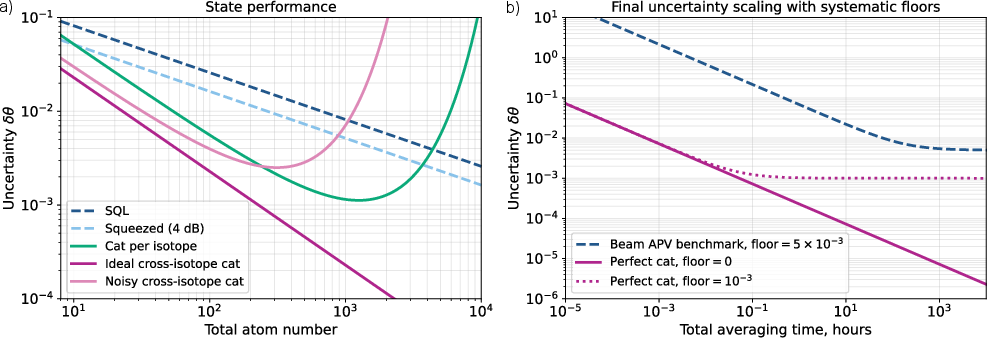
Figure 3: (a) Uncertainty in deviation parameter N2 vs. total atom number for one hour averaging, contrasting SQL, squeezed, same-isotope cats, and cross-isotope cat protocols. (b) Uncertainty vs. averaging time, illustrating asymptotic saturation at the systematic floor.
Systematic Limitations and Experimental Feasibility
While entanglement-enhanced protocols can efficiently approach the fundamental noise floor, ultimate performance is constrained by systematics: the possibility of ordinary physical effects (e.g., electric field imperfections, polarization leakage, isotope-dependent trap shifts) that mimic the reversal-odd signature of the weak interaction. The analysis underscores that entanglement cannot average away such systematics—only improvements in control, calibration, and experimental reversals can address these.
Neutral Yb enables clean isotope-chain measurements, but mapping APV signals coherently in the presence of short-lived excited states is technically challenging. Ion chains (YbN3, BaN4) are more compatible with Ramsey-based interference protocols and DFS encoding, but are limited by reduced atom number and magnetic sensitivity, requiring further advances in control and error rejection.
Outlook: Practical and Theoretical Implications
Practical Impact: This framework paves the way for quantum-enhanced APV measurements that could potentially reach sub-0.1% precision on weak-charge scaling and access new-physics parameter spaces currently unreachable by standard techniques. In particular, the viability of hybrid protocols—combining local squeezing, shallow cats, and DFS reversal encoding—appears promising. Extension to molecular platforms, leveraging large internal fields and near-degenerate opposite-parity levels, also offers major avenues for sensitivity improvement and new physics searches.
Theoretical Implications: By recasting APV as a parameter estimation task within quantum metrology, this approach establishes a route for translating progress in quantum control and entanglement into meaningful advances in fundamental tests of the Standard Model. However, achieving the full potential of these protocols will require close coordination between quantum information, precision measurement, and atomic/molecular physics communities.
Conclusion
Formulating isotope-chain atomic parity violation as a quantum metrological problem identifies the cross-isotope cat state as the statistically optimal protocol for measuring deviations from Standard Model weak-charge scaling. While entanglement and quantum error rejection can substantially accelerate data acquisition and noise suppression, the ultimate measurement sensitivity is dictated by APV-specific systematics. Realistic progress is expected from strategies combining modest entanglement depth, spin squeezing, and DFS encoding, with the potential for future gains in molecular arrays and hybrid platforms. The transition of APV studies into the domain of quantum-enhanced measurement will require new experimental innovations in systematic error control to fully leverage the power of entanglement.