- The paper demonstrates that worker disagreement in Local SGD identifies sharp Hessian directions, capturing over 85% of the dominant gradient component with moderate buffer sizes.
- Empirical and theoretical analyses reveal that while gradients increasingly concentrate in dominant subspaces, effective optimization relies on updates in the bulk of the parameter space.
- Experiments across MLPs, CNNs, and Transformers confirm that manipulating worker-gap subspaces by suppressing dominant components can accelerate training loss reduction.
Worker Disagreement as an Indicator of Sharp Directions in Local SGD
Overview
The paper "Worker Disagreement Reveals Sharp Directions in Local SGD" (2605.27739) systematically investigates the relationship between distributed SGD worker disagreement and loss landscape geometry in neural network optimization. The central claim, supported by both theory and experiment, is that the pointwise deviations (“gaps”) between local workers and their average in Local SGD are highly structured: they predominantly concentrate along the sharp, high-curvature directions of the Hessian. This finding recasts worker disagreement from a consensus error to a computationally tractable estimator for the dominant Hessian subspace, thus providing a low-cost, Hessian-free diagnostic for optimization dynamics. The theoretical analysis elucidates the stochastic and geometric origins of this effect, and a suite of experiments on MLPs, CNNs, and Transformers substantiates the claim.
Dominant–Bulk Structure and Subspace Concentration in Local SGD
Contemporary results have established that the Hessian of deep networks possesses a dominant–bulk split, with a small number of large eigenvalues and a high-dimensional bulk of near-zero curvature directions [song2025does, arous2024highdimsgd]. Gradients early and late in training are typically concentrated in the dominant Hessian eigenspace—a phenomenon confirmed here for Local SGD as well with metrics such as the dominant alignment χC(⋅).
Across MNIST (MLP), CIFAR-10 (CNN), and SST2 (Transformer), the Hessian spectrum rapidly develops a pronounced gap, with only C (the number of classes) top eigenvalues separated from the bulk.
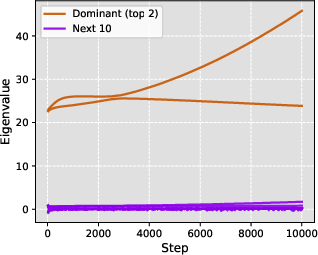
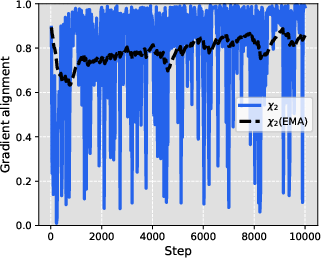
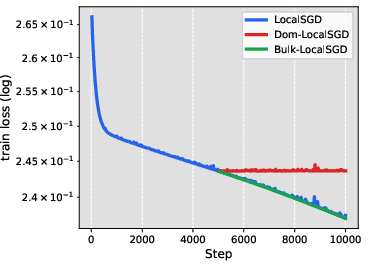
Figure 1: The Hessian spectrum of an MLP on MNIST (left) exhibits clear separation into dominant and bulk directions, and the gradient's alignment with the dominant eigenspace increases during training (middle). Suppressing bulk directions stalls optimization (right).
The empirical results directly validate that:
- Gradients become dominated by the top-C eigenspace over the course of training.
- The parameter updates that actually drive optimization progress reside primarily in the bulk; restricting updates to the dominant subspace halts progress, whereas suppressing the dominant component can even accelerate descent.
This observation is consistent with works such as [song2025does, zhou-etal-2025-bsfa], which assert that the magnitude of updates does not necessarily map to their efficacy in reduction of empirical risk.
Theoretical Analysis: Coupling of Worker Disagreement and Loss Curvature
The core theoretical contribution is a linearized model of Local SGD worker updates, showing that the covariance of the worker–average gap at synchronization is controlled by the stochastic-gradient noise covariance and the local Hessian.
More precisely, for small enough communication interval τ (i.e., frequent synchronization), the gap covariance satisfies:
Cov(Δ)≈η2(1−M1)q=0∑τ−1(I−ηH)qΣ(I−ηH)q
where H is the Hessian, Σ is the per-step noise covariance, and η is the step size.
Projecting onto individual Hessian eigendirections, the worker disagreement along a given direction ur scales as
Var(⟨Δ,ur⟩)∝σr2ψτ(ηλr)∝λrγψτ(ηλr)
for empirically observed noise–curvature coupling C0 with C1 [zhang2026superlinear]. The bulk of the worker disagreement thus accumulates where both curvature and injected noise are large—i.e., the sharp directions of the Hessian. This supports the identification of the span of worker-local parameter deviations as an estimator for the dominant subspace.
Worker-Average Gaps as Dominant Subspace Estimators
The next section tests the theory empirically by maintaining a FIFO buffer of worker–average gaps, forming the empirical span (via Gram matrix eigendecomposition), and evaluating how well this subspace captures the true dominant component of gradients.
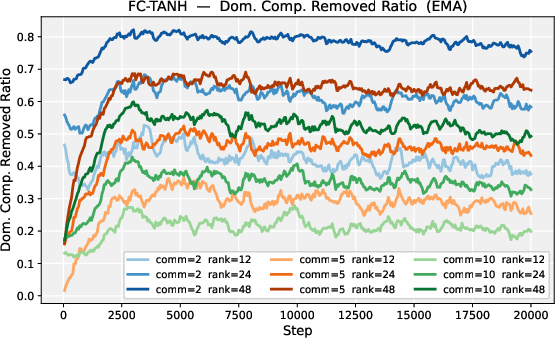
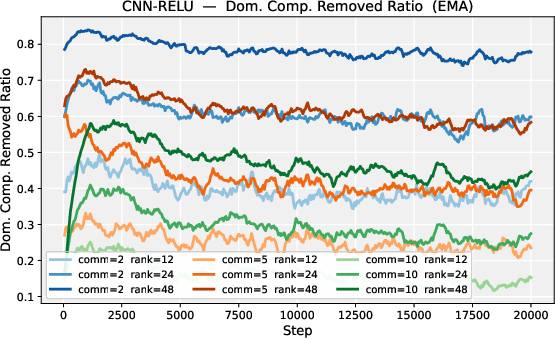
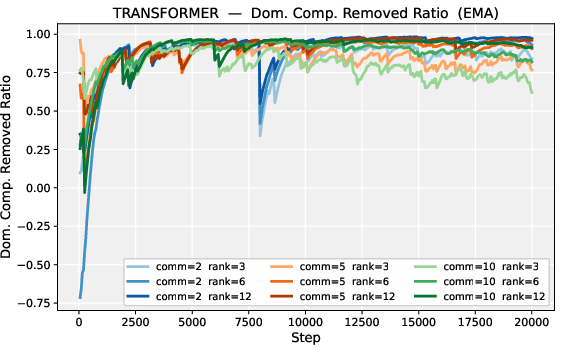
Figure 2: The fraction of the gradient’s true dominant Hessian component suppressed by worker-gap subspaces increases with buffer capacity and generalizes across architectures (MLP, CNN, Transformer).
Key findings include:
- A moderate-size buffer of recent worker gaps consistently captures a large fraction (often C2) of the dominant gradient component.
- Increasing buffer size improves coverage, but already with small buffers (e.g., C3 for C4), most dominant structure is recovered.
- Results are robust across model classes and data modalities, with the effect strongest for low-dimensional dominant structure (e.g., binary classification tasks).
Communication Period Ablation
The experiments further conduct a communication period (C5) ablation. Shorter C6 yields higher-fidelity dominant subspace estimation, reflecting the improved accuracy of constant-Hessian approximations on shorter local trajectories. This aligns with the theoretical model, which assumes local linearity of the curvature during the C7 steps between communication.
Figure 3: As C8 decreases, the worker-gap subspace estimate aligns more closely with the dominant Hessian subspace.
Manipulating Optimization via Gap-Subspace Filtering
Given that worker-gap subspaces identify sharp directions, the paper explores whether dynamically suppressing update components aligned with this subspace, or amplifying their orthogonal complement, modifies optimization. The setup modifies the outer update as C9.
Key outcomes are:
- Suppressing the dominant (worker-gap) component accelerates training loss reduction.
- Amplifying the bulk (orthogonal) component similarly leads to faster optimization, while suppressing the bulk degrades performance or stalls training.
- Extremely strong amplification can introduce instability, but moderate suppression of the dominant subspace is consistently beneficial.
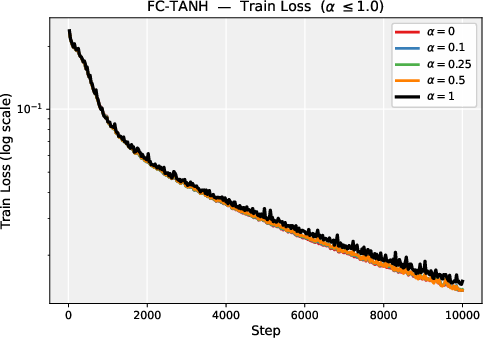
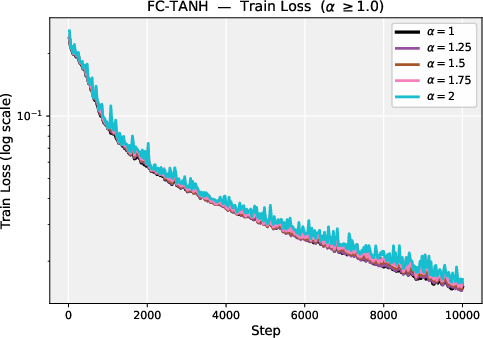
Figure 4: On MNIST, suppressing the dominant (gap-aligned) component (C0) leads to faster training.
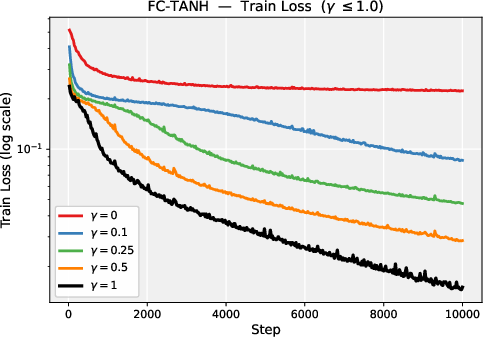
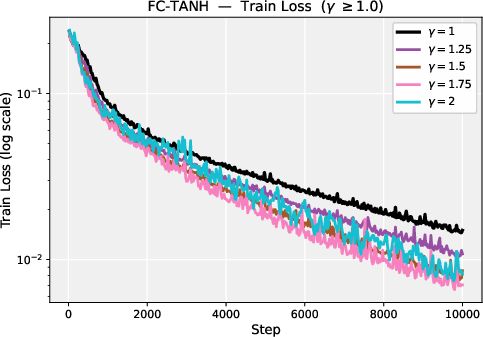
Figure 5: Amplifying the bulk (C1) accelerates optimization, while suppressing these directions (C2) hinders convergence.
These results strongly reinforce the computational relevance of the dominant–bulk split and position local disagreement as a lever for optimization control.
Implications and Future Work
This work provides a computationally efficient, Hessian-free method to estimate sharp directions via Local SGD’s byproduct—worker disagreement—generalizing across architectures and datasets. Theoretical and empirical analyses contradict a naive alignment picture: sharp Hessian directions dominate gradient and disagreement energy, but effective optimization depends crucially on the bulk.
Practical implications include:
- Diagnostic tools for identifying over-concentration in sharp directions, potentially signaling poor generalization or stagnation.
- Plug-and-play mechanisms for dynamically reweighting components of distributed SGD updates to suppress harmful directions, as already being advanced in frameworks such as BSFA [zhou-etal-2025-bsfa].
On the theoretical side, the results corroborate recent literature challenging the overemphasis on sharp directions in deep learning optimization [song2025does]. There is substantial scope for future work in leveraging worker disagreement for adaptive control of distributed optimizers, as well as deeper study into how communication frequency and SGD-induced noise interact with loss geometry.
Conclusion
The study thoroughly establishes worker–average gaps in Local SGD as a statistically meaningful, low-cost proxy for dominant Hessian structure, rigorously characterizing their coupling to the landscape’s anisotropy. Empirical analysis confirms that manipulating these learned subspaces can accelerate or stall learning, indicating both theoretical depth and immediate practical utility for the design and monitoring of distributed neural optimization algorithms.