- The paper demonstrates that polymer extension at stagnation points drives flow thickening, challenging traditional shear-thinning expectations.
- It employs a rigorous energy-balance framework with quantitative experiments in 2D and 3D porous geometries to capture extensional resistance.
- The findings offer practical insights for applications in enhanced oil recovery, chromatographic separation, and microfluidic device design.
Introduction
The anomalous flow thickening behavior observed when viscoelastic polymer solutions traverse porous media at low Reynolds number has remained unresolved for decades, contradicting predictions based on bulk shear rheology. Contrary to traditional expectations of shear-thinning, such systems display a marked increase in apparent viscosity above a threshold flow rate—termed "flow thickening." The paper "Polymer extension at stagnation points governs flow thickening of polymer solutions in ordered porous media" (2605.27731) formulates a rigorous mechanistic framework linking pore-scale flow kinematics, specifically polymer extension at stagnation points, to macroscopic flow resistance. The work is validated experimentally across two- and three-dimensional (2D, 3D) ordered porous media and contrasted with disordered systems.
Energy-Balance Framework and Mechanistic Decomposition
Starting from the Cauchy momentum equation and mechanical energy balance, the authors derive an explicit expression for the normalized apparent viscosity in a porous medium:
ηIηapp=1+(Q/A)2ηIk⟨χ⟩t,V+ϕ2Dp2ηIk⟨Tr⟩t,Vη0ζ2
The decomposition distinguishes three contributions:
- Shear resistance: The bulk shear viscosity term.
- Elastic instability dissipation: Viscous dissipation from unsteady flow fluctuations triggered by elastic instabilities, quantitatively characterized by ⟨χ⟩t,V.
- Extensional resistance: Dominant at higher flow rates, representing additional dissipation due to polymer extension quantified by the local, flow-history-dependent Trouton ratio, ⟨Tr⟩t,V.
Notably, the extensional term, absent in prior power-law fluid models, directly links local polymer elongation to macroscale resistance.
Experimental Validation in Ordered 2D and 3D Porous Geometries
Extensive experiments in millifluidic 2D hexagonal pillar arrays (both “staggered” and “aligned”) and 3D consolidated sphere packings (simple cubic, body-centered cuboid) were performed using a weakly shear-thinning, highly elastic HPAM solution. Flow visualization was achieved via confocal microscopy with particle-image velocimetry, enabling direct access to pore-scale velocity fields.
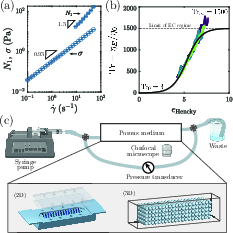
Figure 1: Polymer solution rheology, extensional response (Trouton ratio vs. accumulated Hencky strain), and schematic of the experimental approaches in 2D/3D geometries.
Flow-thickening consistently coincides with the onset of elastic instabilities (at Wic≈0.3 for 2D, Wic≈2−3 for 3D arrays). Critically, the elastic instability term alone underpredicts total resistance at elevated Weissenberg number, but inclusion of the extensional contribution quantitatively recovers experimental measurements. The extensional length scale ζ is found to be geometry-dependent, determined from unit-cell characteristics.
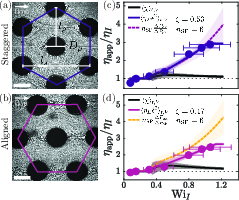
Figure 2: Pathline images and normalized ηapp/ηI vs. Wi for staggered/aligned 2D arrays, showing necessity of the extensional term for macroscopic resistance.
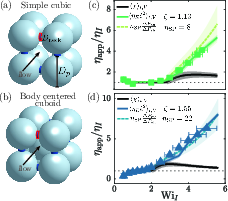
Figure 3: Schematic and normalized viscosity measurements in 3D sphere packings (SC, BC), emphasizing localization of polymer extension to neck regions between grains.
Localization of Extension: Importance of Stagnation Points
Contrary to prior assumptions that pore constrictions ("throats") dominate extension, direct measurement of accumulated Hencky strain reveals values routinely exceeding the coil-stretch threshold and far surpassing those predicted solely from contractions. The strongest extension originates at stagnation points, where local velocity gradients are maximized. By counting stagnation points per unit cell, the authors demonstrate linear scaling of extensional resistance, introducing a resistance-per-stagnation point model:
ηIηapp=[1+(Q/A)2ηIk⟨χ⟩t,V][1+ΔPshΔPex⋅nSP]
where ΔPex/ΔPsh is measured via an optimized cross-slot rheometer and nSP enumerated directly from geometry.
Analysis extended to lightly sintered bead and crushed glass packings (disordered media) indicates that both elastic instability and extensional mechanisms are relevant, but the extensional length scale ⟨χ⟩t,V0 clusters at ⟨χ⟩t,V1, situated between pore-throat diameter and grain diameter. In disordered media, ⟨χ⟩t,V2 becomes an effective fit parameter, reflecting local complexity and heterogeneity ("porous individualism"), and the resistance model remains robust but increasingly sensitive to spatial sampling.
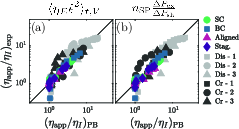
Figure 4: Collapse of measured apparent viscosity vs. power-balance predictions across ordered and disordered media.
Auxiliary Stress Contributions and Modeling Simplifications
While the extensional term dominates thickening in ordered media, upper-bound analysis suggests shear-induced normal stresses (⟨χ⟩t,V3) contribute negligibly to macroscopic resistance for these geometries, but may become significant in more confined or irregular systems. Polymer-wall interactions are neglected given ⟨χ⟩t,V4 is much smaller than pore throat, yet would be relevant in nanoscale media. Storage and dissipation of elastic energy during deformation/relaxation (polymer stress tensor) is omitted; future characterization opportunities include direct birefringence or Lagrangian trajectory reconstructions.
Practical and Theoretical Implications
This framework enables quantitative prediction and control of viscoelastic flow behavior in porous architectures, relevant to energy, environmental remediation, chromatographic separation, microfluidic device engineering, and enhanced oil recovery. It establishes pore-scale polymer extension at stagnation points as the key determinant of flow thickening in ordered media, obviating reliance on semi-empirical or purely fluctuation-based models. Adjustable pore geometry or targeted fluid rheology thus provides a rational basis for tuning macroscopic flow resistance.
Speculations and Future Directions
Potential advances include:
- Integration of transient polymer stress dynamics and explicit elastic energy storage/dissipation terms.
- Extension to more confined or ultra-disordered media with significant wall interactions.
- Statistical sampling strategies for robust modeling in heterogeneous disordered systems.
- Exploitation of stagnation-point control via microfluidic strictures or domain engineering for targeted fluid processing applications.
Conclusion
The paper presents a comprehensive mechanistic and quantitative framework that resolves the longstanding puzzle of polymer solution flow thickening in ordered porous media, rigorously establishing polymer extension at stagnation points as the governing factor. The model is experimentally validated across varied geometries and generalized to disordered systems, offering both theoretical insight and practical tools for advanced rheological engineering (2605.27731).

