- The paper benchmarks photon-conditioned squeezed states against Fock and cat states using matched mean photon number, highlighting tradeoffs in scalar negativity.
- Methodology involves analytic and numerical evaluation of Wigner negativity and displacement-fidelity radii to assess state anisotropy and response robustness.
- Findings emphasize the tunable directional displacement response via the squeeze axis, essential for homodyne-aligned noise mitigation in CV photonics.
Photon-Conditioned Squeezed States: Directional Displacement Response and Resource Mapping in CV Photonics
Overview and Objectives
"Photon-Conditioned Squeezed States for Directional Displacement Response in Continuous-Variable Photonics" (2605.27660) systematically benchmarks several established non-Gaussian state families—squeezed Fock states, photon-subtracted squeezed states, and coherent cat states—in continuous-variable (CV) quantum optics. The analysis is predicated on matched mean photon number, enabling rigorous comparison of scalar Wigner negativity (δ) and displacement-fidelity radii across reference states. Detailed resource maps are constructed to separate scalar non-Gaussianity from directional displacement response, revealing strong metric-dependent distinctions between photon-conditioned squeezed states and traditional Fock/cat benchmarks. The investigation addresses photon-number budget distribution between non-Gaussian excitation and Gaussian squeezing, and explicitly quantifies tradeoffs that are crucial for homodyne-aligned displacement-noise mitigation and directional sensing.
State Families and Preparation Protocols
The paper considers experimentally motivated state sequences generated from squeezed vacuum S(r)∣0⟩ via one- and two-photon subtraction, forming states aS(r)∣0⟩ and a2S(r)∣0⟩ respectively. The single-photon-subtracted state is strictly proportional to the squeezed single-photon state S(r)∣1⟩; however, the two-photon-subtracted state yields an even-parity squeezed superposition rather than an ideal S(r)∣2⟩, as confirmed by explicit Bogoliubov transforms and analytic ratios.
Reference benchmarks include unsqueezed Fock states ∣1⟩, ∣2⟩ and even/odd coherent cat states C±(α) where mean photon number is set via analytic relations, guaranteeing fair resource comparison.
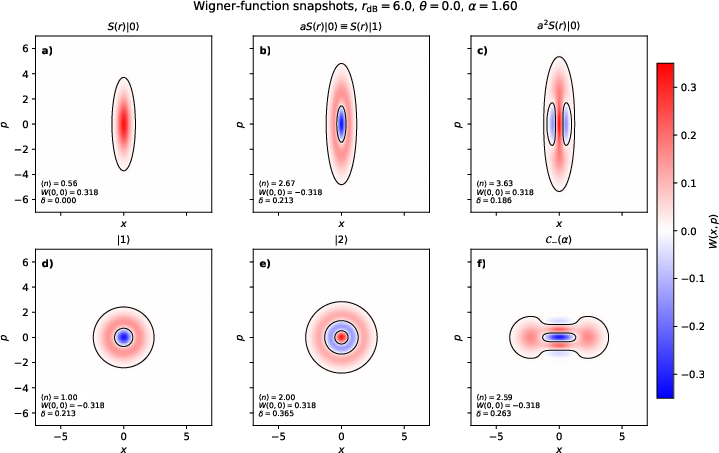
Figure 1: Wigner-function snapshots of photon-conditioned squeezed states and canonical references, illustrating parity, non-Gaussianity, and origin-centered anisotropic phase-space structures.
Scalar Wigner Negativity: Metrics and Ordering
Integrated Wigner negativity δ and normalized negativity S(r)∣0⟩0 are computed for matched mean photon number across all state families. The analysis leverages invariance properties under Gaussian unitaries, confirming that squeezing alone does not augment total Wigner negativity for states such as S(r)∣0⟩1. Cat states consistently dominate scalar negativity metrics due to coherent separation-induced interference, while photon-conditioned squeezed states serve as parity-resolved, origin-centered alternatives.
Strong numerical results show clear non-monotonicity in resource ordering depending on the chosen metric. Notably, photon-conditioned squeezed states do not universally maximize S(r)∣0⟩2 or S(r)∣0⟩3 per photon compared to cat benchmarks, substantiating the claim that squeezing redistributes (but does not amplify) existing non-Gaussian structure.
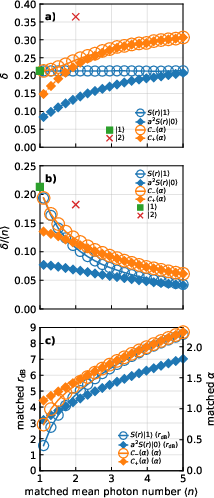
Figure 2: Scalar resource metrics at matched energy, indicating total and energy-normalized Wigner negativity and operational parameter costs for each state family.
Directional Displacement Response: Fidelity Radii and Anisotropy
Directional displacement-fidelity radii S(r)∣0⟩4 are evaluated as a function of quadrature angle, with axis-specific values S(r)∣0⟩5 and S(r)∣0⟩6 extracted for a fixed fidelity threshold (S(r)∣0⟩7). The quadrature variance scaling for squeezed Fock states directly informs displacement sensitivity and robustness: S(r)∣0⟩8, S(r)∣0⟩9, confirming that squeezing redistributes response between conjugate quadratures. Fock state benchmarks are isotropic, while cat states' anisotropy is governed by coherent-state separation along a dominant axis.
Photon-conditioned squeezed states, especially the two-photon-subtracted variant, exhibit pronounced anisotropy, achieving enlarged favorable-axis fidelity radii over finite angular sectors—a directional resource unattainable with isotropic Fock references or angularly fixed cats. This response is tunable via the squeeze axis, matching experimentally relevant homodyne directions.
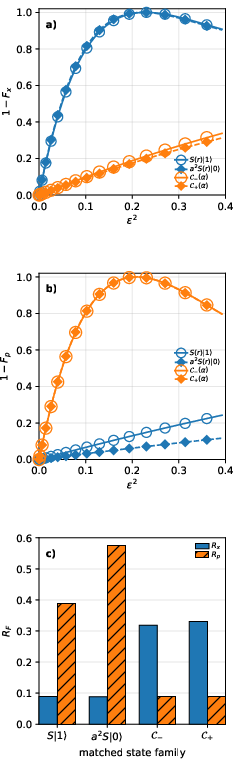
Figure 3: Displacement-fidelity radii and anisotropy ratios for matched-energy states, highlighting robust axes in photon-conditioned squeezed states and isotropy in Fock references.
When angular contours are analyzed at aS(r)∣0⟩0, photon-conditioned squeezed states display sector-specific superiority in displacement tolerance, quantifiable via aS(r)∣0⟩1 and aS(r)∣0⟩2 metrics.
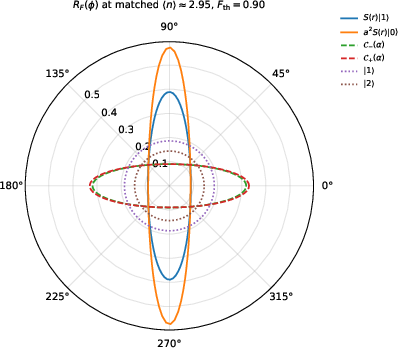
Figure 4: Angular displacement-fidelity radius aS(r)∣0⟩3 contours demonstrating directional robustness for photon-conditioned squeezed states in comparison with isotropic Fock and nearly degenerate cat references.
Practical and Theoretical Implications
The findings identify photon-conditioned squeezed states as optimal candidates for applications involving phase-referenced, homodyne-aligned CV settings, where displacement-noise anisotropy is either inherent or controllable. The squeeze axis offers tunability of robustness vs. sensitivity, crucial for targeted displacement-noise mitigation and precision sensing, while cat benchmarks remain superior for tasks requiring maximal scalar non-Gaussianity.
Benchmarking with matched mean photon number decouples protocol- and platform-specific costs from intrinsic resource quality, facilitating fair pre-selection of target states for experimental realization and establishing clear tradeoff curves that inform both theoretical pursuits and practical implementations in CV quantum information.
Future Directions
The resource map constructed suggests extensions toward grid-state synthesis, conditional generation protocols for codes like GKP, and sector-based optimization of displacement-error-mitigation strategies. Incorporating realistic channel models (optical loss, finite detector efficiency, etc.) and recovery maps will refine operational distances for quantum error correction. State selection informed by sector-specific displacement response may accelerate deployment of robust CV encodings and directional sensors.
Conclusion
The matched-photon-number benchmarking of photon-conditioned squeezed states, Fock states, and cat states reveals a multidimensional resource space in CV photonics. Cat states lead in scalar negativity, while photon-conditioned squeezed states offer unparalleled squeeze-axis-controlled directional robustness, vital for anisotropic displacement-noise environments. The squeeze axis thus becomes a resource dimension orthogonal to traditional measures, underscoring the necessity of metric-dependent resource selection for CV tasks in quantum information and sensing.

