- The paper introduces a Zeeman-selective sympathetic cooling method that uses a stabilized 435 nm laser and targeted Raman addressing to effectively suppress radial mode heating in 171Yb⁺ chains.
- It details an experimental setup using surface Peregrine chips and acousto-optic deflection to cool multiple radial modes while maintaining mean phonon numbers below 1 for critical modes.
- The method preserves data qubit coherence with minimal error rates, paving the way for scalable ion-trap quantum computing and efficient quantum simulation of open system dynamics.
Sympathetic Cooling in 171Yb+ Ion Chains with Zeeman-Selective Spectral Isolation
Introduction
The paper "Sympathetic Cooling in Trapped Ions with Spectral Selectivity via the Zeeman Shift" (2605.27577) presents an experimentally robust protocol for sympathetic cooling within homogeneous chains of 171Yb+ ions. By leveraging the Zeeman shift and narrow quadrupole transitions accessible via a $435$ nm laser, the scheme utilizes spectral selectivity and individual Raman addressing to achieve mode-targeted cooling while minimizing impact on non-coolant data qubits. This addresses critical limitations of previous multi-species or isotope-based approaches, such as hardware complexity, inefficient cooling of radial modes, and susceptibility to ion chain reordering.
Experimental Architecture and Cooling Sequence
The protocol implements ion trapping on surface Peregrine chips in a cryogenic environment. Ablation loading and photo-ionization set up a chain of 171Yb+ ions, with initialization, detection, and Doppler cooling performed via $370$ nm excitation. High spatial selectivity in addressing individual ions is achieved with an acousto-optic deflector (AOD)-steered $355$ nm Raman beam, enabling rapid ion selection in chains up to 30 ions. The $435$ nm laser, stabilized to +0 kHz bandwidth, drives the +1 quadrupole transition at an angle optimal for coupling both axial and radial modes.
A detection protocol combines Doppler cooling, microwave (MW) +2-pulse shelving, and repetitive application of the +3 nm laser to extract the resonance frequencies of ions shelved into +4.
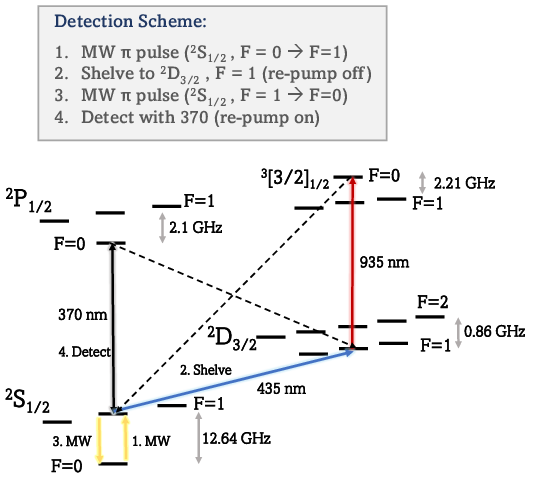
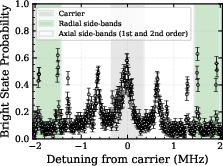
Figure 1: Detection scheme for extracting the resonance frequencies of ion populations shelved to metastable +5.
The key to spectral isolation is exploiting the Zeeman effect. The individual Raman beam selectively excites the coolant ion into the upper Zeeman state (+6), separated by +711 MHz, while leaving data ions unperturbed. Cooling proceeds via repeated cycles of red side-band transitions and re-pumping between Zeeman sublevels, accomplished by precisely controlling the laser frequencies and MW pulses.
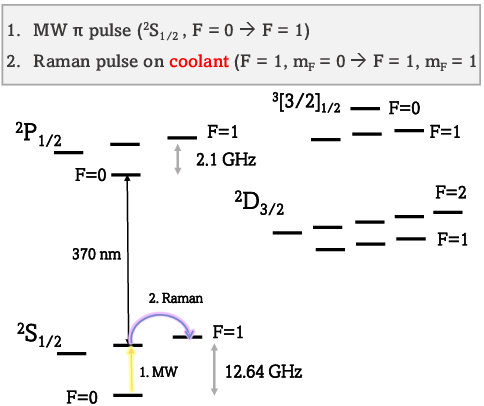
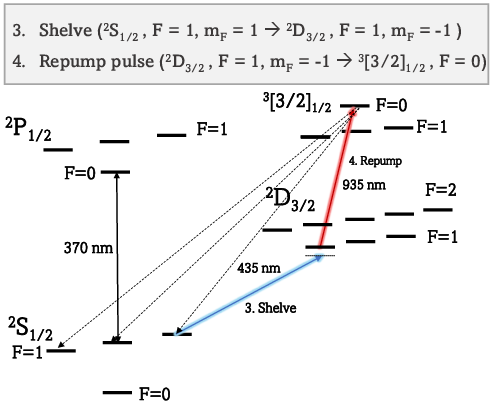
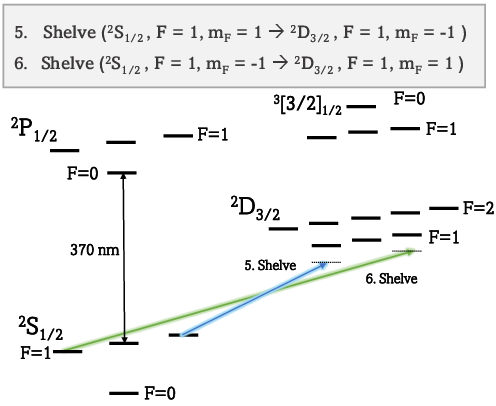
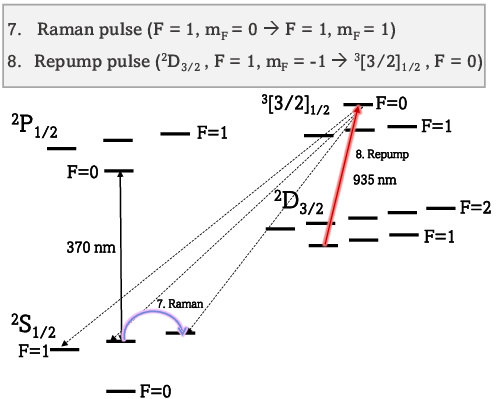
Figure 2: Sequence for same-isotope sympathetic cooling in +8Yb+9, utilizing selective Raman addressing and Zeeman-shifted shelving.
Motivated by the necessity to suppress motional heating, particularly for two-qubit gate fidelity, the protocol demonstrates mode-selective cooling within a five-ion chain. By designating specific ions as coolant, the scheme allows the targeting and suppression of six radial modes (COM, tilt, higher-order, zig-zag), evidenced by significant reduction in side-band transition probabilities post-cooling as measured by side-band thermometry (1710 for all modes).
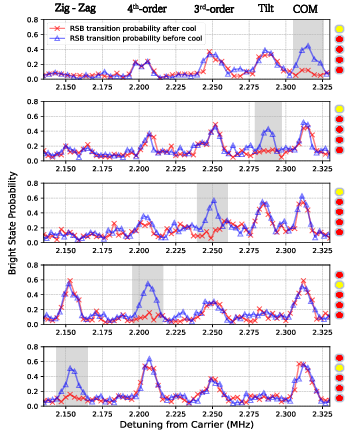
Figure 3: Targeted cooling for all radial modes in a five-ion 1711Yb1712 chain, showing mode suppression via RSB transition probability reduction.
The COM and tilt modes, known for their higher sensitivity to electric field noise (baseline heating rates 1713 quanta/sec and 1714 quanta/sec, respectively), are maintained near their ground states (1715, 1716) under periodic cooling cycles.
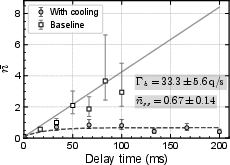
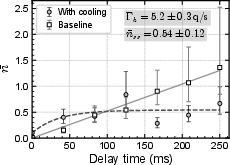
Figure 4: Heating rate suppression of COM and tilt modes in a five-ion chain under periodic cooling.
Systematic studies on number of cooling pulses and duty cycle illustrate the equilibrium points attainable for 1717 in both COM and tilt modes, with diminishing returns for increasing pulse counts beyond 12–30.
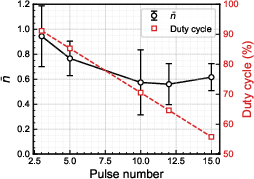
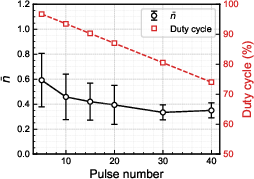
Figure 5: Steady-state mean phonon number versus cooling pulse count and duty cycle for COM and tilt modes.
Data Qubit Coherence During Cooling
A critical aspect for quantum computational viability is preserving data qubit coherence during cooling. Ramsey interferometry and spin-echo sequences reveal that while application of cooling pulses modestly reduces coherence (1718 time 1719 ms for non-coolant ions vs. +0 s baseline), loss per pulse is limited to +1/s, corresponding to error rates +2 per +3 ms cooling cycle—well below thresholds for quantum logic error correction.
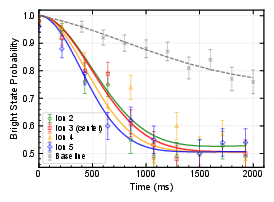
Figure 6: Microwave spin-echo measurements quantifying data qubit coherence during active cooling.
The dominant estimated decoherence pathways originate from intensity fluctuations in the +4 nm laser (quadratic in Rabi frequency, inverse linear in detuning), confirmed experimentally.
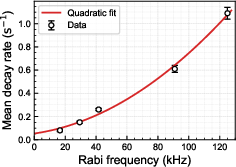
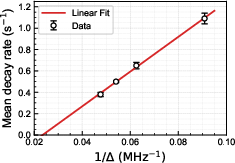
Figure 7: Decay rate of non-coolant ion coherence as a function of +5 nm laser Rabi frequency and detuning.
Allan deviation analysis for the laser amplitude, cross-referenced with the observed coherence times, further substantiates this causal relationship.
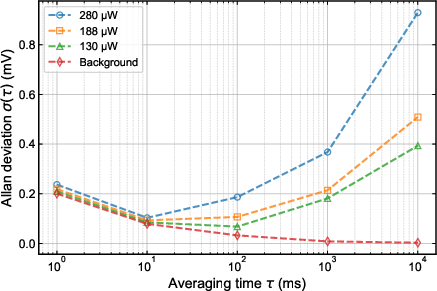
Figure 8: Allan deviation of +6 nm beam amplitude over +7 s, contextualizing coherence fluctuation timescales.
Absorption of scattered +8 nm photons is shown to be negligible, both theoretically and by experimental suppression.
Practical and Theoretical Implications
The scheme enables high-duty-cycle sympathetic cooling entirely within same-isotope chains, obviating the need for multi-species or isotope-mixed setups. This reduces resource overhead, eliminates chain re-ordering and shuttling, and ensures more efficient cooling, particularly of radial modes. Potential extensions include dynamic role-swapping between coolant and data ions via MS gates, allowing real-time mode targeting without ion movement. The protocol also offers a tunable dissipative source for quantum simulation of open system models and system-bath couplings.
Further improvements, such as laser intensity stabilization and increased Zeeman splitting for larger detuning, promise even longer data ion coherence without sacrificing cooling efficacy. Individual addressing of the cooling beam could entirely mitigate the residual light shift errors.
Conclusion
The presented Zeeman-selective sympathetic cooling protocol for +9Yb$435$0 chains achieves efficient, targeted motional suppression with minimal impact on data qubit coherence. The approach simplifies experimental complexity, enhances radial mode cooling efficiency, and provides a versatile platform for scalable ion-based quantum computation and quantum simulation. Future developments are anticipated in dynamic coolant assignment, laser stabilization, and integration with open system simulation frameworks.

