- The paper introduces a Dirac-line critical state serving as a topological mediator between type-I and type-II Weyl regimes.
- It employs effective Hamiltonians to quantify spectral reconstructions and topological invariants, including Berry flux and Fermi surface stability.
- It reveals that interaction-induced flat bands significantly enhance pairing scales, suggesting new avenues for unconventional superconductivity.
Dirac-Line Criticality and Emergent Horizons in Weyl Lifshitz Transitions
Introduction
"Dirac-Line Criticality and Emergent Horizons in Weyl Lifshitz Transitions" (2605.27453) addresses the interplay of topological and symmetry-driven phenomena in Weyl and Dirac semimetals, with a focus on Lifshitz transitions, Dirac-line criticality, and the analogies between emergent quasiparticle horizons and black hole physics. The paper analyses transitions between type-I and type-II Weyl fermions, introduces a Dirac-line critical state as a topological mediating configuration, and demonstrates the spectral and topological consequences using effective Hamiltonians. Additionally, it investigates topological invariants N1 (local Fermi-surface stability), N2 (Dirac line winding), and N3 (Berry monopole/Chern number), as well as the impact of interaction-driven flat-band formation and its implications for enhanced pairing scales.
Topological Classification and Model Hamiltonians
The paper develops a classification for topological Lifshitz transitions involving nodes of distinct codimensions. Type-I Weyl semimetals feature point-like Fermi surfaces and linear (conical) dispersion, while type-II Weyl semimetals exhibit overtilted cones, resulting in intersecting electron and hole pockets at the Weyl point. The Dirac-line criticality emerges at the transition (f=1) between these regimes, forming a nodal line protected by the winding number of the determinant of the block matrix B(p). The authors rigorously construct invariants:
- N2 Dirac-line winding: For the block matrix Hamiltonian, N2=∮C2πidlD−1(B)∂lD(B), encoding the momentum-space vortex topology.
- N3 Berry monopole/Chern number: Assigns +1 or −1 to left/right Weyl nodes, transporting Berry flux across Lifshitz reconstructions.
- N20 Fermi surface topology: Ensures the local stability of Fermi surfaces against disruptions.
The topological phase transition is mediated by critical configurations—Dirac-line or type-II Weyl point—characterized by both N21 and N22. The model Hamiltonians, both in the abstract tilted Weyl form and more elaborate forms (e.g., displaced Weyl, massive Dirac), quantify how Fermi surface topology is reorganized, capturing both local (zero-energy spectral loci) and global (Berry transport) aspects.
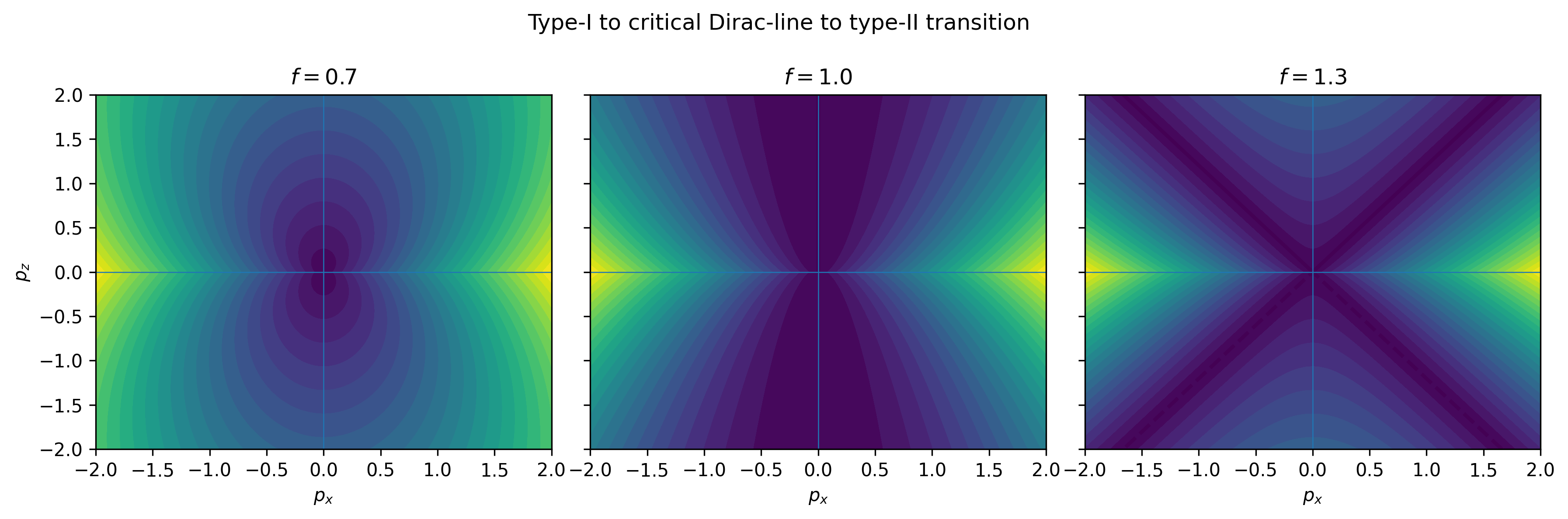
Figure 1: Evolution of the zero-energy structure of the tilted Weyl Hamiltonian across the Lifshitz transition. For N23, the zero-energy set collapses to the Weyl point. At N24, the critical Dirac-line condition is reached. For N25, finite zero-energy contours appear, corresponding to the type-II Weyl regime.
Horizon Analogy and Black Hole Physics
A key innovation is the mapping of spectral transitions to analogues of black hole horizons in the Painlevé-Gullstrand metric. The Weyl Hamiltonian, modified by a spatially dependent tilt parameter (frame-drag velocity N26), captures the transition across the horizon (N27), where the Weyl cone is overtilted. This is interpreted as crossing from type-I ("outside horizon") to type-II ("inside horizon") regimes. The spectral signature is the emergence of an additional zero-energy solution within the horizon.
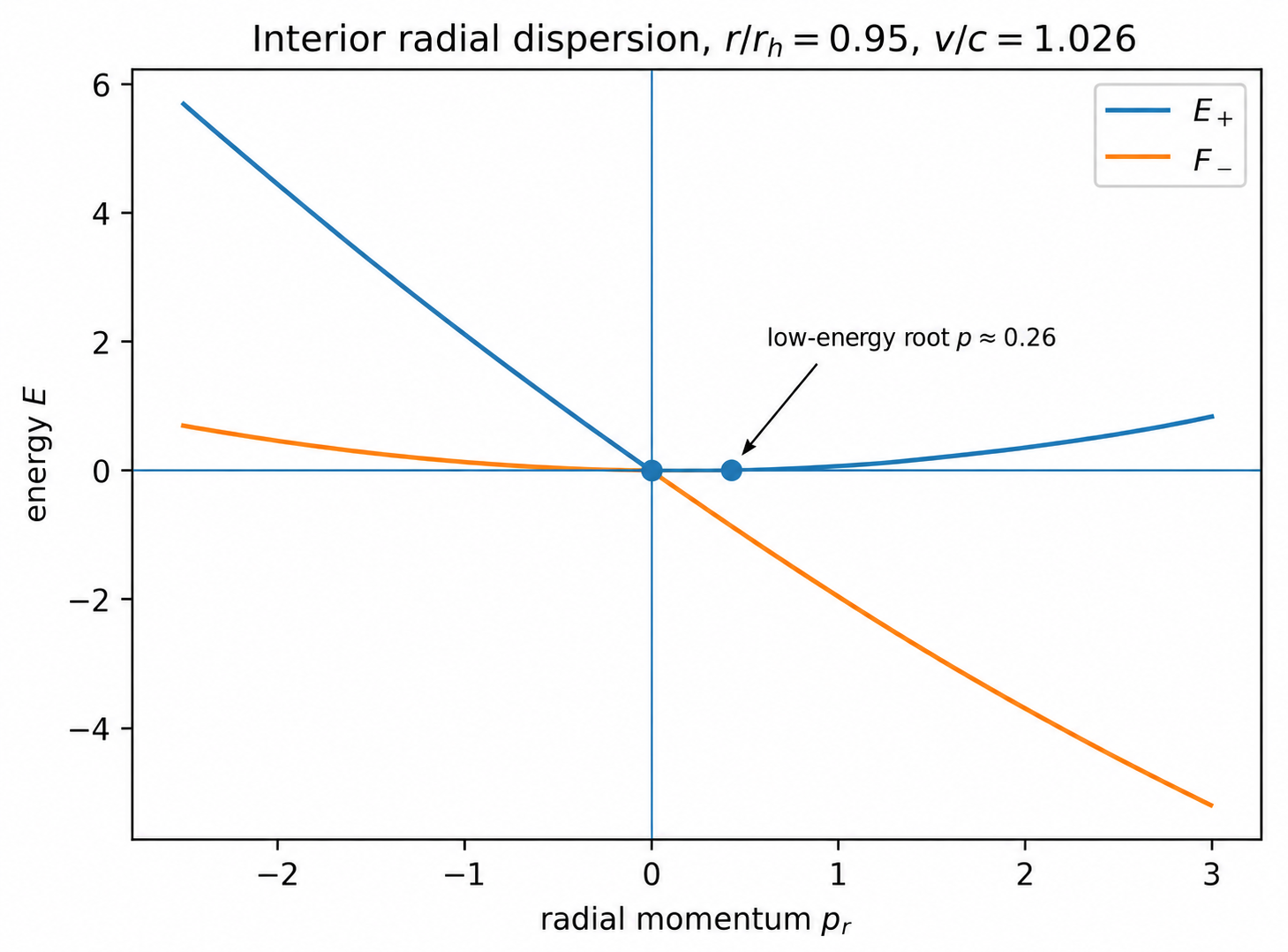
Figure 2: Radial dispersion for the Painlevé-Gullstrand Weyl Hamiltonian in the interior region at N28, where N29. The overtilted spectrum develops an additional zero-energy crossing, indicating the appearance of bounded interior Fermi-pocket structure.
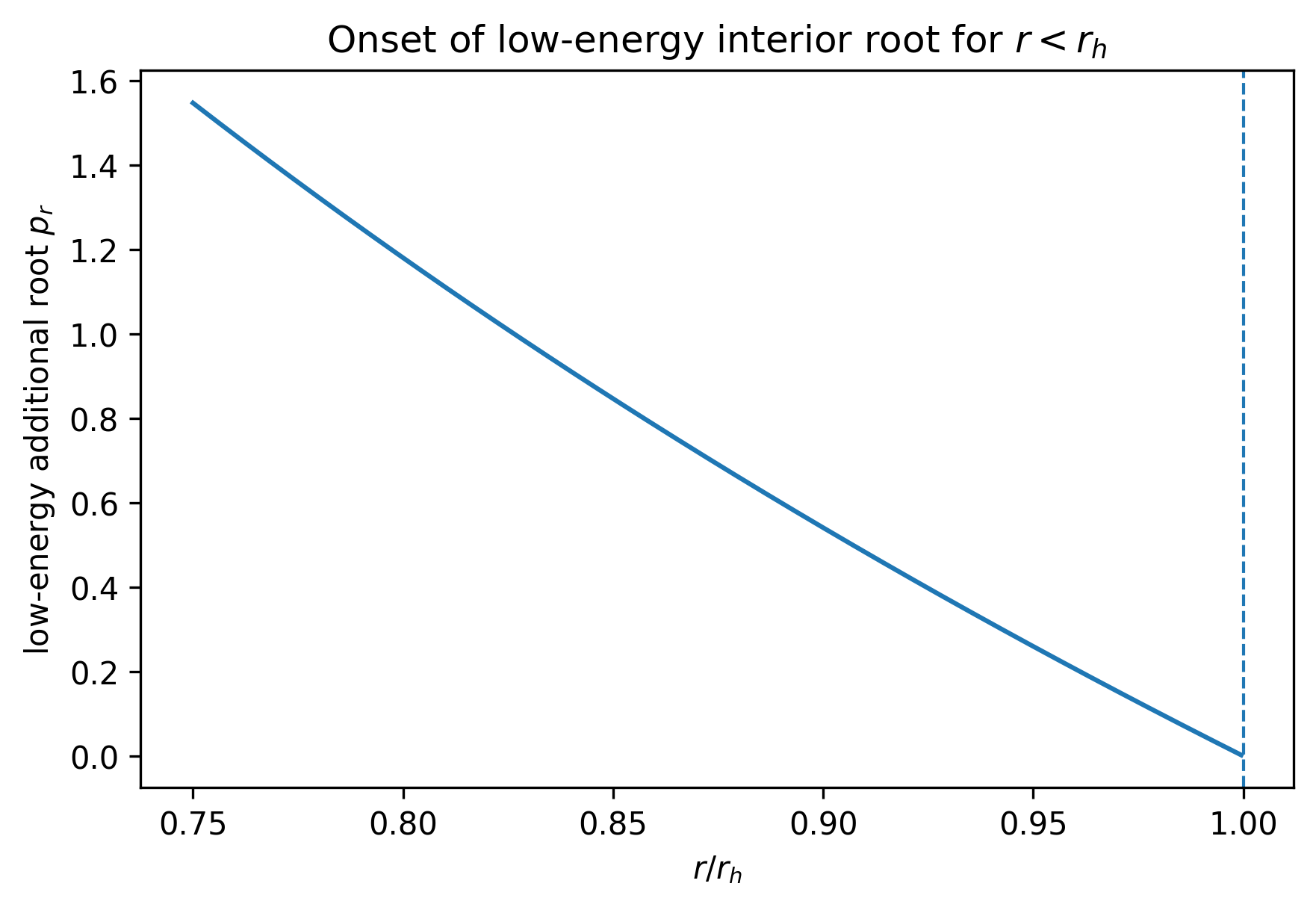
Figure 3: Appearance of the additional zero-energy root across the horizon. In the normalized horizon model, the non-trivial root appears only for N30, where N31, and grows continuously inside the overtilted region.
The emergence of Hawking radiation is discussed in terms of the occupation and relaxation of interior Fermi pockets. The effective Hawking temperature is determined by the velocity gradient at the horizon:
N32
in normalized units, confirming that sharper horizons map to higher analogue Hawking temperatures.
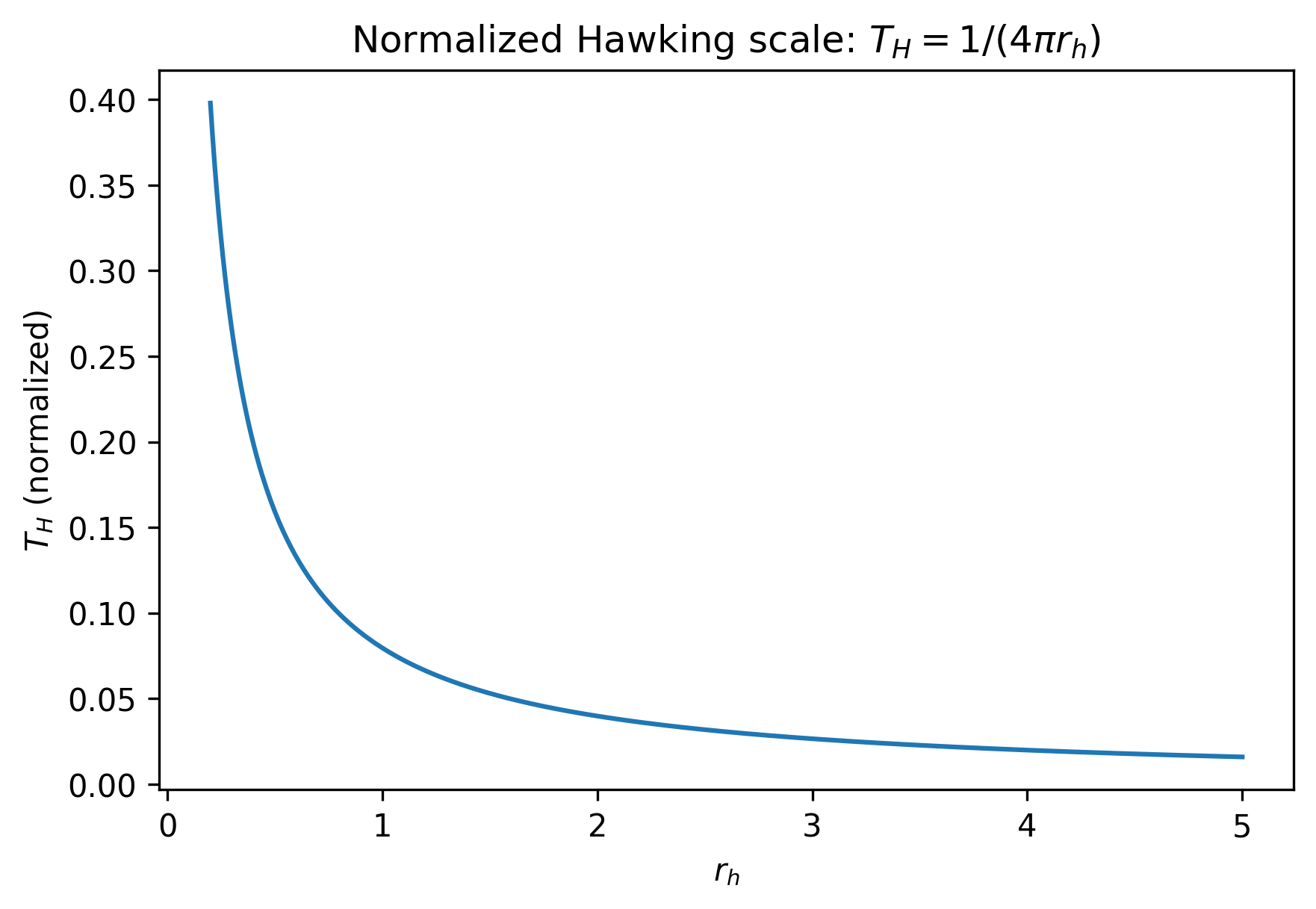
Figure 4: Normalized Hawking-temperature scale as a function of the horizon radius N33 in units with N34. The scale follows N35, showing that smaller effective horizons correspond to larger analogue Hawking temperatures.
Lifshitz Reconstruction and Berry Monopole Transport
The paper systematically analyses the displaced Weyl model, where the Berry monopole is moved through Fermi surface configurations. Two distinct Lifshitz transition points emerge:
- First at N36: Weyl node touches the Fermi surface.
- Second at N37: inner Fermi surface collapses.
These transitions underscore the separation between flux-exchange and surface-disappearance events, with intermediate regimes characterized by reorganized topological content.
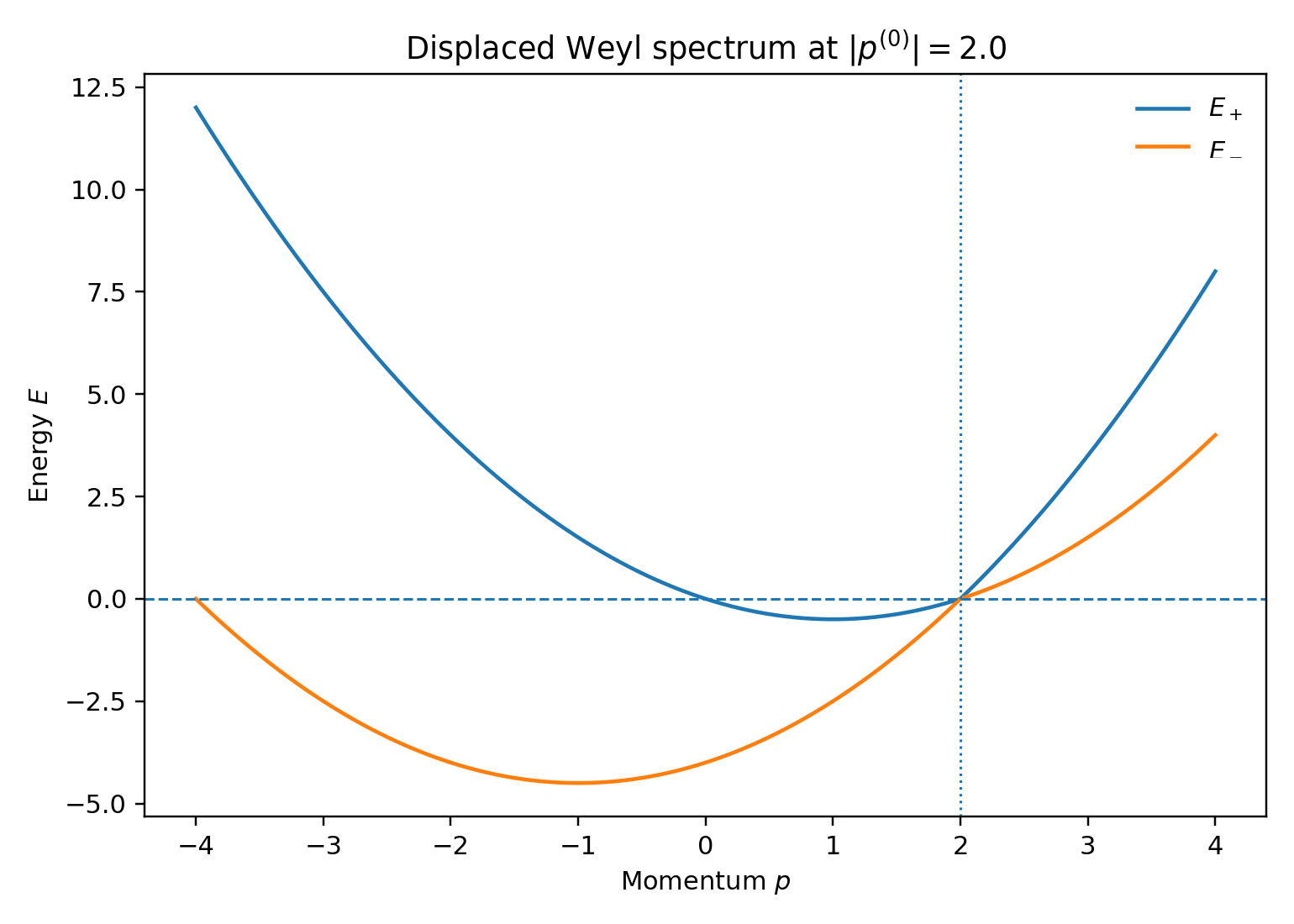
Figure 5: Displaced Weyl spectrum along the displacement axis at N38, corresponding to the first Lifshitz transition for the normalized choice N39, f=10, and f=11. At this point the Weyl node touches the Fermi surface and mediates the topological reconstruction.
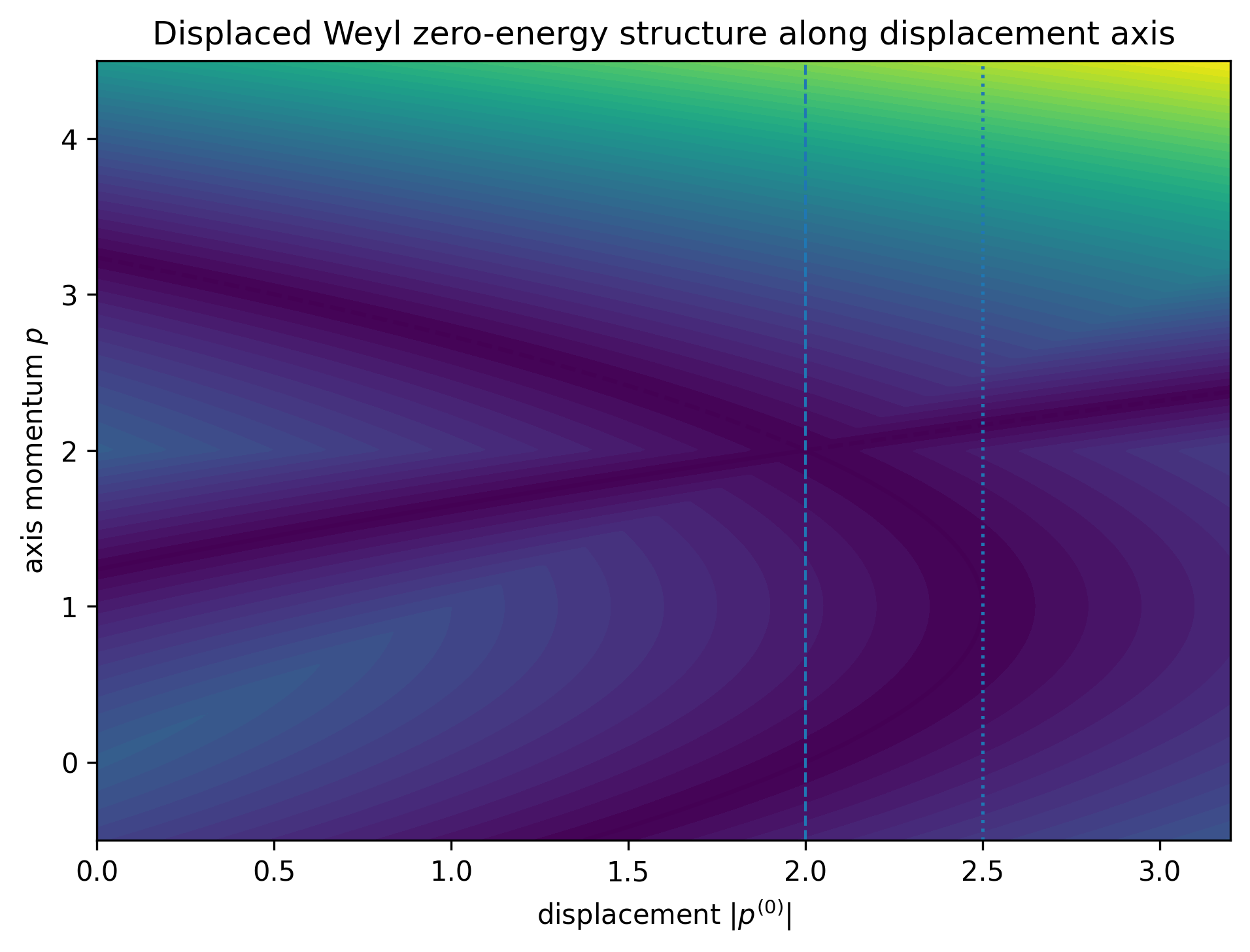
Figure 6: Transition map for the displaced Weyl model in the regime f=12. The zero-energy structure changes as the displacement f=13 is varied. The dashed and dotted horizontal lines mark the first transition at f=14 and the second transition at f=15, respectively.
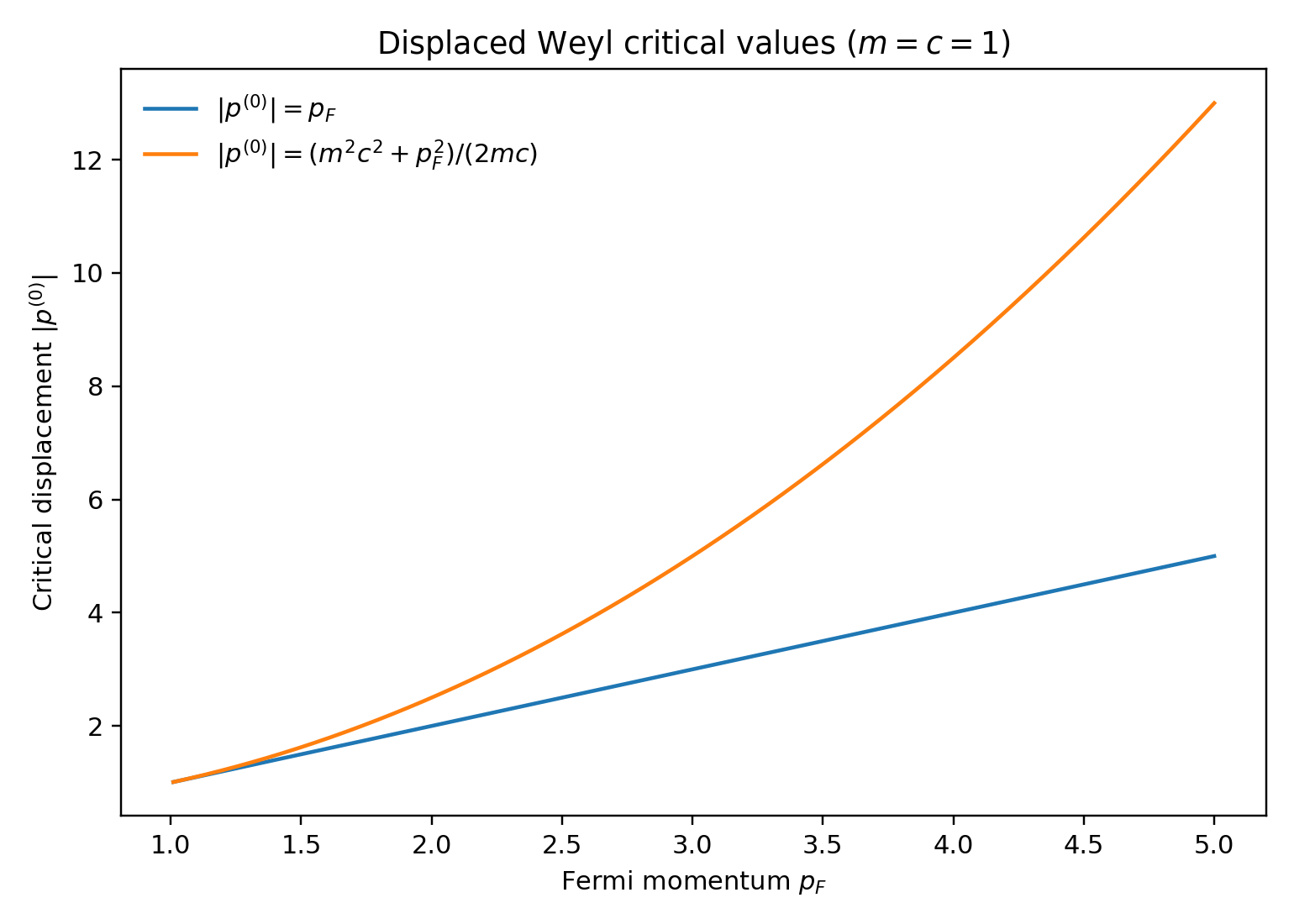
Figure 7: Critical displacement values in the displaced Weyl model as functions of f=16 in the regime f=17. The first critical value is f=18, while the second is f=19. Their separation shows that the Fermi-surface touching event and the collapse of the inner surface are distinct Lifshitz transitions.
Interaction-Induced Flat-Band Physics
A central theoretical claim is that electron-electron interactions near topological transitions can drive flat-band formation, i.e., zeros of codimension 0 with singular density of states. This alters the pairing scale from being exponentially suppressed in B(p)0 in conventional metals to linearly proportional in flat-band systems:
B(p)1
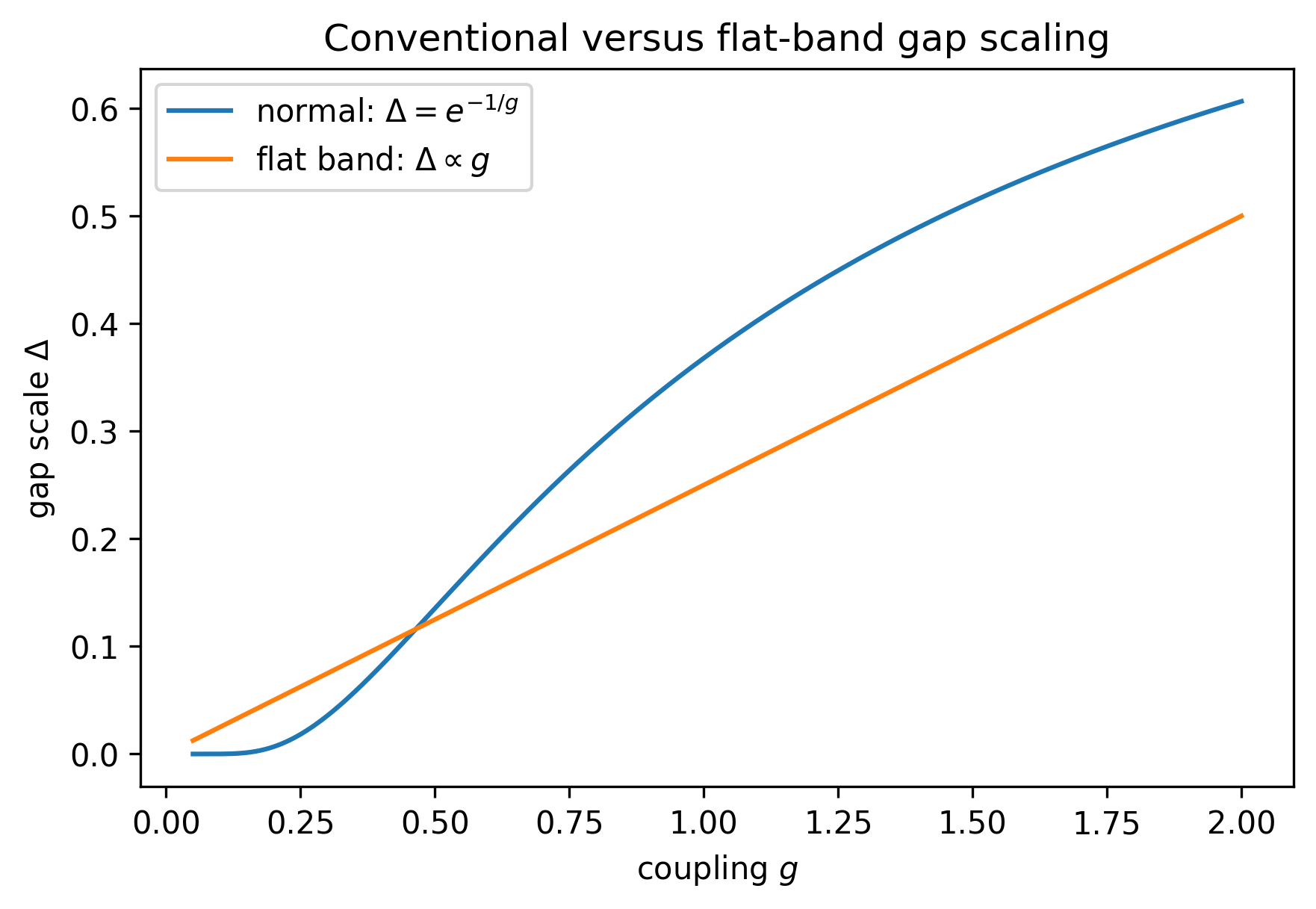
Figure 8: Normalized comparison between the conventional exponentially suppressed pairing scale and the linear flat-band pairing scale. The figure is intended as a scaling illustration rather than a material-specific prediction.
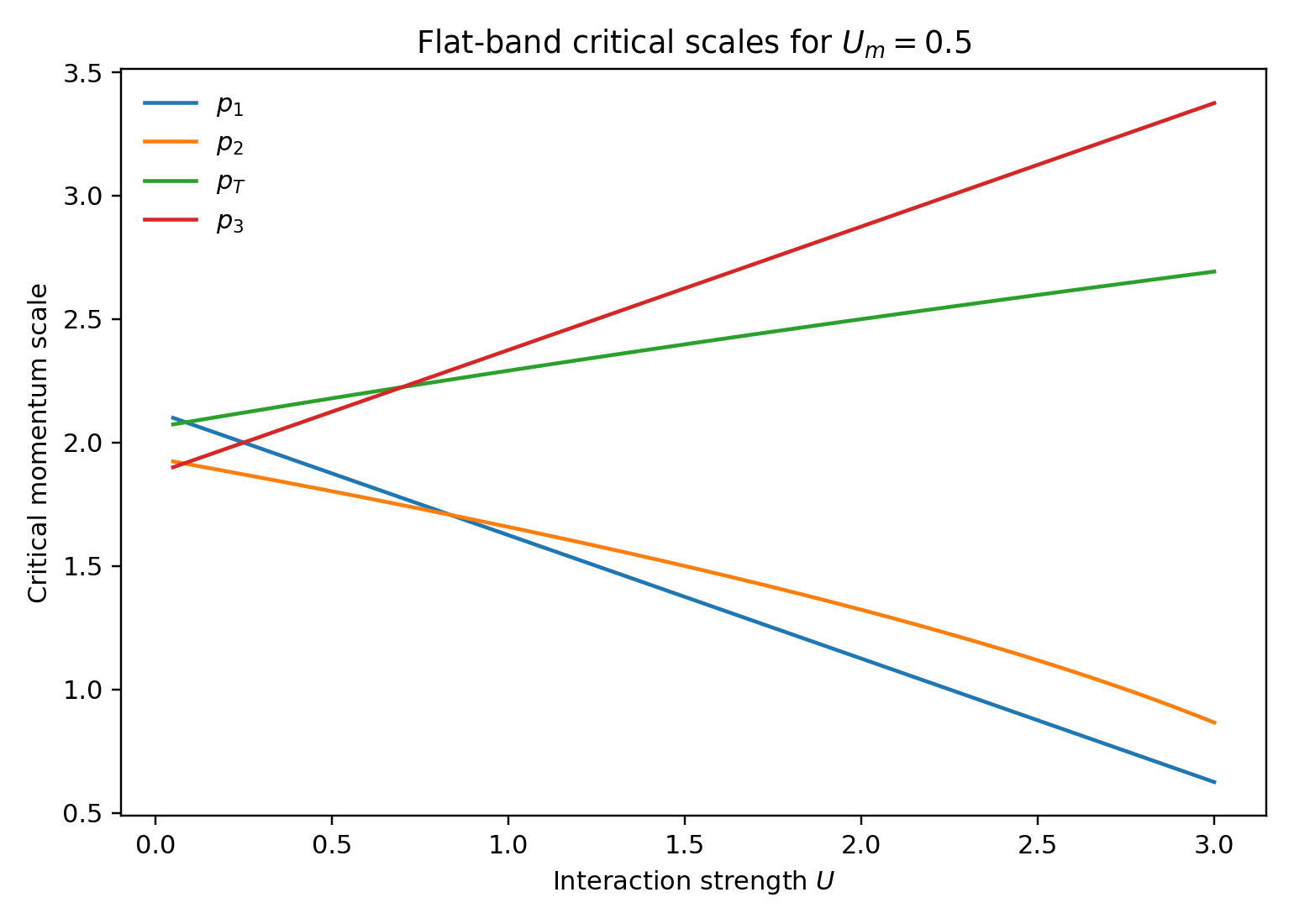
Figure 9: Flat-band critical scales as functions of the interaction strength B(p)2 for fixed Um=0.5.Themultiplebranchesshowthattheinteractingflat−bandsectorcontainsseveraldistinctcriticalmomentaassociatedwithseparateLifshitzreconstructions.</p></p><p>Theanalysisdemonstratesthatinteraction−drivenflat−bandregionsexhibittheirowninternalLifshitztransitions,producingmultiplecriticalscalesinmomentumspacedependentonB(\mathbf{p})$3 and $B(\mathbf{p})$4. Such regimes are plausible candidates for high-$B(\mathbf{p})$5 superconductivity due to the singular enhancement of pairing.
Implications and Outlook
The results establish a rigorous link between topological semimetal spectral transitions and emergent horizon analogues, both in static and interaction-driven cases. The formalism accounts for the intricate interplay of topological invariants and quantifies the impact of Dirac-line criticality and Lifshitz transitions on zero-energy geometry, Berry-flux transport, and many-body instabilities. Practically, the framework:
- Provides predictive criteria for identifying Dirac-line and Weyl criticality in condensed-matter systems.
- Shows the direct analogy between event horizons and type-I/type-II Weyl transitions in engineered materials.
- Quantifies flat-band enhancement mechanisms for unconventional superconductivity.
Theoretically, it advances the classification of topological transitions by associating co-dimension and symmetry-protection with observable spectral features, and offers potential generalizations to nexus points, knotted nodal lines, and complex Fermi topologies.
Conclusion
The paper rigorously demonstrates how Dirac-line criticality and related Lifshitz transitions organize the spectral and topological landscape of Weyl and Dirac semimetals, with explicit analogies to gravitational horizons and Hawking physics. The interplay of topological invariants enables both flux-transfer and band-collapse events, while interaction-driven flat bands substantiate strong pairing enhancements. These results form a consistent, quantitative bridge between lattice-fermion topology, relativistic analogues, and correlated electron effects. Future developments may include the construction of artificial horizon analogues in solid-state systems, exploration of nexus and knotted-line topologies, and the search for flat-band-facilitated room-temperature superconductors.

