- The paper clarifies the distinction between reconstructed dark energy descriptors and microscopic theories, emphasizing the kinematic basis of effective phantom behavior.
- Reconstruction of effective dark energy is influenced by background assumptions, such as the FLRW metric and Friedmann equation, making direct observational inference challenging.
- Effective phantom behavior does not imply ghost instabilities or Big Rip futures; instead, it reflects transient kinematic features amidst diverse theoretical models.
Effective Phantom Dark Energy: Conceptual and Observational Implications
Introduction
The paper "Effective Phantom Dark Energy: What Cosmological Reconstruction Does and Does Not Imply" (2605.27301) addresses the theoretical and observational context surrounding recent mild preferences for dynamical, potentially phantom or phantom-crossing, dark energy inferred from large-scale cosmological datasets. Central to this discussion is the distinction between effective reconstructed dark energy descriptors (density, equation of state) and the underlying microscopic physical theory. The author systematically clarifies the framework, assumptions, and implications of cosmological dark energy reconstruction, particularly in light of concerns about ghost instabilities, violation of energy conditions, and catastrophic cosmic futures that often accompany claims of phantom dark energy.
Framework of Cosmological Dark Energy Reconstruction
Reconstruction of the effective dark energy sector in observational cosmology is inherently a kinematic procedure rooted in a set of background assumptions: spatially flat FLRW metric, standard Friedmann equation of General Relativity, and separately conserved non-relativistic matter. The observed expansion history, H(z), is decomposed as
H2(z)=3mp21[ρm0(1+z)3+ρDEeff(z)]
with the effective dark energy density defined as the residual:
ρDEeff(z)=3mp2H2(z)−ρm0(1+z)3
and the inferred effective equation of state
wDEeff(z)=−1+31+zdzdlnρDEeff(z)
These constructs are not direct observables, but inferred quantities susceptible to the adopted assumptions and parameter choices. Different microscopic models—modified gravity, interacting dark sectors, departures from standard matter scaling—can yield equivalent effective reconstructions, making the interpretation of wDEeff highly non-trivial.
Phantom and Phantom-crossing Behaviour: Definitions and Mechanisms
Phantom behaviour is defined by wDEeff<−1, corresponding to an effective density increasing with cosmic time (dρDEeff/dt>0). Phantom crossing describes trajectories where wDEeff traverses the boundary at −1.
Crucially, effective phantom behaviour does not necessitate a fundamental, pathological phantom field with negative kinetic energy or violation of the null energy condition (NEC) at the level of the microscopic stress tensor. It is instead a feature of the expansion history reconstructed under the stated assumptions.
Multiple physically consistent frameworks, including scalar-tensor theories, modified gravity, interacting dark sectors, and braneworld models, can yield effective phantom or phantom-crossing behaviour without fundamental instabilities.
Observational Status: DESI BAO, CMB, and Supernova Constraints
Recent DESI BAO measurements, combined with CMB and Type Ia supernovae, have provided improved constraints on the late-time expansion history. Parametric reconstructions (e.g., CPL w(z)=w0+wa1+zz) indicate regions of preference with phantom or phantom-crossing phenomenology (H2(z)=3mp21[ρm0(1+z)3+ρDEeff(z)]0, H2(z)=3mp21[ρm0(1+z)3+ρDEeff(z)]1). The preferred parameter domains typically yield transient phantom phases at H2(z)=3mp21[ρm0(1+z)3+ρDEeff(z)]2 in the past, evolving to quintessence-like behaviour at the present epoch:
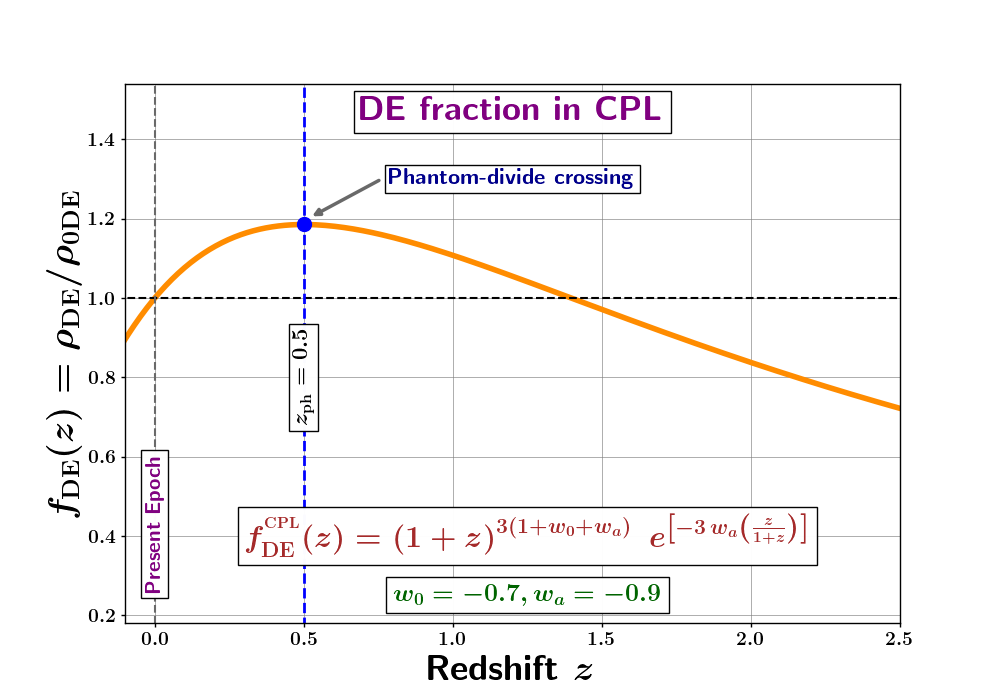
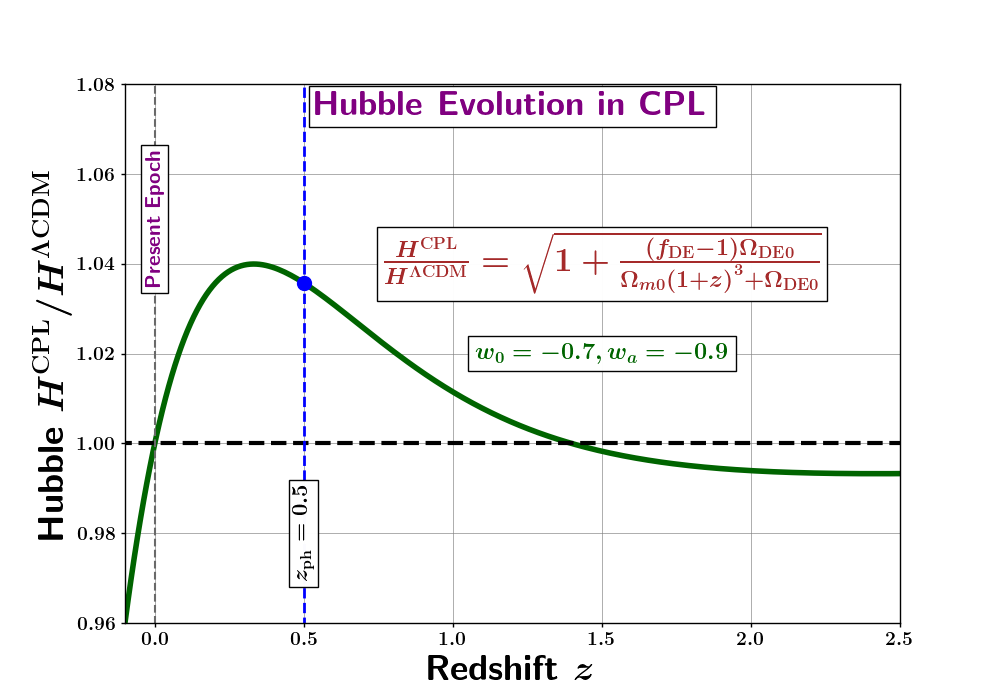
Figure 1: Evolution of DE density relative to its present value and corresponding Hubble parameter ratio in CPL parametrization, highlighting the transient phantom-crossing scenario.
This reconstruction corresponds to an effective dark energy density growing with cosmic time over a finite redshift range, peaking near the phantom-crossing epoch, and subsequently declining.
The statistical significance for such dynamical behaviour remains modest and debates persist regarding robustness, systematics, and parametric dependence. However, the qualitative preference appears across multiple approaches, not strictly tied to CPL.
Physical Implications and Theoretical Clarifications
A decisive observation is that reconstructed effective phantom behaviour:
- Does not automatically imply microscopic ghost instabilities, as the effective dark energy sector may be kinematic or phenomenological.
- Does not guarantee violation of the fundamental null energy condition, since H2(z)=3mp21[ρm0(1+z)3+ρDEeff(z)]3 is not synonymous with H2(z)=3mp21[ρm0(1+z)3+ρDEeff(z)]4 for the full stress-energy tensor.
- Does not necessitate a future Big Rip singularity, as transient phantom phases yielding H2(z)=3mp21[ρm0(1+z)3+ρDEeff(z)]5 are often followed by non-phantom regimes, preventing divergent expansion within finite cosmic time.
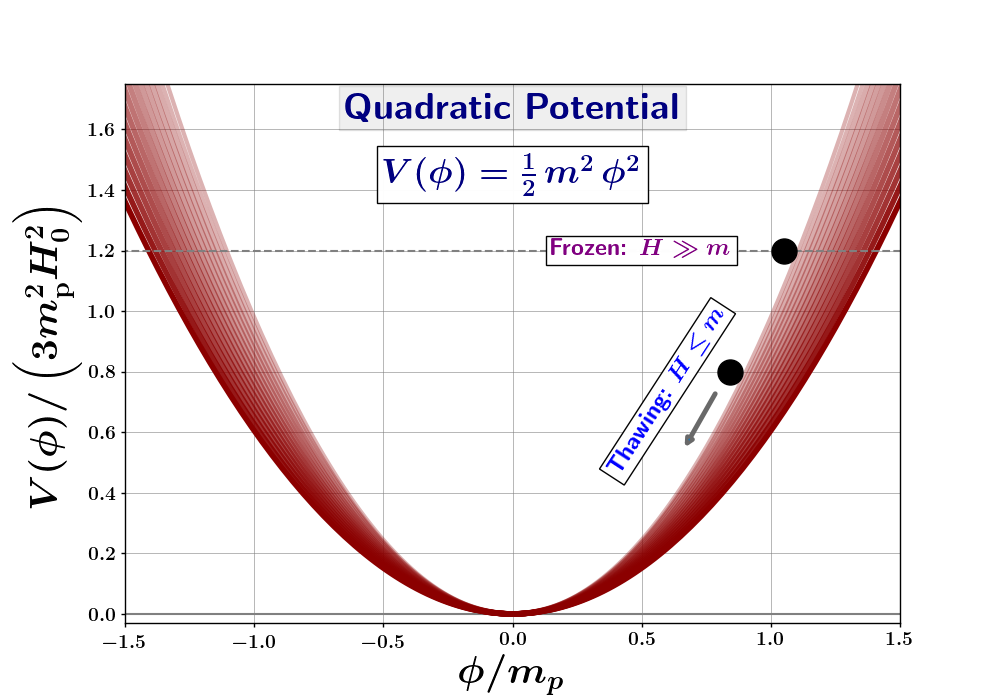
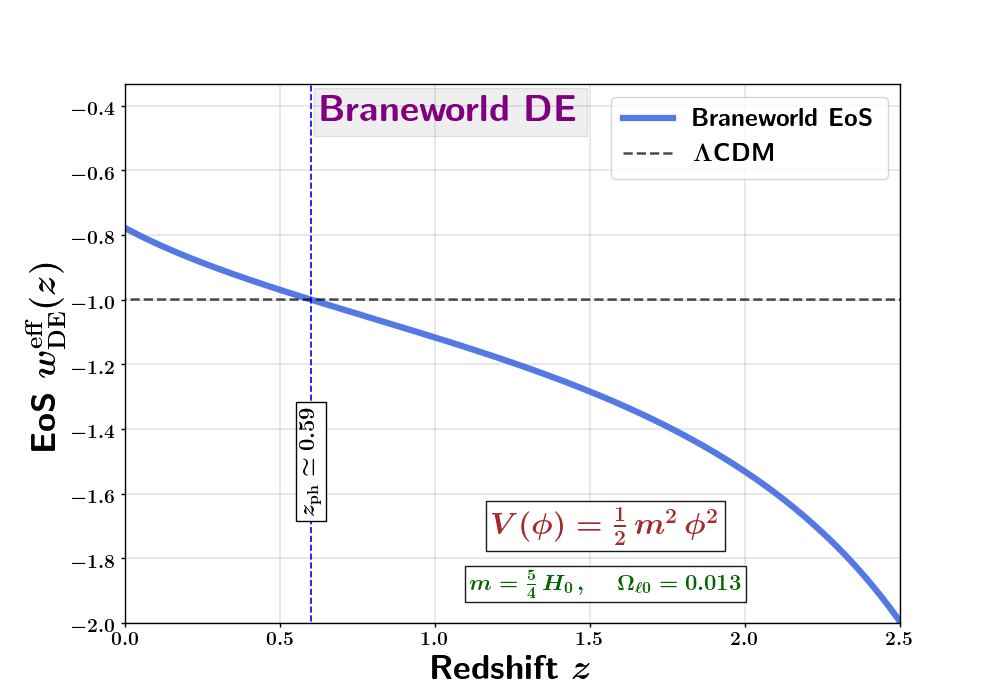
Figure 2: Evolution of effective DE density and Hubble parameter for a braneworld scenario with quadratic thawing potential, demonstrating phantom-crossing behaviour compatible with observational constraints.
Mechanisms such as interacting dark sectors, scalar-tensor and modified gravity theories, or braneworld extra-dimensional models, achieve effective phantom behaviour by altering the expansion history without fundamentally pathological degrees of freedom. For instance, on the ghost-free normal branch of a braneworld, extra-dimensional corrections generate H2(z)=3mp21[ρm0(1+z)3+ρDEeff(z)]6 absent microscopic NEC violation:
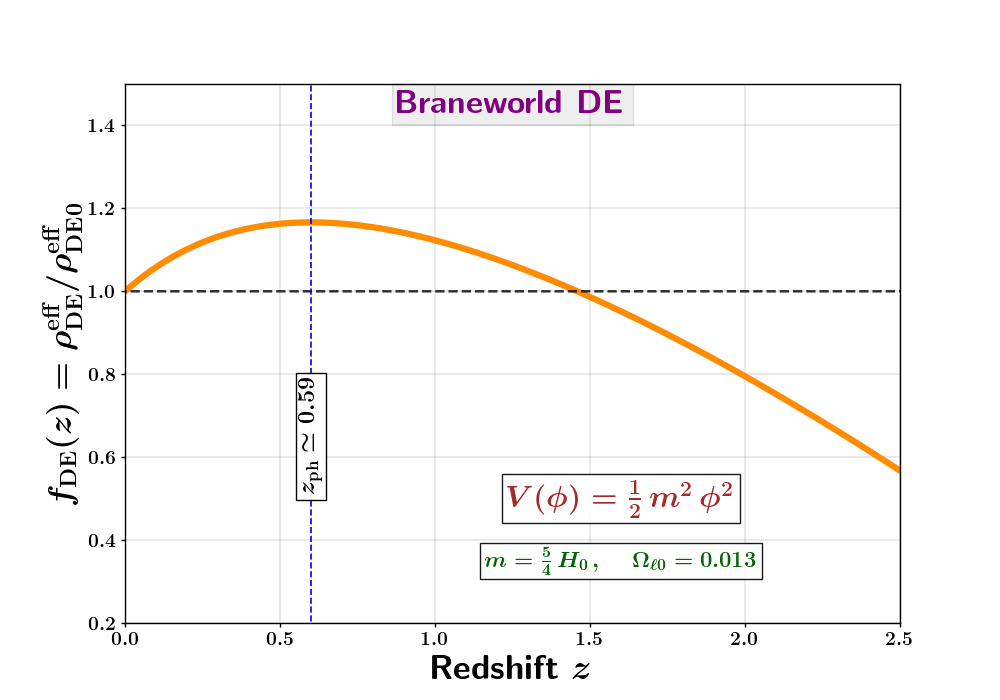
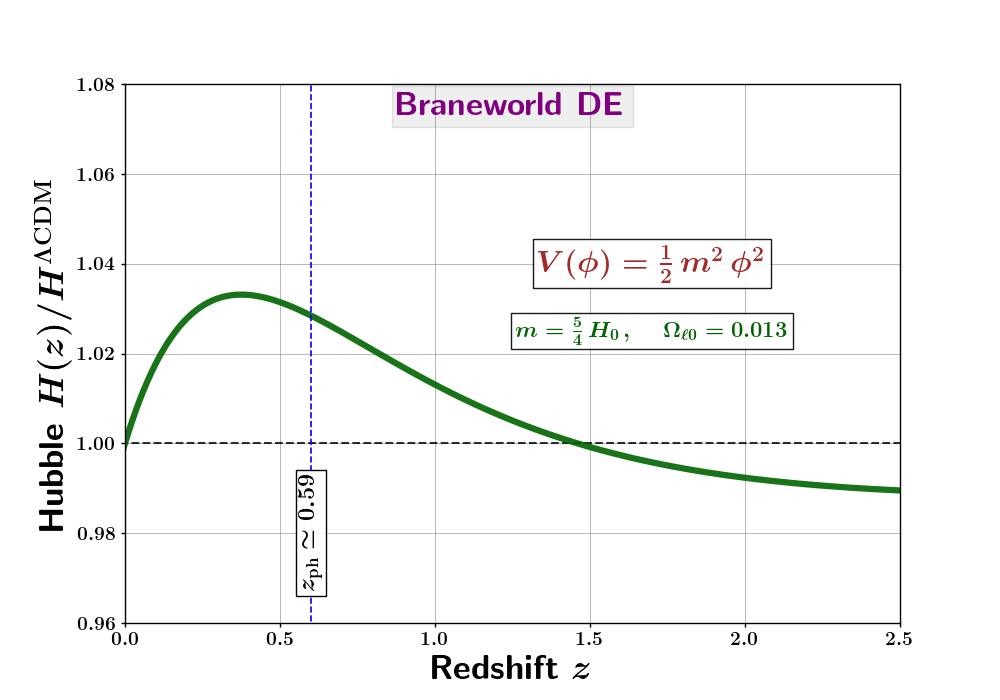
Figure 3: Quadratic scalar potential for braneworld thawing dark energy (left) and associated evolution of reconstructed effective EoS (right), with phantom divide crossing at H2(z)=3mp21[ρm0(1+z)3+ρDEeff(z)]7.
Implications for Future Cosmological Reconstructions and Model Building
The key implications are:
- Effective dark energy quantities cannot be directly mapped to underlying microphysics. Careful separation of background kinematic reconstruction and fundamental theory is necessary.
- Observational preference for dynamical, phantom or phantom-crossing dark energy may persist or diminish with future data, but theoretical caution is warranted in interpretation. Practitioners should avoid conflating effective behaviour with pathologies inherent to microphysical models.
- Perturbative and structure formation predictions must be incorporated to distinguish competing microscopic scenarios, as degenerate background expansion histories are common among different theories.
Conclusion
This analysis systematically articulates the conceptual distinction between reconstructed effective phantom dark energy and its physical interpretation. In light of recent observational trends, it is emphasized that effective phantom or phantom-crossing behaviour in cosmological reconstructions conveys kinematic features of the expansion history, not direct evidence for fundamental ghost instabilities, NEC violation, or inevitable cosmic singularities. Multiple theoretically consistent models can realize such phenomenology without pathologies. The proper interpretation of these observationally inferred descriptors is essential for informed model building and future progress in cosmology. As observational precision increases, the relationship between effective reconstructions and underlying physics should be continually reevaluated to avoid erroneous conclusions.

