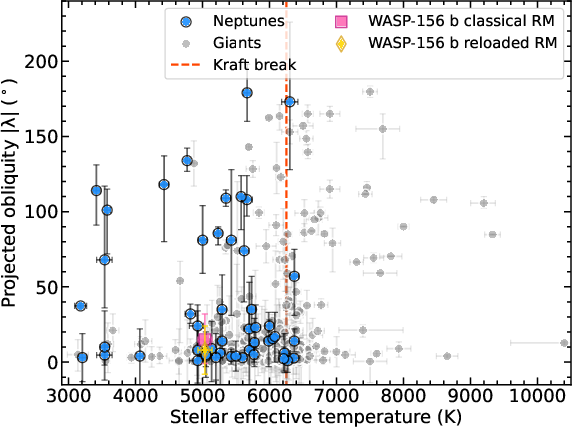
- The paper demonstrates that WASP-156 b’s orbit is well-aligned with its host star, directly refuting earlier polar orbit claims.
- The study employs high-resolution spectroscopy (ESPRESSO and MAROON-X) and NGTS photometry to refine orbital and stellar parameters with improved data quality.
- The work rules out significant massive companions and supports disk-driven migration or in situ formation as key formation processes for close-in Neptunes.
The Sky-Projected Obliquity of WASP-156 b: Aligned, Not Polar
Introduction and Scientific Context
The Neptunian ridge planet WASP-156 b occupies a key region in exoplanet demographics—situated between the "Neptunian desert" and "savanna," regimes defined by a complex interplay between migration, tidal dissipation, and photoevaporation. Understanding the dynamical history of close-in Neptunes requires precise characterization of both their system architecture and their orbital inclination with respect to the stellar spin axis (obliquity). WASP-156 b's previous status as a highly misaligned (potentially polar) orbit rendered it a crucial test case for hypotheses about obliquity bimodality and primordial misalignments in sub-Jovian populations.
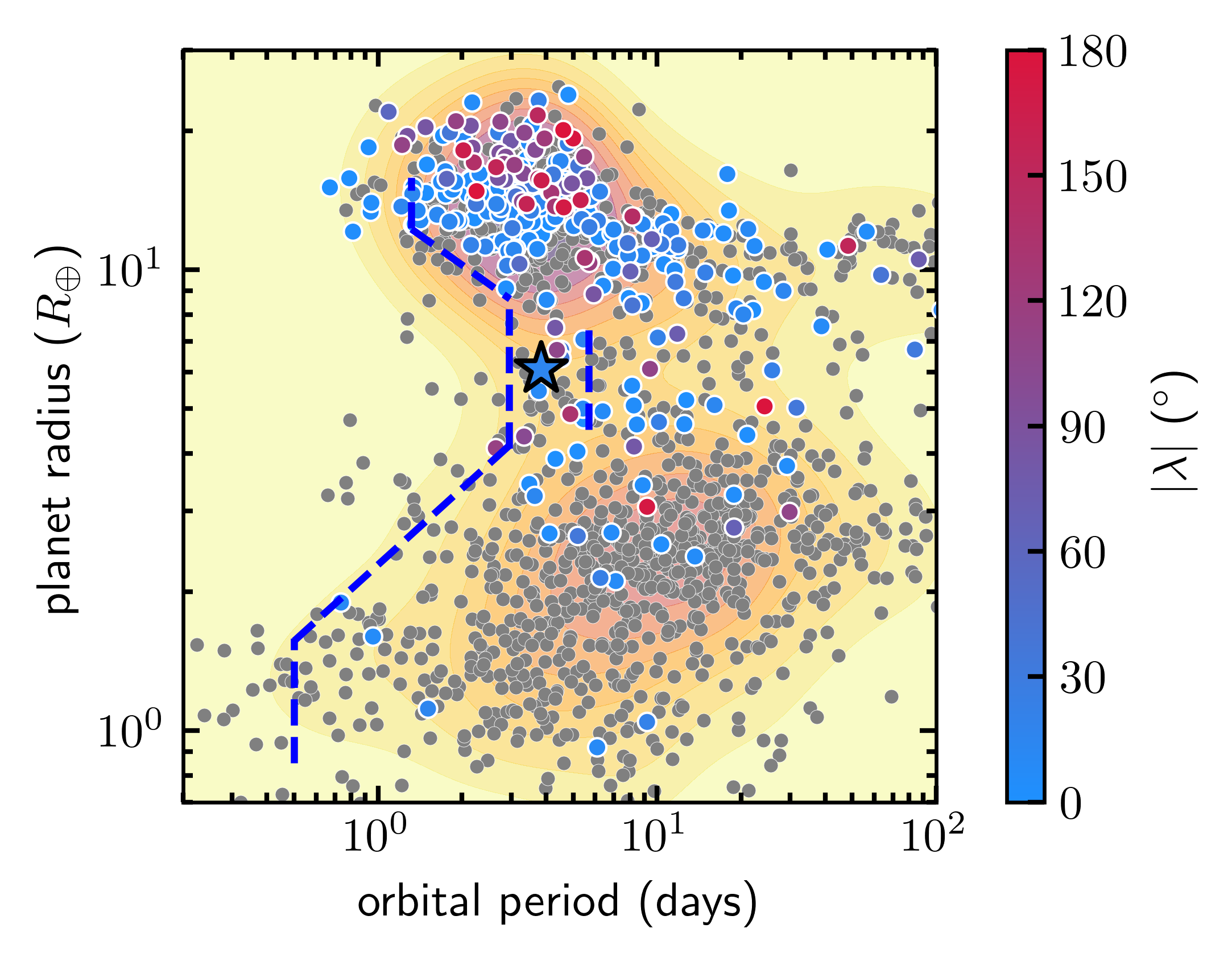
Figure 1: Orbital period vs. planet radius, highlighting WASP-156 b’s position near the Neptunian ridge and the boundaries of known period–radius features in close-in exoplanet distributions.
This work applies high-resolution time-series spectroscopy from ESPRESSO and MAROON-X, new NGTS photometry simultaneous with transit monitoring, and an exhaustive reanalysis of photometric and radial velocity (RV) archives to update the system’s orbital and spin–orbit geometry parameters. The Rossiter–McLaughlin (RM) effect and "reloaded RM" analysis are leveraged to disentangle the spin–orbit architecture and measure the sky-projected obliquity λ. The resulting constraints directly refute earlier claims of a polar orbit and have implications for formation and migration models of close-in Neptunes.
Observational Data Sets and Refinement of Stellar Parameters
The campaign comprises two ESPRESSO/VLT transit sequences, one Gemini-N/MAROON-X sequence, contemporaneous multitelescopic NGTS photometry, and extensive archival RVs (CORALIE, SOPHIE, HIRES, HARPS). Data quality, cadence, and S/N—especially for the ESPRESSO and NGTS data—are markedly improved relative to previous CARMENES-based efforts. The ESPRESSO observations, with S/N = 85 (order 87), enable robust line profile analysis and precision RV extraction.
Spectroscopic analysis with PAWS yields refined stellar parameters (Teff∼5036 K, logg∼4.46, [Fe/H] ∼ 0.32) and, critically, an upper limit on the projected stellar rotational velocity (vsini⋆≤2 km s−1), significantly lower than previous literature values based on lower-resolution SOPHIE spectra.
System Parameter Re-derivation
A joint photometric–RV fit (TESS, NGTS, CORALIE, SOPHIE, HARPS, HIRES) via the juliet framework yields improved posterior constraints for planetary and orbital properties: P=3.8362 d, Mp=42±2M⊕, Rp=6.15±0.12R⊕, e<0.16 (3Teff∼50360). Phase-folded combined data for NGTS, TESS, and RVs align tightly with the best-fitting global model.
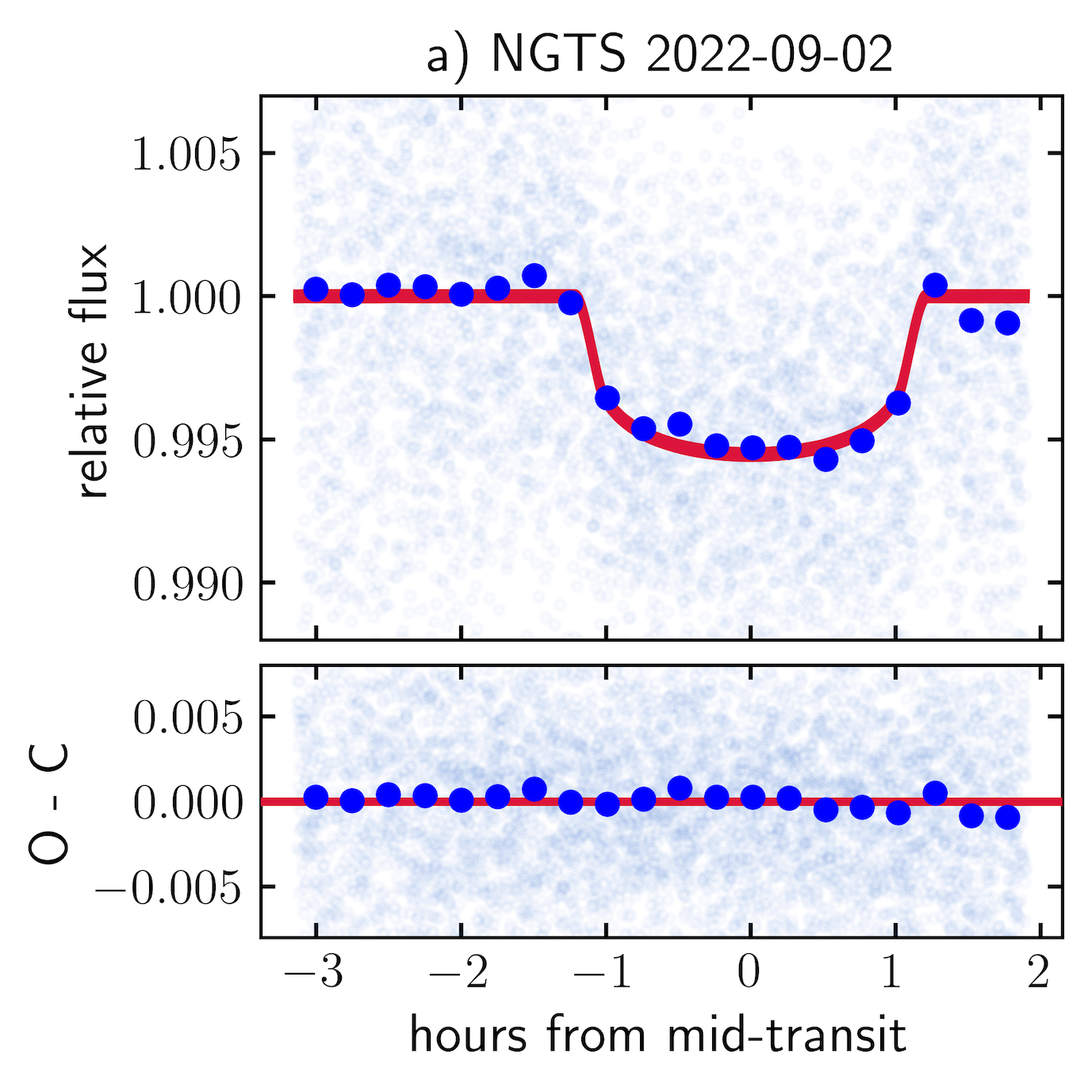
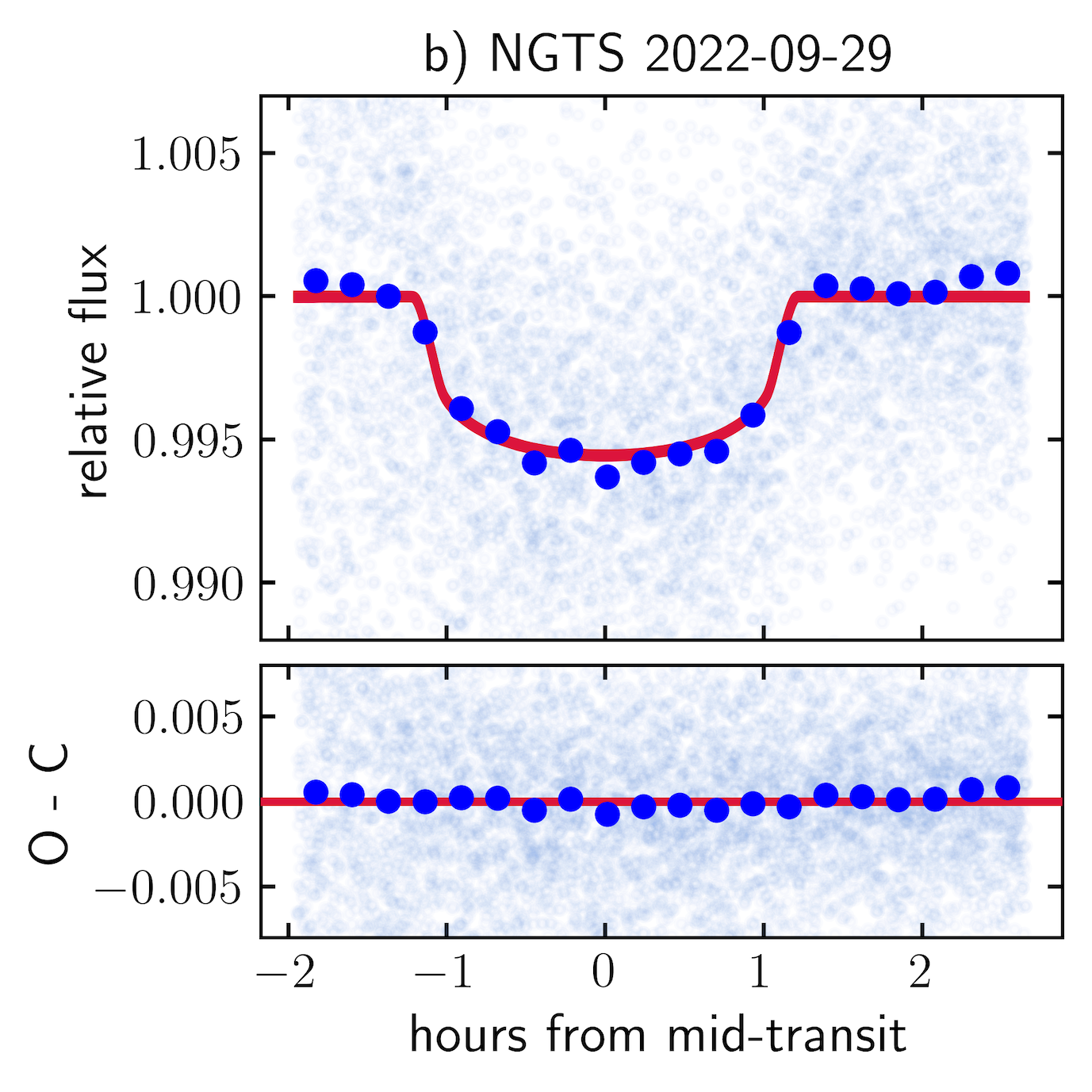
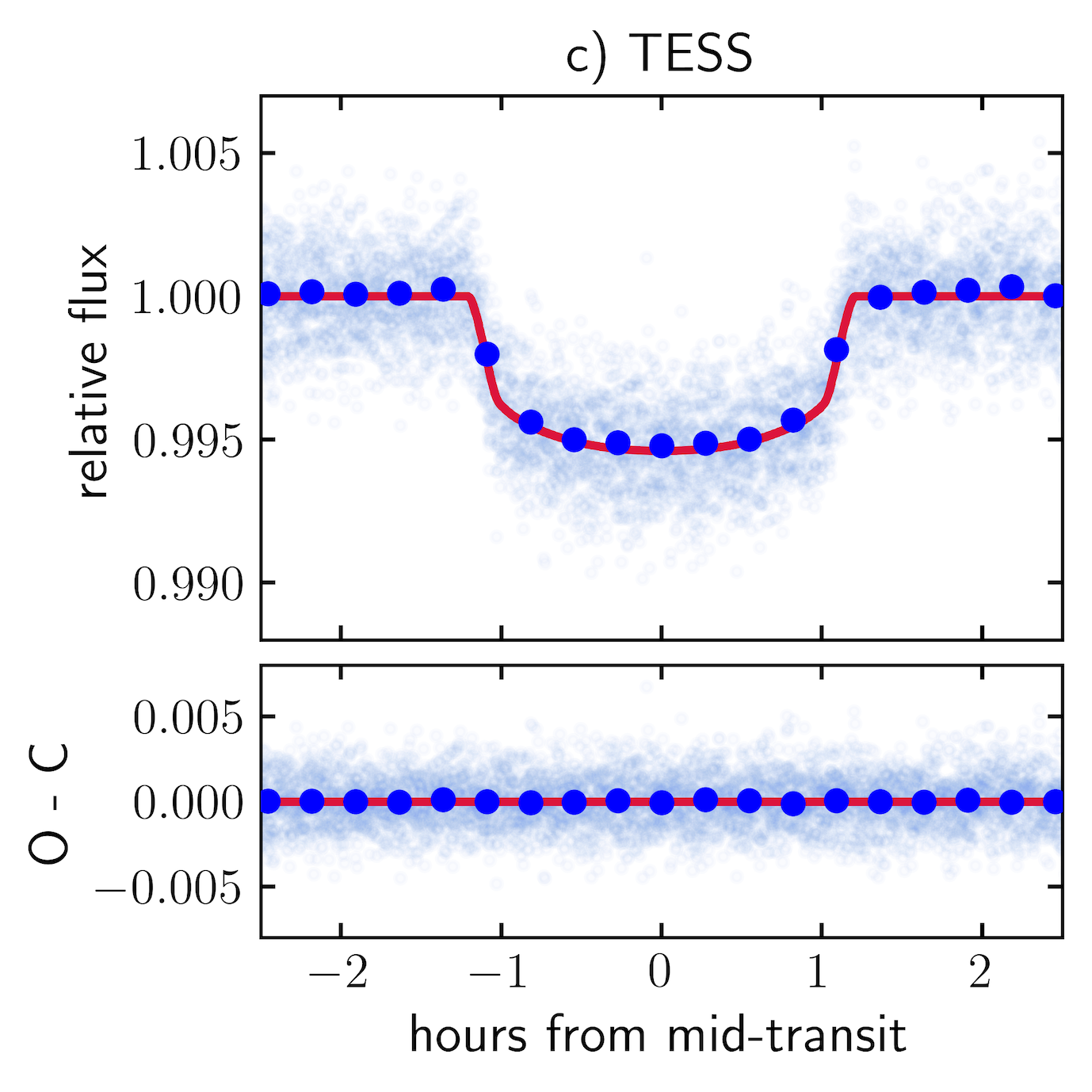
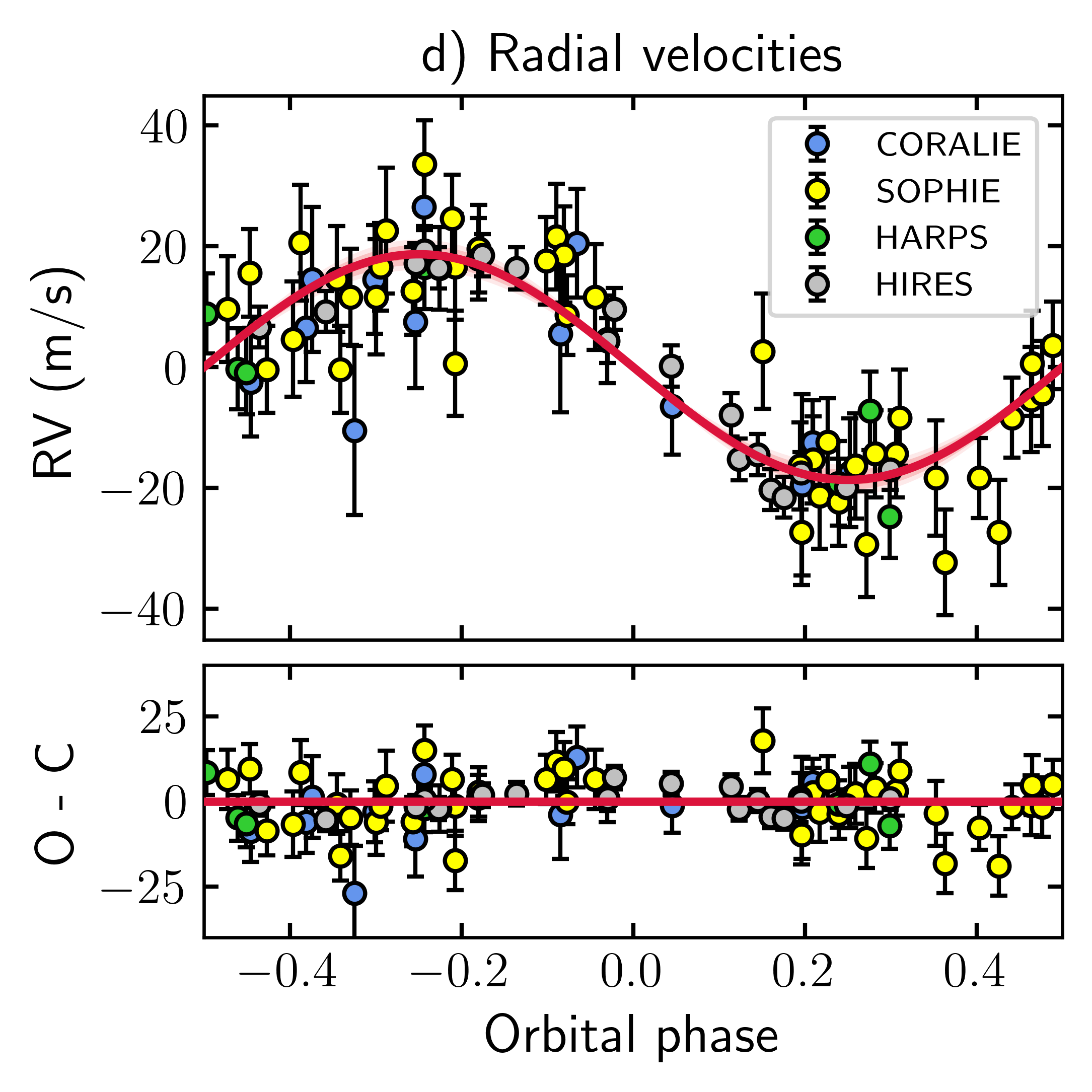
Figure 2: Photometry and RV phase curves for WASP-156 b, displaying both NGTS and TESS transit fits and the corresponding RV orbital signature.
Rossiter–McLaughlin and Reloaded RM Analyses
Classical RM
Using serval-based template-matching RVs, the team models the classical RM effect with the ironman code. Informative Gaussian priors on global parameters reduce degeneracies, with broad, noninformative priors imposed on Teff∼50361 and Teff∼50362. Each ESPRESSO night is analyzed independently and jointly.
The joint fit results in:
- Sky-projected obliquity: Teff∼50363 deg
- Projected rotational velocity: Teff∼50364 km sTeff∼50365
This directly contradicts the previously reported polar value and is consistent with alignment.
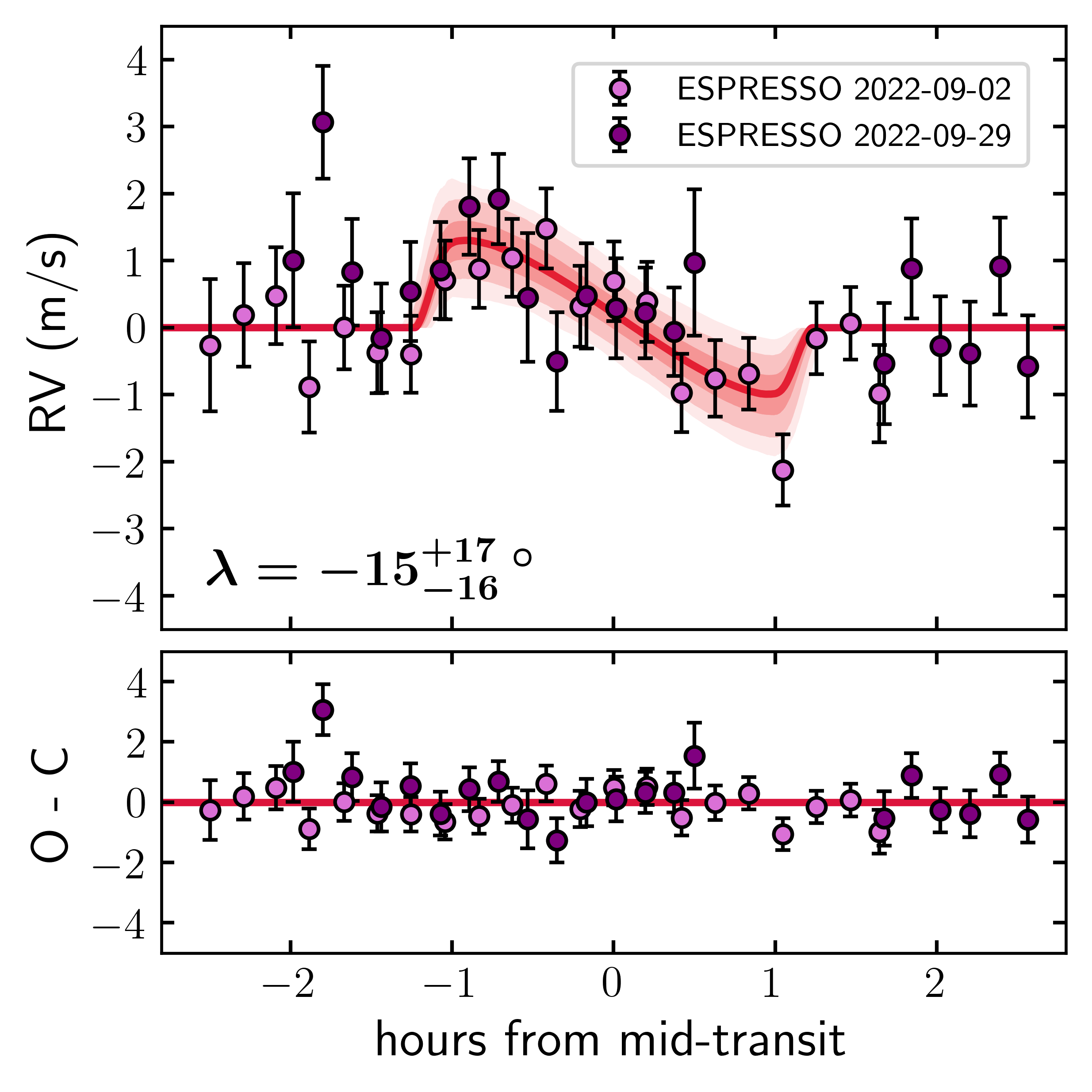
Figure 3: ESPRESSO disc-integrated RVs during transit and the best-fit RM model, showing an aligned projected obliquity.
Reloaded RM
The reloaded RM framework explicitly reconstructs local CCFs along the transit chord and models the stellar surface velocity field. Local RVs for in-transit CCFs are measured and compared with solid-body rotation models (neglecting overfitting from convective signals).
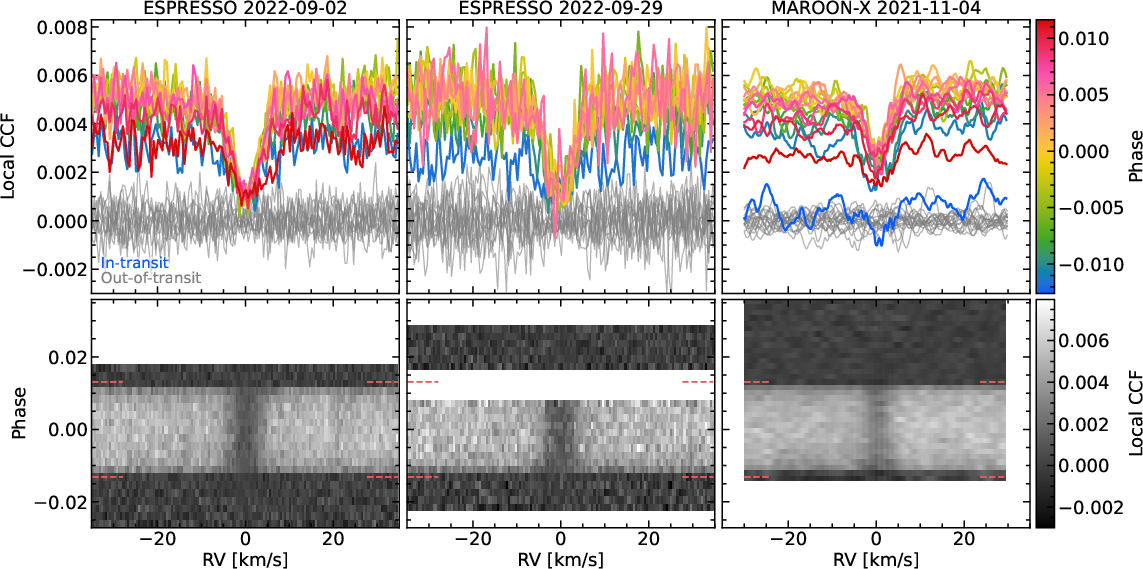
Figure 4: Local CCFs through transit for both ESPRESSO transits and the MAROON-X transit; color coding tracks orbital phase, mapping the planet’s path across the stellar disc.
The global fit for both ESPRESSO nights yields:
- Sky-projected obliquity: Teff∼50366 deg
- Teff∼50367 km sTeff∼50368
MAROON-X data alone are uninformative due to high noise, but do not contradict these results.
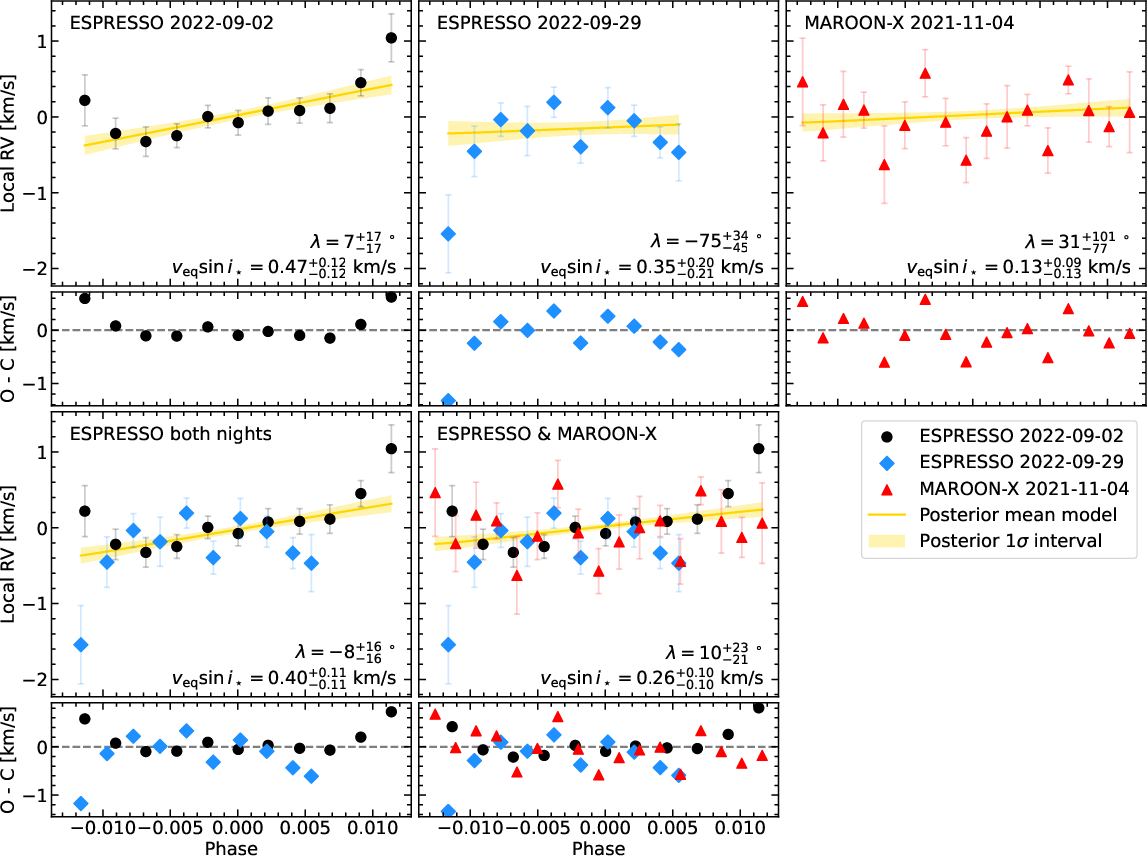
Figure 5: Local RVs and solid-body fit for both ESPRESSO nights (bottom left), demonstrating consistency with alignment and low rotational velocity.
Discrepancy with Previous Polar Obliquity Claim
The previously reported polar obliquity (Teff∼50369) from CARMENES data is attributed to a degeneracy between logg∼4.460 and logg∼4.461 magnified by a prior strongly favoring a high logg∼4.462 km slogg∼4.463)—a value not supported by the present high-resolution data. The CARMENES time series itself, per re-examination, is subject to low S/N, strong telluric contamination, and only provides a weak constraint on the RM signature in the absence of prior information.
A recent independent ESPRESSO-based analysis is consistent with the new aligned obliquity within uncertainties but is less constraining due to the use of phase curve/CCF-based RVs and literature (lower) impact parameter.
Systematic errors and degeneracy in the RM modeling—especially at low logg∼4.464 with modest impact parameter—necessitate caution with earlier results that relied on low-quality line profile data and empirical logg∼4.465 calibrations.
Dynamical Constraints: Companions and System Isolation
No additional companions (stellar or planetary) are identified in high-resolution imaging, nor in the long-baseline, multi-instrument RV residuals. Synthesis modeling rules out the presence of Jupiter-mass planetary companions within 5 au at logg∼4.466 confidence.
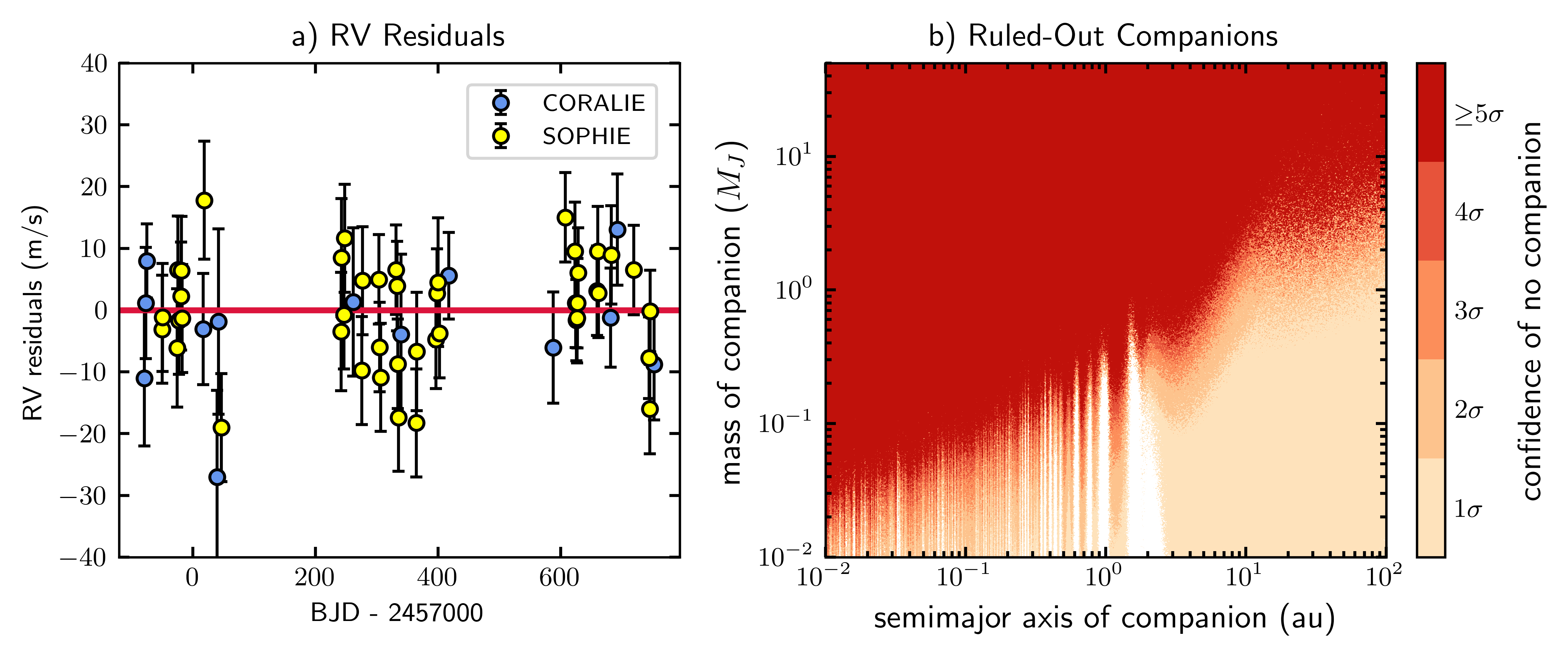
Figure 6: RV residuals (left) and exclusion contour for additional companions (right); Jupiter-mass planets can be ruled out interior to 5 au.
Physical and Theoretical Implications for Migration
- The system’s aligned orbit, lack of massive perturbers, and circularization are consistent with in situ formation or disk-driven migration, not high-eccentricity excitation followed by tidal circularization.
- The tidal realignment timescale greatly exceeds the system age, so present-day alignment cannot be explained by post-migration tidal alignment for a planet with WASP-156 b's mass and separation.
- The conclusion is robust even for unknown stellar inclination, as Monte Carlo draws from isotropic logg∼4.467 distributions based on the measured logg∼4.468 and system geometry indicate that a polar 3D obliquity is unlikely.
Context within Close-In Neptune Populations and Obliquity Bimodality
Additionally, analysis of the sample in the context of the Neptunian ridge, desert, and savanna:
- WASP-156 b’s density (∼01 g cm∼1) places it at the threshold between low- and high-density Neptunes potentially affected by photoevaporation during disk migration.
- No atmospheric escape signatures (e.g., He metastable triplet) have been detected, but extant data are not definitive.
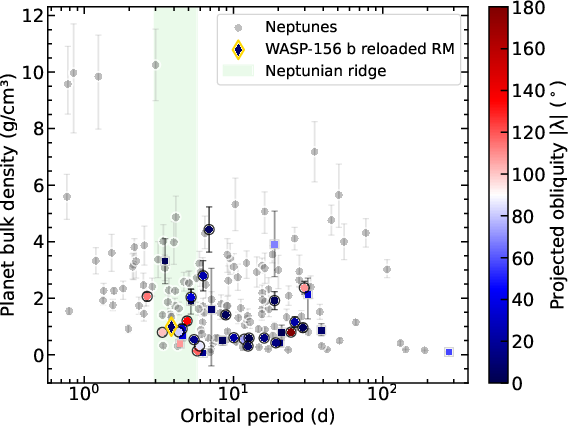
Figure 8: Bulk density as a function of orbital period for Neptunes, with the Neptunian ridge shaded; WASP-156 b lies near the density brink where photoevaporation may shape population structure.
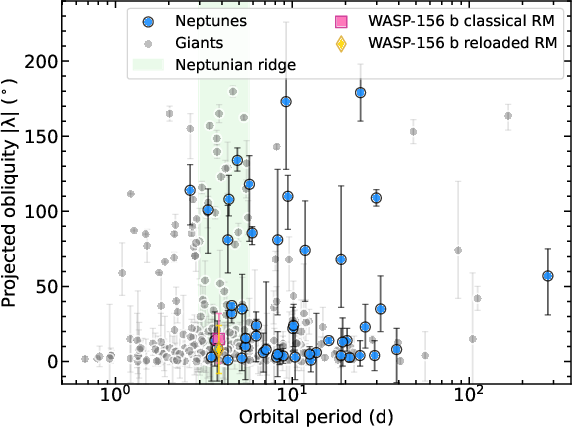
Figure 9: Projected obliquity versus orbital period; WASP-156 b is colored by the new ∼2, repositioning the planet in the aligned cohort of close-in Neptunes.
Conclusion
This work revises the sky-projected obliquity of WASP-156 b from a previously reported polar value to well-aligned (∼3 deg, reloaded RM; ∼4 deg, classical RM), offers a robust upper limit on ∼5 (∼6 km s∼7), and demonstrates the absence of significant companions. The polar orbit claim is directly refuted by precise, high-S/N spectroscopy and rigorous modeling, with alignment favored both empirically and theoretically.
Implications include:
- Strengthened association between alignment and formation in cool-star Neptunes,
- The importance of authoritative ∼8 estimation and high-quality time-series spectroscopy for obliquity measurements,
- Tighter constraints on models positing high-eccentricity migration or polar-obliquity clustering.
The WASP-156 b system strengthens the case for disk-driven migration or in situ formation in the Neptunian ridge and enriches the empirical foundation for population-level studies of close-in exo-Neptunes' dynamical histories.
(2605.27291)