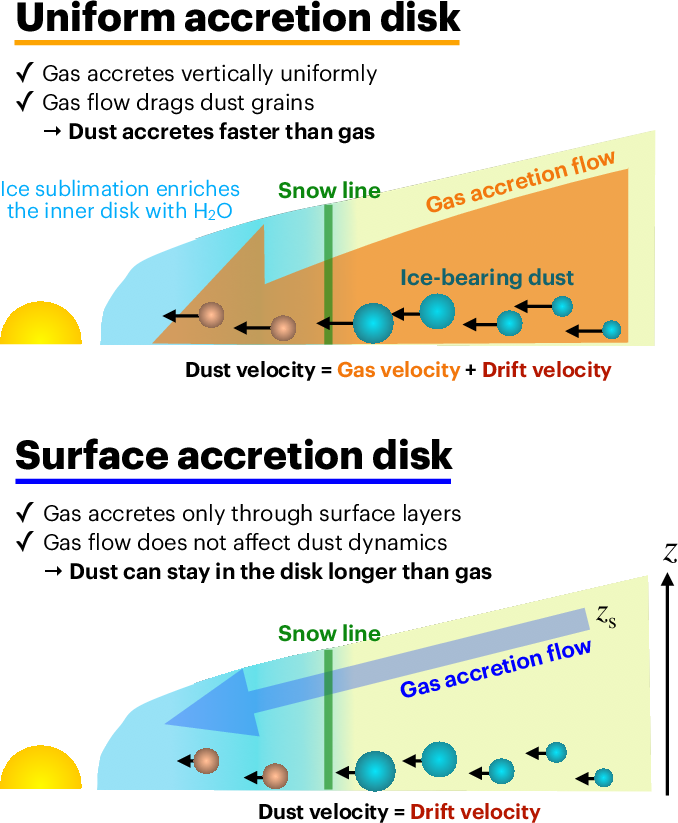
- The paper presents a novel model in which MHD wind-driven surface accretion, coupled with slow-drifting fragile icy grains, yields an order-of-magnitude water vapor enrichment.
- It employs coupled gas, dust, and water vapor evolution simulations, contrasting uniform and surface-concentrated accretion models to capture disk chemical dynamics.
- The model explains the mass-metallicity anti-correlation by showing that selective gas removal elevates the water-to-gas flux across the snow line.
Background and Motivation
Observational campaigns utilizing JWST and other platforms have revealed that many gas giant exoplanets possess atmospheric metallicities substantially exceeding those of their host stars, a phenomenon further characterized by a pronounced anti-correlation between planetary mass and metallicity (Figure 1).
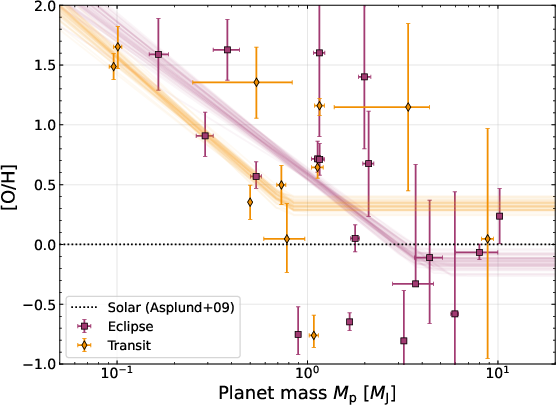
Figure 1: Atmospheric oxygen abundances relative to solar as a function of giant exoplanet mass, illustrating the observed mass-metallicity anti-correlation.
Theoretical models have posited that super-stellar metallicities may originate from accretion of vapor-enriched disk gas, driven by sublimation of icy grains migrating across the snow line. Previous frameworks assumed high sticking efficiency and rapid drift for icy pebbles. However, recent disk observations and laboratory experiments indicate that icy dust at low temperatures is exceptionally fragile, resulting in suppressed growth and slow radial drift. This calls into question whether conventional dust-gas transport models can robustly explain the observed metallicity patterns in planetary atmospheres.
Surface-Accretion Model and Methodology
This work introduces a new scenario for heavy-element enrichment in protoplanetary disks predicated on two premises: (1) icy dust is fragile and exhibits slow drift, and (2) magnetohydrodynamical (MHD) disk winds drive gas accretion near the disk surface, rather than the midplane. The authors present two disk accretion models—vertically uniform and surface-concentrated accretion—each simulated with a coupled suite capturing gas, dust, and water vapor spatial-temporal evolution, as well as dust growth, fragmentation, sublimation, and condensation processes.
Key technical modeling features include:
Numerical results demonstrate that in the uniform accretion scenario, slow-drifting, fragile icy grains yield only modest water vapor enhancement (factor of ∼3), whereas the surface-accretion model produces an order-of-magnitude higher enrichment (∼15 wt\%) inside the snow line (Figure 3). This discrepancy arises because surface accretion selectively removes gas but leaves settled dust largely intact, amplifying the solid-to-gas ratio and thus the water-to-gas flux across the snow line.
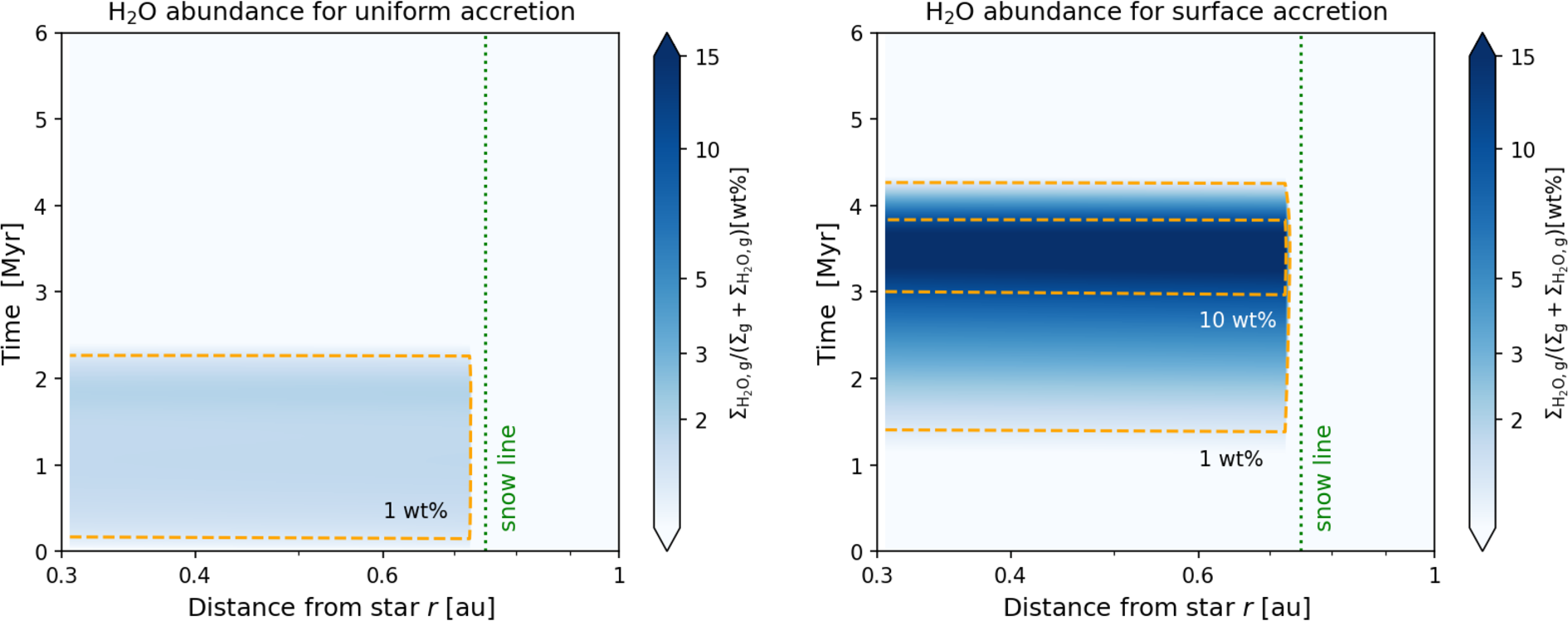
Figure 3: Temporal evolution of water vapor concentration inside the snow line, contrasting uniform and surface-accretion models; the latter attains significantly higher enrichment.
Water vapor enrichment as a function of residual disk gas mass reveals a strong anti-correlation in the surface-accretion case, while uniform accretion yields only a weak dependence (Figure 4). Additionally, the enhancement magnitude and anti-correlation strength are sensitive to dust grain stickiness: more fragile grains favor the surface accretion scenario.
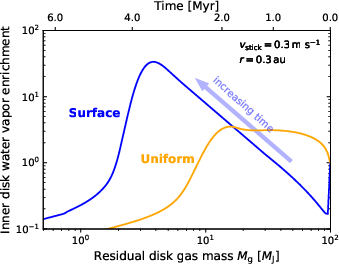
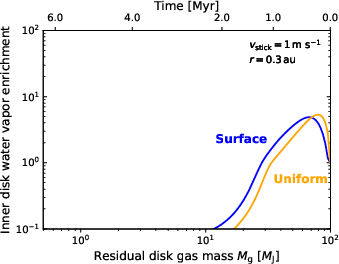
Figure 4: Water vapor enrichment at r=0.3au versus residual disk mass, showing pronounced anti-correlation for surface accretion, especially for fragile grains.
Radial profile evolution in both disk models underscores the fundamental differences in their transport regimes and chemical evolution (Figure 5).
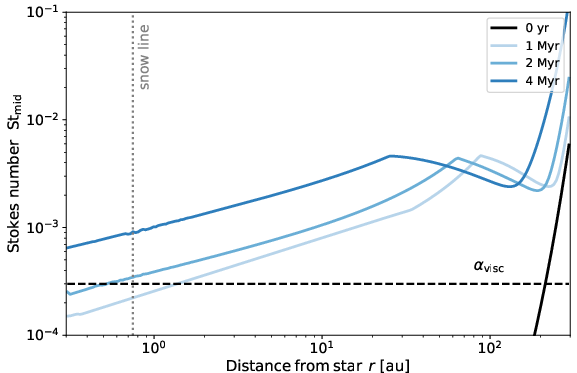
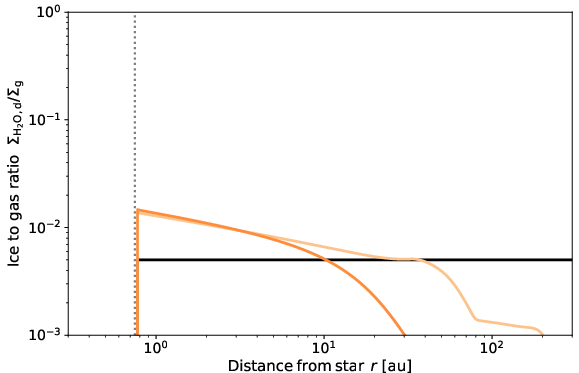
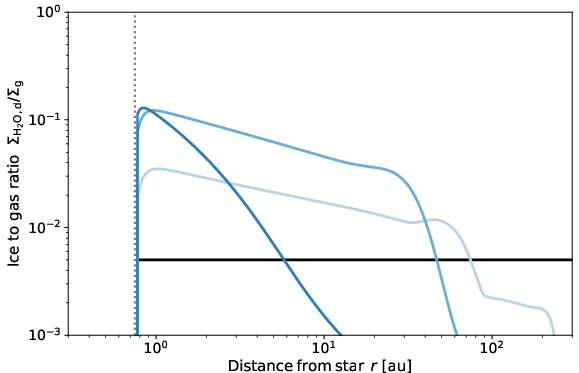
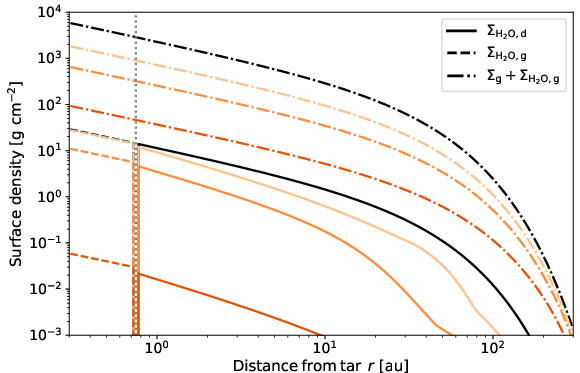
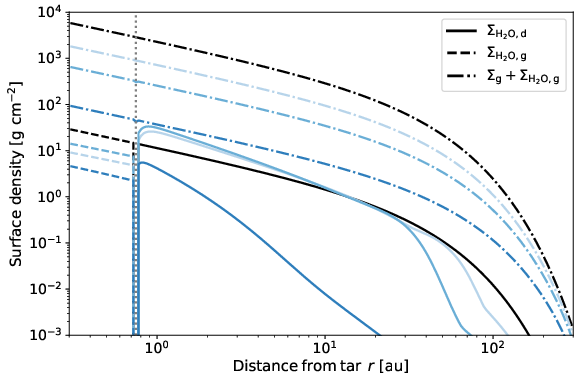
Figure 5: Evolution of radial disk profiles in uniform (left) and surface (right) accretion models, depicting changes in Stokes number, ice-to-gas ratio, and surface densities.
Theoretical and Practical Implications
The authors assert that surface gas accretion, in concert with slow drift of fragile icy grains, naturally sets up vapor-rich environments interior to the snow line. This mechanism not only achieves super-stellar enrichment levels consistent with exoplanet atmospheric measurements but also reproduces the observed mass-metallicity anti-correlation.
Key theoretical implications:
- Disk wind-driven surface accretion modifies gas-solid fractionation, decoupling dust and gas evolution.
- Planet formation in vapor-rich surface-accretion disks can explain the strong inverse relationship between atmospheric metallicity and planet mass.
On the practical side, the model provides strong guidance for interpreting infrared and submillimeter observations of disk chemistry and structure. Future observational tests may be possible via JWST's spatially resolved molecular line measurements, although radial substructures and vertical chemical gradients must be carefully modeled.
Speculation on Future Developments
- Advanced planet formation simulations incorporating surface accretion are required to quantitatively validate the predicted anti-correlation.
- Further laboratory studies on dust fragmentational properties at low temperatures may refine the dust transport assumptions.
- High-resolution, multi-wavelength observations of inner-disk vapor and pebble transport will be instrumental for empirical validation.
Conclusion
This study presents a physically motivated model for heavy element enrichment in disk gases, showing that MHD wind-driven surface accretion in disks with fragile, slowly drifting icy dust is a plausible origin for the observed mass-metallicity anti-correlation in exoplanetary atmospheres. The results reinforce the critical importance of disk vertical accretion structure and dust properties in dictating inner disk chemistry and subsequent planetary composition. These findings provide a robust foundation for future theoretical modeling and observational surveys targeting protoplanetary disk evolution and planet formation (2605.27289).