- The paper introduces an extended framework for classifying time crystals by analyzing spontaneous time-translation symmetry breaking and stabilization mechanisms.
- The study employs experimental data from superconducting qubits, trapped ions, and other quantum platforms to verify robust subharmonic dynamics and phase rigidity.
- The research implications include potential applications in resilient quantum memory and error correction as well as a roadmap for exploring nonequilibrium dynamics.
Time Crystals on Quantum Devices: Comprehensive Review and Classification
Introduction
The concept of time crystals (TCs) represents one of the central advancements in nonequilibrium quantum many-body physics. Time crystals exhibit spontaneously emerging temporal order—robust, long-lived periodic dynamics that are not simply inherited from external driving patterns. The paper "Time Crystals on Quantum Devices" (2605.27211) provides an authoritative review of the state-of-the-art in the experimental realization and classification of time crystals, especially as implemented on quantum hardware platforms. Critical to this review is the proposal of an extended framework transcending the simple discrete versus continuous time crystal dichotomy, facilitating systematic understanding of the various stabilization mechanisms and the diversity of physical realizations.
Theoretical Framework: Spontaneous Time-Translation Symmetry Breaking
A time crystal is characterized by spontaneous time-translation symmetry breaking (SτB) in many-body systems, leading to long-range temporal order that may manifest as subharmonic responses relative to the external drive. Early theoretical proposals sought equilibrium realizations but were rapidly excluded by no-go theorems. The focus shifted to nonequilibrium platforms, particularly periodically driven (Floquet) systems where SτB leads to discrete time crystals (DTCs) with periodicity nT (typically n=2) in response to driving with period T.
A minimal set of requirements for genuine many-body quantum time crystals includes:
- Spontaneous breaking of time-translation symmetry in the thermodynamic limit, evidenced by robust temporal long-range order in local observables.
- The necessity of entanglement and many-body interactions.
The review further elucidates distinctions between subharmonic response (a minimal nontrivial signature) and full phase-level rigidity, where the response is robust to perturbations, persists over a finite parameter range, and becomes infinitely long-lived as system size grows. These features sharply distinguish authentic DTC phases from transient period-doubling phenomena in finite or weakly interacting quantum systems.
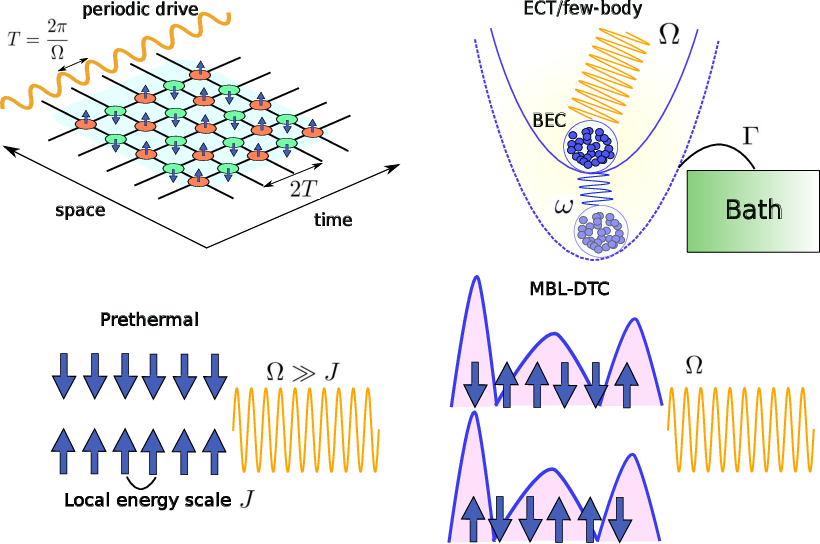
Figure 1: Illustration of DTC formation: external drive of period T yields robust subharmonic system motion with period $2T$, stabilized by mechanisms such as prethermalization or many-body localization.
Mechanisms of Ergodicity Breaking and Stabilization
Ergodicity is generically expected for isolated driven quantum systems, resulting in rapid heating and loss of any nontrivial temporal structure. Time crystal phases necessitate mechanisms to evade ergodicity, with two principal paradigms:
- Prethermal DTCs: Emergence in high-frequency driven systems where energy absorption is exponentially suppressed, leading to persistently ordered dynamics described by an effective quasi-local Hamiltonian valid for exponentially long times. Prethermal DTCs are highly sensitive to initial conditions and occur mainly for low-entropy, symmetry-broken initial states.
- Many-Body Localized DTCs (MBL-DTCs): Strong disorder and interactions lead to MBL, preventing thermalization even under periodic driving. Here, the subharmonic response arises generically from random initial states, with eigenstate order supporting robust DTC behavior even at high entropy.
Additional regimes include critical time crystals stabilized by the competition between long-range interactions and disorder, systems stabilizable by effective classical or mean-field mechanisms (e.g., BECs), and open and dissipative systems, where energy exchange with the environment can lock nonequilibrium limit cycles leading to continuous time crystals (CTCs) or boundary time crystals.
The review surveys a diverse set of quantum platforms deployed for time crystal research:
- Superconducting qubits: Offer scalability and rapid gate operations but suffer from noise and coherence limitations.
- Trapped ions: Feature long coherence times and highly controllable all-to-all or tunable-range couplings.
- Neutral atom systems and Rydberg platforms: Enable flexible geometries and scalable entanglement.
- Solid-state NV centers and nuclear spin ensembles: Achieve long-lived coherences and high-fidelity control in both ordered and disordered spatial structures.
- Photonic circuits and cavity/resonator systems: Naturally dissipative platforms suitable for open-system time crystal phases.
- BEC and magnon condensates: Exemplify many-body bosonic systems well-modeled by effective classical equations in large-N or mean-field limits.
These platforms have enabled direct physical realization and investigation of the full range of time crystalline phenomena, from purely unitary to strongly dissipative limits.
Experimental Implementations and Numerical Results
Many-Body Localized Time Crystals
The first canonical MBL-DTC experiment utilized trapped-ion arrays, observing robust period-doubling under Floquet driving with strong randomness in effective magnetic fields. Extension to superconducting qubit chains and 2D arrays (e.g., digital quantum processors) established MBL-DTC observation despite strong device noise, with clear subharmonic dynamics observed in autocorrelation measurements over multiple disorder realizations.
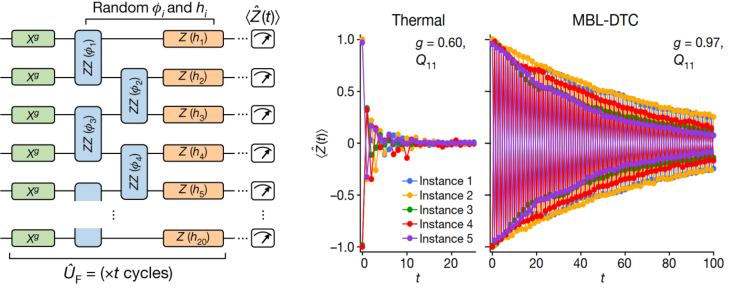
Figure 2: Gate-based implementation of an MBL-DTC using superconducting qubits, demonstrating subharmonic dynamics robust to disorder and unaffected by the initial bitstring state.
Prethermal Time Crystals
Prethermal DTCs were experimentally realized in high-frequency driven trapped-ion qubit arrays and nuclear magnetic resonance (NMR) simulators. Strong numerical evidence supports extended prethermal phases, revealing characteristic slow decay of magnetic order and subharmonic response for suitably prepared low-temperature initial states. Superconducting qubit and 3D 13C solid state systems have further verified such phases, including higher-order subharmonics (e.g., quadrupling) and extensions to qudit machines (Qutrit DTCs).
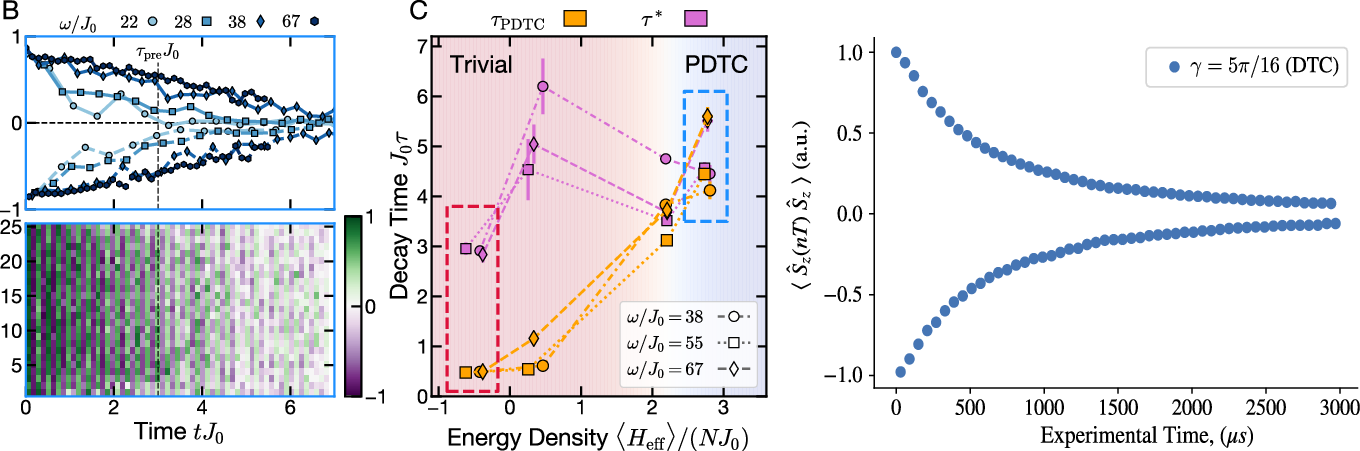
Figure 3: Prethermal DTC observation in trapped-ion and NMR platforms, showing slow magnetization decay and subharmonic stroboscopic autocorrelation signals from symmetry-broken initial states.
Classical/Mean-Field and Open-System Time Crystals
Laboratory realization of CTCs and dissipative DTCs has been achieved in bosonic condensates driven under continuous pumping (including pump-induced nonlinearities), high-Q magnonic systems, and complex spin-gas feedback networks. Distinct order parameters such as intracavity photon number or magnon population exhibit long-lived subharmonic or incommensurate oscillations, establishing the existence of time crystalline behavior in open quantum systems governed by Lindblad dynamics or effective classical equations.
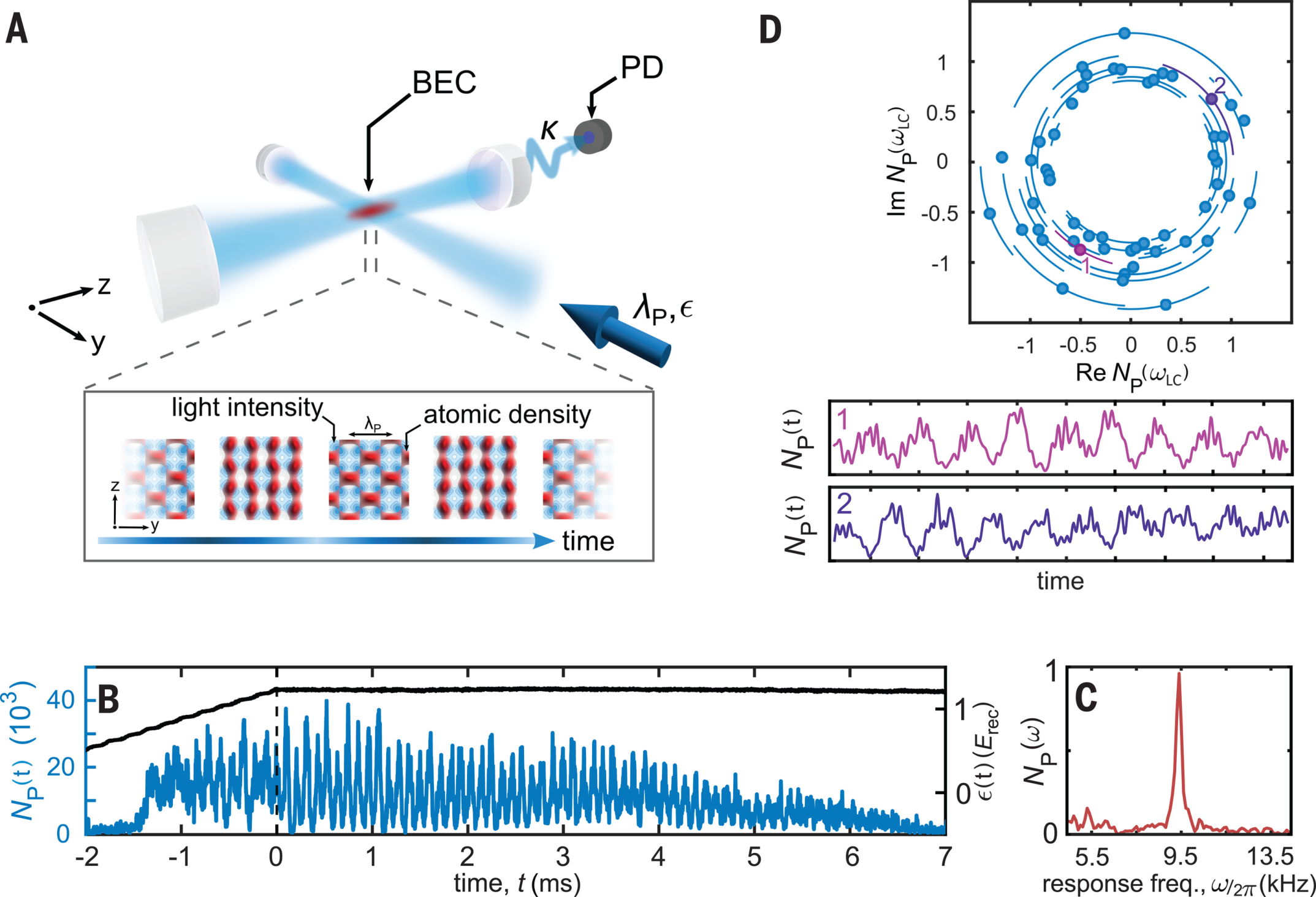
Figure 4: Observation of dissipative CTCs in BEC magnon condensates, with amplitude-pumped dynamics yielding robust subharmonic oscillations in cavity photon count as the principal order parameter.
Time Quasicrystals and Higher-Order Phenomena
Beyond strict periodicity, quasicrystal phases manifest under incommensurate (quasiperiodic) driving, yielding multiple subharmonic peaks in the system's spectrum and complex quasiperiodic order in observables. Recent superconducting qubit and NV center experiments directly measure these phenomena, including prethermal quasicrystals and time rondeau crystals featuring algebraically decaying temporal correlations under non-periodic but structured driving protocols.
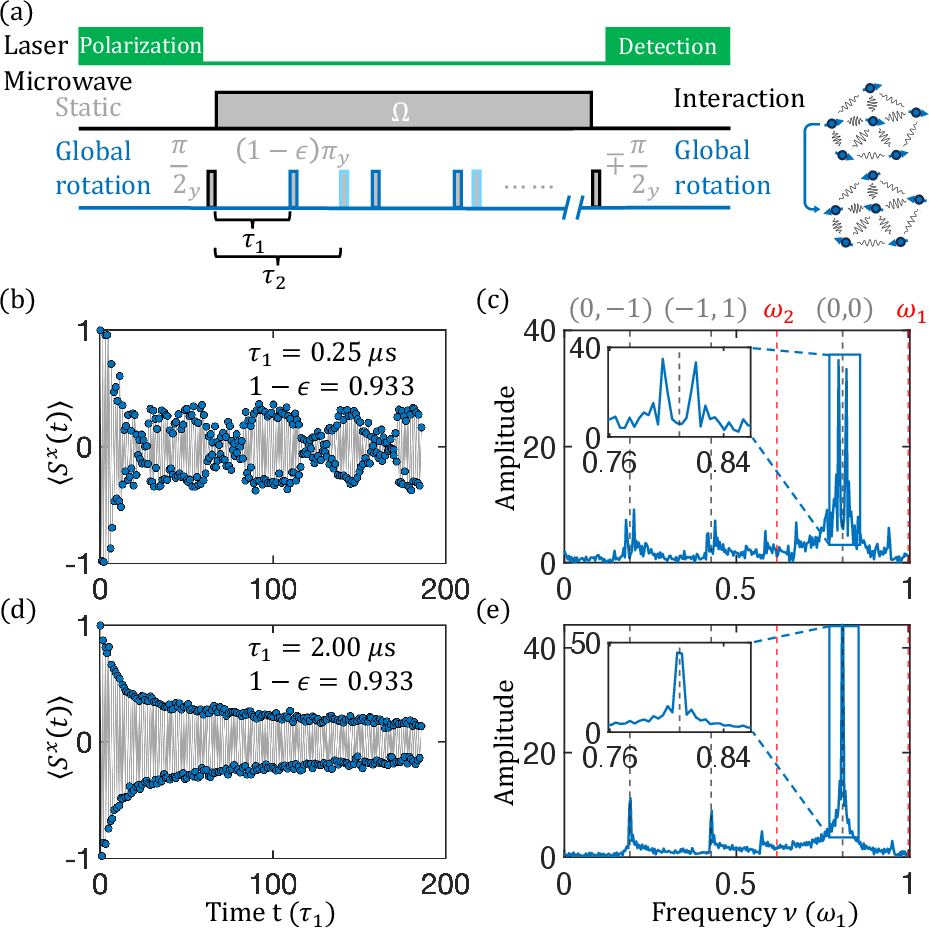
Figure 5: Discrete time quasicrystal realization with multiple non-commensurate subharmonic peaks in the Fourier spectrum, observed in driven NV center systems.
Classification Framework and Implications
The review introduces a detailed classification table (see Table 1 in the paper) cross-referencing phenomenological classes of time crystals (e.g., closed DTC, dissipative CTC, critical, controlled, topological, time quasicrystal) and their dominant stabilization mechanisms (e.g., MBL, prethermalization, ECT/few-body, or unknown/other). Significant experimental progress now covers most matrix entries, but a broad landscape remains for discovery, particularly in dissipative, topologically nontrivial, and controlled time crystal phases.
The implications are manifold:
- Practical: Quantum time crystals can be leveraged for resilient quantum memory, quantum sensing, and the development of symmetry-protected quantum information protocols. Controlled and topological TCs have particular relevance for quantum error correction architectures.
- Theoretical: The full taxonomy of ergodicity-breaking routes, their interplay, and the nature of phase transitions between different time-crystalline regimes represent frontier problems in nonequilibrium quantum dynamics.
- Technological: As quantum hardware matures, especially coherent, large-scale digital-analog platforms, the systematic engineering of time crystal phases becomes a tangible resource for quantum information tasks.
Outlook: Open Problems and Future Directions
The review identifies several promising future avenues:
- Characterization of critical regimes and universality classes of phase transitions between time crystal phases.
- Quantitative investigation of entanglement and information properties (e.g., stabilizer entropy) through time crystal transitions.
- Realization of clean DTCs, disorder-free prethermal DTCs, and higher-dimensional or qudit-based time crystals on next-generation quantum devices.
- Exploration of measurement-induced, feedback-controlled, or monitored-driven TCs as robust error-corrected objects.
- Synthesis of dissipative and topologically protected phases for quantum metrology, sensing, and memory.
Implementing these exotic dynamical phases and elucidating their properties on programmable quantum processors is poised to significantly expand both foundational and applied quantum science.
Conclusion
The experimental and theoretical exploration of time crystals on quantum devices has matured into a sophisticated, multi-faceted field. The development of a unifying classification—beyond the DTC/CTC dichotomy—to encapsulate the diverse stabilization mechanisms and physical character of realized phases facilitates a comprehensive understanding essential for further progress. Both from a quantum information perspective and as a lens into nonequilibrium quantum statistical mechanics, time crystals highlight the unique dynamical capabilities of quantum hardware, and continued advances promise both fundamental insights and near-term technological applications.

