- The paper introduces the R^(wst) statistic, a novel wavelet scattering method that mitigates tracer bias without explicit modeling to capture non-Gaussian information.
- It employs a Gaussian-process-regression emulator with subpercent interpolation accuracy validated by leave-one-out tests to reliably predict scattering coefficients.
- The method improves cosmological constraints by 30–43% over traditional two-point statistics, ensuring robust parameter inference even across varying bias regimes.
Bias-Robust Wavelet Scattering Statistics for Cosmological Constraints with Stage-IV Galaxy Surveys
Introduction and Motivation
Extracting precision cosmological information from Stage-IV galaxy surveys is fundamentally constrained by the nonlinear nature of large-scale structure (LSS) and uncertainties in tracer bias. Conventional clustering statistics such as the two-point correlation function (2PCF) are insufficient for capturing non-Gaussian information and require explicit bias models, which can lead to systematic errors when the modeling is incomplete. This paper introduces a bias-robust statistic, Rwst, constructed from m-mode ratios of the wavelet scattering transform (WST). The statistic is designed to retain cosmological sensitivity while minimizing dependence on tracer bias, circumventing the need for explicit bias modeling and improving robustness on the informative, nonlinear scales probed by next-generation surveys.
The WST provides a multi-scale, nonlinear, and interpretable representation of complex density fields; its cascade of analytically defined wavelet convolutions and modulus operations yields coefficients sensitive to higher-order and non-Gaussian information not captured by Gaussian summaries. Central to this work is the m-mode ratio statistic Rwst, computed as ratios between neighboring azimuthal wavelet modes at fixed spatial and angular scales. Since tracer bias primarily modulates the field’s amplitude, these ratios effectively cancel amplitude-driven systematics while preserving anisotropic information essential for cosmological inference.
Halo fields from the Kun and JiuTian simulation suites are employed for development, emulator training, covariance estimation, and robustness validation. Sample selection across three fixed number-density and mass-range halo catalogs enables controlled tests on sensitivity to tracer bias.
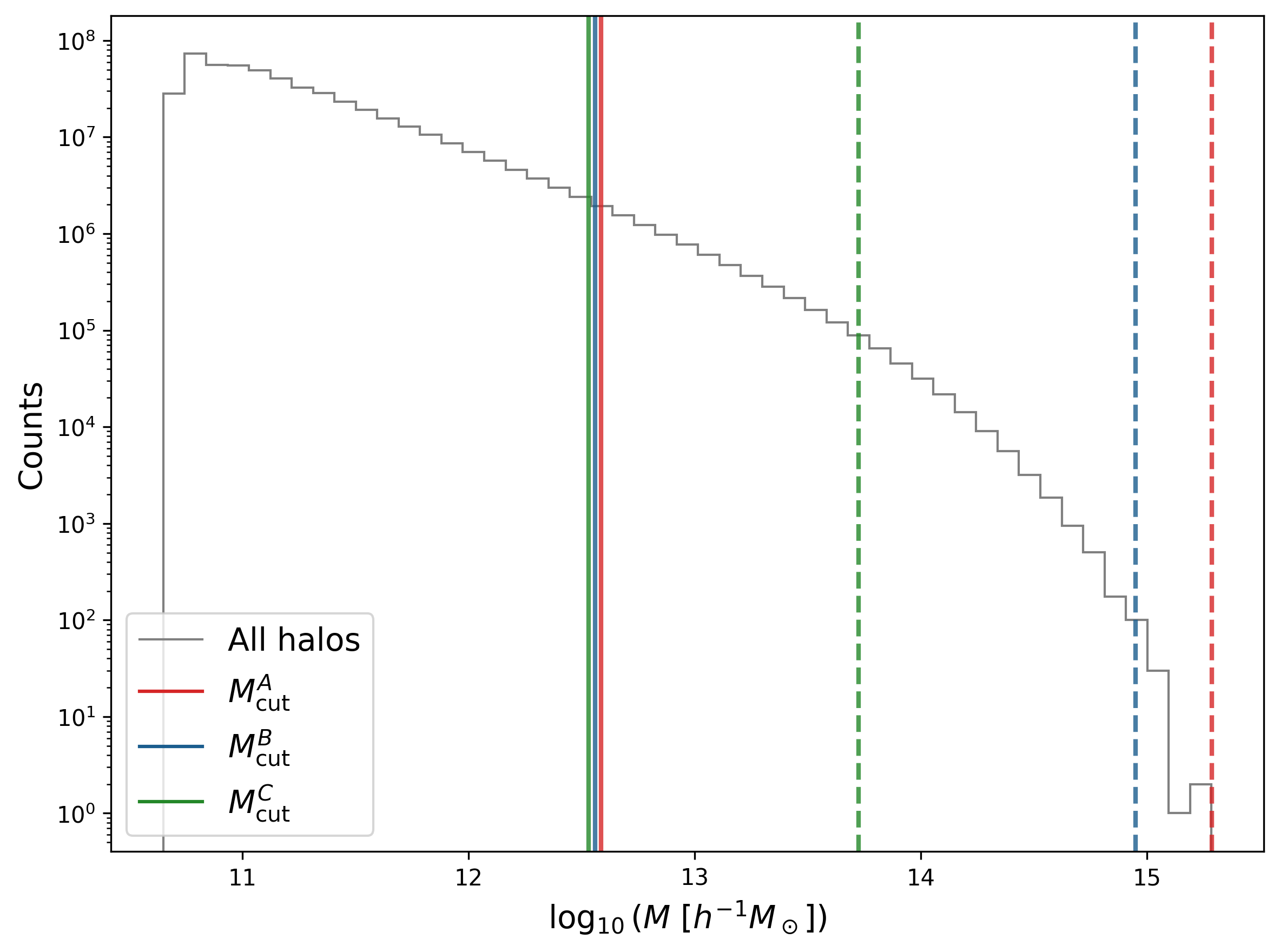
Figure 1: Mass distributions of the three mass-selected halo samples, McutA, McutB, and McutC, highlighting shifting bias regimes with identical number densities.
Emulator Construction and Validation
Given the computational infeasibility of direct simulation-based inference, the authors implement a Gaussian-process-regression (GPR) emulator for each coefficient of the Rwst data vector using the Kun simulations. Unlike PCA-compressed approaches, they directly emulate individual components, preserving interpretability and avoiding potential information loss. Cross-validation, including leave-one-out (LOO) tests, demonstrates percent-level interpolation accuracy, with prediction errors consistently subdominant relative to realistic observational uncertainties.
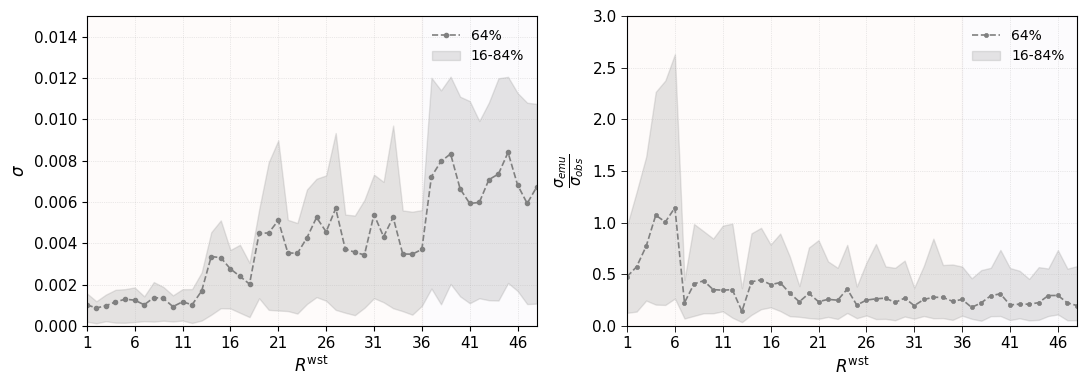
Figure 2: LOO error metrics for Rwst coefficients display subpercent prediction errors and confirm emulator reliability across physically relevant modes.
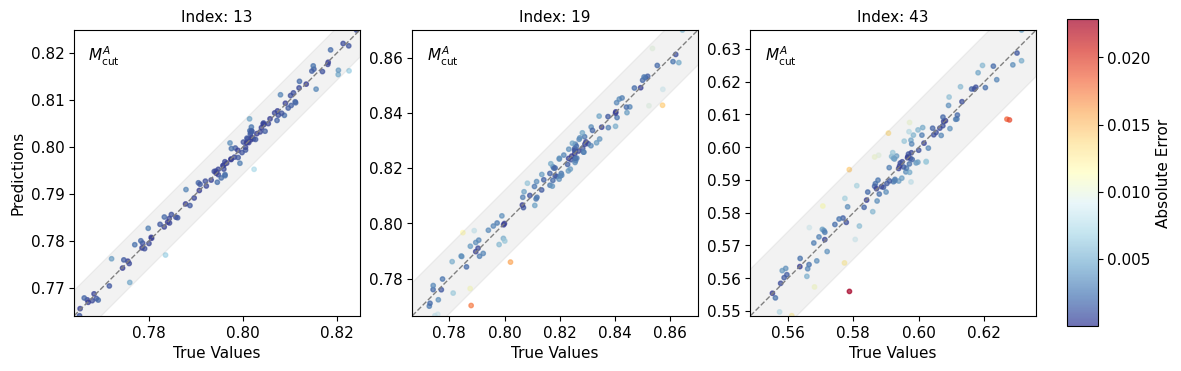
Figure 3: Scatter plots of predicted vs true m0 values from LOO cross-validation exemplify emulator accuracy for representative mode indices.
The emulator uncertainty is quantified and incorporated in the full likelihood analysis, ensuring propagation of residual interpolation errors. The covariance is estimated using subvolumes from the JiuTian simulation, and phase correction is applied via a ratio-based method, addressing fixed-phase sample variance in the training data.
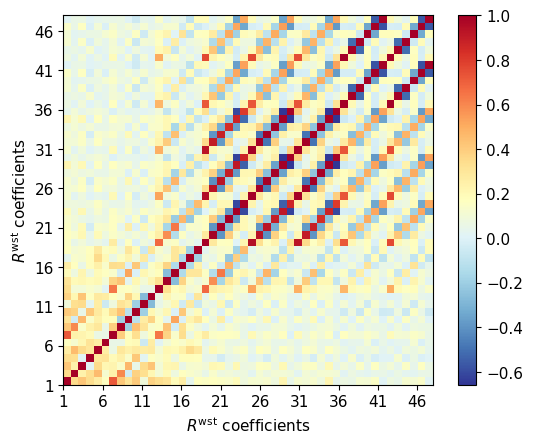
Figure 4: Correlation matrix for m1 coefficients estimated from JiuTian subvolumes; strong diagonal and hierarchical off-diagonal structure reflects complementarity between modes.
Cosmological Parameter Inference and Benchmarking
MCMC analyses are conducted by inferring cosmological parameters using mock data from Kun simulations, with the pipeline successfully recovering input cosmological values within the m2 marginalized posteriors. The typical uncertainties achieved for core parameters are m3 for m4, m5 for m6, m7 for m8, and m9 for Rwst0.
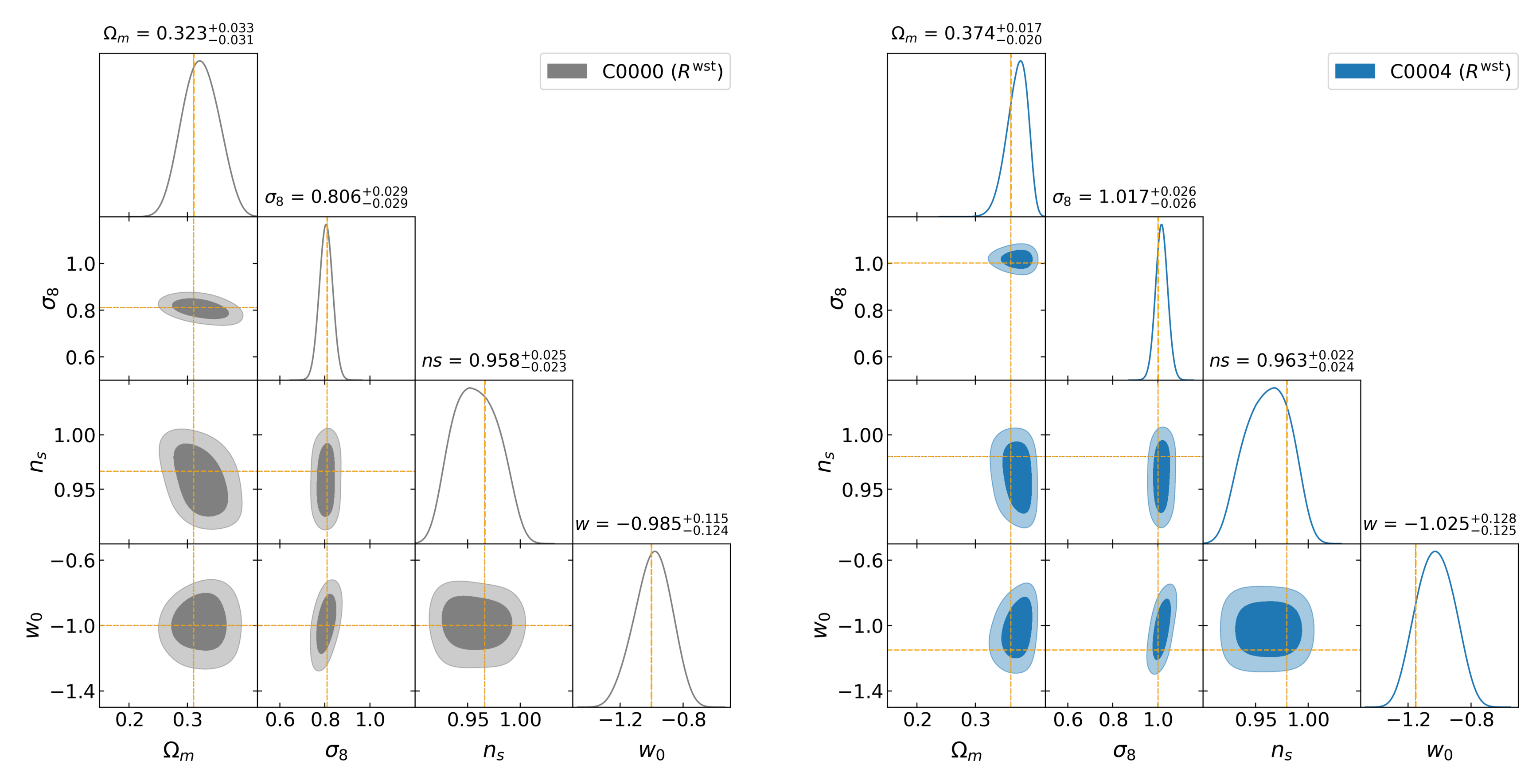
Figure 5: Posterior contours for four cosmological parameters from the Kun suite, demonstrating unbiased recovery and constraint tightness from Rwst1.
A direct comparison with 2PCF-based inference, performed on the same mock data, reveals that Rwst2 improves marginalized uncertainties by Rwst3–Rwst4 across Rwst5, Rwst6, Rwst7, and Rwst8. The joint Rwst9–m0 m1 credible contour area is reduced by nearly a factor of two (m2 for 2PCF vs m3 for m4), indicating a stronger constraint and significant degeneracy breaking beyond the two-point level.
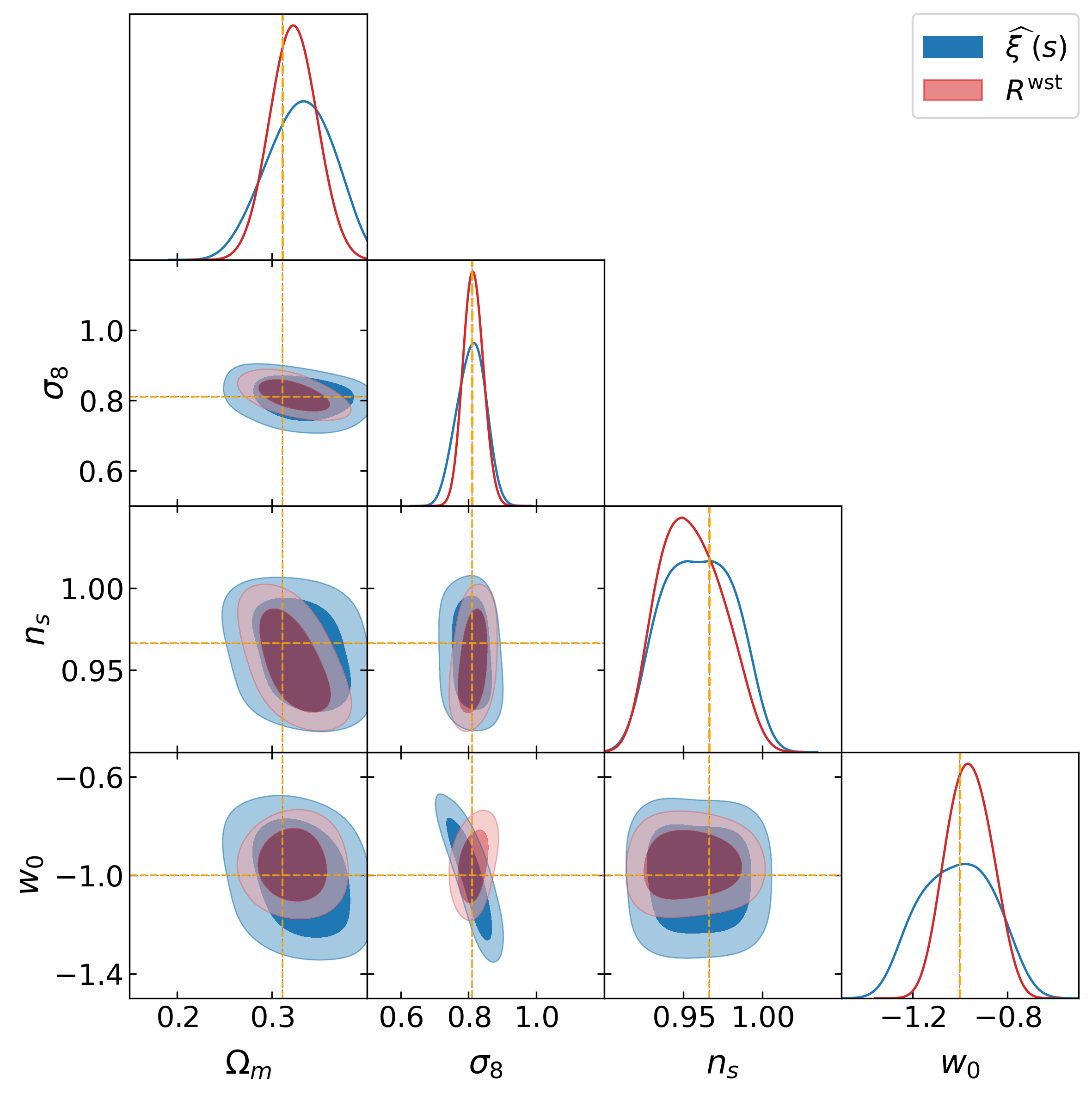
Figure 6: Marginalized posteriors from m5 and 2PCF demonstrate tighter constraints and improved degeneracy resolution with the wavelet scattering statistic.
Robustness to Tracer Bias
Bias robustness is systematically validated by applying the fixed emulator and covariance to three halo catalogs spanning different bias regimes (m6, m7, m8). The inferred values of m9, Rwst0, and Rwst1 remain statistically stable across the samples. Rwst2 shows an upward shift as bias decreases (lower halo masses), manifesting the expected partial degeneracy between amplitude and bias, but even the most extreme shift (Rwst3) remains at the Rwst4 level. The results demonstrate that Rwst5 is insensitive to systematic bias variations, supporting its utility as a bias-robust observable.
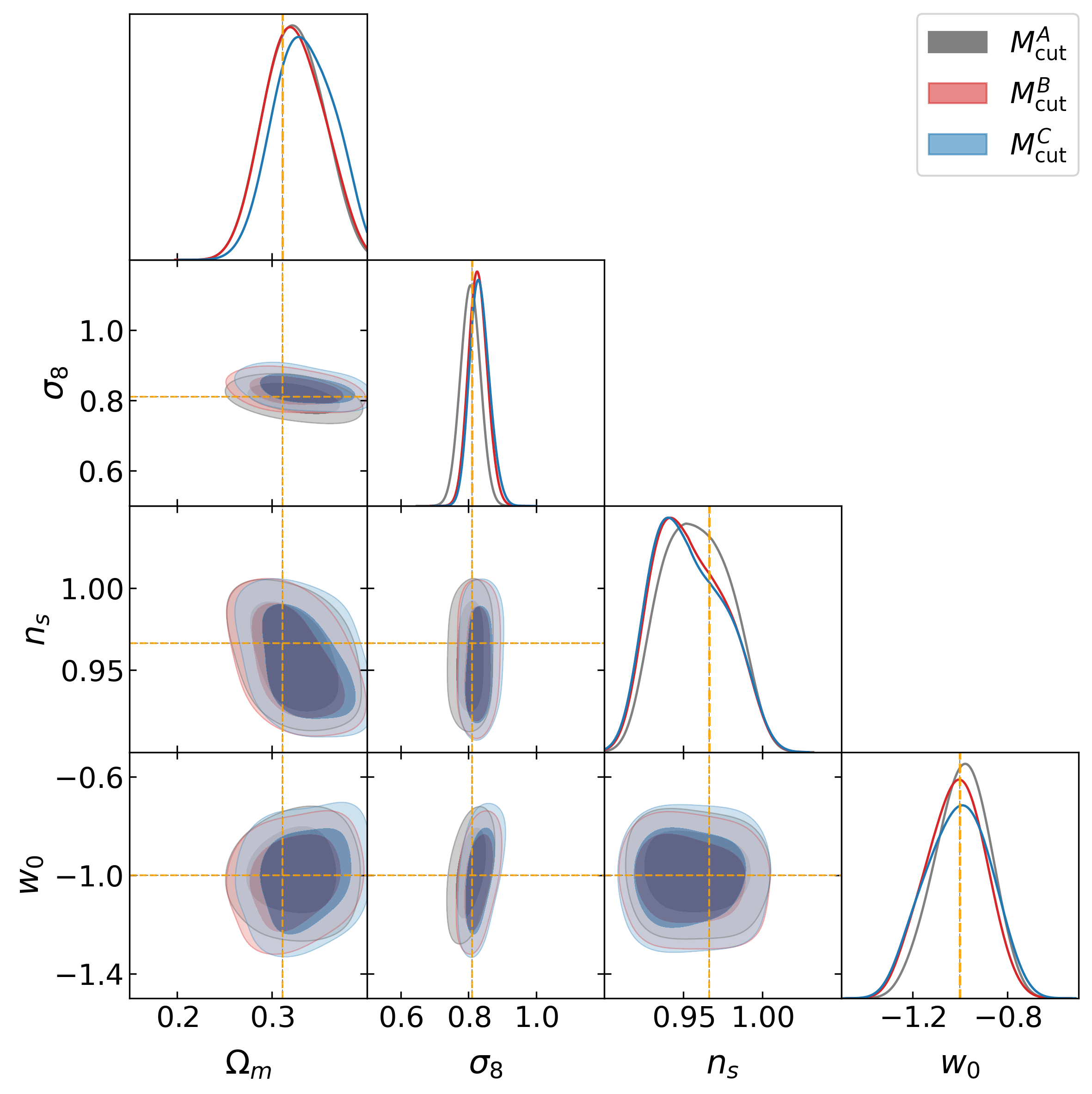
Figure 7: Posterior distributions for biased halo samples confirm the stability and robustness of Rwst6 to tracer bias, with only mild sensitivity in Rwst7.
Practical and Theoretical Implications
The Rwst8 statistic outperforms traditional two-point statistics on nonlinear scales and offers strong mitigation of bias-induced systematics. By removing the need for explicit bias modeling, the approach can significantly reduce nuisance parameter burden and systematic uncertainties in Stage-IV LSS analyses. The framework is readily extendable to alternative tracer populations and more complex observational effects.
This methodology facilitates extraction of non-Gaussian information from galaxy surveys, enhancing the ability to constrain dark energy, dark matter, and structure formation. The results underscore the theoretical value of interpretable, analytic signal transformations in cosmology—a domain often dominated by black-box machine-learning approaches.
Future enhancements could include multi-redshift analyses, survey-mask modeling, redshift-space distortions, and hybrid inference with complementary statistics. The WST-ratio framework is readily compatible with joint analyses and can be integrated with conventional methods to further tighten cosmological constraints.
Conclusion
This paper establishes the wavelet scattering Rwst9-mode ratio McutA0 as a powerful, bias-robust, and non-Gaussian statistic for Stage-IV galaxy surveys (2605.27087). The authors demonstrate percent-level emulator accuracy, unbiased cosmological parameter inference, and improved degeneracy breaking relative to standard two-point methods. McutA1 maintains stability under substantial changes in tracer bias, validating its practical efficacy in precision cosmology. Its adoption in future cosmological analyses can substantially enhance robust information extraction from nonlinear regimes, accelerating progress in observational constraints on fundamental physics.

