- The paper provides precise mass and radius measurements of 65 small planets, revealing a rocky-to-volatile transition near 6 M_E.
- The paper employs joint photometry and high-cadence RVs to map the radius valley and uncover a bimodal mass distribution in small planet populations.
- The paper demonstrates a strong planet mass–host metallicity correlation and defines optimal strategies for achieving sub-m/s RV precision.
The Small Transiting Planet Population Revealed by ESPRESSO With Extreme Precision Radial Velocities
Introduction and Program Overview
The ESPRESSO spectrograph on the VLT was explicitly designed for the precise characterization of low-mass planets via radial velocities, directly addressing the challenge imposed by the small amplitudes produced by terrestrial and sub-Neptune-mass planets. The ESPRESSO Guaranteed Time Observations (GTO) Working Group 3 (WG3) sub-program has systematically followed up on candidate small transiting planets identified by K2 and TESS, targeting objects with Rp≲2R⊕ (for rocky-planet confirmation) and up to Rp≲4R⊕ in the critical ∼50–200S⊕ insolation regime, where the rocky-gaseous transition is expected.
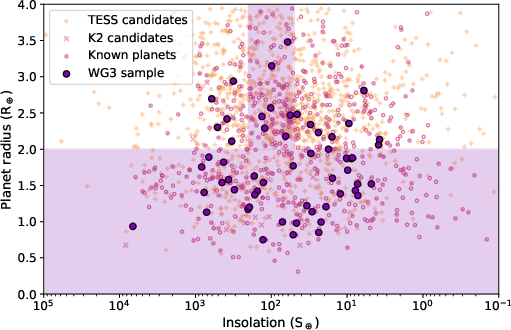
Figure 1: WG3 sample region (purple shaded areas) and individual target planets (purple circles), together with the population of confirmed and validated small planets (pink circles) and TESS/K2 candidates (orange/pink).
The sub-program observed a dynamically updated list of bright, low-to-moderate activity-hosting stars accessible from Paranal, from September 2018 to March 2023, with priority to systems not targeted with RVs by other consortia. The survey achieved the robust confirmation and/or mass measurement of 65 planets in 30 systems, with the aggregate population providing a basis for in-depth analysis of planetary structure, host properties, system architectures, and observational selection effects.
Mass–Radius–Insolation Space and Rocky-Volatile Transition
The resulting sample spans the parameter space from Mercury-like to volatile-rich planets, with robust mass-radius determinations enabled by ESPRESSO's sub-m/s RV precision, often improved further by joint model inference and multi-instrument photometry.
A primary claim is the presence, in the medium ($50$–200S⊕) insolation regime, of a tentative rocky-to-volatile transition at Mp≃6M⊕. Planets below this threshold correspond to high-density, rock/iron-dominated interiors, whereas above this mass, planets require a volatile-rich envelope, as established from joint placement on state-of-the-art composition tracks [Zeng et al. 2019, Luo et al. 2024].
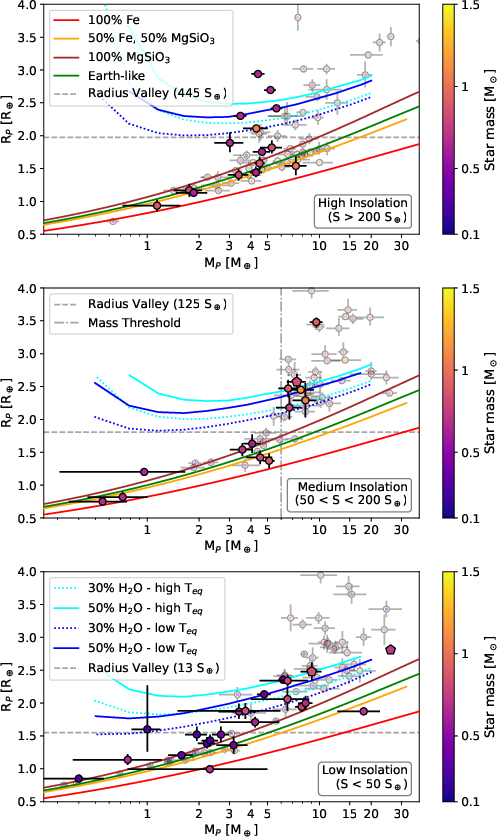
Figure 2: Mass-radius diagrams for three insolation regimes. WG3 planets (solid), PlanetS (semi-transparent), host-mass coloring, with theoretical composition model curves overlaid.
In the high-insolation regime, an additional population of stripped rocky planets extends up to Mp∼10M⊕ with no analogs at lower irradiation, consistent with photoevaporative envelope loss exposing massive cores. At low insolation, no sharp Mp threshold for envelope retention is observable, attributed primarily to the preponderance of M-dwarf hosts and related degeneracies in mass–radius–composition space.
The Radius Valley, Mass Distributions, and the Composition Bimodality
The ESPRESSO dataset enables unprecedented probing of the radius valley—the bimodal distribution and scarcity of planets around Rp≃1.7R⊕—a proxy for the transition between bare-core and envelope-bearing planets. By mapping planetary radii and insolations, and overlaying the precisely measured, insolation-dependent valley locus [Ho & Van Eylen 2023], the sample confirms:
- Below the valley, planet masses are tightly distributed (Rp≲4R⊕0–Rp≲4R⊕1), with a sharp upper cutoff at Rp≲4R⊕2.
- Above the gap, there's a broad, continuous mass distribution (Rp≲4R⊕3–Rp≲4R⊕4).
- The intersection of the population kernel densities is at Rp≲4R⊕5, coincident with the mass-composition boundary in the Rp≲4R⊕6–Rp≲4R⊕7 regime.
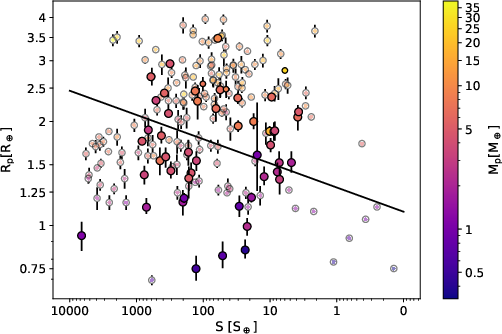
Figure 3: Insolation-radius diagram, including the insolation-dependent radius gap from Ho & Van Eylen (2023).
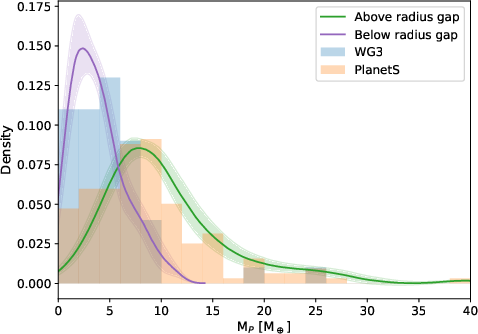
Figure 4: Kernel density estimations for the mass distributions above (green) and below (purple) the radius gap, with clear bimodality.
This refines previous claims by providing high-fidelity mass measurements, especially below the gap, where ESPRESSO delivers adequate sensitivity.
A statistically significant (p~10⁻⁵) correlation between planet mass and host metallicity is detected, modeled as Rp≲4R⊕8. Massive sub-Neptunes and super-Earths preferentially orbit metal-rich stars. This is compatible with core accretion scenarios where higher disk metallicity yields more massive cores and greater prospects of envelope accretion [Chen et al. 2025].
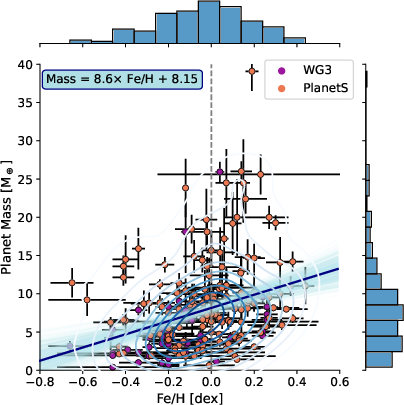
Figure 5: Stellar metallicity versus planet mass. Blue contours and regression model lines quantify the statistical correlation.
Further, by comparing the summed planetary masses in multi-planet systems to ALMA-inferred protoplanetary disk masses [Manara et al. 2023], the survey demonstrates that the planetary material often comprises a substantial fraction—sometimes the majority—of the inferred host disk mass at the epoch of planet formation. This reinforces the necessity for either high conversion efficiency, early formation, or preferential giant planet formation in atypically massive disks.
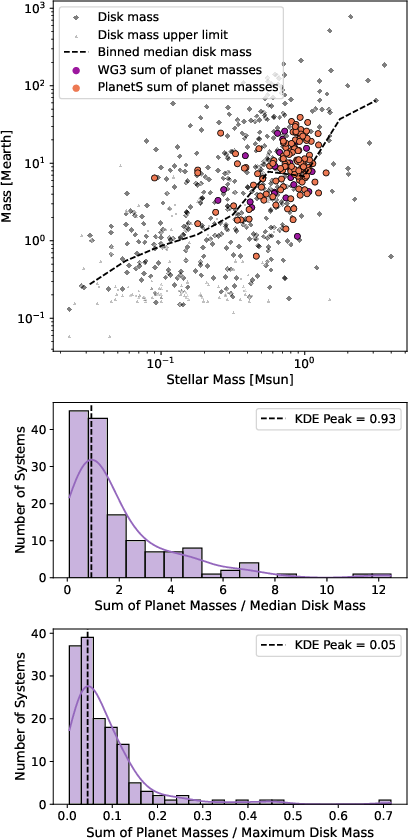
Figure 6: (Top) Host stellar mass versus cumulative planet mass per system and disk mass; (Middle, Bottom) Planet/disk mass ratios show rocky planet systems are frequently comparable to median disk masses.
System Architectures and "Peas-in-a-Pod" Regularities
The WG3 sample, dominated by compact multi-planet systems, serves as a testbed for distributional regularities. Analysis of consecutive planet pairs reveals:
- Outer planets are statistically more massive and less dense than their inner neighbors, statistically significant at p~Rp≲4R⊕9.
- Mass and radius ratios within systems show greater variability in mass than in radius, consistent with a density correlation and a possible reflection of disk-driven migration imprints or photoevaporation sequencing.
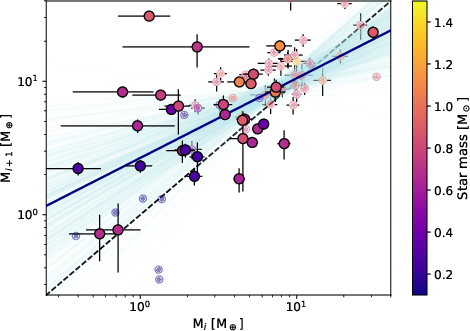
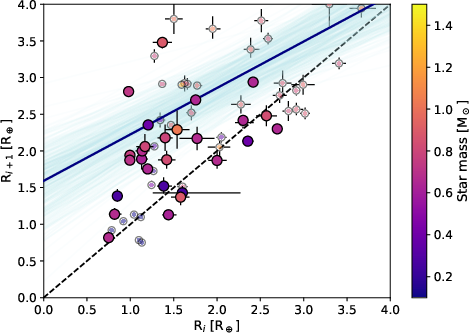
Figure 7: Mass/radius of consecutive planet pairs; the median fit line quantifies consistent trends toward higher outer mass/radius.
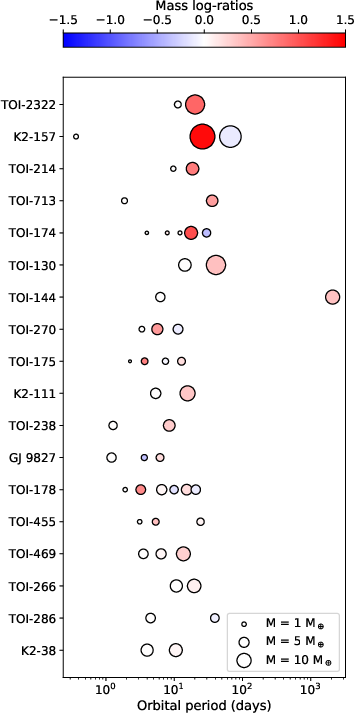
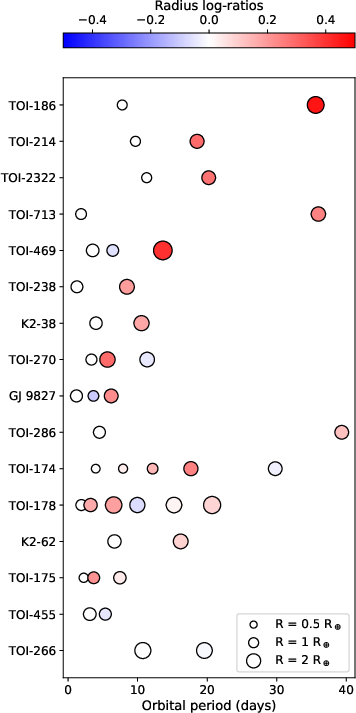
Figure 8: Visualization of mass/radius similarity orderings ("distance metrics") in multiplanet systems, illustrating larger diversity in mass than in radius.
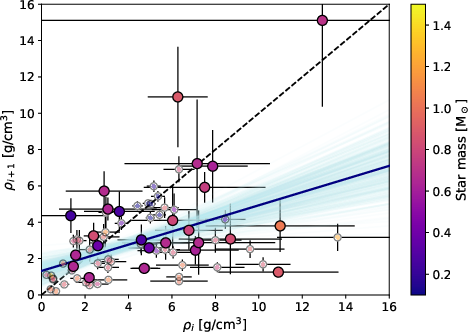
Figure 9: Densities of consecutive planet pairs, showing the systematically lower density in the outer component, especially in higher-mass host systems.
Atmospheric Characterization Potential
The Transmission and Emission Spectroscopy Metrics (TSM/ESM) have been computed for all ESPRESSO planets, revealing that approximately 22% possess sufficiently high TSM or ESM to be promising targets for atmospheric characterization with JWST or future extremely large telescopes. High TSM/ESM corresponds to optimal combinations of planet size and host brightness (in J/K). Several ESPRESSO-characterized planets dominate the population in their TSM/ESM class, such as TOI-455 c and TOI-175 b, reinforcing their strategic importance for subsequent follow-up.
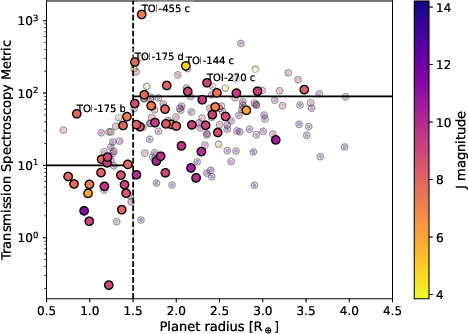
Figure 10: TSM versus planet radius for WG3 and comparison samples, highlighting planets well above the threshold for spectroscopic follow-up.
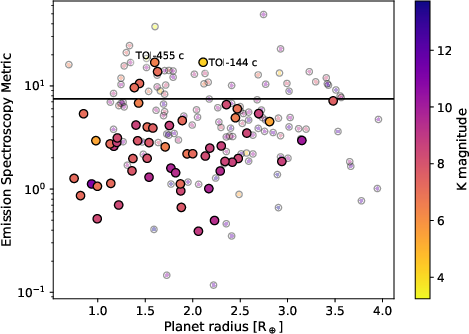
Figure 11: ESM versus planet radius, again isolating prime spectroscopic candidates by their bright host K-magnitude.
Survey Strategy, Yield, and Activity Diagnostics
WG3 strategy (focusing observations on systems with promising initial signals and relatively bright, quiescent hosts) delivers maximal RV yield per unit time. To achieve ∼500 precision in planet semi-amplitudes, a threshold of ∼501 ESPRESSO-quality RVs per target is required. Blending in lower quality (e.g., HARPS/HIRES) RVs in high-cadence/higher-activity scenarios can degrade final semi-amplitude precision, due to both instrumental offsets and increased noise contributions.
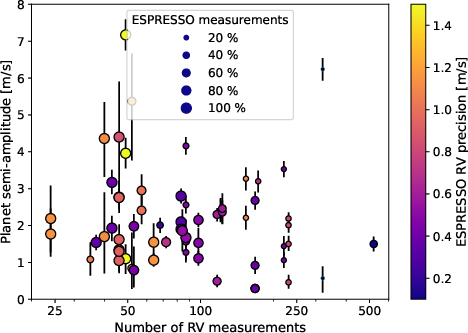
Figure 12: Semi-amplitude detection versus total number of RV measurements; point size and color denote ESPRESSO precision and measurement fraction respectively.
Precise stellar activity mitigation remains the limiting factor for characterizing the smallest planets. FWHM of the cross-correlation function is empirically the most informative RV activity indicator for the majority of targets. Despite advanced GP-based activity modeling, residual stellar jitter is typically ∼502 above ESPRESSO's photon-limited stability, confirming astrophysical noise floors well in excess of current instrument systematic floors.
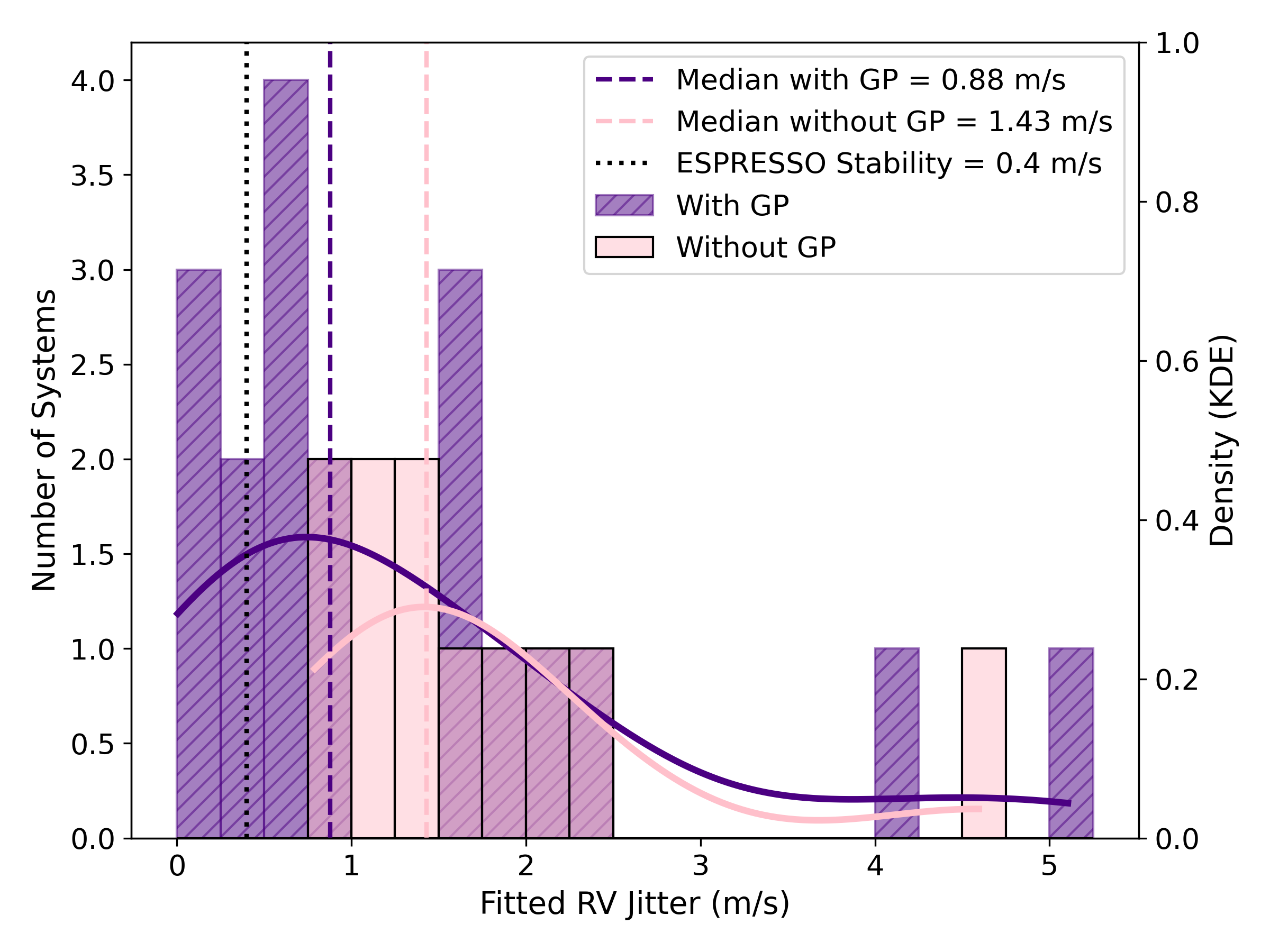
Figure 13: Distributions of fitted RV jitter for systems with/without GP-based activity modeling. A minimal achievable jitter floor is apparent, well above ESPRESSO’s raw long-term precision.
Conclusion
The ESPRESSO WG3 GTO sub-program has delivered a cornerstone population of small, transiting planets with extreme-precision RVs, enabling:
- Refined empirical determination of rocky–volatile mass thresholds (∼503 at moderate insolation).
- Quantitative mapping of the radius valley and mass bimodality with high statistical fidelity.
- Detailed evidence for mass–metallicity correlation at ∼504–∼505, consistent with core-accretion expectations and robust to heterogeneous literature metallicities.
- Direct comparison of planet-to-disk mass, implying either saturated rocky planet formation efficiency or early, massive disk stages.
- New statistical benchmarks on within-system masses/radii/densities among small planets.
- Definition of robust requirements for precision RV follow-up (measurement count/precision/activity mitigation), directly informing future missions (e.g., PLATO).
- Identification of specific high-priority spectroscopic targets poised for atmospheric study via JWST/ELTs.
The sample and corresponding analysis represent a stringent testbed for planet formation, photoevaporation, and dynamical evolution models. The residual challenges, notably stellar activity mitigation, delineate the next frontier for ultra-low-mass planet detection and precise parameter inference at the terrestrial limit.