- The paper demonstrates that conventional entanglement criteria overlook coherences between photon-number sectors, revealing the limitations of standard CV and DV separations.
- It introduces a fidelity-based witness that confirms genuine hybrid entanglement when its measured value falls below a critical bound defined by separable states.
- Experimental parameters, such as required squeezing levels in SPDC-generated macroscopic Bell states, are analyzed to enable unified quantum protocols.
Genuine Hybrid Number-Polarization Entanglement: A Technical Overview
Introduction
This paper interrogates a fundamental conceptual boundary in quantum optics: the strict separation between continuous-variable (CV) and discrete-variable (DV) entanglement paradigms. While CV entanglement is typically framed in terms of optical phase space or number correlations (e.g., squeezed state correlations), DV entanglement refers to quantum correlations among photonic degrees of freedom (DOFs) such as polarization within fixed photon-number manifolds. The authors demonstrate, both formally and operationally, that this dichotomy is inadequate for describing certain experimentally pervasive states—most notably, macroscopic Bell states (MBS)—and introduce a witness for certifying genuine "hybrid" entanglement that cannot be reduced to either the CV or DV regime alone (2605.26962).
Theoretical Framework and State Classification
The core of the discussion is the structure of SPDC-generated macroscopic Bell states. Formally, MBS are coherent superpositions spanning all photon-number sectors, constructed from pairs of two-mode squeezed vacuum (TMSV) states with polarization as the labelling DOF. The operational preparation involves generating and interfering such TMSVs, often realized in a Sagnac interferometer configuration.
The authors delineate the entanglement landscape with three convex sets:
- Sep: States that are both number- and polarization-separable.
- N: States that are number-separable, possibly entangled in polarization within fixed photon numbers.
- P: States that are polarization-separable, potentially allowing number (CV) entanglement.
States outside the convex hull of N∪P are designated as genuinely hybrid entangled, exhibiting correlations that do not admit a classical mixture decomposition into either DV or CV entanglement (Figure 1).
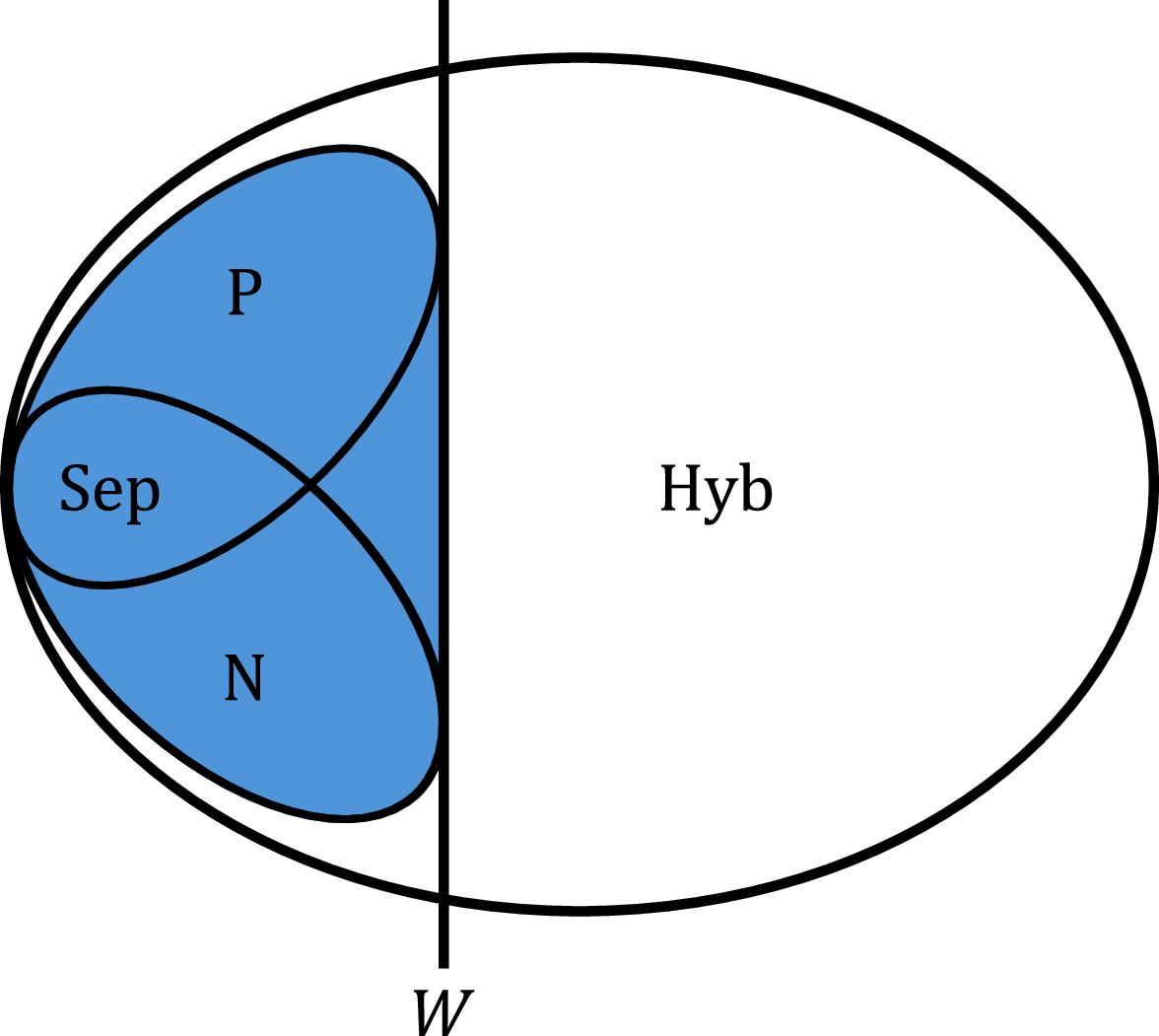
Figure 1: State space of fully separable states (Sep), number-separable states (N), polarization-separable states (P), and the hybrid-entangled set (Hyb); the witness W defines a hyperplane separating Hyb from the convex hull of N∪P.
Importantly, standard entanglement witnesses—such as Stokes operator variances or CHSH-type inequalities—are insensitive to hybrid entanglement. These traditional criteria detect entanglement that resides within fixed-N (DV) or in marginal quadrature/number distributions (CV) but are blind to coherences between photon-number sectors.
Witness Construction and Operational Criterion
To detect hybrid entanglement, the paper introduces a fidelity-based witness. The relevant operator takes the form
W=F1−∣Ψ−⟩⟨Ψ−∣
where ∣Ψ−⟩ is the MBS singlet state and F is the maximal overlap achievable by states in the convex hull of N∪P. The main criterion is:
$\langle W \rangle = \Tr(W\rho) < 0$
implying ρ is genuinely hybrid entangled.
For experimental feasibility, the bound W0 must be evaluated for accessible photon-number subspaces and for squeezing parameters corresponding to the physical source. The authors rigorously derive upper bounds for both number- and polarization-separable states as functions of the squeezing parameter W1:
- Number-separability: The maximal fidelity is set by the largest probability amplitude in a given photon-number sector, determined by the distribution W2 from the MBS decomposition.
- Polarization-separability: The maximum overlap is given by W3, reflecting that polarization product states can overlap with MBS singlets only at a W4 rate for each photon number.
Figure 2 summarizes the operational regime for the witness.
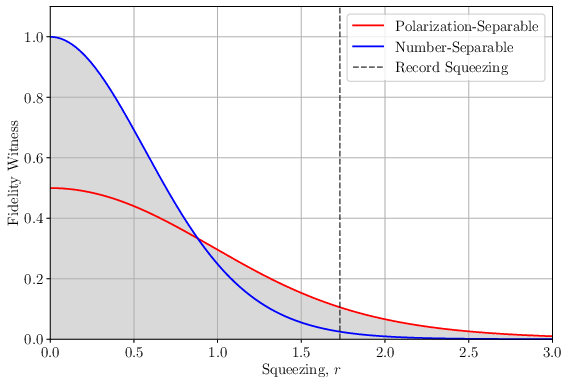
Figure 2: Scaling of the hybrid entanglement witness versus squeezing in the non-vacuum Fock sectors. Fidelity to MBS must exceed the shaded region to certify genuine hybrid entanglement; the dashed line indicates the current record for squeezing.
The analysis confirms that the required squeezing levels and fidelities are currently achievable, ensuring the practical implementability of the hybrid entanglement witness.
Implications and Extension to Higher Dimensions
The research asserts that MBS and their hybrid entanglement structure act as prototypical examples, but the framework extends to alternative internal DOFs such as time, frequency, or spectral modes. For such systems, a hybrid structure is anticipated, potentially producing entanglement that is high-dimensional in the DV domain and non-classical in the CV number domain.
This hybrid approach unifies two previously disjoint quantum optics paradigms and suggests a more fundamental, observer-independent characterization of entanglement in bosonic systems. The formalism naturally enables the design of quantum protocols—spanning computation, communication, and metrology—that can utilize the full extent of entanglement resources in mixed-mode architectures.
Moreover, the proof structure parallels the distinction between multipartite and bipartite entanglement: the inability to write a state as a mixture over CV- or DV-entangled states (analogous to mixtures over bipartitions in multipartite theory) is the operational hallmark of genuine hybrid entanglement.
Future Directions
Developing a complete axiomatic framework for hybrid entanglement remains open. A systematic generalization to more complex labelling DOFs, multipartite, and high-dimensional settings is advocated. Additionally, the possible exploitation of hybrid entanglement for error-robust quantum protocols or for leveraging both CV and DV quantum technologies in a unified platform is highlighted as a direction for applied research.
Conclusion
The paper provides a rigorous operational definition and experimental criterion for genuine hybrid number-polarization entanglement, formally unifying CV and DV quantum optics. The results demonstrate that conventional categorization is insufficient for states generated by standard SPDC-based sources and that hybrid entanglement is a resource that can now be both theoretically identified and experimentally certified. The proposed witness is compatible with state-of-the-art photonic platforms, paving the way for new hybrid quantum protocols and a deeper theoretical understanding of entanglement in optical systems.