- The paper introduces a pairwise protocol to efficiently reconstruct Liouvillian coefficients from randomized measurements with classical memory independent of system size.
- It employs a least-squares estimation using pairwise decoupling and randomized Pauli measurements to isolate one- and two-body dynamics with high statistical accuracy.
- Numerical studies demonstrate that the protocol achieves full-rank reconstruction and error saturation, ensuring scalability for large quantum systems.
Pairwise Liouvillian Learning from Randomized Measurements: Protocol Design and Scalability Analysis
Introduction and Motivation
The paper "Pairwise Liouvillian learning from randomized measurements: practical aspects and guidelines for operating the protocol in large-scale experiments" (2605.26953) presents a comprehensive review and numerical analysis of a protocol for reconstructing the Liouvillian generator of quantum many-body dynamics from randomized Pauli measurements. The authors focus on practical aspects that enable scalable operation in large experiments with up to two-body, long-range interactions and single-body noise. Unlike generic approaches, the proposed protocol efficiently isolates and reconstructs the coefficients of the Liouvillian in a pairwise manner, ensuring that classical memory requirements remain independent of system size.
The motivation for Liouvillian learning is rooted in the verification and benchmarking of analog quantum simulators (AQS), where discrepancies between the programmed and realized quantum dynamics are critical indicators for quantum advantage. Existing procedures have demonstrated scalability under locality assumptions, but practical resource allocation remains an unresolved challenge in large-scale experimental settings.
Theoretical Structure: Liouvillian Model and Pairwise Decoupling
The protocol considers qubit systems whose density matrix evolution follows the Lindblad master equation, encapsulating both Hamiltonian and dissipative (noise) effects:
dtdρ(t)=−i[H,ρ(t)]+D[ρ(t)]
The Hamiltonian H is represented in the Pauli basis, including single-qubit and two-qubit interaction terms, parameterized by $3N + 9N(N-1)/2$ coefficients. Dissipative processes are modeled as single-body Lindblad terms, which can be diagonalized to yield jump operators and their rates, associated with local and global dephasing, amplitude damping, and depolarization.
A crucial innovation is the reduction of the reconstruction task to closed linear systems on each qubit pair, exploiting commutation properties of Pauli operators. This yields a least-squares estimation system where the only relevant parameters for a pair (i,j) are the one- and two-body Hamiltonian and dissipation terms. The pairwise structure ensures that the classical memory required to store and invert the measurement matrix M is O(1) with respect to system size N. This enables protocol scalability across large qubit arrays.
Experimental Protocol: Randomized Measurement and Sampling
The experimental sequence is formalized in a pairwise randomized Pauli measurement protocol:
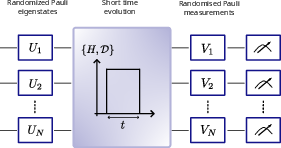
Figure 1: Pairwise Liouvillian learning experimental protocol—randomized Pauli state preparation, time evolution, and random Pauli measurements repeated for R settings, with NT time points and NM repetitions.
For each experiment, random local unitaries are applied for both state preparation (sampling from a set to cover all Pauli eigenstates) and measurement (sampling to provide H0, H1, H2 observables). The protocol uses repeated measurements to accumulate sufficient statistics, and leverages process shadows and classical shadow techniques for efficient parallelization and data extraction.
Compatible measurement settings are selected post hoc from the random ensemble, mapping subsets of bitstring outcomes to specific single- or two-body observables for each qubit pair. This design guarantees informational completeness and isolation of mixed-state preparations, overcoming systematic limitations in finite measurement budgets.
Numerical Analysis: Scalability and Rank Completion
The paper provides detailed numerical studies quantifying the probability of obtaining a full-rank measurement matrix H3 for reconstruction as a function of experimental settings H4 and system size H5. The threshold behavior observed indicates that after a critical value H6, full-rank systems are achieved with high probability:
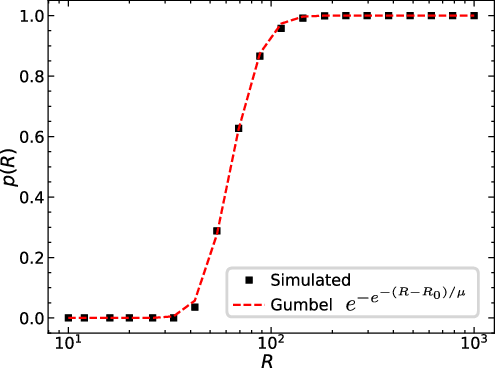
Figure 2: Probability of full rank for a qubit pair as a function of H7, fit with a Gumbel activation; full rank is achieved with probability one for H8 for H9.
Extending to full-system analysis, the threshold scales logarithmically with system size:
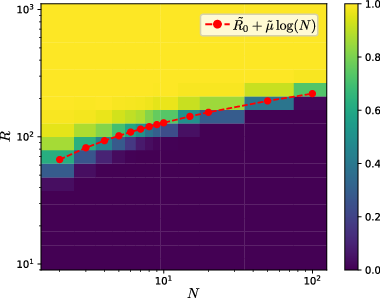
Figure 3: Probability of having full rank for all qubit pairs as a function of $3N + 9N(N-1)/2$0 and $3N + 9N(N-1)/2$1, showing logarithmic dependence and scalability.
These results confirm that the required experimental configurations grow only slowly with system size, supporting the practical feasibility of pairwise Liouvillian learning in large experiments.
Reconstruction Accuracy: Systematic versus Statistical Errors
The protocol reconstructs Liouvillian coefficients by fitting polynomial interpolations to time series of measured observables. The interplay between fitting degree and reconstruction error is meticulously studied, revealing a bias-variance tradeoff:
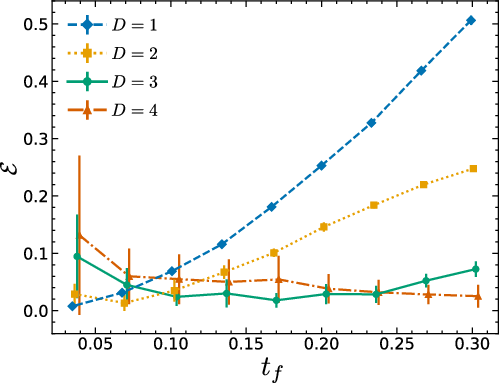
Figure 4: Reconstruction error versus maximal time and interpolation degree; bias dominates at low degrees and long times, variance at high degrees and short times.
Saturation of reconstruction errors with system size is demonstrated, indicating asymptotic independence and confirming scalability in realistic settings:
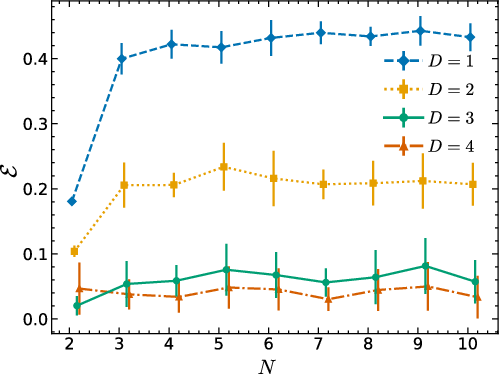
Figure 5: Reconstruction error as a function of system size and polynomial degree; error remains approximately constant beyond $3N + 9N(N-1)/2$2.
These findings provide strong numerical justification for the pairwise protocol's robustness against resource constraints, informing experimentalists on parameter selection for optimal accuracy.
The workflow for protocol deployment is further detailed, with preprocessing, circuit generation, experiment execution, and postprocessing delineated. The authors provide software tools (available via GitLab) to facilitate simulation and learning for arbitrary two-body Liouvillian models, including trotterized Hamiltonian dynamics and randomized measurement extraction.
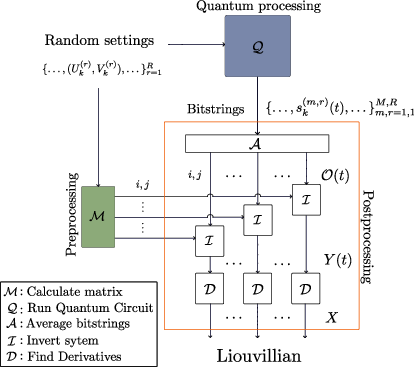
Figure 6: Schematic diagram of the learning pipeline—drawing random settings, preprocessing, quantum experimentation, bitstring acquisition, and coefficient extraction.
Empirical results with up to $3N + 9N(N-1)/2$3, millions of measurements, and reduced budgets demonstrate successful learning of both one-body and nearest-neighbor two-body coefficients, including the recovery of spatial decay laws and dissipation rates.
Practical Guidelines and Extensions
Concrete guidelines are provided for parameter choices—number of random settings $3N + 9N(N-1)/2$4, measurements per setting $3N + 9N(N-1)/2$5, time points $3N + 9N(N-1)/2$6, and polynomial degree $3N + 9N(N-1)/2$7—with benchmarking suggested for small systems prior to scaling. The protocol's simplicity and scalability facilitate several avenues for extension, including ansatz-free Liouvillian learning, time-dependent Liouvillian reconstruction, and metrology-optimized protocols (Heisenberg limit). The randomized measurement approach guarantees informational completeness, allowing relaxation of structural assumptions and regularization strategies for spatial profiles.
Conclusion
The pairwise Liouvillian learning protocol rooted in randomized measurements enables efficient, scalable reconstruction of quantum many-body dynamics, isolating relevant Hamiltonian and Lindblad coefficients with classical memory independent of system size. Detailed numerical analyses validate full-rank completion, error saturation, and practical guidelines for experimental implementation. The protocol's flexibility invites further extensions in structure discovery, certification, and metrological accuracy for quantum simulation and benchmarking.

