- The paper introduces a constrained symplectic quantization method for the free scalar field, establishing equivalence with standard Feynman path integrals.
- It details a deterministic τ-flow approach with mode-by-mode spectral analysis, numerically verifying energy conservation, propagator agreement, and canonical commutators.
- The methodology circumvents sign problems inherent in Euclidean sampling, enabling robust extraction of spectral functions, transport coefficients, and causal observables.
Constrained Symplectic Quantization for the Free Scalar Field
Introduction and Theoretical Framework
The paper "Constrained Symplectic Quantization II: The Free Scalar Field" (2605.26892) develops the constrained symplectic quantization (CSQ) framework for relativistic quantum field theory and rigorously applies it to a free scalar field in $1+1$ Minkowski dimensions. The central goal is to provide a deterministic, microcanonical sampling protocol for quantum field fluctuations, facilitating direct access to real-time (Minkowskian) correlation functions without reliance on Euclidean importance sampling or stochastic quantization.
CSQ extends symplectic quantization by embedding quantum fluctuations in an additional intrinsic time τ, with dynamical evolution governed by a non-stochastic, constrained Hamiltonian flow. Operators φ^(x) and their conjugate momenta are replaced by τ-dependent complexified fields and momenta, evolving under a real generalized Hamiltonian HSQ. Crucially, the fields and action are analytically continued to C, and explicit constraints are imposed on τ-trajectories to select dynamically stable manifolds coinciding with convergent integration cycles for the functional integral.
The paper formally establishes—through controlled limiting arguments and an explicit contour deformation correspondence—that the CSQ microcanonical generating functional is equivalent, in the continuum limit, to the standard Feynman generating functional in Minkowski signature, for any renormalizable scalar field theory. For interacting models, the equivalence extends to the full hierarchy of Dyson–Schwinger equations, with the constrained τ-flow encoding all quantum equations of motion and yielding correct contact terms.
Construction of CSQ for the Free Scalar Field
The implementation for a free real scalar field in $1+1$ dimensions proceeds via the following steps:
- The action is expressed as S[φ]=∫d2x[21(∂μφ)2−21m2φ2], analytically continued to τ0.
- The generalized Hamiltonian τ1 includes the kinetic term τ2 and the imaginary part of the complexified action.
- Mode expansion diagonalizes the dynamics; for each mode τ3, the sign of the quadratic form τ4 determines the constraint, τ5, guaranteeing bounded, oscillatory τ6-evolution.
- The constrained Hamiltonian dynamics is simulated numerically via a symplectic leapfrog integrator, with repeated spectral projection to compensate for numerical leakage across the stability boundaries.
The analytic structure of the CSQ approach ensures that the microcanonical τ7-averages correspond to path-integral averages over a rotated contour in the complexified field space, enforcing convergence via mode-dependent τ8 rotations.
Numerical Results and Verification
Energy Conservation and Stationary Regime
The paper documents precise conservation of the generalized Hamiltonian and equipartition between kinetic and potential energies along long τ9-trajectories in the stationary regime.
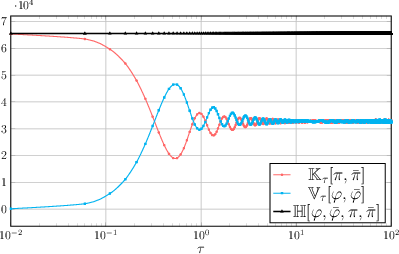
Figure 1: Time evolution of the kinetic and potential energy for the free scalar field, evidencing conservation and stabilization of the symplectic trajectory.
Momentum-Space Propagator Agreement
The symplectic φ^(x)0-averages yield two-point functions in momentum space matching the analytic lattice prediction for the free scalar propagator. Only the imaginary part (Feynman weight) remains after averaging, as expected.
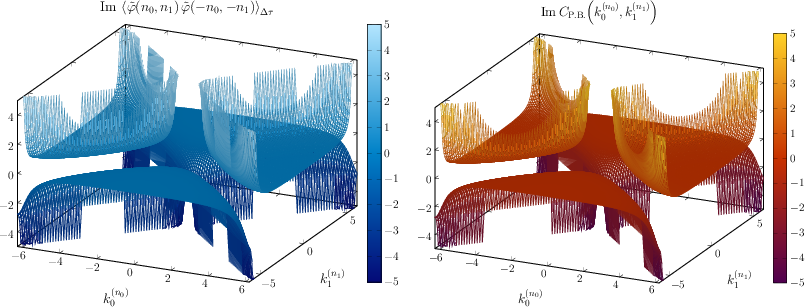
Figure 2: Numerically measured imaginary part of the momentum-space propagator under periodic boundary conditions against exact analytic prediction, confirming pole structure.
Marginalizing the two-point correlator over spatial coordinates and projecting onto zero momentum, the oscillation frequency yields the mass gap φ^(x)1 directly.
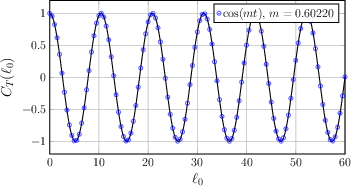
Figure 3: Temporal correlator projected onto zero spatial momentum; oscillation frequency identifies the propagator pole and mass gap.
Similarly, spatial marginalization at zero frequency demonstrates exponential decay with decay rate controlled by φ^(x)2.
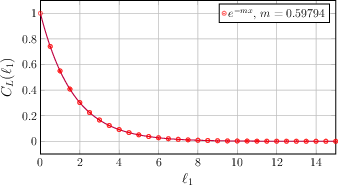
Figure 4: Spatial correlator at zero frequency exhibiting exponential decay; mass gap extracted from spatial profile.
Canonical Commutator and Uncertainty Principle
A canonical commutation relation is calculated from φ^(x)3-averaged symplectic dynamics. The extracted commutator magnitude matches φ^(x)4 with no free parameters, validating the preservation of quantum mechanics' uncertainty structure.
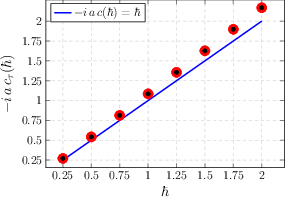
Figure 5: Numerical extraction of φ^(x)5 for various φ^(x)6, consistent with canonical equal-time commutation.
CSQ φ^(x)7-evolution reproduces the field-theoretic Dyson–Schwinger hierarchy, including contact terms at coincident points. The equation-of-motion estimator and one-insertion estimator conform to theoretical expectations.
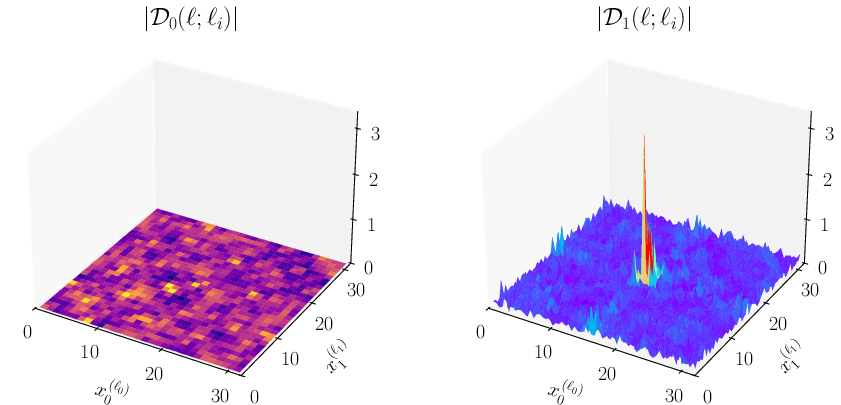
Figure 6: Equation-of-motion estimator vanishes everywhere; one-insertion estimator produces localized contact term at insertion site, confirming lattice implementation of Dyson–Schwinger equations.
Spectral and Causal Dynamics via Initial-Value Boundary Conditions
By manipulating initial field profiles and boundary conditions:
- Uniform initial fields isolate the Neumann zero mode, and the corresponding mode autocorrelator yields precise mass-gap extraction.
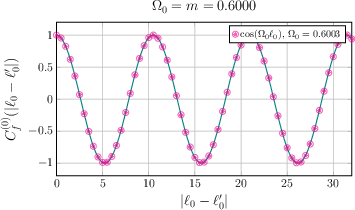
Figure 7: Uniform initial slice excites zero mode, enabling clean mass-gap measurement via projected correlator oscillation.
- Single-mode preparations confirm the lattice dispersion relation mode-by-mode, providing direct numerical spectroscopy.
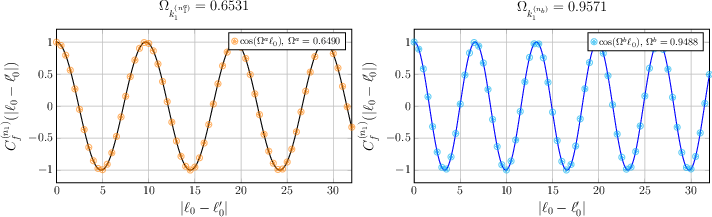
Figure 8: Mode-by-mode extraction matches theoretical lattice dispersion relation, validating frequency structure in CSQ dynamics.
- Localized initial pulses propagate causally, generating spatial-temporal correlators within the light cone, obeying continuum predictions.
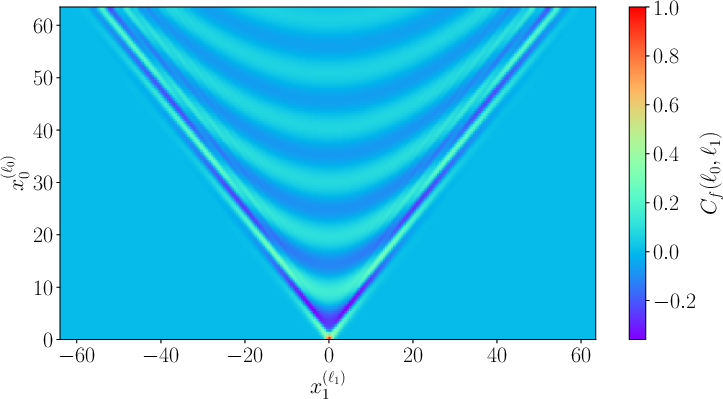
Figure 9: Heatmap of causal propagation for localized excitation; correlation peaks within the causal region.
Comparison with the exact Bessel-function solution for the massive continuum field confirms invariant collapse and mass extraction inside the light cone.
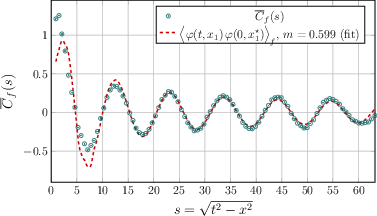
Figure 10: Averaged correlator inside the light cone follows continuum Bessel-function expectation; best-fit mass consistent with input parameter.
Practical and Theoretical Implications
CSQ provides stable deterministic access to real-time Minkowskian observables—directly on the lattice—for quantum field theories. This circumvents sign problems inherent to Euclidean importance sampling and stochastic quantization, with possibility for extension to interacting field theories, gauge systems, and condensed matter non-equilibrium dynamics. The method enables extraction of spectral functions, transport coefficients, scattering amplitudes, and resonance physics in finite volume for strongly coupled systems.
The deterministic φ^(x)8-flow approach, grounded in microcanonical statistical mechanics and analytic continuation, allows the definition of quantum averages via time-sampled ergodicity, making it robust to the pathologies and instabilities of previous symplectic and stochastic quantizations. The contour deformation correspondence to Lefschetz-thimble integration establishes a conceptual bridge to modern sign-problem mitigation strategies, but at a more fundamental dynamical level.
Conclusion
The work rigorously demonstrates that, for a free scalar field, constrained symplectic quantization delivers equivalence with the Feynman path integral in real-time Minkowski space, including correlation functions, commutator structure, and Dyson–Schwinger hierarchies with contact terms. The numerically robust, deterministic CSQ protocol exhibits strong agreement with analytic predictions for both spectral and causal observables. Extensions to interacting theories, lattice gauge models, and non-equilibrium condensed matter systems are motivated, with broad implications for computational quantum field theory and quantum statistical mechanics.