Attractors in a Generalized Relativistic Second Order Spin Hydrodynamics
Published 26 May 2026 in hep-ph | (2605.26728v1)
Abstract: We investigate the attractor of spin density in relativistic spin hydrodynamics using Zubarev's non-equilibrium statistical operator formalism in the spin probe limit. We derive the (0+1)D Bjorken flow equations and the associated attractor equation while retaining second order gradient corrections in the relevant relaxation constitutive equations including couplings associated with nonlinear response and nonlocal memory effects. We analyze the early time fixed point structure and analytically determine the early time attractor solution, thereby clarifying branch selection and the role of different dynamical corrections. We find that source-like driving terms modify the leading correction to the attractor solution without changing the fixed point structure, whereas self feedback terms involving the rotational stress tensor modify the dominant balance and modify the early time fixed point structure. We further study the late time asymptotic behavior in the conformal limit and show that the newly added terms affect the first subleading asymptotics without changing the leading late time branches. These results provide a unified picture of early and late time attractor dynamics in the conformal limit.
The paper formulates a generalized second-order spin hydrodynamic framework using the Zubarev NESO formalism to capture attractor dynamics and branch selection under Bjorken flow.
It derives attractor equations that incorporate nonlinear spin-vorticity coupling, nonlocal memory effects, and corrections from dissipative and rotational stress channels.
Numerical analysis validates the framework, demonstrating how second-order corrections control early-time fixed points and late-time asymptotics critical for modeling QGP spin polarization.
Attractor Phenomena in Generalized Second Order Relativistic Spin Hydrodynamics
Conceptual Foundations
The manuscript "Attractors in a Generalized Relativistic Second Order Spin Hydrodynamics" (2605.26728) presents a rigorous analysis of attractor dynamics in spin hydrodynamics within the Zubarev NESO formalism, emphasizing the (0+1)D Bjorken flow. The context is motivated by the substantial spin polarization observed in heavy-ion collisions, especially the global Λ hyperon polarization and associated QGP vorticity phenomena. While the attractor paradigm has reshaped modern hydrodynamic modeling by sidestepping strict reliance on gradient expansions, its implications for spin hydrodynamic variables have hitherto been less explored.
The authors construct a generalized second-order spin hydrodynamic framework, systematically extending prior analyses of minimal causal models [Wang:2024afv] to include nonlinear response and nonlocal memory effects characteristic of Zubarev NESO-based constitutive equations. This approach encompasses spin relaxation and vorticity coupling and introduces additional dissipative and rotational stress channels beyond standard hydrodynamic conservation laws.
Derivation of Attractor Equations
The starting point is the set of conservation laws for charge, energy-momentum, and total angular momentum, decomposed in a canonical-like pseudogauge into ideal and dissipative contributions. Focusing on the spin probe regime (vanishing charge densities and chemical potentials), the equations are specialized to the Bjorken symmetry in Milne coordinates. The spin density evolution equation simplifies, with only the longitudinal (Sxy) polarization retained under symmetry constraints.
The key reduction yields: ∂τS+τS+2ϕ=0
where ϕ≡ϕxy represents the rotational stress tensor's longitudinal component. The second-order constitutive equation for ϕ contains both source-like (spin-vorticity coupling and expansion corrections) and self-feedback (rotational stress memory) terms: ϕ+τϕ∂τϕ=2γχωS+γϕθϕ+2γpΓθχωS
with relevant transport coefficients expressed via correlation functions and susceptibility scaling.
Upon nondimensionalization using the Knudsen number w=τ/τϕ, the spin decay rate attractor function f(w) is introduced: f(w)≡3S2wdwdS
yielding a second-order ODE for f(w) parametrized by dimensionless combinations Sxy0, Sxy1, Sxy2 (encapsulating microscopic relaxation and coupling strengths).
Early Time Fixed Point Analysis
A dominant-balance analysis exposes the early time (Sxy3) fixed-point structure:
Minimal and homogeneous second-order models admit double fixed points Sxy4.
The positive branch Sxy5 yields a regular attractor solution:
Sxy6
Source-like driving contributions (Case B) do not alter fixed points but modify the leading correction:
Sxy7
Self-feedback contributions (Case C) reorganize the fixed point structure:
Sxy8
with the selected branch for Sxy9 remaining ∂τS+τS+2ϕ=00 and the correction:
∂τS+τS+2ϕ=01
Early time regularity selects the positive branch, consistent with physical dilution of spin under Bjorken expansion. The hierarchy of corrections is synthesized in the table summarizing fixed points, selected branches, and leading corrections.
Late Time Hydrodynamic Asymptotics
The late time (∂τS+τS+2ϕ=02) attractor asymptotics are dominated by the minimal causal structure: ∂τS+τS+2ϕ=03
with ∂τS+τS+2ϕ=04 and ∂τS+τS+2ϕ=05 receiving contributions from source and self-feedback terms: ∂τS+τS+2ϕ=06
The amplitude scales as: ∂τS+τS+2ϕ=07
For ∂τS+τS+2ϕ=08, the asymptotics transition to exponentially damped oscillatory branches, indicating the attractor's sensitivity to transport coefficients.
Source driving and self-feedback terms modify only the subleading asymptotics; the leading branches remain fixed, underscoring their closure-dependent subtlety.
Numerical Analysis and Dynamical Branch Selection
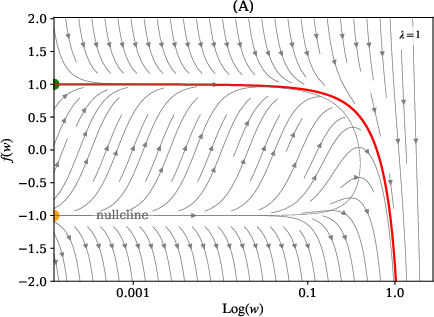
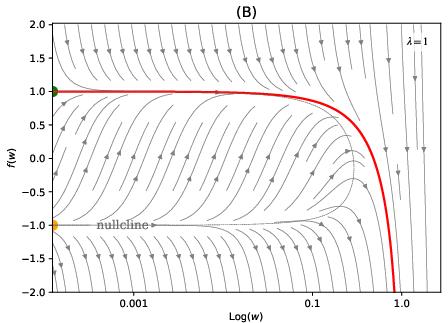
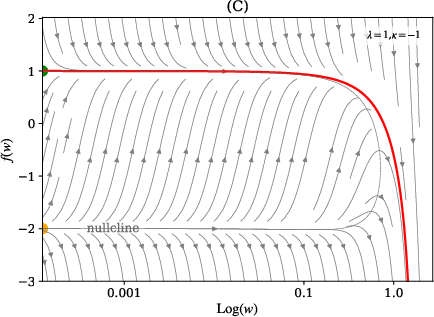
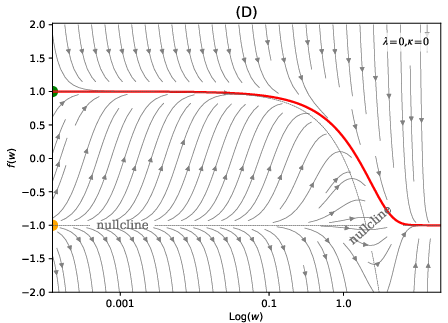
The numerical evolution is plotted in phase space for Cases A, B, and C (Figure 1).
Figure 1: Attractor solutions for Case A, B, and C. Arrows show the flow fields, red solid curves denote attractors, and filled circles mark fixed points. Cases A and B depend on ∂τS+τS+2ϕ=09, whereas Case C depends on ϕ≡ϕxy0 and ϕ≡ϕxy1.
The analysis confirms that Case C (self-feedback) shifts the early time repulsive fixed point—demonstrating that second-order corrections in NESO spin hydrodynamics can qualitatively reorganize transient dynamics. Conversely, source-like corrections (Case B) leave fixed points unchanged but affect the approach rate. At large ϕ≡ϕxy2, all cases exhibit exponential damping, distinguishing them from persistent tails in the homogeneous relaxation/ideal limits.
Implications and Outlook
This work provides a formal framework for attractor identification and branch selection in second-order spin hydrodynamics, rigorously characterizing the impact of various dynamical corrections. The results clarify that:
Second-order relaxation terms are critical for physically relevant branch selection, controlling universal loss of initial condition memory in the spin sector.
Source terms (spin-vorticity, expansion) and self-feedback (rotational stress memory) affect attractors differently: the former modifying corrections about fixed points, the latter reorganizing the fixed point structure.
Late time asymptotics evidence closure-dependent sensitivity only in subleading behavior, preserving dominant branched damping.
Practically, these findings guide the modeling of spin polarization observables in heavy-ion collisions, emphasizing the necessity to consider full closure structures for predictive hydrodynamic simulations. Theoretically, they bridge microscopic transport coefficient constraints and hydrodynamic universality, paving the way for future multi-component attractor analyses and integration with chiral kinetic frameworks.
Conclusion
The manuscript systematically extends spin attractor theory to incorporate generalized second-order corrections in relativistic hydrodynamics. It rigorously demonstrates that early and late time attractor structures can be explicitly mapped, with well-defined selection and correction mechanisms governed by closure-dependent terms. These results have both practical significance for modeling QGP spin polarization and foundational implications for nonequilibrium hydrodynamics of angular momentum carrying degrees of freedom.
“Emergent Mind helps me see which AI papers have caught fire online.”
Philip
Creator, AI Explained on YouTube
Sign up for free to explore the frontiers of research
Discover trending papers, chat with arXiv, and track the latest research shaping the future of science and technology.Discover trending papers, chat with arXiv, and more.