- The paper introduces a dual-scaffold approach combining 2D Gaussian surfels and sparse SDF voxels to enhance both photometric quality and geometric accuracy.
- The paper employs explicit and implicit tethering mechanisms to keep Gaussian primitives near the surface, effectively eliminating floating artifacts.
- The paper achieves state-of-the-art reconstruction on indoor datasets with a 9× speed improvement compared to global SDF-guided methods.
Gaussian-Voxel Duet: Dual-Scaffolding Hybrid Representation for Fast and Accurate Monocular Surface Reconstruction
Introduction
Monocular multi-view 3D surface reconstruction remains a persistent challenge, particularly when reconciling high-fidelity geometry with rendering efficiency. While recent point-based approaches like 3D Gaussian Splatting (3DGS) achieve fast, realistic novel view synthesis, their geometric reconstructions often suffer from floating artifacts and imprecise surfaces owing to the shape-radiance ambiguity under monocular supervision. Extensions that regularize Gaussians with neural Signed Distance Fields (SDF) improve surface accuracy but introduce substantial computational cost due to dense, global SDF optimization.
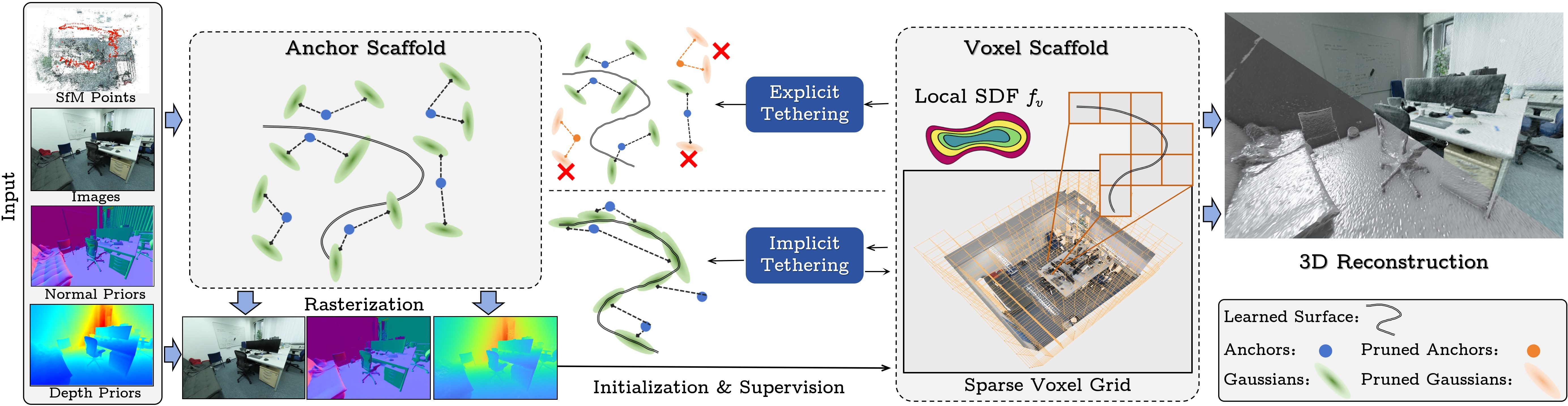
"Gaussian-Voxel Duet: A Dual-Scaffolding Hybrid Representation for Fast and Accurate Monocular Surface Reconstruction" (2605.26616) addresses this trade-off. The paper proposes a hybrid dual-scaffold approach that synergistically combines an anchored 2D Gaussian surfel scaffold for appearance with a sparse local SDF voxel scaffold for geometry, coupled via explicit and implicit tethering mechanisms. This design restricts Gaussian primitives to a surface-proximal band defined by the SDF, eliminating outliers without compromising photometric quality. The method consistently achieves state-of-the-art geometric and photometric performance on diverse real-world indoor datasets and demonstrates substantial efficiency gains over prior SDF-guided approaches.
Methodology
The core framework constructs a dual representation of the scene:
Mutual Tethering
To tightly couple the scaffolds, the paper introduces two surface-aware regularization mechanisms:
Optimization Objective
Anchor scaffold optimization incorporates photometric, depth, and normal priors, with monocular cues used for warm-up and annealed over time. Voxel scaffold optimization includes color, depth, normal, and Eikonal losses. The total objective is the sum of anchor, voxel, and tethering losses, with negligible sensitivity to hyperparameter choices.
Mesh extraction is direct: Marching Cubes applied to the local SDF, yielding watertight meshes. Unlike multi-stage TSDF fusion pipelines used by baselines, this is efficient and robust.
Experimental Results
Comprehensive experiments on ScanNet++, ScanNetv2, and DeepBlending datasets validate the approach.
Surface Reconstruction
Quantitatively, the method outperforms implicit (MonoSDF, Ash), explicit (2DGS, GeoSVR, PGSR), and SDF-hybrid (GSDF, GS-Pull) baselines on all geometric metrics (accuracy, completeness, precision, recall, F-score).
- On ScanNet++: highest F-score (0.842), recall (0.890), and precision (0.805).
- On ScanNetv2: highest F-score (0.785), with strong robustness to noisy initialization and motion blur.
Qualitatively, reconstructions display superior global and local structure, with clean, artifact-free geometry even in textureless and large-scale scenes.
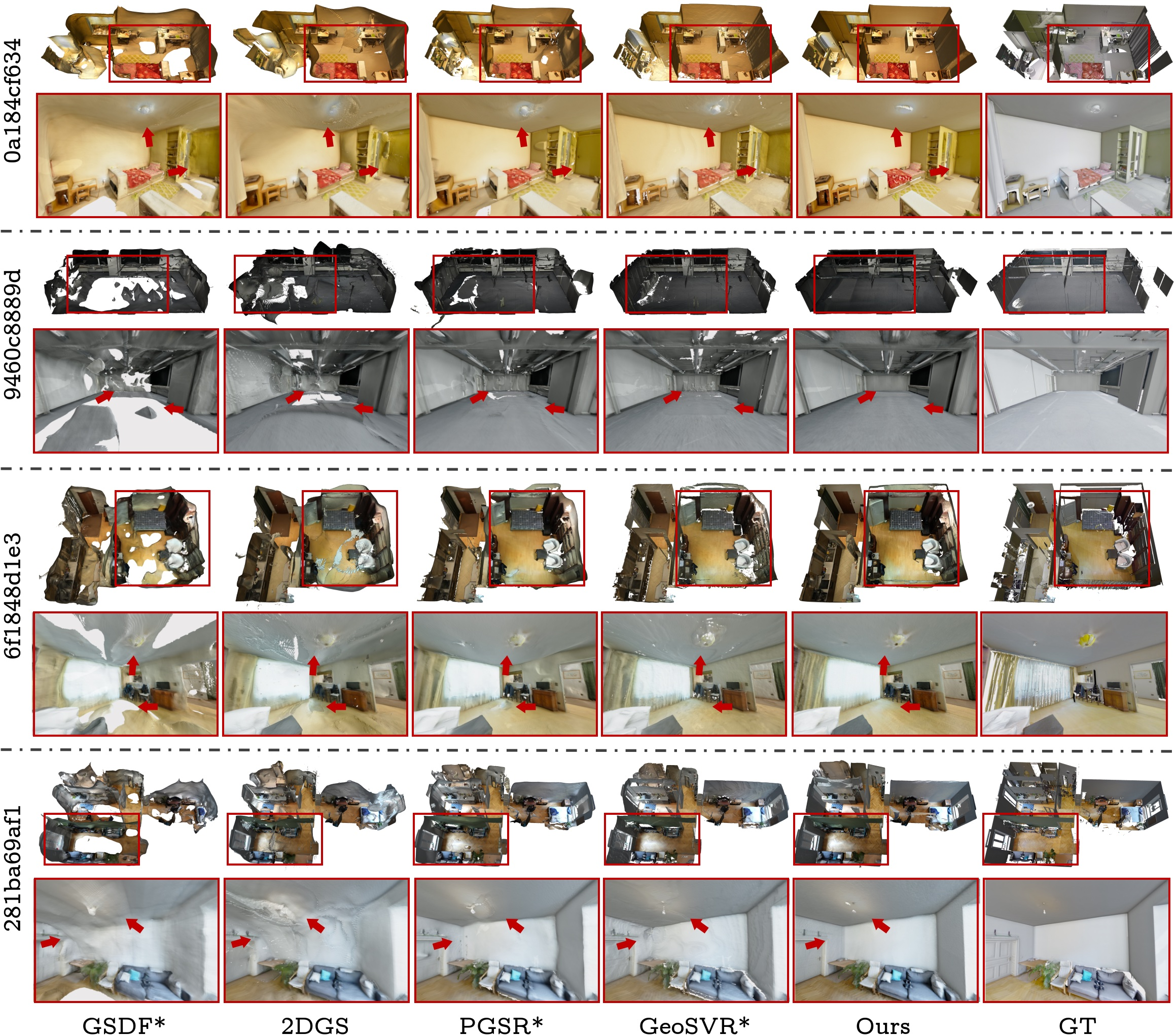
Figure 3: Superior global and local mesh quality on ScanNet++ versus baselines, evidenced by fewer floating Gaussians and preserved smoothness in challenging regions.
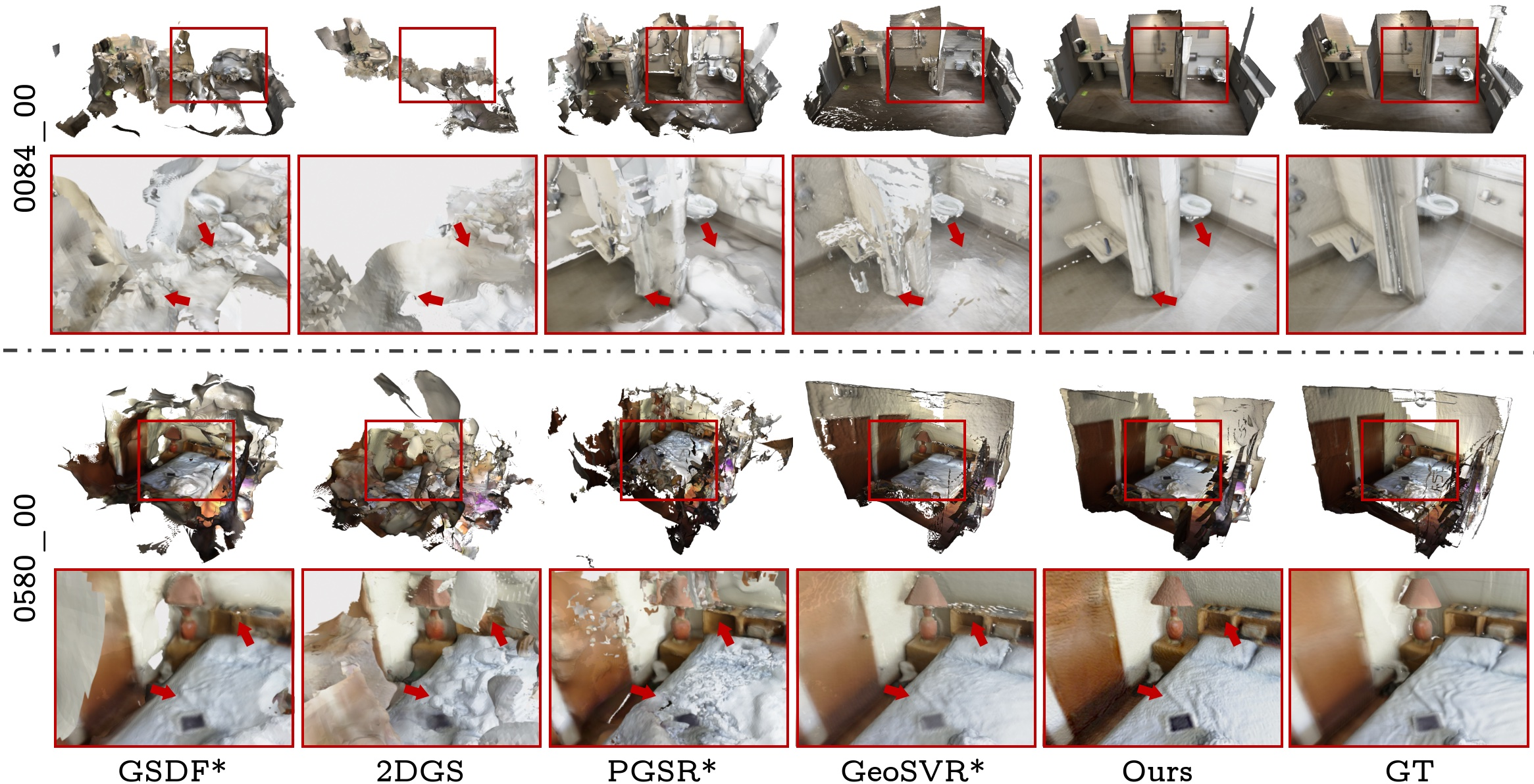
Figure 4: Robustness on ScanNetv2, yielding artifact-free meshes despite low-resolution inputs and noisy SfM points.
Further qualitative and quantitative error analysis demonstrates a substantial reduction in proportion and magnitude of floating Gaussians compared to state-of-the-art alternatives.
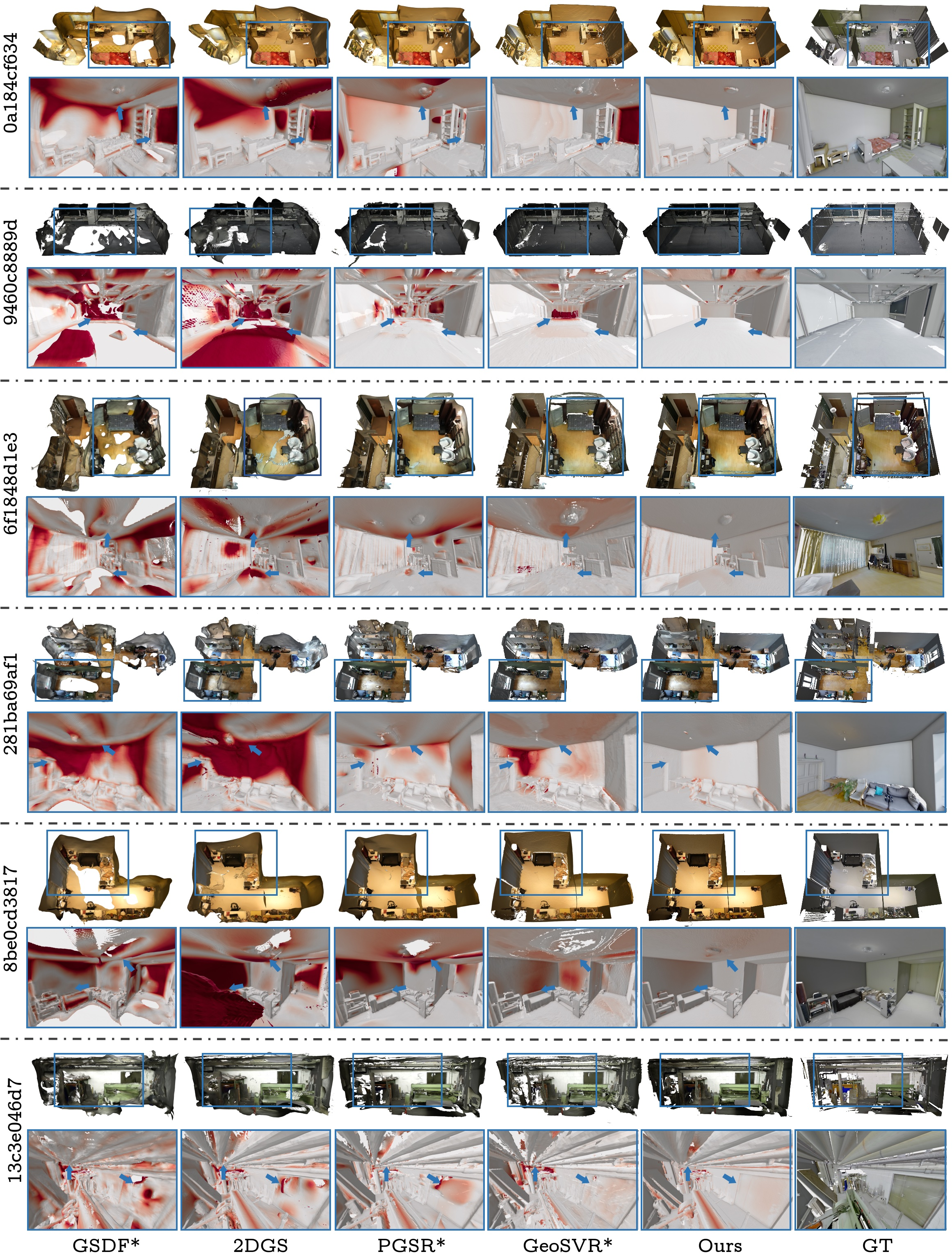
Figure 5: Scene-wise error map visualizations on ScanNet++, highlighting precise error localization and strong overall geometric accuracy versus baselines.
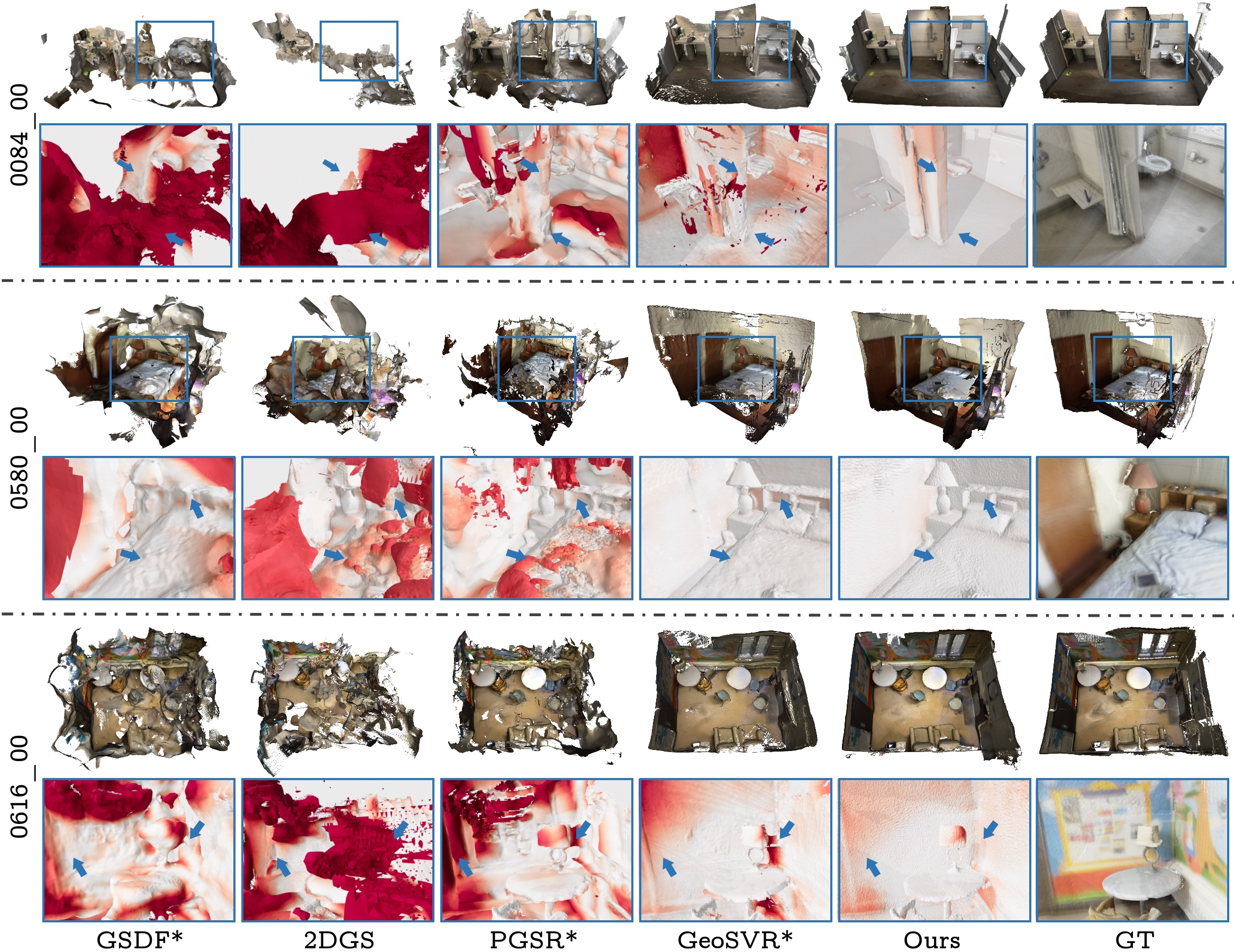
Figure 6: Robust surface extraction on ScanNetv2, balancing fine detail preservation and surface smoothness, outperforming patch-based and hybrid competitors.
Novel View Synthesis
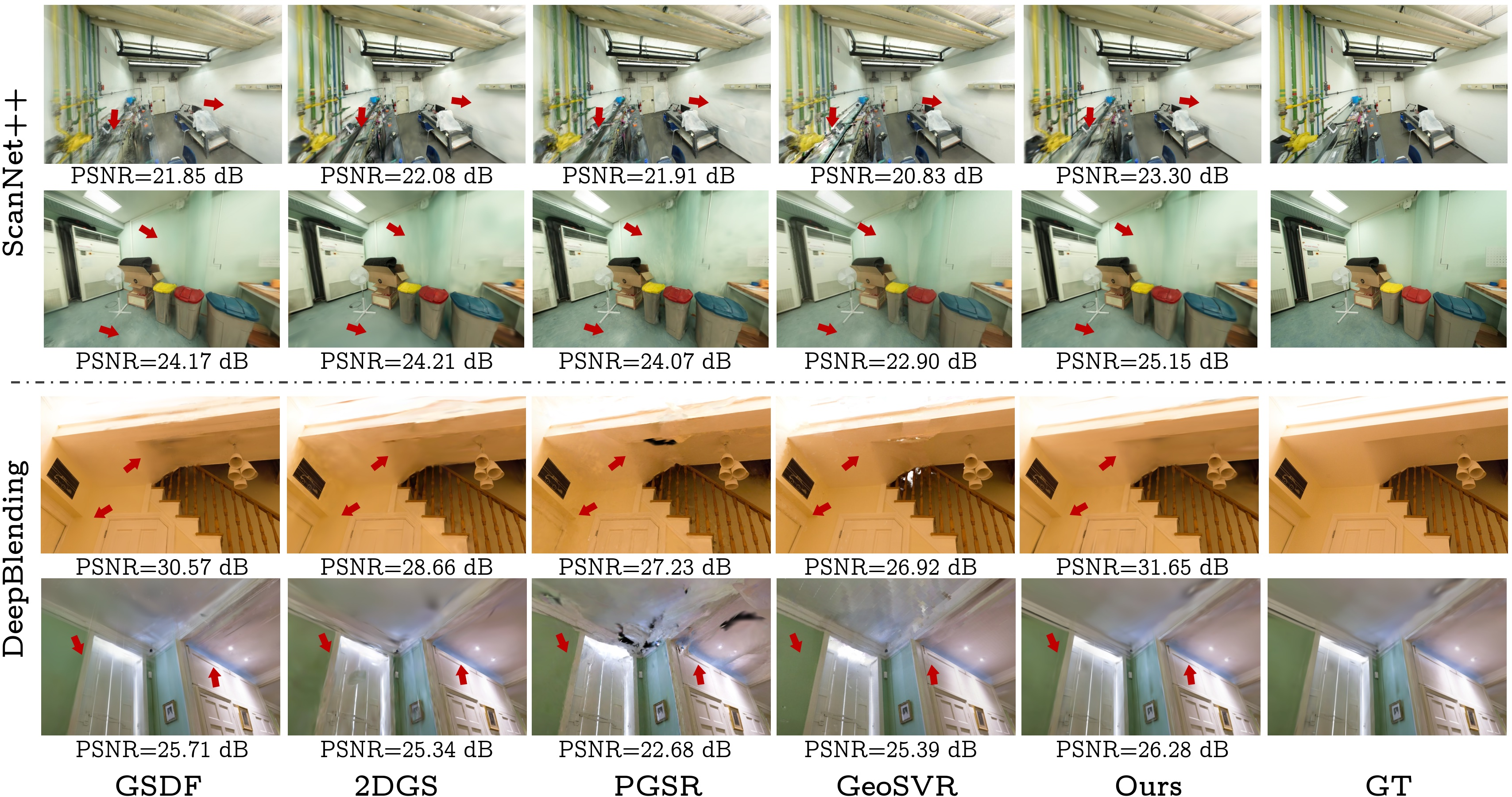
The method also achieves strong rendering metrics:
Efficiency
Gaussian-Voxel Duet yields a significant acceleration in convergence and training time compared to global SDF-guided approaches:
- 9× faster than GSDF on both ScanNet++ and DeepBlending.
- Competitive with pure explicit methods while delivering superior geometry.
Ablation
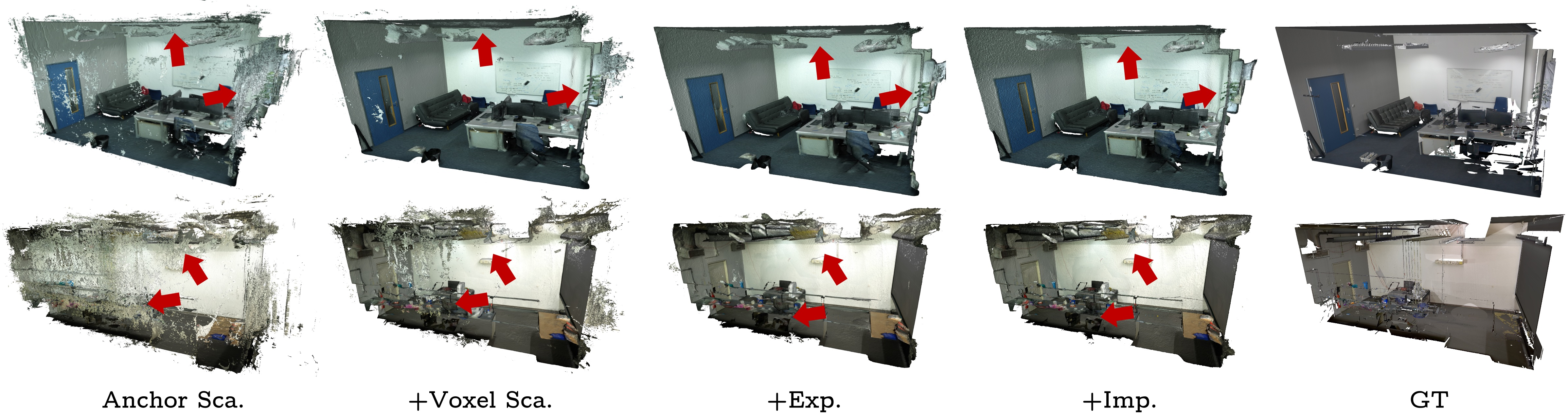
A detailed ablation confirms contributions from each module:
Generalization, Scalability, and Limitations
The method maintains performance over a range of scene complexities and scales.
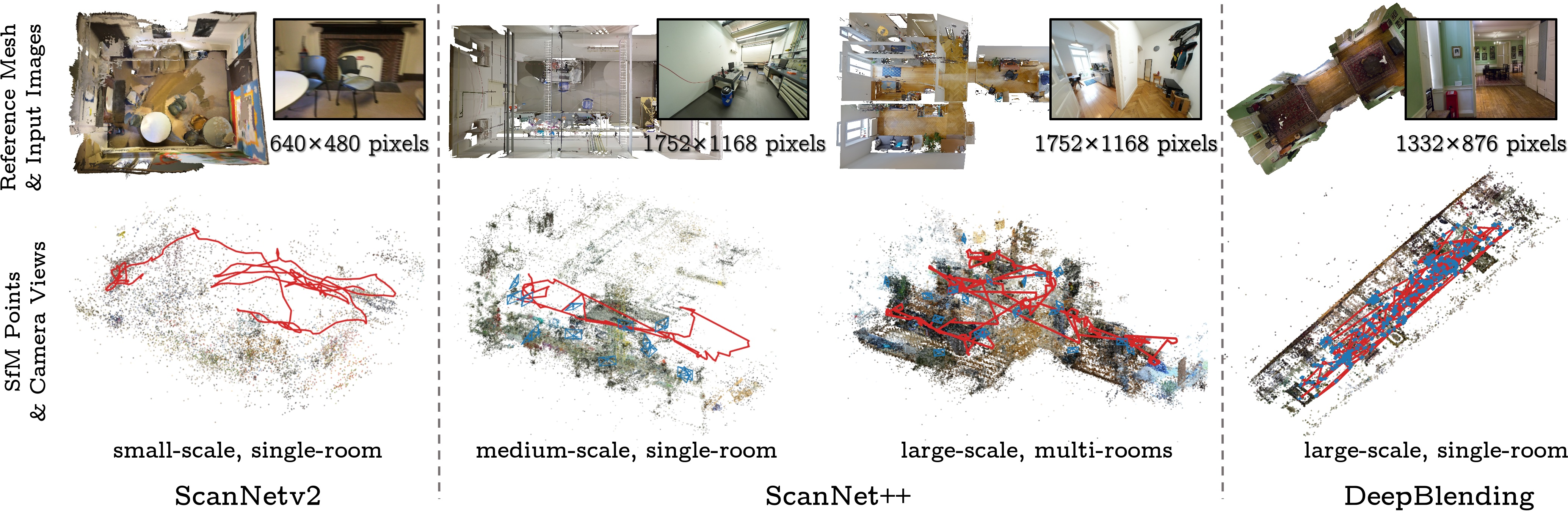
Figure 9: Dataset overview showing scene scale, image resolution, and evaluation protocols for all tested datasets.
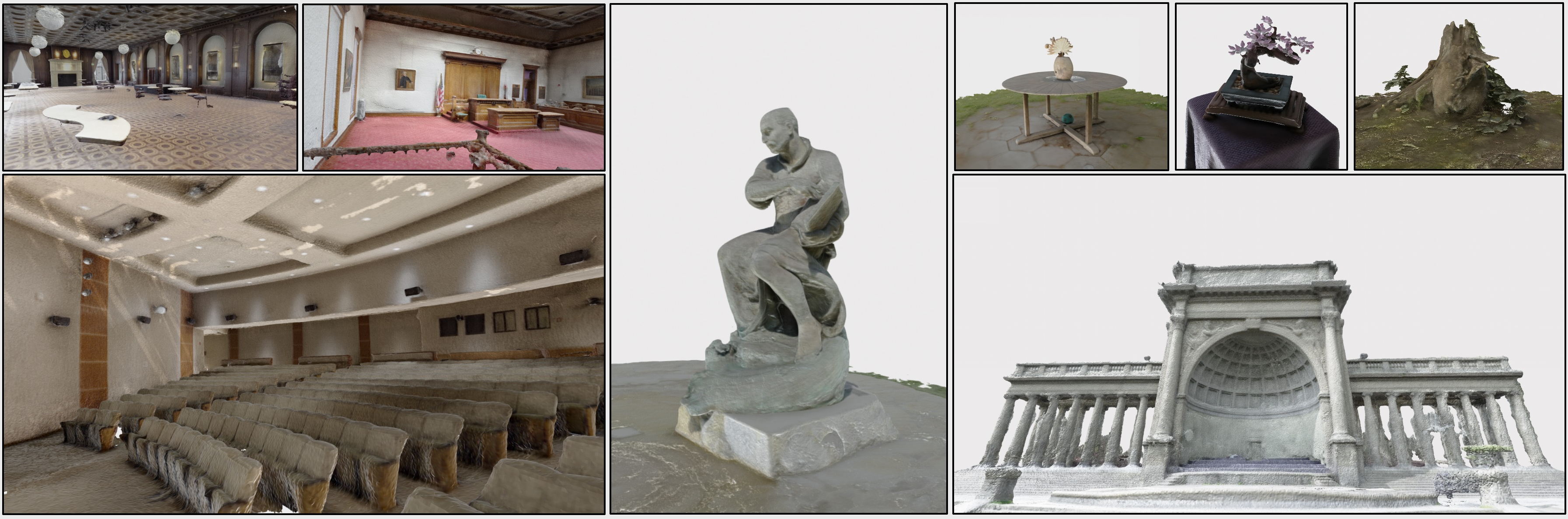
Figure 10: Qualitative scalability demonstration on large-scale scenes, evidencing method’s efficacy under expansive settings.
Preliminary exploration on unbounded scenes is promising but less effective due to SDF’s preference for watertight surfaces; extensions to Unsigned Distance Fields or multiresolution scaffolds are suggested as future directions.
Implications and Future Directions
The Gaussian-Voxel Duet paradigm introduces a compelling direction for efficient, accurate surface reconstruction from monocular images, explicitly bridging efficient point-based modeling with surface-aware geometric priors. By localizing optimization to surface-proximal bands and employing mutual regularization, it achieves a strictly superior trade-off between rendering quality, geometric accuracy, and convergence speed.
Future work could address:
- Unbounded/Outdoor Scenes: Integrating UDF or explicitly handling open surfaces to extend beyond indoor or watertight geometry.
- Hierarchical Grids: Adopting multi-resolution voxel scaffolds for improved detail at varying scales.
- Generalization: Combining per-scene optimization with global, feed-forward predictors for fast, initialization-agnostic setups.
Conclusion
Gaussian-Voxel Duet combines explicit appearance anchors and a sparse, local SDF voxel scaffold via mutual tethering. This yields state-of-the-art monocular surface reconstruction and robust, photorealistic rendering with real-time efficiency, overcoming the key weaknesses of both unregularized 3DGS and slow global SDF models. The dual-scaffold paradigm stands to inform future research on scalable, surface-consistent hybrid representations for both reconstruction and rendering across diverse scene types.