- The paper shows that compactification and geometric superposition significantly enhance entanglement harvesting by mitigating acceleration-induced noise.
- The study employs perturbative techniques with two-level Unruh-DeWitt detectors and Gaussian switching in compactified Minkowski spacetime to derive explicit numerical results.
- Results reveal that anti-parallel acceleration outperforms parallel setups, broadening the operational regime for effective field-mediated entanglement extraction.
Summary of "Probing Spacetime Topology and Superposition with Accelerated Detectors"
Introduction and Motivation
The paper investigates entanglement harvesting via Unruh-DeWitt (UDW) detectors with uniform acceleration trajectories in Minkowski spacetime compactified along a spatial direction and extended to quantum superpositions of such topologies. Entanglement harvesting protocols operationalize the extraction of field-mediated nonlocal correlations by localized quantum systems, which are sensitive to both the spacetime background and detector trajectories. Here, the interplay between acceleration, compactification, and coherent spacetime superposition is analyzed with specific emphasis on parallel and anti-parallel acceleration settings, and transverse detector separation.
Model Specification
Two UDW detectors, modeled as two-level systems, are coupled locally (via Gaussian switching) to a massless scalar field in Minkowski spacetime. The detectors accelerate either in parallel or anti-parallel fashion along the x-direction, while being separated along the y-direction. Compactification is imposed along the z-axis, characterized by a periodicity parameter L. The paper extends to superpositions of two compactification lengths L1 and L2, managed via an auxiliary control Hilbert space, resulting in computation of field correlators on superposed spacetime geometries.
The density matrix of the detectors after interaction, conditioned on the final spacetime control state, is computed perturbatively to second order in the coupling. Entanglement is quantified by concurrence and negativity, with the conditions for harvesting determined by the competition between local noise and nonlocal correlation terms in the density matrix.
Influence of Acceleration and Spacetime Topology
The trajectories for both parallel and anti-parallel acceleration scenarios are derived explicitly in Rindler coordinates. Detector separation perpendicular to acceleration introduces a geometric penalty, enhancing spacelike separation and diminishing nonlocal correlators relative to cases where separation and acceleration are collinear.
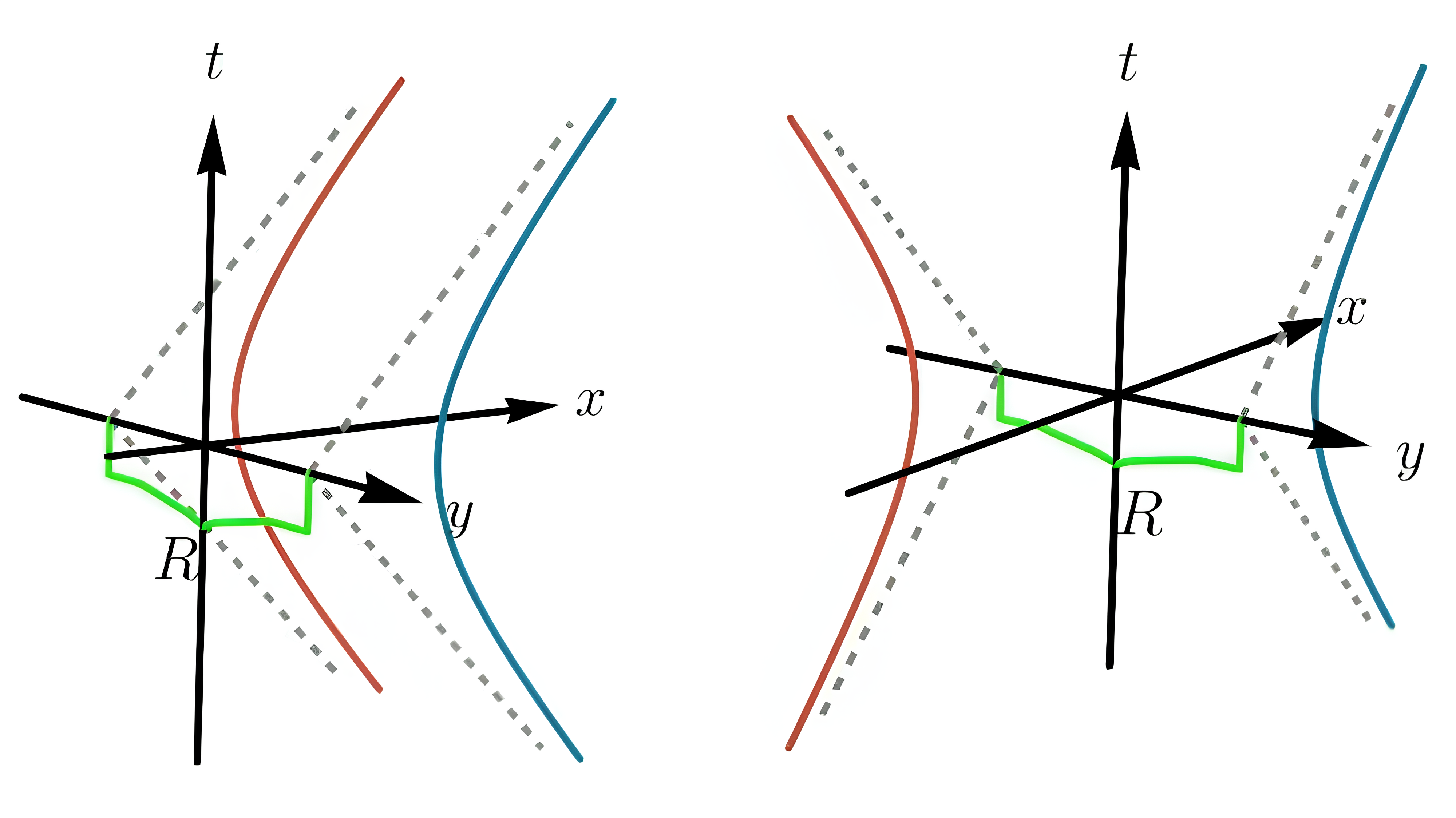
Figure 1: Trajectories of two detectors in Minkowski space, with parallel and anti-parallel acceleration, and separation along the y-direction.
Compactification modifies the spectral structure of the quantum field via a topological image sum, leading to enhancement of field correlations and substantial increase in harvested entanglement. Superposition of compactified geometries further introduces interference terms in the correlators, which are accessible only via conditioning on the final control state, thereby operationalizing quantum geometric effects.
Numerical Results and Entanglement Analysis
Numerical simulations are presented for concurrence as a function of detector gap Ω, spatial separation R, acceleration a, and compactification length L. The main findings are:
- Entanglement suppression: Transverse separation reduces harvested entanglement universally, independent of spacetime topology.
- Compactification enhancement: Compactified geometry increases both the magnitude and parameter range of nonzero concurrence, especially at small compactification length and low acceleration.
- Superposition broadening: Coherent superposition of two compactified sectors enlarges the region in parameter space where entanglement is accessible, particularly at higher accelerations.
The results show that anti-parallel acceleration not only survives but amplifies its advantage in compactified and superposed backgrounds, yielding greater concurrence (up to 0.6 at high acceleration) compared to parallel acceleration, which peaks at low acceleration.
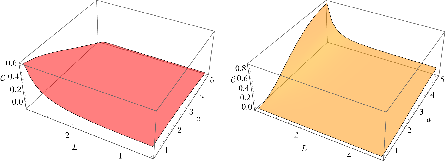
Figure 2: Concurrence y0 as a function of compactification length y1 and acceleration y2, displaying enlarged entanglement regions for compactified and superposed spacetime.
Theoretical and Practical Implications
The interplay between acceleration and topology is established as nontrivial: compactification counteracts the degradation of entanglement caused by acceleration-induced local thermal noise (via the Unruh effect), extending the regime of entanglement harvesting. Superposed geometry, by virtue of interference in the field correlators, redistributes the balance between local and nonlocal contributions, operationally demonstrating quantum geometric features. In the high-acceleration regime, where individual compactified branches lose harvested entanglement, the coherent superposition sustains extractable concurrence.
For anti-parallel acceleration, closest approach geometry enhances nonlocal correlations, explaining systematic superiority in harvesting across all spacetime backgrounds.
Future Directions
Potential extensions include non-Gaussian switching, massive or fermionic fields, finite-temperature backgrounds, and non-perturbative detector-field interaction. The framework also suggests directions for operationally probing quantum spacetime and testing quantum gravity scenarios via detector-based protocols, e.g., in superposed black hole geometries.
Conclusion
This work unifies three major relativistic quantum information concepts—acceleration, compactification, and geometric superposition—by quantifying their collective effect on entanglement harvesting. The findings clarify that compactification and coherent superposition can significantly ameliorate geometric and noise-induced losses in entanglement, with anti-parallel acceleration consistently providing an advantage. Operational signatures of quantum spacetime can thus be probed by analyzing the balance of local and nonlocal contributions in detector-based protocols.

