Published 25 May 2026 in quant-ph and math-ph | (2605.26331v1)
Abstract: Uncertainty relations are usually formulated as trade-off relations between two or more observables. Here we show that the uncertainty of a single observable already has a nontrivial lower bound originating from the noncommutativity between the observable and the quantum state. We prove sharp lower bounds on the variance of a single observable and then sharpen them further by introducing the classical uncertainty of the observable under a fixed state. The optimal coefficient is determined solely by the smallest and largest eigenvalues of the state. Our results include an optimal state-dependent improvement of Luo's Wigner--Yanase-type relation and a direct bound showing that coherence or asymmetry of the state with respect to the observable gives an unavoidable contribution to its uncertainty. For qubits, the sharpened bounds become exact identities, giving a complete decomposition of the variance into classical and noncommutative parts. These single-observable relations also yield improved product-form uncertainty relations for pairs of observables.
The paper establishes state-dependent lower bounds on the variance of a single observable by optimizing coefficients beyond traditional Wigner–Yanase bounds.
It delineates a clear decomposition of variance into classical and quantum contributions, achieving exact equalities for qubit systems.
The framework extends to product-form uncertainty relations, impacting quantum metrology, state discrimination, and coherence quantification.
Uncertainty Relations for a Single Quantum Observable
Introduction
Uncertainty relations are foundational to quantum mechanics, conventionally framing constraints as trade-offs between pairs of non-commuting observables. While the Heisenberg-Robertson-Schrödinger relations have dominated the formalization of quantum uncertainty, most focus has been on multi-observable generalizations, variance formulations for mixed states, and the decomposition of quantum versus classical contributions via constructs like the Wigner–Yanase skew information. The paper "Uncertainty Relation for a Single Observable" (2605.26331) departs from this bilateral paradigm by establishing optimal, state-dependent lower bounds on the variance for a single observable, dictated exclusively by the noncommutativity of the observable and the quantum state.
Main Results: State-Dependent Lower Bounds for Single Observable Variance
This work demonstrates that for any non-maximally mixed state ρ and any observable A, there exists a nontrivial lower bound on Varρ(A) stemming from the noncommutativity between A and either ρ or ρ. Specifically, two inequalities are derived: Vρ(A)≥cρ∥[A,ρ]∥2,Vρ(A)≥cρ∥[A,ρ]∥2,
where cρ and cρ are state-dependent coefficients, optimized in terms of the minimal and maximal eigenvalues of ρ. The optimization of these coefficients marks a strict improvement over Luo's Wigner–Yanase-type bound, as the optimal values always exceed A0 (except in the limit of minimal purity).
Notably, for a qubit, the sharpened bounds become exact equalities—a unique feature not present in higher dimensions. Moreover, the classical (commuting) and quantum (noncommuting) parts of the variance are unambiguously separated by decomposing A1 into diagonal/off-diagonal parts with respect to A2's eigenbasis.
The implications are twofold: (1) even the variance of a single observable in a mixed state contains irreducible quantum contributions if the state and observable do not commute, and (2) these contributions can be exactly quantified. The result extends to multiple observables: product-form uncertainty relations based solely on single-observable bounds can outperform the canonical Robertson–Schrödinger relations upon averaging.
Methodology
The authors construct a one-parameter family of uncertainty relations, parametrized by A3,
A4
and show that the optimal coefficient is
A5
where A6 and A7 are the extremal eigenvalues of A8. This coefficient is state-dependent but uniform for all observables.
This extends the familiar Luo bound (for A9) which uses the Wigner–Yanase skew information, to a broader class including the case Varρ(A)0 that involves the commutator with Varρ(A)1 itself. Supplementing the lower bound with the maximal "classical" variance (the variance of the eigenvalue-diagonal part of Varρ(A)2), the variance admits a strict decomposition into classical and noncommutative parts.
Structure of Quantum Uncertainty: Noncommutative Versus Classical Contributions
The classical contribution is evaluated via a supremum over all possible eigenvalue-degeneracy-resolving bases, operationalized through the pinching map associated with Varρ(A)3. The quantum contribution is precisely the non-diagonal action of Varρ(A)4 with respect to Varρ(A)5: Varρ(A)6
This clarifies that only when Varρ(A)7 and Varρ(A)8 commute does the lower bound saturate at the classical part, and for qubits, both parts together exhaust the variance.
Special Case: Qubit Systems
In the Varρ(A)9 case, every non-maximally mixed state and every observable A0 realizes this decomposition as an exact identity. The optimal lower bounds collapse to the same value regardless of A1, meaning that the minimal and maximal eigenvalues of the state (fully determined by the state's purity) quantitatively dictate the uncertainty decomposition.
After decomposing the qubit state with Bloch vector A2 and measuring an observable in direction A3, the variance and commutator norm can be evaluated in closed-form, revealing that the off-diagonal component's contribution to the variance is fully captured by the optimal lower bound.
Comparison with Conventional Multi-Observable Uncertainty Relations
Applying the single-observable lower bounds pairwise for two observables and forming the product bound yields
A4
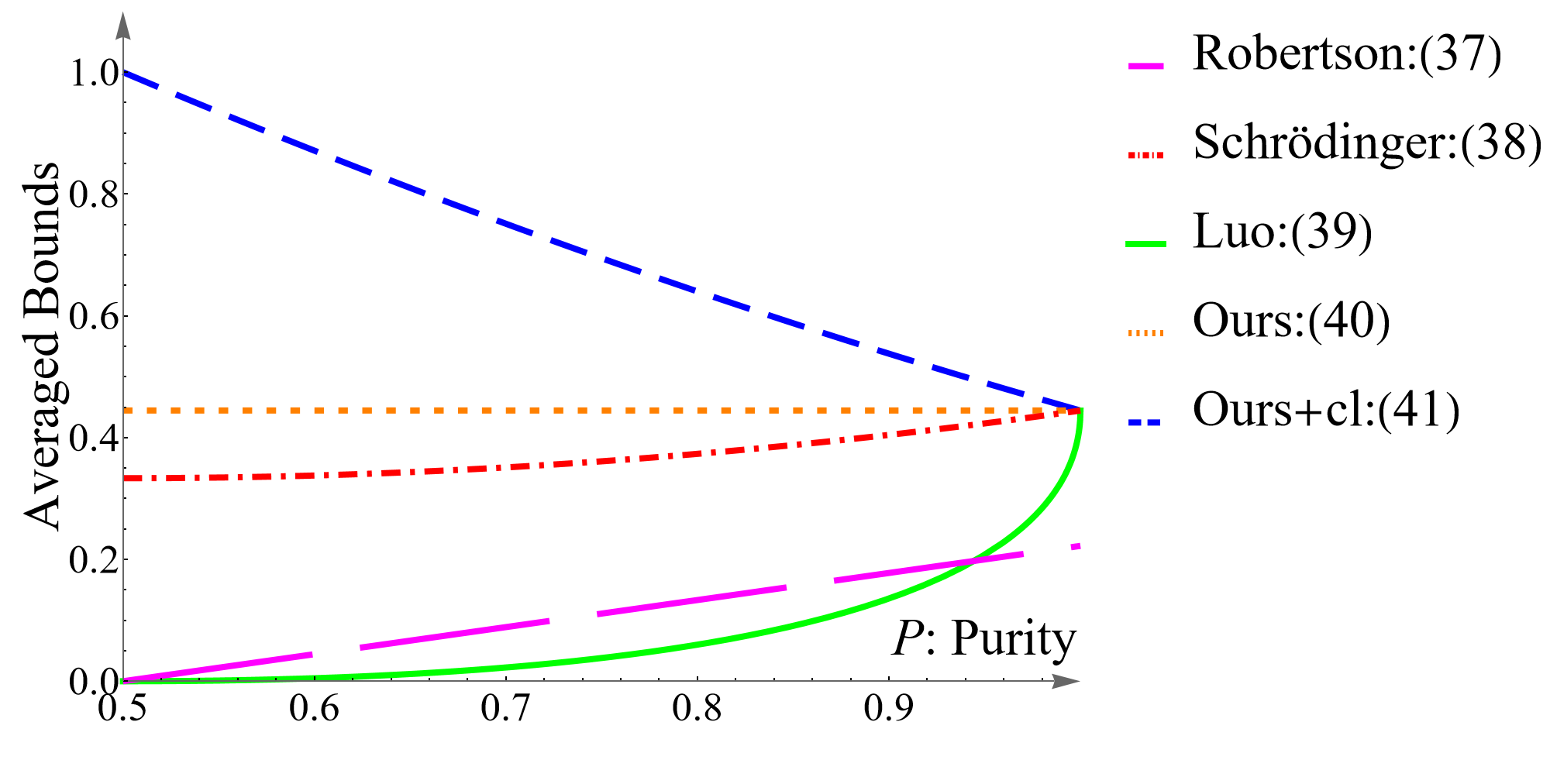
which, especially in the qubit case, can be strictly stronger on average than the Robertson or Schrödinger product uncertainties. This is quantified by averaging over all observable pairs and showing that for mixed qubit states the optimized single-observable approach yields higher lower bounds (Figure 1):
Figure 1: State purity versus the averaged lower bounds obtained from the Robertson relation, the Schrödinger relation, the Luo-type bound, and the optimal single-observable relations.
Implications and Theoretical Significance
These findings revise the standard paradigm that quantum uncertainty fundamentally arises only in the mutual incompatibility of pairs of observables. The irreducible variance for a single observable, governed purely by its noncommutativity with the state, is quantifiable, and, for qubits, exactly characterizes all uncertainty structure. This informs resource-theoretic protocols involving coherence and asymmetry, and impacts state discrimination, quantum metrology, and certification of nonclassicality, where state-observable noncommutativity is a more relevant signature than pairwise observable commutation.
The explicit state-dependent decomposition of variance will facilitate refined analyses in quantum measurement and control, including contexts where resource quantification of coherence/asymmetry is operationally central.
Conclusion
This work establishes and optimizes genuinely state-dependent lower bounds on the uncertainty of a single observable, generalizing known Wigner–Yanase-type relations by introducing exact optimal coefficients. The decomposition of variance into classical and quantum (noncommuting) contributions is made explicit and, for qubit systems, exact. These results highlight the inherent quantum component in the uncertainty of an observable, uniquely determined by its relationship to the state and independent of any observable pairwise noncommutativity. Applications include enhanced lower bounds for product-form uncertainty relations and resource theory. The framework delineated is expected to inform future investigations into the structure of quantum uncertainty in higher-dimensional systems and in measurement protocols.
“Emergent Mind helps me see which AI papers have caught fire online.”
Philip
Creator, AI Explained on YouTube
Sign up for free to explore the frontiers of research
Discover trending papers, chat with arXiv, and track the latest research shaping the future of science and technology.Discover trending papers, chat with arXiv, and more.