- The paper introduces a mapping of the Domany-Kinzel automaton into isoTNS quantum states, demonstrating entanglement transitions via directed percolation.
- It employs a tensor network approach to analyze critical scaling and correlation behaviors at the DP critical point with algebraic decay.
- The study highlights how defect conservation governs the transition from W-like long-range pairwise entanglement to short-range correlations.
Entanglement Pattern Transition in Quantum States Derived from Directed Percolation
Introduction and Motivation
Quantum phases of matter are inherently distinguished by the entanglement structure of their ground states, encompassing topologically ordered phases, symmetry-breaking, and SPT phases. Beyond stable equilibrium phases, non-equilibrium classical stochastic processes grant access to a broader landscape of entangled quantum states by mapping their trajectories into the Hilbert space through isometric Tensor Network States (isoTNS). This paper examines entanglement pattern transitions in quantum states constructed from the (1+1)D Domany-Kinzel automaton, representing the directed percolation (DP) universality class, focusing on the critical phenomena associated with an absorbing phase transition. The approach enables systematic exploration of states that do not correspond to stable many-body phases, but nonetheless exhibit fundamental entanglement transitions.
Mapping Classical Automata to Quantum States
A paradigmatic stochastic process is mapped into a quantum state by associating time evolution in the classical automaton with an additional spatial direction in the quantum lattice. The quantum wavefunction is a superposition of all trajectories, with probabilities encoded via amplitudes. For the DK automaton, even and odd sites are updated alternately, with local rules specified by conditional probabilities P(i∣jk), enabling a brickwork tensor network representation with bond dimension χ=2. Physical legs lock virtual legs, producing a two-dimensional isoTNS encoding the automaton's stochastic dynamics.
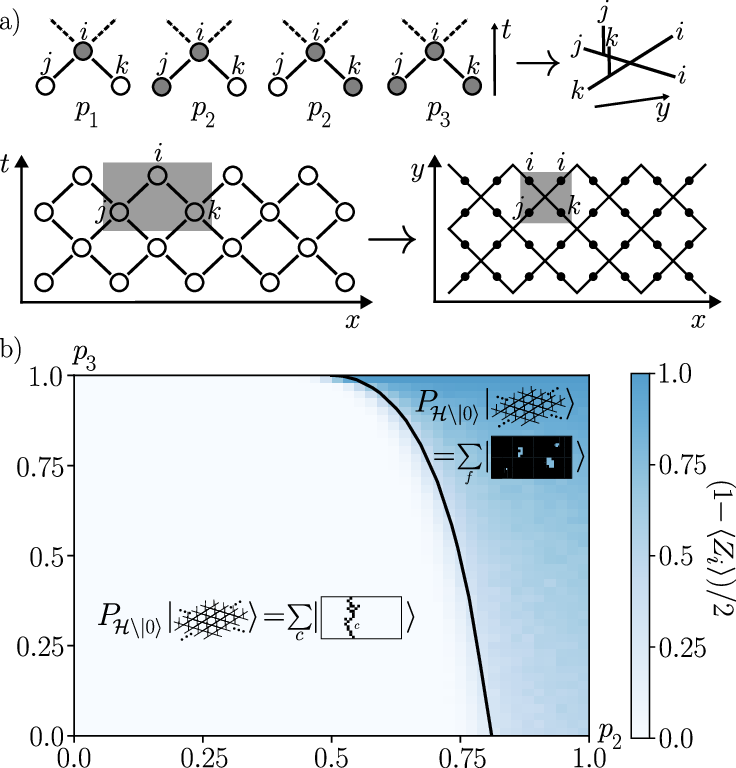
Figure 1: The Domany-Kinzel automaton and its mapping to an isoTNS quantum state, with the phase diagram highlighting the absorbing and active phases.
The conservation of probability directly enforces the isometric condition on local tensors, guaranteeing sequential circuit realizability and efficient contraction. The parent Hamiltonian HDK is constructed as a sum of projectors with continuous dependence on automaton probabilities (p1,p2,p3), remaining well-defined across the absorbing phase transition.
Criticality and Correlation Structure
Evaluating diagonal observables via the automaton mapping, the DK-derived isoTNS demonstrates distinct correlation scaling at the DP critical point. Correlations are measured via normalized density-density functions Cnormi(j), which, unlike standard correlations, remain finite in finite systems and at the critical point. In large systems, correlations vanish outside the active phase. At the critical probability pc, algebraic correlations emerge along all directions, governed by DP critical exponents (β/ν∥, β/ν⊥).
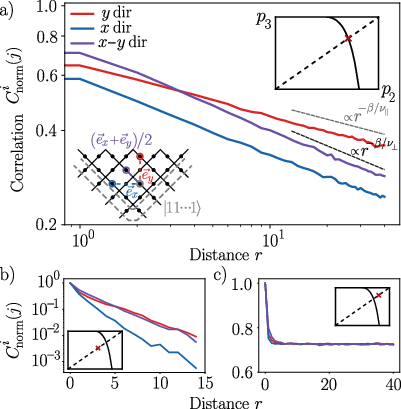
Figure 2: Normalized correlations in the DK quantum state exhibit algebraic scaling at the critical line and exponential/constant behavior in the absorbing/active phases.
Notably, the DK isoTNS is the first explicit example supporting critical scaling in all spatial directions, diverging from previously studied isoTNS critical points with a single critical direction.
Entanglement Pattern Transition and Ground State Manifold
With periodic boundary conditions, the quantum interpretation acquires additional structure due to a U(1) conservation law on defect number ND, enforced by χ=20. The ground state manifold of χ=21 is degenerate, hosting both the vacuum state χ=22 and a nontrivial orthogonal ground state χ=23, which encodes spanning clusters in the time-like direction. Deep in the absorbing phase, χ=24 becomes an equal weight superposition of strings winding the periodic direction, reminiscent of the χ=25 state.
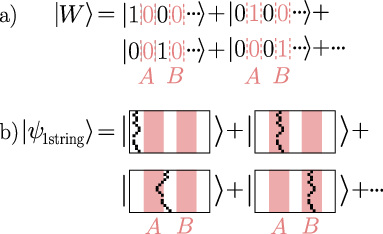
Figure 3: Comparison between the χ=26 state and the DK-derived ground state demonstrating robust pairwise entanglement between distant regions in the absorbing phase.
The negativity of reduced density matrices for subsystems χ=27 and χ=28 spanning the periodic direction remains finite and independent of their separation, providing a rigorous measure of pairwise entanglement analogous to the χ=29 state. As the critical line is approached, the cluster broadens and the entanglement pattern transitions from HDK0-like to trivial. In the active phase, entanglement becomes short-range, with correlations decaying beyond the critical correlation length HDK1.
The presence of this transition is contingent upon the defect conservation law; generic deformations (HDK2) destroy the degeneracy and enforce uniqueness of the ground state, showing that these entanglement classes are not stable topological phases but rather fragile, reliant on symmetries and conservation laws.
Parent Hamiltonian Structure
The parent Hamiltonian HDK3 acts as a sum of local projectors on 8-qubit neighborhoods, enforcing the locking condition of qubits and projecting onto superpositions determined by the local environment. In the HDK4 regime, the Hilbert space splits into sectors indexed by the defect number, and only zero-defect configurations contribute to the ground state manifold. The vacuum is an isolated ground state, disconnected from other states by local operations, while HDK5 encodes delocalized cluster configurations.
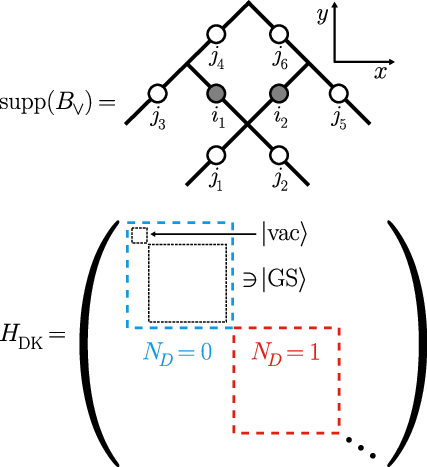
Figure 4: The structure and support of the parent Hamiltonian HDK6, illustrating its sector decomposition and degeneracy.
Extensions and Universality
The automaton-to-isoTNS mapping extends to higher-dimensional DP and other stochastic automata, permitting exploration of a gamut of universality classes and multi-absorbing-state transitions. The critical entanglement structure persists in these generalizations, as shown by mapping 2D bond DP processes to three-dimensional quantum states exhibiting directionally dependent algebraic correlations.
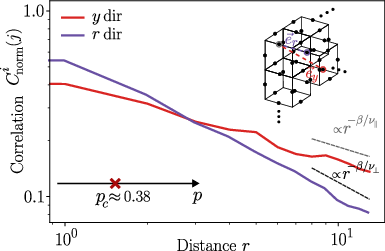
Figure 5: Normalized correlations in a 3D isoTNS state derived from 2D bond DP, featuring critical scaling in multiple directions.
Crucially, systems with additional symmetry constraints (e.g., the Kasteleyn model) do not realize the same entanglement pattern transitions due to sectorization of the ground state manifold, confirming the role of Hilbert space connectivity.
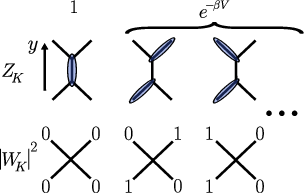
Figure 6: Mapping of the Kasteleyn model to a TNS, illustrating difference in sector structure and absence of entanglement pattern transition.
Implications and Future Directions
The framework highlights the utility of stochastic automata for generating families of quantum states exhibiting nontrivial entanglement transitions not accessible via equilibrium ground states. The results suggest that the presence of a vacuum as a disconnected ground state is essential for stabilizing HDK7-like entangled states in local Hamiltonians. This insight connects to recent work on the instability of HDK8 states under generic perturbations and the classification of Dicke states and many-body scars.
Possible extensions include exploring classical automata with rich symmetry and absorbing state structure, mapping self-organized criticality and memory-stabilizing rules to quantum states, and characterizing the conditions under which entanglement pattern transitions can persist in non-injective TNS.
Conclusion
The paper establishes a systematic approach for constructing quantum states from absorbing phase transitions in classical stochastic automata, focusing on the DK automaton and its DP criticality. The resulting isoTNS hosts a transition between HDK9-like pairwise entanglement and trivial entanglement, dictated by defect conservation and criticality. This mechanism expands the landscape of quantum states accessible through tensor networks, emphasizing non-equilibrium phenomena as a powerful organizing principle. These insights lay the groundwork for a broader exploration of entanglement classes and nontrivial Hilbert space connectivity in quantum many-body systems beyond equilibrium phases.

