- The paper introduces a flux-controlled Floquet quantum walk that creates a logical 0/π boundary subspace using coin-dependent drift and momentum-dependent mixing.
- It demonstrates dual-gap topology by quantifying independent winding numbers and achieving robust 2T period doubling in edge responses.
- The work offers an experimentally accessible platform for realizing topological quantum information processing through precise bulk dynamical signatures.
Flux-Controlled Anomalous Floquet Quantum Walk: Boundary Logical Subspace and Bulk Dynamical Probes
Floquet Walk Construction and Microscopic Realization
The paper "Boundary 0/π logical subspace and bulk dynamical probes in flux-controlled anomalous Floquet quantum walks" (2605.25792) introduces a one-dimensional quantum walk protocol, meticulously defined via a coin-dependent drift and momentum-dependent mixing. The Floquet unitary is U(k)=e−iθ2(k)σxe−iθ1(k)σz, with θ1(k) encapsulating the flux ϕ as a spatial drift and θ2(k) encoding coin mixing. A bipartite lattice, driven with periodic modulation and Peierls phase control, directly realizes this protocol at the microscopic level; the mapping between lattice Hamiltonians and quantum walk operations is exact.
Importantly, this setup admits two chiral symmetric time frames, enabling separate quantization of quasienergy gaps at $0$ and π/T, characterized by winding numbers W1 and W2. The dual-gap structure organizes four topological phases within the (M,ϕ) parameter space: trivial, U(k)=e−iθ2(k)σxe−iθ1(k)σz0-only, U(k)=e−iθ2(k)σxe−iθ1(k)σz1-only, and coexistence (U(k)=e−iθ2(k)σxe−iθ1(k)σz2 and U(k)=e−iθ2(k)σxe−iθ1(k)σz3 edge modes).
Bulk Topological Structure
In the bulk, the Floquet operator is always represented as a U(k)=e−iθ2(k)σxe−iθ1(k)σz4 unitary matrix, which allows explicit computation of the quasienergy bands:
U(k)=e−iθ2(k)σxe−iθ1(k)σz5
with gap closings determined by integer values of U(k)=e−iθ2(k)σxe−iθ1(k)σz6 and U(k)=e−iθ2(k)σxe−iθ1(k)σz7 at critical U(k)=e−iθ2(k)σxe−iθ1(k)σz8. The chiral symmetry, U(k)=e−iθ2(k)σxe−iθ1(k)σz9, requires reading the topology in two symmetric time frames (θ1(k)0, θ1(k)1). The winding numbers correspond to independent indices for the θ1(k)2 and θ1(k)3 gaps, yielding:
θ1(k)4
(Figure 1)
Figure 1: Bulk topological phase diagram reveals domains differentiated by winding numbers θ1(k)5 and θ1(k)6, marking the presence of edge modes at θ1(k)7 and θ1(k)8.
Boundary θ1(k)9 Logical Subspace and Doubled-Period Response
Under open boundary conditions, the coexistence region features both ϕ0 and ϕ1 edge modes localized at the same boundary. These modes, denoted ϕ2 and ϕ3, define a two-dimensional logical subspace ϕ4, protected by chiral symmetry and dual gap topology. Floquet evolution acts as a relative phase operation within this subspace: a single period alternates the sign of the ϕ5 mode, resulting in robust ϕ6 oscillations in local boundary observables when both modes are coherently occupied.
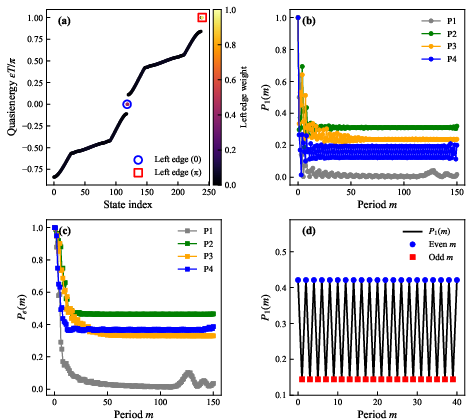
Figure 2: Open-boundary edge spectrum and time-domain site-one probability illustrate the ϕ7 doubled-period response for the coexistence sector, with modes at ϕ8 and ϕ9 on the same edge.
Numerical evidence is provided for four sectors; only the coexistence case manifests pronounced period doubling. Optimized superpositions of the edge modes explicitly maximize this effect, showing alternating local expectation values at the boundary.
Bulk Dynamical Probes: Mean Chiral Displacement and Critical Dynamics
The bulk dynamical signatures of dual-gap topology are accessed through two complementary probes:
- Frame-resolved mean chiral displacement (MCD): Running time averages of θ2(k)0 in each symmetric time frame approach the winding number targets, θ2(k)1, θ2(k)2, over pre-reflection time windows. This quantitatively resolves the dual-gap structure dynamically in the bulk.
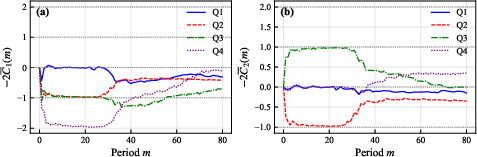
Figure 3: Frame-resolved mean chiral displacement traces for bulk representative points converge toward their respective winding numbers, validating the bulk topology from real-space dynamics.
- Benchmark critical dynamics: Local stroboscopic return probabilities at analytically tractable θ2(k)3 and θ2(k)4 gap-closing points expose qualitative differences. For θ2(k)5 gap benchmark, the Floquet evolution produces θ2(k)6 period alternation, yielding sharp odd-even separation in local observables. The θ2(k)7 gap case lacks such staggering, as justified by leading-order expansions of the Floquet operators.
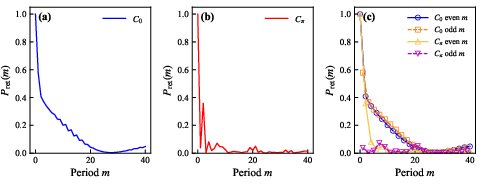
Figure 4: Short-time return probabilities show strong odd-even alternation for θ2(k)8 gap critical points, but weak staggering for θ2(k)9 gap critical points, illustrating the dynamical distinction between gap types.
Distinct bulk and boundary responses are tied to the same microscopic flux-controlled quantum walk protocol. The appearance of robust $0$0 signals is not generic, but strictly contingent on simultaneous edge mode occupancy.
Implications and Outlook
The coupling of boundary logical structure and bulk dynamical diagnostics within a flux-tunable Floquet protocol provides a symmetry-protected, minimal platform for quantum-walk information primitives. The logical ($0$1) boundary sector, supporting coherent superpositions and doubled-period responses, is of particular relevance for stroboscopic edge qubit manipulations—notably without invoking non-Abelian anyonic statistics.
Bulk probes such as MCD offer practical, real-space dynamic readout of topological invariants, directly accessible in driven lattice experiments (optical lattices, photonic quantum walks, coupled resonator arrays). The distinction between $0$2 and $0$3 gap criticality in dynamical diagnostics should motivate further exploration of Floquet-engineered critical phases and their applications in topological quantum information platforms.
The theoretical framework articulates a unified, experimentally tractable approach: driven bipartite lattices with position-resolved detection yield both logical edge subspaces and bulk topology via the same Floquet protocol, suggesting future developments in programmable topological Floquet matter, including hybrid quantum information and robust probe schemes.
Conclusion
This study establishes a flux-controlled anomalous Floquet quantum walk with explicit microscopic realization in driven bipartite lattices, organizing both boundary logical subspaces and bulk dynamical probes under a unified protocol. The coexistence region delivers symmetry-protected $0$4 boundary modes with stroboscopic period doubling, while bulk chiral displacement and critical dynamics enable direct dynamical readout of dual-gap topology. Experimental platforms already possess the necessary ingredients for implementation and measurement, so the presented framework is poised for near-term realization and further extension into programmable Floquet architectures for information processing and topological control.