- The paper presents T2S-MPC, integrating explicit time-embedding in a neural residual model to capture nonstationary dynamics.
- It employs a two-timescale learning scheme, updating fast and slow parameters separately to achieve rapid adaptation and stable control.
- Empirical evaluations on a 2D quadrotor demonstrate reduced tracking error and enhanced robustness compared to traditional MPC approaches.
T2S-MPC: Time-Embedded Online Adaptive Model Predictive Control for Time-Varying Dynamics
The challenge of controlling nonlinear dynamical systems with unknown, unstructured, and unpredictable time-varying dynamics remains fundamental in autonomous robotics, industrial processes, and safety-critical systems. Traditional adaptive control methods are limited by assumptions regarding parametric uncertainty and known structure, precluding robust performance under complex nonstationarity. Existing learning-based MPC techniques, including neural and non-neural architectures, have improved adaptation but largely address specific, structured forms of variation. The T2S-MPC framework introduces a principled approach—explicitly encoding temporal information into a neural residual dynamics model, and employing a two-timescale update protocol to efficiently balance rapid adaptation and stable learning.
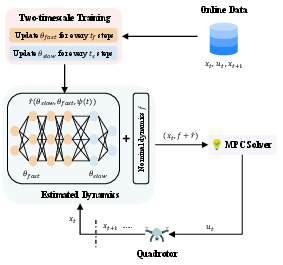
Figure 1: Schematic representation of T2S-MPC, demonstrating integration of a time-embedded neural residual model and two-timescale learning within the MPC framework.
Methodology
System Decomposition and Model Structure
T2S-MPC decomposes the true dynamics ft as ft=f+rt, where f is the nominal model and rt is the unknown, time-varying residual. The neural residual model r^θ receives state, control input, and an explicit time embedding ψ(t), which constitutes the key mechanism for capturing nonstationarity. The time embedding employs structured sine/cosine features with a frequency basis, augmenting the input space to provide explicit temporal context. This architecture avoids reliance on implicit adaptation through online updates alone, a critical limitation observed in prior neural MPC approaches.
Two-Timescale Online Learning
Model parameters θ are partitioned into {θf,θs}, updated at disparate frequencies: θf adapts rapidly (every tf steps), whereas ft=f+rt0 updates infrequently (every ft=f+rt1 steps). This separation is motivated by the need to track both fast-evolving and slower environmental changes without incurring instability or overfitting. Empirical loss is minimized separately for each partition, with data batches defined by recency and random sampling, respectively.
MPC Integration
At each control step, T2S-MPC solves a finite-horizon OCP with the composite model ft=f+rt2 as system dynamics. Only the first action of the optimized control sequence is executed, maintaining the classical MPC receding horizon protocol.
Experimental Evaluation
2D Quadrotor Testbed
The evaluation utilizes a high-fidelity 2D quadrotor simulation (PyBullet), comprising stabilization and trajectory tracking tasks under diverse time-varying disturbances—linear drift and periodic perturbations—with stochastic noise components.
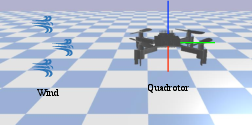
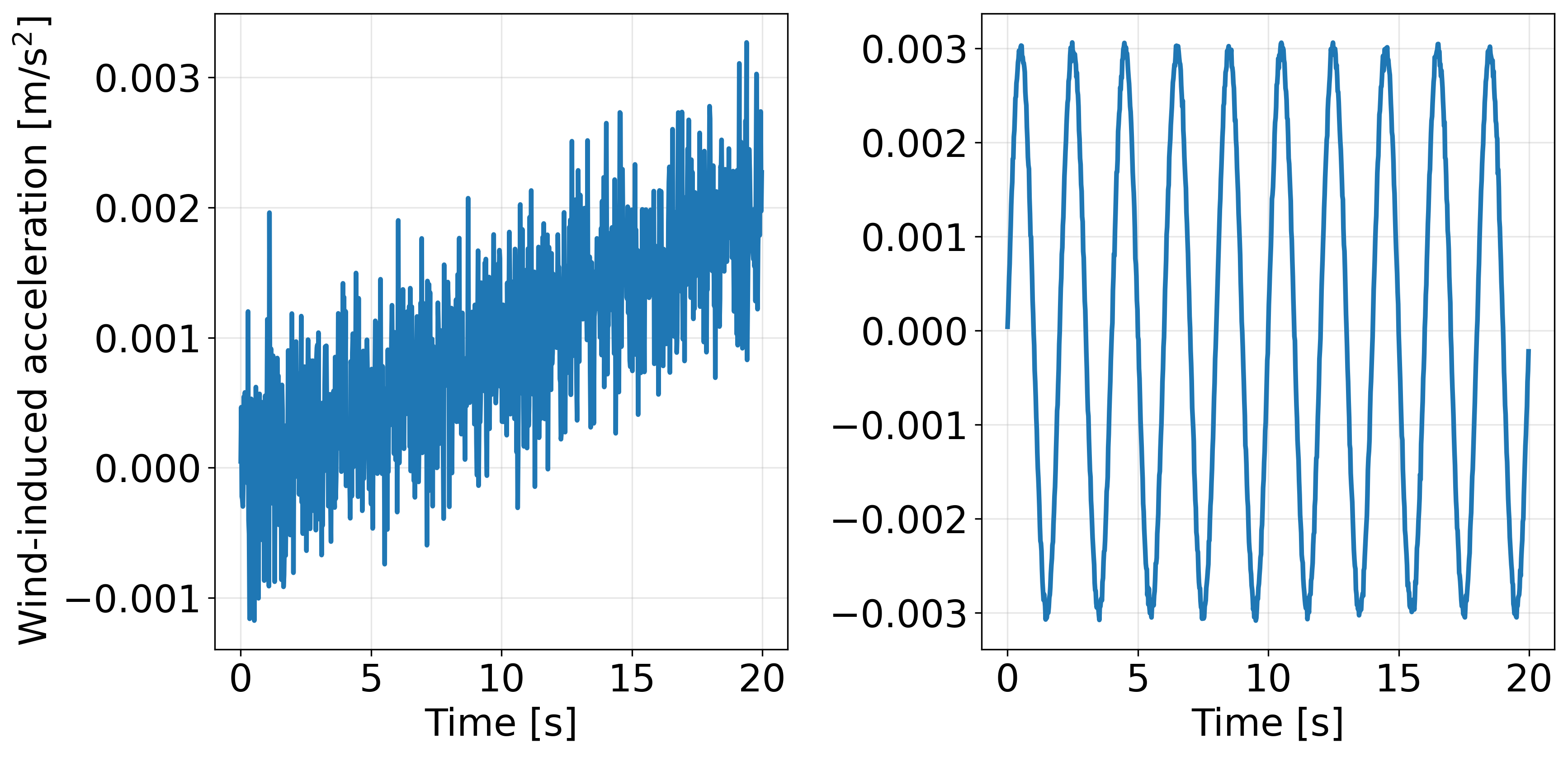
Figure 2: Visualization of the 2D quadrotor simulation platform employed for empirical validation.
Disturbances are injected at the acceleration level along the ft=f+rt3-axis to simulate real-world phenomena such as wind or dynamic payloads. Performance metrics include average Euclidean tracking error over multiple runs.
Baselines and Ablation
Comparisons are made against: classical MPC (nominal model only), neural MPC (residual model sans time embedding and two-timescale updates), and two T2S-MPC ablations (removing either time embedding or two-timescale updates). All methods share a standardized control frequency (50 Hz), prediction horizon (ft=f+rt4), and cost structure.
T2S-MPC demonstrates marked gains in both stabilization and trajectory tracking tasks, consistently achieving lower error across all disturbance regimes. Strong numerical results are reported: in stabilization, T2S-MPC yields ft=f+rt5 error under linear drift and ft=f+rt6 under periodic disturbance, outperforming both baselines and ablations.
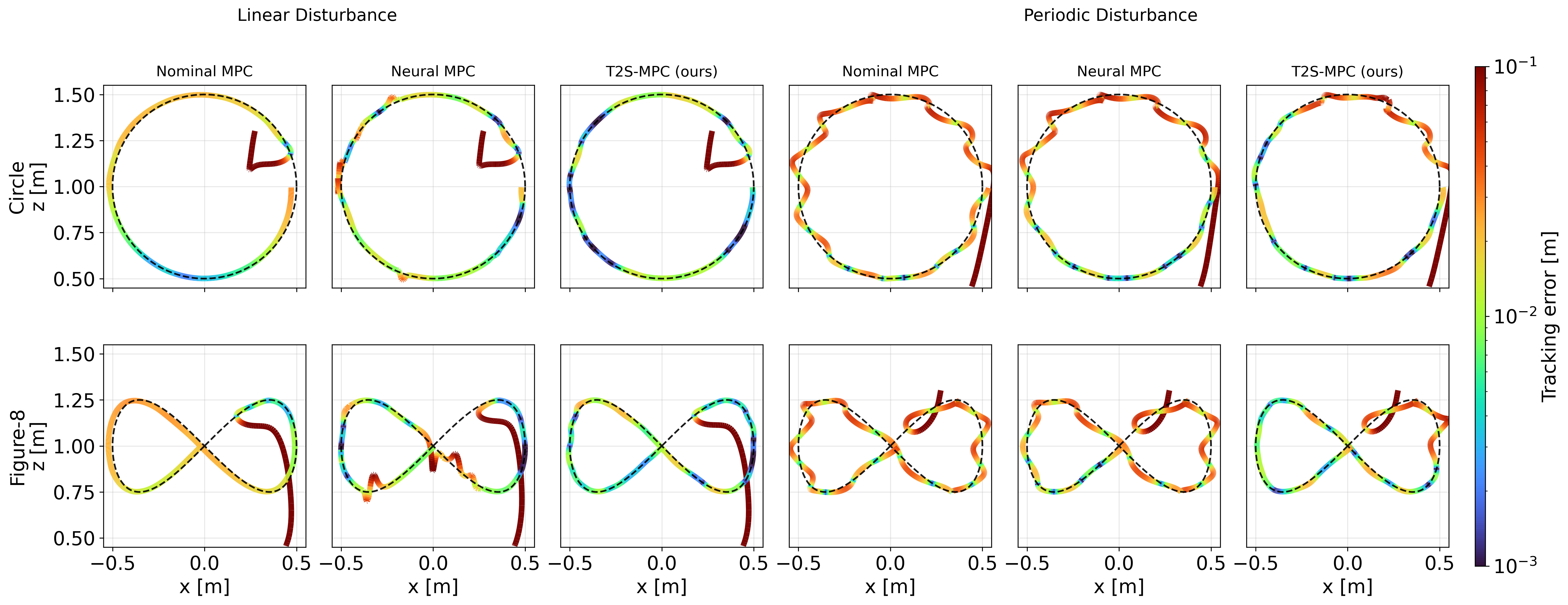
Figure 3: Trajectory tracking performance of T2S-MPC compared to baselines and ablated variants, evidencing reduced deviation and robust adaptation under time-varying disturbances.
In trajectory tracking, T2S-MPC achieves up to 20% reduction in average error relative to neural MPC, with superior robustness to both circular and figure-eight references under all disturbance types.
Robustness and Generalization
Through a disturbance ablation study, T2S-MPC maintains performance across wide-ranging magnitudes and periods without hyperparameter retuning, evidencing strong generalization. Notably, response is stable even as disturbance strength increases or as the form of drift changes (e.g., polynomial, stepwise).
Computation Efficiency
Despite increased parameterization due to time embedding, the two-timescale update scheme yields comparable or improved computational efficiency relative to single-scale neural MPC, supporting real-time feasibility (average update times: ~1022 ms for T2S-MPC versus 1268 ms for neural MPC).
Implications and Future Directions
T2S-MPC's explicit temporal conditioning and hierarchical update mechanism constitute a substantive methodological advance, facilitating adaptation to fundamentally unpredictable nonstationarity without structural assumptions, offline meta-learning, or disturbance-specific tuning. Practically, this enables deployment in environments with diverse, evolving dynamics (aerial robots, ground platforms, actuator degradation scenarios). Theoretically, T2S-MPC motivates renewed investigation into representation learning for online adaptive control, particularly regarding the granularity and structure of time embeddings, stability analysis under more aggressive disturbance profiles, and integration with probabilistic uncertainty quantification (e.g., Bayesian neural networks, Gaussian processes).
Anticipated future developments include extension to high-dimensional robotic platforms, increased robustness to high-frequency disturbances, and hybridization with meta-learning and regret-minimization frameworks for provable performance guarantees in unknown nonstationary environments.
Conclusion
T2S-MPC presents a comprehensive framework for online adaptive MPC in time-varying dynamical systems, using explicit time embedding and a two-timescale neural residual update protocol. Empirical evaluations on a quadrotor testbed establish superior adaptation, control accuracy, and robustness across a spectrum of nonstationary scenarios. The approach offers strong practical utility for autonomous systems facing diverse temporal perturbations and provides a foundation for advanced research in adaptive learning-based control.