- The paper introduces a minimal model showing that angular-recoil feedback from a movable scatterer promotes self-selected chiral rotation in WGM resonators.
- The study reveals that Doppler-induced asymmetry leads to a supercritical Z2 bifurcation with an instability threshold scaling proportional to m⁻².
- Optical signatures, such as Doppler-split backscattered spectra, provide clear evidence of the emerging mechanical chirality and nonreciprocal behavior.
Self-Generated Chiral Rotation in Whispering-Gallery Optomechanics
Introduction and Motivation
This research addresses the dynamics of whispering-gallery-mode (WGM) resonators when the angular coordinate of a localized scatterer becomes a mechanical variable. Traditionally, WGM mode splitting arises from static defects that passively couple clockwise (CW) and counterclockwise (CCW) optical modes. Here, the scatterer is endowed with mechanical mobility, creating an active angular-recoil backaction pathway. The central inquiry is whether reciprocal optical pumping—equal bidirectional drive without externally imposed handedness—can induce spontaneous mechanical chirality, namely, self-selected unidirectional rotation in an initially achiral resonator.
Minimal Model and Angular-Recoil Coupling
The theoretical framework consists of a single WGM doublet (a+, a−), driven reciprocally and coupled via a movable scatterer at angular position ϕ. The interaction Hamiltonian incorporates the angular-dependence through e2imϕ phase factors. Each circulation-changing photon transfer yields a mechanical recoil of ±2mℏ—rendering every backscattering process physically significant for the scatterer's angular momentum.
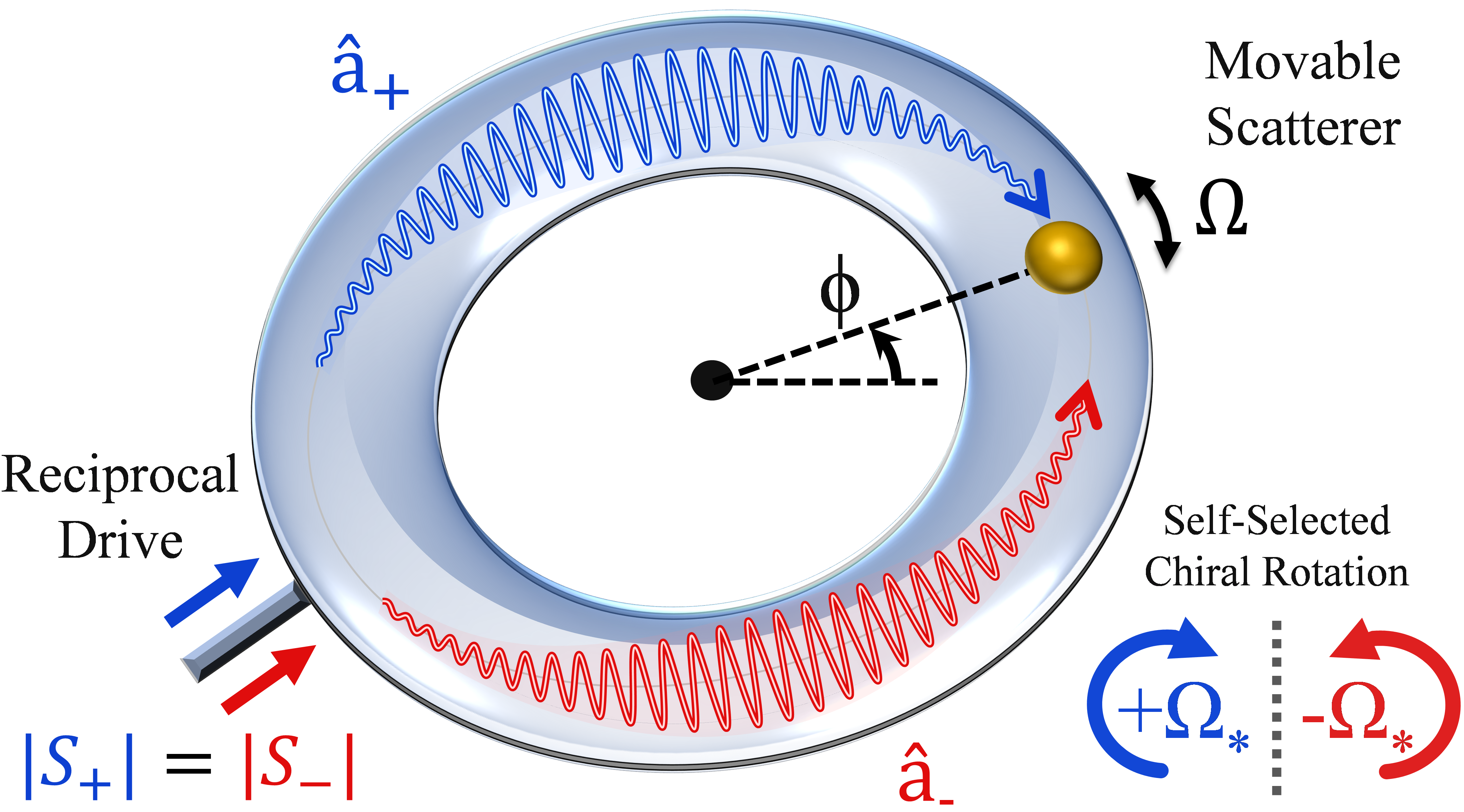
Figure 1: Schematic illustration of angular-recoil backaction in a WGM resonator. The movable scatterer couples CW and CCW modes, with each scattering event transferring quantized angular momentum and inducing rotational Doppler shifts.
This angular-recoil channel distinguishes itself from passive mode-splitting, as a rotating scatterer produces asymmetric Doppler shifts in the scattering rates. The feedback mechanism from these Doppler shifts changes the net optical torque, manifesting an instability above a critical drive threshold.
Reciprocal Backaction, Instability, and Threshold Scaling
Adopting the weak-scattering limit (J≪γ), all optical and mechanical rates are much slower than the cavity linewidth. Reciprocal bidirectional driving ensures that at rest (Ω=0), no preferred rotation emerges; both scattering channels are balanced. However, finite angular velocity introduces a Doppler shift, making one channel closer to resonance and the other farther. The resulting torque is odd in Ω, and the gradient at Ω=0 determines stability.
The system exhibits a dynamical instability characterized by negative angular friction for positive detuning (Δ>0), thereby amplifying any infinitesimal seed velocity. The critical photon number a−0 for instability scales as a−1, with both the recoil quantum and Doppler shift proportional to the WGM azimuthal index a−2.
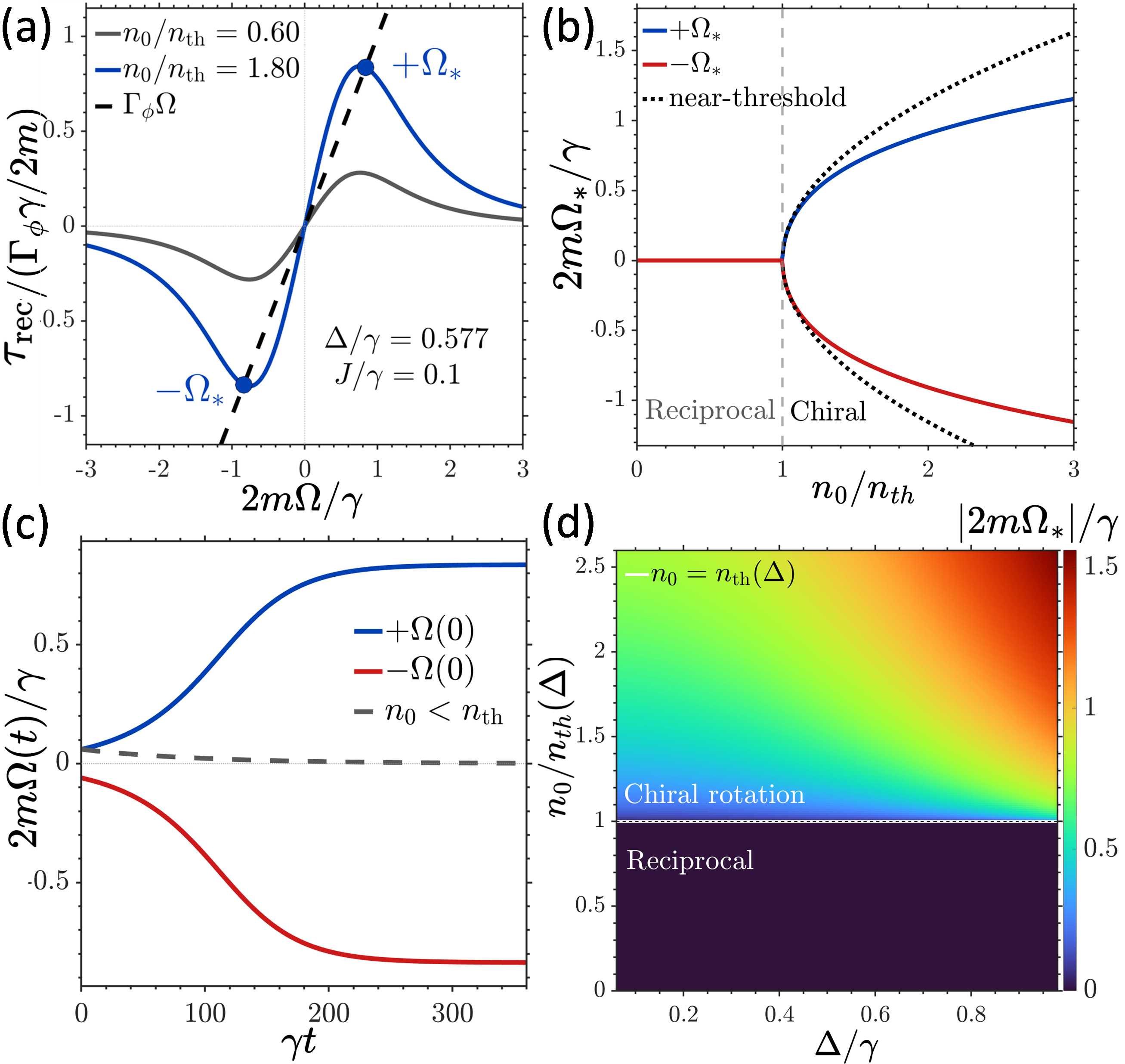
Figure 2: The reciprocal angular-recoil instability: (a) Optical torque versus Doppler shift, highlighting the phase transition from reciprocal (a−3) to chiral (a−4) rotation; (b) Steady-state angular velocity above threshold; (c) Time-domain evolution; (d) Instability phase diagram in drive versus detuning.
Above threshold, the rotor dynamics bifurcate into two symmetry-related steady states, each corresponding to finite CW or CCW rotation. The bifurcation is a supercritical a−5 transition, and the saturation mechanism is rooted in the Doppler detuning that limits further amplification.
Optical Signature and Directional Readout
The emergent mechanical chirality induces distinct optical signatures. Weak-probe scattering in either direction produces Doppler-split backscattered spectra, with resonance centers shifted oppositely by the self-selected angular velocity. The normalized backscattering asymmetry (a−6) becomes finite only in the chiral phase, providing a direct observable of the mechanical state. Maximum asymmetry scales with photon flux, toggling precisely at instability onset.
(Figure 3)
Figure 3: Optical characterization of the mechanically chiral phase: (a) Direction-dependent backscattered spectra; (b) Backscattering asymmetry versus probe detuning; (c) Maximum asymmetry as a function of intracavity photon number.
This effect is distinguishable from externally imposed rotation or conventional optical isolators; here, the optical asymmetry is intrinsically tied to the spontaneously selected mechanical handedness, not an external bias.
Implications and Extensions
The study formulates a minimal mechanism-level theory for optomechanical chirality in WGM resonators. By stripping away extraneous symmetry-breaking effects (standing-wave trapping, one-sided propulsion, strong multimode scattering, externally imposed rotation), it isolates angular-recoil feedback as the sole source of spontaneous mechanical selection. The threshold scaling and bifurcation structure strongly constrain design parameters for experimental implementation, emphasizing the importance of minimizing moment of inertia and angular damping.
Practically, this mechanism provides a new approach for generating autonomous rotation in nanomechanical and photonic systems without external bias. It also opens routes for direction-dependent optical readout and discrimination via Doppler-split signatures. Theoretically, the results expand the taxonomy of dynamical symmetry breaking in hybrid optomechanical platforms, establishing mechanical velocity as a self-selected order parameter distinct from conventional optical circulation and Kerr-induced bistability.
Future developments could incorporate noise-driven switching between chiral states, non-Markovian dissipation, strong-scattering effects, and platform-tailored extensions for engineered angular pinning or multimode backaction. The regime's integration prospects span quantum photodetection, nonreciprocal device engineering, and autonomous nano-actuators.
Conclusion
This paper demonstrates that WGM mode splitting, when mediated by a mechanically active scatterer, becomes a dynamical backaction channel capable of spontaneous chiral rotation. Reciprocal optical pumping, under suitable detuning, destabilizes the nonrotating state and selects one of two symmetry-related mechanical velocities. The self-generated chirality manifests as Doppler-shifted direction-dependent optical responses, providing an observable signature of the emergent mechanical order parameter. These findings transform passive defect-induced mode splitting into a minimal, autonomous mechanism for chiral optomechanical motion, broadening the conceptual and practical paradigm of driven nonlinear photonics and hybrid systems.