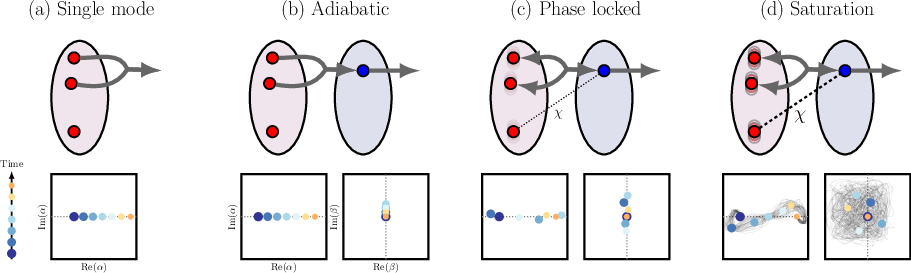
- The paper shows that nonadiabatic buffer dynamics, cross-Kerr nonlinearities, and dephasing induce chaotic bit-flip events that break the expected exponential error suppression.
- It employs quantum trajectory simulations, semiclassical analysis, and Liouvillian spectral methods to delineate distinct dynamical regimes in two-mode cat qubit systems.
- Experimental comparisons validate that full two-mode models are crucial for accurately predicting bit-flip behaviors and guiding robust quantum error correction architecture.
Bit Flip Saturation and Chaotic Dynamics in Dissipative Cat Qubits
Introduction
The paper "Bit flips, saturation, and quantum chaos in dissipative cat qubits" (2605.24100) provides a rigorous analysis of the mechanisms limiting the error protection of dissipative cat qubits. The primary focus is the saturation of the bit-flip error suppression at large photon numbers, an important problem for hardware-efficient quantum error correction with bosonic encodings. Through a combination of quantum trajectory simulations, semiclassical analysis, Liouvillian spectral methods, and direct comparison with experiment, this work reveals that the interplay between nonadiabatic buffer dynamics, nonlinearities (especially cross-Kerr), and dephasing leads to chaotic dynamics during bit-flip events, resulting in breakdown of the exponential suppression of bit flips with increasing cat size.
Dissipative Cat Qubit Model and Dynamical Regimes
The physical implementation considered consists of a memory resonator hosting the quantum information, coupled to a strongly dissipative buffer cavity. The full quantum dynamics is governed by a two-mode Lindblad master equation that accommodates two-photon exchange, buffer and memory single-photon loss, dephasing, Kerr nonlinearities, and cross-Kerr coupling. Stabilization of the logical cat states is enabled by parametric driving and fast buffer dissipation.
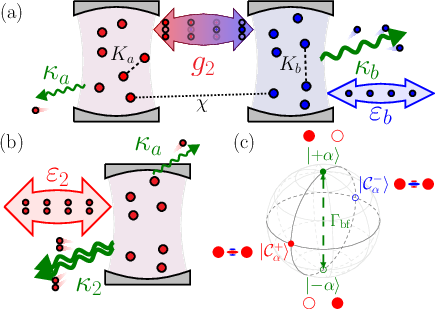
Figure 1: Pictorial description of the Hamiltonian and dissipators stabilizing cat states, depicting the memory (left) coupled to a buffer (right) via two-photon downconversion.
A critical theoretical prediction for idealized single-mode dissipative cats is exponential suppression of bit-flip errors as the cat size (photon number) increases, provided only single-photon loss and weak dephasing are present. However, the empirical breakdown of this regime—manifested as saturation of the bit-flip time—cannot be captured by such single-mode models, even with additional dissipation terms. This observation motivates the necessity for a detailed two-mode (memory+buffer) analysis across different dynamical regimes, determined by ratios between the buffer decay, nonlinearity strength, and dephasing.
Bit flips in this setting are rare two-mode processes, fundamentally involving both the buffer and memory. The analysis identifies several distinct dynamical regimes:
Quantitative Analysis of Bit-Flip Scaling and Saturation
Comprehensive numerical analysis confirms that in the ideal (fully adiabatic, weakly nonlinear) limit, single-mode predictions are accurate: the bit-flip rate decreases exponentially with increasing mean photon number. However, in experimentally relevant nonadiabatic and nonlinear/cross-Kerr regimes, this scaling fails. The key findings include:
- Deviation from Adiabaticity: Nonadiabatic effects alone degrade but do not destroy exponential scaling; bit-flip suppression persists for a range of parameters as long as reflection symmetry and phase-locking hold.
- Cross-Kerr Nonlinearity + Dephasing: The co-presence of these interactions with nonadiabaticity produces strong saturation—beyond a critical cat size, further increases in photon number do not appreciably suppress bit-flip errors.
- Kerr Nonlinearity in the Memory: Even small Kerr in the memory, particularly with positive sign, leads to optical bistability and a rapid collapse in logical qubit fidelity at high drive.
Exponential suppression of bit-flip errors is thus shown to be a fragile property, contingent on an intricate symmetry of the joint two-mode system.
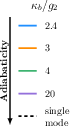
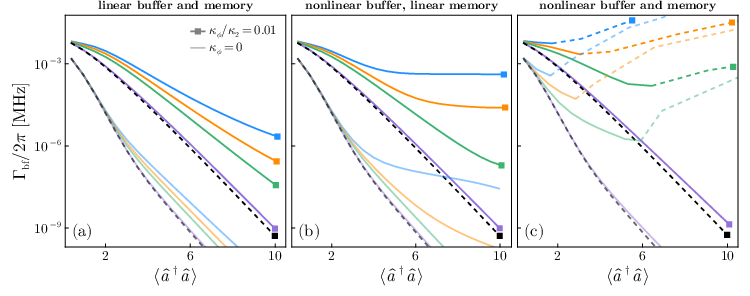
Figure 3: Bit-flip error rate Γbf as a function of memory photon number across different regimes—demonstrating saturation and deviation from single-mode exponential suppression when cross-Kerr and dephasing are present.
Trajectory and Spectral Characterization of Bit-Flip Events
Quantum trajectory simulations reveal the anatomy of a bit-flip event in different regimes. In the phase-locked regime, switches between logical states occur along highly constrained phase-space paths, with fluctuation and vacuum phases clearly separated. Onset of cross-Kerr and dephasing dismantles this structure: bit flips become irregularly long, chaotic excursions in phase-space where the system explores delocalized regions, and transiently loses phase-locking.
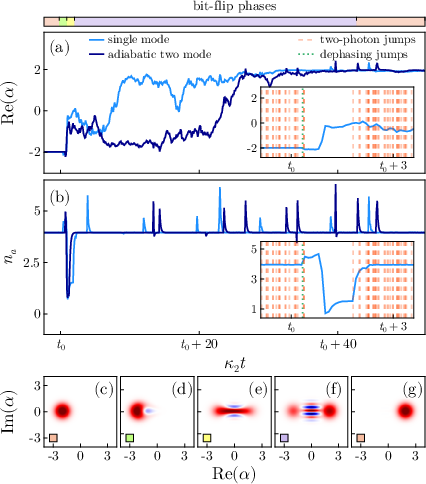
Figure 4: Quantum trajectory ∣Ψ(t)⟩ across a bit flip, showing clear multi-stage structure in the adiabatic regime.
Liouvillian spectral analysis, particularly via the Spectral Statistics of Quantum Trajectories (SSQT), elucidates this transition. In regular, phase-locked dynamics, only a handful of low-lying eigenmodes are relevant during a bit flip; in the chaotic regime, bit-flip events activate a macroscopic number of Liouvillian eigenmodes, many with high entropy and large imaginary/real eigenvalue ratios, characteristic of spectral chaos and indicative of delocalization in Liouville space.
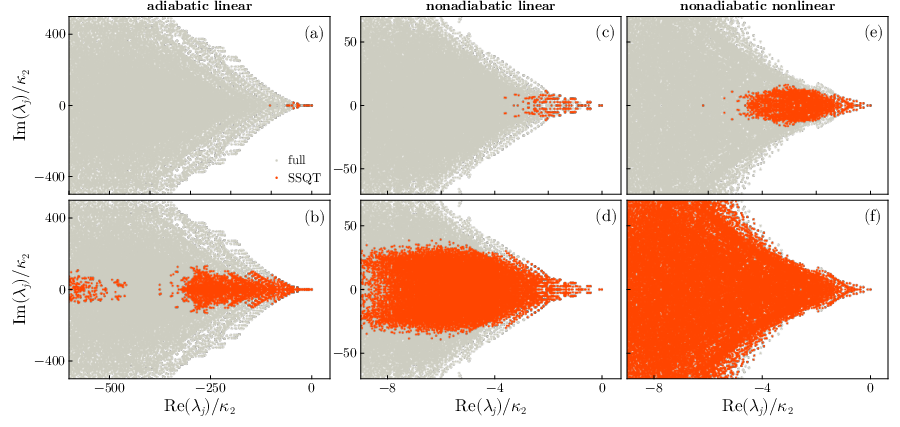
Figure 6: Liouvillian eigenvalues participating in dynamics during a bit-flip event; the spectrum's spread and delocalization sharply increase in the chaotic nonadiabatic, nonlinear regime.
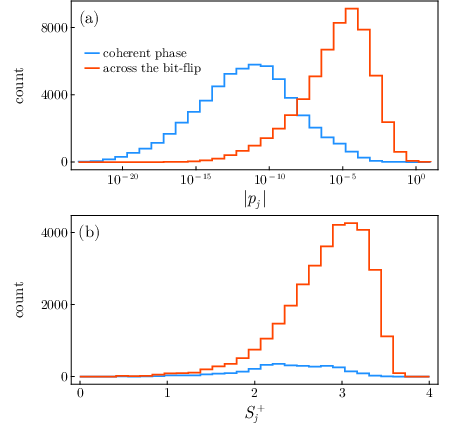
Figure 8: Distribution of quasi-probabilities and entropy of Liouvillian eigenstates, highlighting dramatic spreading and mixedness in chaotic switching events.
Reflection Symmetry, Phase Locking, and the Chaotic Transition
Semiclassical analysis demonstrates that for linear, weakly dissipative two-mode cats, a reflection symmetry of the semiclassical equations of motion and the Liouvillian ensures phase locking between the buffer and memory, independently of adiabaticity. This phase locking is lost precisely when nonlinearities (cross-Kerr, Kerr memory) or dephasing become strong enough to overwhelm the dissipative locking mechanisms, enabling chaotic dynamics during bit flips. Theoretical criteria delineating these transitions are derived both semiclassically and from spectral diagnostics.
Experimental Validation and Implications
The model's predictions are directly compared to recent experimental measurements of bit-flip errors in state-of-the-art superconducting cat qubits. It is shown that only the full two-mode model, incorporating nonadiabaticity, realistic cross-Kerr, and dephasing, quantitatively matches the observed bit-flip time saturation. Single-mode models overestimate coherence times by several orders of magnitude at large cat sizes.
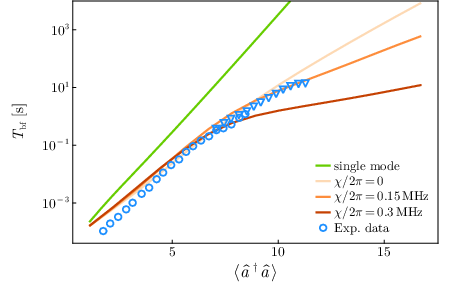
Figure 10: Comparison of simulated bit-flip times with experiment, demonstrating necessity of two-mode, nonlinear, and nonadiabatic theory for quantitative agreement.
The practical implication is that further improvements in error bias of dissipative cat qubits for quantum computing will require engineering parameter regimes that preserve phase-locking and minimize buffer-induced nonlinearities, as well as developing protocols and architectures robust to emergent chaotic dynamics.
Conclusion
This paper establishes that the experimentally observed saturation of bit-flip suppression in dissipative cat qubits is the macroscopic signature of chaotic dynamical processes activated by the combined presence of nonadiabatic buffer dynamics, cross-Kerr nonlinearity, and dephasing. The work provides a unified and technically grounded description of where single-mode models fail, and situates the discussion of bosonic error correction performance limitations within the broader theory of open quantum chaos. These results impose concrete limits and offer critical design insights for future bosonic quantum information architectures, motivating both engineering efforts to mitigate chaos-inducing terms and fundamental research on the interplay between symmetry, chaos, and quantum error correction.
References
See (2605.24100) and references therein for further theoretical and experimental background.