- The paper introduces a periodic Nieh-Yan coupling that modifies the Einstein-frame potential to improve natural inflation predictions.
- It employs a detailed transition to the Einstein frame and contrasts pure Nieh-Yan with combined Ricci-scalar and Nieh-Yan scenarios.
- Joint couplings generate plateau potentials that restore slow-roll conditions and align inflationary observables with CMB constraints.
Natural Inflation in Metric-Affine Gravity with Nieh-Yan Coupling
Introduction and Motivation
This work revisits the natural inflation paradigm within the context of metric-affine gravity (MAG), focusing explicitly on periodic non-minimal couplings between the inflaton and the Nieh-Yan topological term. While the original natural inflation model, based on a pseudo-Nambu-Goldstone boson (PNGB) potential, elegantly suppresses higher-order corrections, it is tightly constrained (and disfavored) by recent CMB observations. Prior extensions—especially those leveraging non-minimal couplings to the Ricci scalar within both metric and Palatini formulations—have provided partial reconciliation with data, but often require trans-Planckian scales or large coupling constants (Racioppi et al., 2024, Bostan et al., 25 Nov 2025, Antoniadis et al., 2018). The present analysis examines whether the introduction of a periodic coupling to the Nieh-Yan term—available in affine geometric settings with torsion—can rescue natural inflation, particularly in the sub-Planckian periodicity regime and with moderate non-minimal couplings.
The action is formulated in the Jordan frame with three non-minimal coupling functions: f(ϕ) to the Ricci scalar, f~(ϕ) to the Holst invariant, and fNY(ϕ) to the Nieh-Yan term. The focus is on scalar inflationary models, specifically with the canonical natural inflation potential
V(ϕ)=Λ4[1+cos(ϕ/M)]
where M is the periodicity scale. Two key coupling scenarios are considered:
- Nieh-Yan-only coupling: f(ϕ)=1, f~(ϕ)=0, fNY(ϕ)=ξNYΩ(ϕ),
- Ricci-scalar plus Nieh-Yan: f(ϕ)=1+ξΩ(ϕ), fNY(ϕ)=ξNYΩ(ϕ), with f~(ϕ)0.
The derivation proceeds with transition to the Einstein frame, following standard manipulation in metric-affine gravity, with specific attention to the non-trivial kinetic normalization induced by the scalar-torsion couplings.
Dynamical Effects of Nieh-Yan Coupling
The non-minimal coupling to the Nieh-Yan term yields a field-dependent kinetic function of the form
f~(ϕ)1
for vanishing Ricci scalar and Holst couplings (f~(ϕ)2, f~(ϕ)3). The key dynamical effect is the flattening and stretching of the Einstein-frame potential, which becomes increasingly linear as f~(ϕ)4 grows, away from stationary points.
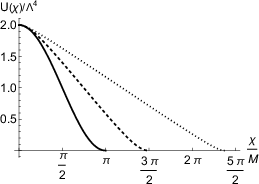
Figure 1: f~(ϕ)5 vs. f~(ϕ)6 for various values of f~(ϕ)7 with f~(ϕ)8. Increasing the Nieh-Yan coupling yields a linearized regime.
This linearization has direct implications for resulting scalar spectral index (f~(ϕ)9) and tensor-to-scalar ratio (fNY(ϕ)0). In the strong coupling (large fNY(ϕ)1) limit, inflationary predictions converge to those of linear inflation, systematically moving away from the parameter region favored by current CMB observations. The fNY(ϕ)2–fNY(ϕ)3 plane, for both 50 and 60 e-folds, reveals that pure Nieh-Yan natural inflation is incompatible with combined BICEP/Keck and ACT constraints, even as fNY(ϕ)4 (the periodicity in units of fNY(ϕ)5) is varied.
Joint Ricci Scalar and Nieh-Yan Coupling: Viable Sub-Planckian Natural Inflation
When a non-minimal coupling to the Ricci scalar is added fNY(ϕ)6, the model's phenomenology changes significantly. Notably, for fNY(ϕ)7 and sub-Planckian periodicity fNY(ϕ)8, the Einstein-frame potential develops a plateau structure, with the Nieh-Yan coupling extending the flat region and lowering the peak.
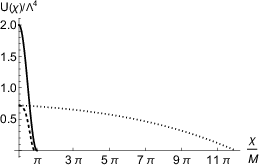
Figure 3: fNY(ϕ)9 vs. V(ϕ)=Λ4[1+cos(ϕ/M)]0 illustrating the comparative flattening for standard natural inflation, Palatini-type non-minimal coupling, and combined Palatini plus Nieh-Yan couplings for V(ϕ)=Λ4[1+cos(ϕ/M)]1.
For this parameter regime, inflationary observables such as V(ϕ)=Λ4[1+cos(ϕ/M)]2, V(ϕ)=Λ4[1+cos(ϕ/M)]3, and running V(ϕ)=Λ4[1+cos(ϕ/M)]4 can fall within the observed ranges, provided V(ϕ)=Λ4[1+cos(ϕ/M)]5 is moderately large (V(ϕ)=Λ4[1+cos(ϕ/M)]6) and the energy scale V(ϕ)=Λ4[1+cos(ϕ/M)]7. Numerical analysis establishes that for vanishing or very small V(ϕ)=Λ4[1+cos(ϕ/M)]8, slow-roll is violated due to large V(ϕ)=Λ4[1+cos(ϕ/M)]9, but increasing M0 rapidly restores compatibility with slow-roll and hence with CMB constraints.
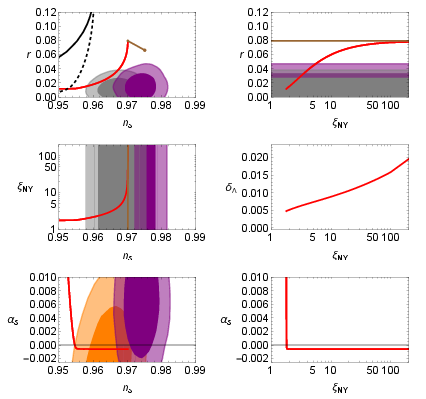
Figure 5: M1 vs. M2, M3 vs. M4, and other relevant observable correlations for M5, M6, and M7, showing entry into the favored CMB region as M8 increases.
Compatibility with CMB anisotropy measurements (Planck, BICEP/Keck, ACT) is thus achieved without recourse to trans-Planckian M9, large couplings, or higher-derivative operators. The combined model robustly interpolates between standard Palatini natural inflation and the linear inflation regime, with the latter recovered for very large f(ϕ)=10.
Implications and Future Directions
The findings demonstrate that a periodic Nieh-Yan coupling, in synergy with a periodic Ricci-scalar coupling, can both flatten the inflaton potential and bring natural inflation into agreement with data for sub-Planckian periodicities and order-unity non-minimal couplings. This mechanism provides an alternative to previous approaches that relied on trans-Planckian scales or an uncomfortably large non-minimal coupling hierarchy.
The capability to engineer viable potentials with only two degrees of freedom (graviton and PNGB inflaton), moderate f(ϕ)=11 and f(ϕ)=12, and without higher-derivative actions is theoretically appealing. It also leverages the geometric latitude of MAG frameworks, where topological and torsion-induced invariants such as Nieh-Yan can have direct cosmological phenomenology. This opens further avenues to explore inflationary dynamics via other affine, torsional, and parity-odd invariants—potentially constraining torsion signatures via CMB or seeking unique predictions in primordial tensor spectra.
Conclusion
By incorporating a periodic non-minimal coupling to the Nieh-Yan term into the natural inflation scenario in metric-affine gravity, and in conjunction with a Ricci-scalar periodic coupling, it is possible to obtain observationally viable inflationary predictions for sub-Planckian decay constants and moderate coupling strengths. The scenario does not alleviate the tension for Nieh-Yan coupling alone, but achieves consistency with CMB data for a physically motivated set of parameters once the Palatini-type scalar-curvature coupling is included. These results establish the phenomenological relevance of topological invariants in early-universe cosmology within extended geometric frameworks.
References: (2605.23827, Racioppi et al., 2024, Bostan et al., 25 Nov 2025, Antoniadis et al., 2018), and related works.