- The paper demonstrates that the inverse Born series (IBS) can reconstruct low-contrast potentials from phaseless data, though its convergence is reduced for high-contrast settings.
- It introduces recursive and Fourier-based algorithms that significantly improve computational efficiency and stability in recovering scattering potentials.
- The study shows that polarization-based methods enable effective phase recovery from scattered-field data, yielding enhanced reconstruction accuracy compared to total field approaches.
Reconstruction Methods for Inverse Scattering Problems with Phaseless Data
Problem Formulation and Context
The paper "Reconstruction methods for inverse scattering problems with phaseless data" (2605.23784) addresses the inverse scattering problem in the context of the Schrödinger equation, focusing on the recovery of the scattering potential V(x) when measurements are restricted to field intensities, i.e., phaseless data. The lack of phase information presents unique challenges, with severe non-uniqueness and ill-posedness issues that distinguish it from conventional inverse scattering problems—well-studied in acoustic and electromagnetic contexts [coltonInverseAcousticElectromagnetic2019, isakovInverseProblemsPartial2017].
The paper considers several measurement modalities: the total field, its far-field intensity, and the scattered field intensity. Three primary reconstruction strategies are developed, aiming to overcome the intrinsic difficulties arising from the loss of phase information.
Theoretical Developments: Inverse Born Series
Central to the paper's methodology is the inverse Born series (IBS), which provides an explicit mathematical framework for reconstructing the potential V from measured data. The IBS enables expressing the solution as a convergent series in Banach space, with formal recursive definitions of multilinear operators Km whose implementation relies on the pseudoinversion of the first-order operator K1 and subsequent composition of higher-order terms.
A critical result is the analysis of the convergence radius for the IBS in the phaseless setting. The paper demonstrates that, for phaseless data, the bounds on forward operators differ from those in the phase-aware scenario. Specifically, the convergence radius and the admissible order of the IBS are substantially reduced, reflecting increased nonlinearity and decreased stability.
Methods for Phaseless Total Field Data
For phaseless measurements of the total field ∣u∣, the paper derives the IBS and adapts its implementation to both general and far-field settings.
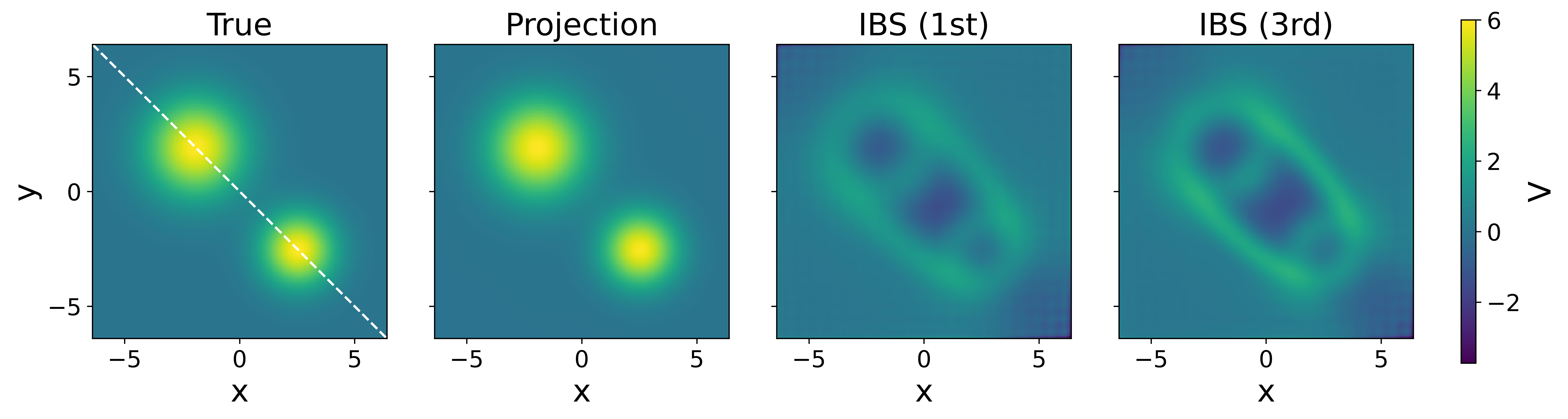
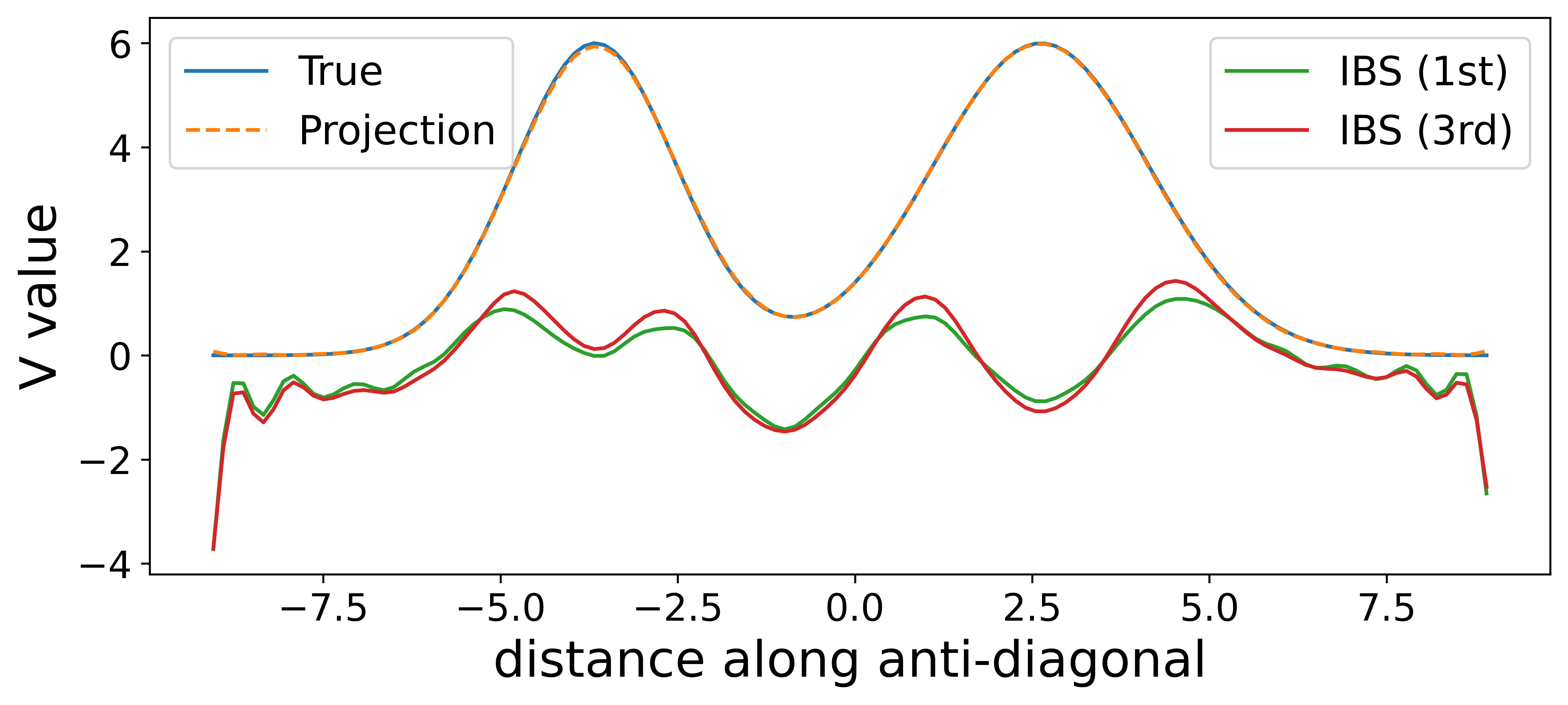
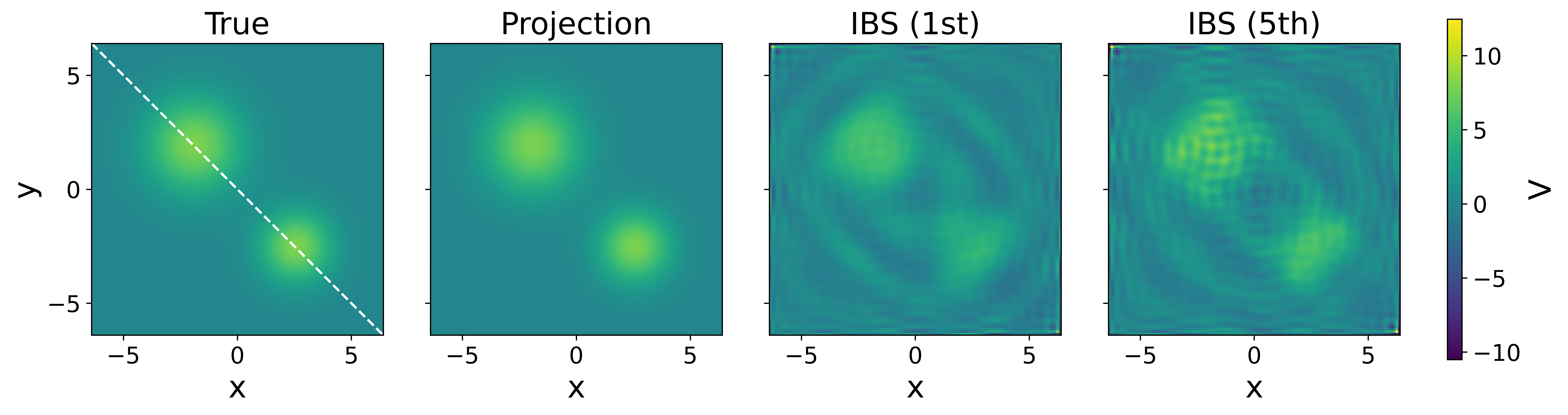
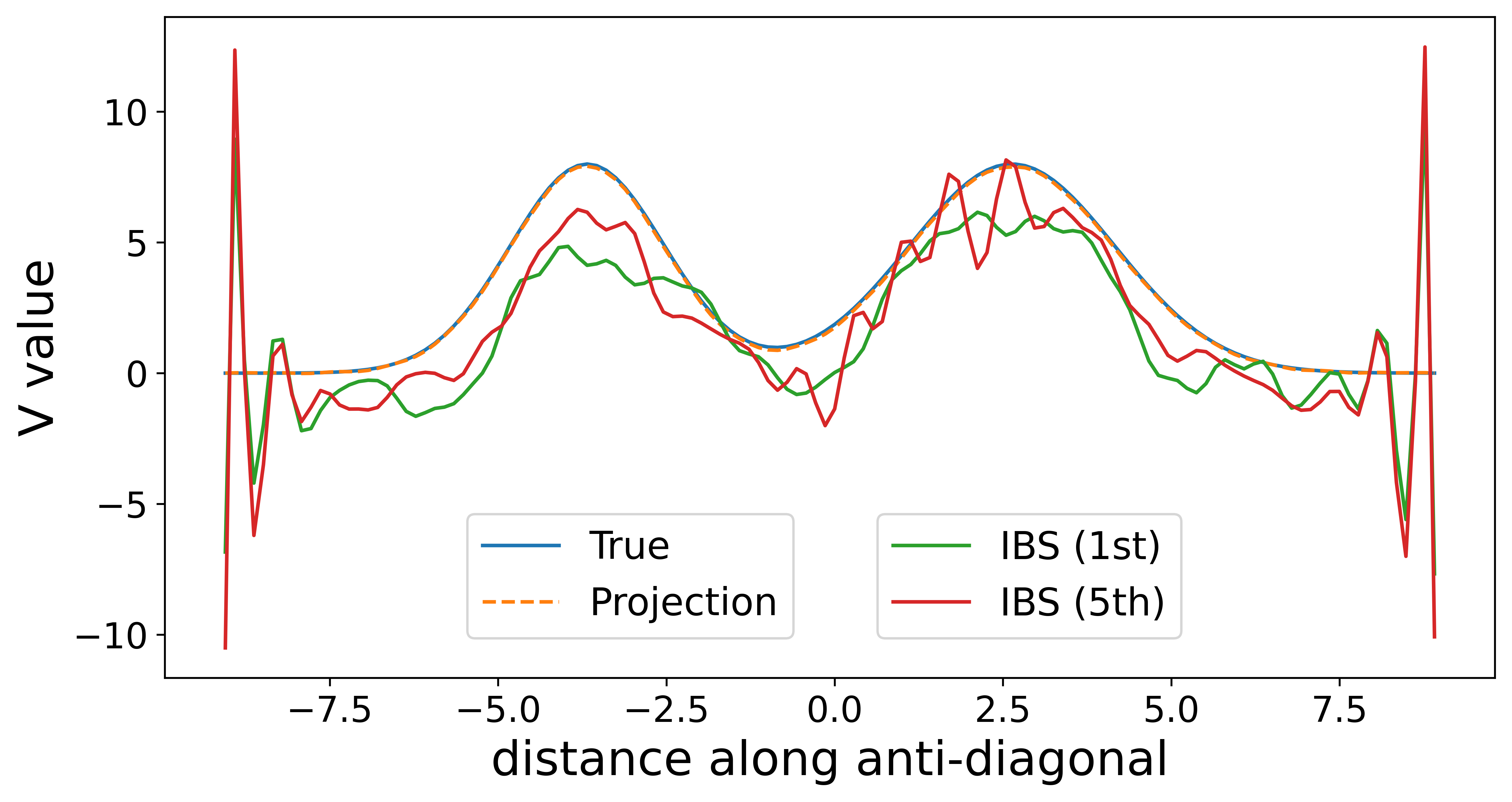
Figure 1: Reconstruction of V Using Phase Data for a low-contrast disk potential.
A significant innovation is an efficient recursive algorithm for computing the multilinear operators Kn, which reduces computational cost from O(n2) to O(n) convolution operations. In the far-field limit, the authors develop a Fourier-based approach that exploits scattering reciprocity between incident and observation directions. This allows direct, stable recovery of Fourier coefficients of V, provided certain ill-conditioning criteria are met.
Figure 2: Reconstruction of V0 Using Phase Data for a high-contrast disk potential.
Numerical experiments with disk and Gaussian mixture potentials validate these methods. Strong numerical results for low-contrast potentials are reported: relative errors with phaseless data are typically 3–4% higher than with full phase, and the rank of the IBS must be carefully managed to ensure convergence. For high-contrast settings, IBS diverges rapidly, consistent with theoretical predictions regarding the reduced convergence radius.
Methods for Far-Field Phaseless Data
The Fourier-based strategy is further explored in the far-field regime, where the scattering amplitude is directly related to the Fourier transform of V1 via linearized Born approximation. By exchanging incident and observation angles and solving a V2 linear system, the method recovers nonuniform Fourier coefficients, with ill-conditioned directions efficiently filtered.
Figure 3: Reconstruction of V3 Using Phase Data for a low-contrast Gaussian mixture.
Figure 4: Reconstruction of V4 Using Phase Data for a high-contrast Gaussian mixture.
Numerical results show:
- Low-contrast potentials: Reconstruction errors for phaseless total field data remain below 6%.
- High-contrast potentials: Error exceeds 40% and IBS fails to converge.
The comparison between phase and phaseless modalities establishes that phaseless scattered-field data yields more accurate reconstructions than total-field data, due to the necessity of discarding ill-conditioned Fourier samples in the latter.
Polarization Methods for Phaseless Scattered Field Data
For phaseless scattered field data, unique recovery of V5 from V6 alone is not possible. The paper deploys a polarization identity, leveraging superpositions of incident plane waves with four distinct polarization parameters (V7). This enables probing different components of the scattering amplitude, facilitating recovery of both modulus and phase information in the Born approximation.
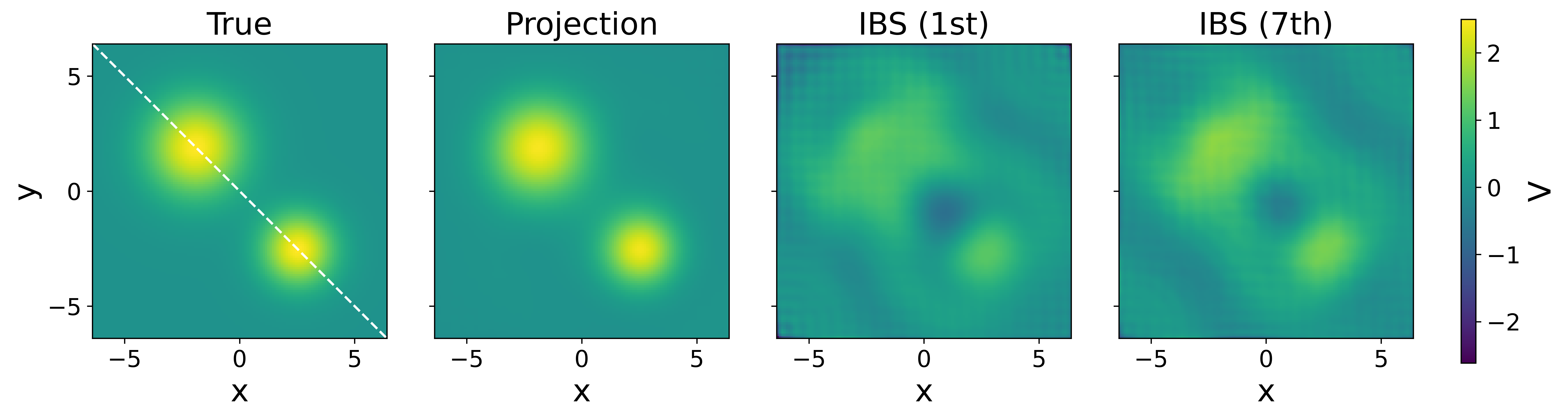
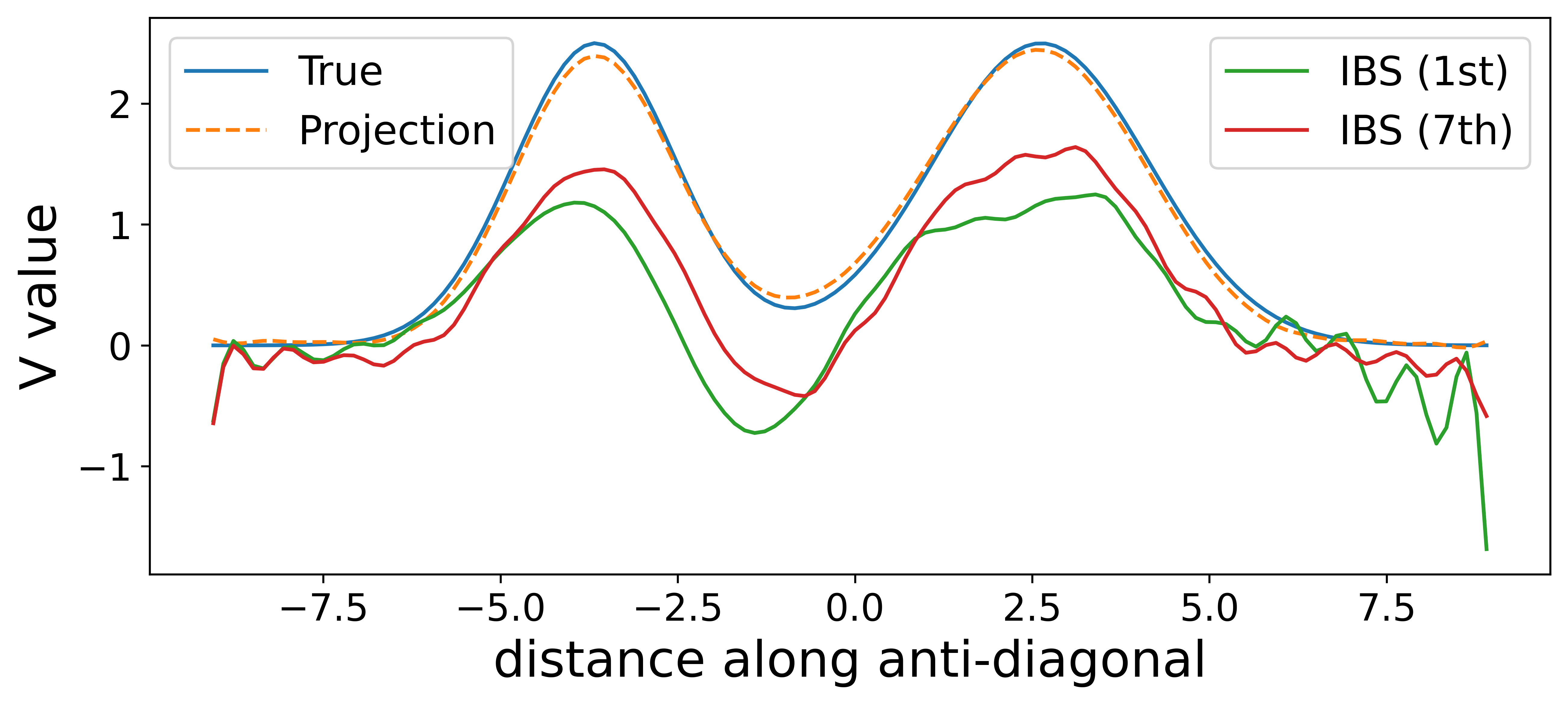
Figure 5: Reconstruction of V8 Using Phase Data in polarization-based method.
After an initial estimate of V9, the approach reconstructs approximate phase information, which is then used for IBS inversion as if phase data were available. Numerical implementations confirm improved accuracy relative to total-field phaseless reconstructions, especially in the far-field regime.
Figure 6: Reconstruction of Km0 Using Phase Data for high contrast with polarization-based method.
Numerical Implementation and Algorithmic Advances
Implementation details emphasize the efficient evaluation of forward and inverse solvers, exploiting FFT-based convolutions and NUFFT for nonuniform Fourier inversion. The algorithmic pipeline distinguishes three cases:
- Phase data: Direct pseudoinversion of Born operators; Fourier inversion for far-field.
- Phaseless total field: IBS with recursive Km1 computation; Fourier filtering for far-field.
- Phaseless scattered field: Polarization-based phase estimation, followed by IBS.
Numerical experiments reveal that for each modality, low-contrast potentials are reconstructable with high fidelity, while high-contrast settings lead to substantial IBS divergence.
Figure 7: Reconstruction of Km2 Using Phase Data for low-contrast disk under Fourier method.
Figure 8: Reconstruction of Km3 Using Phaseless Data for low-contrast disk under Fourier method.
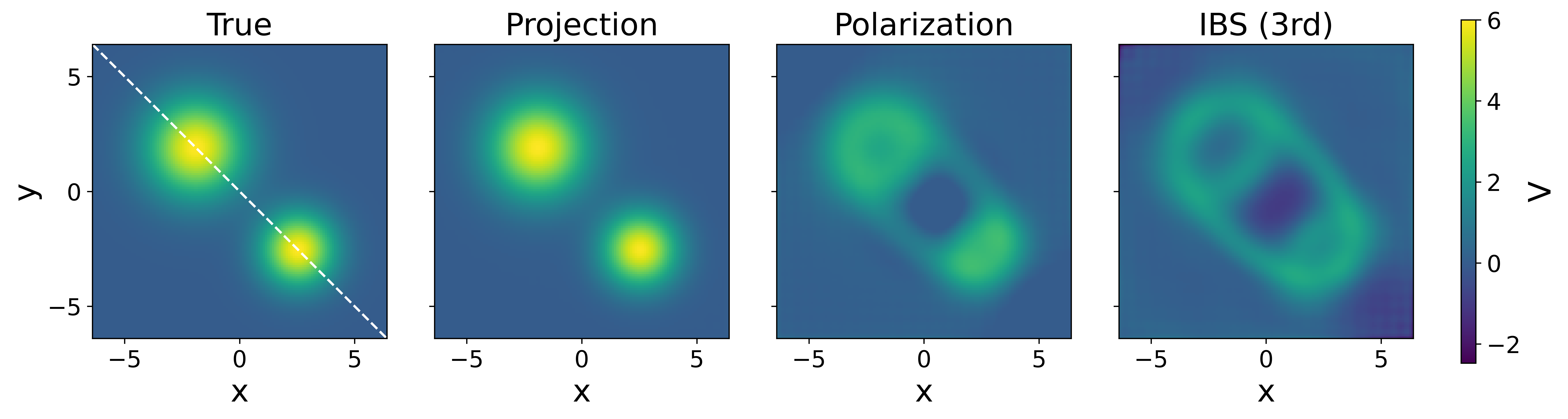
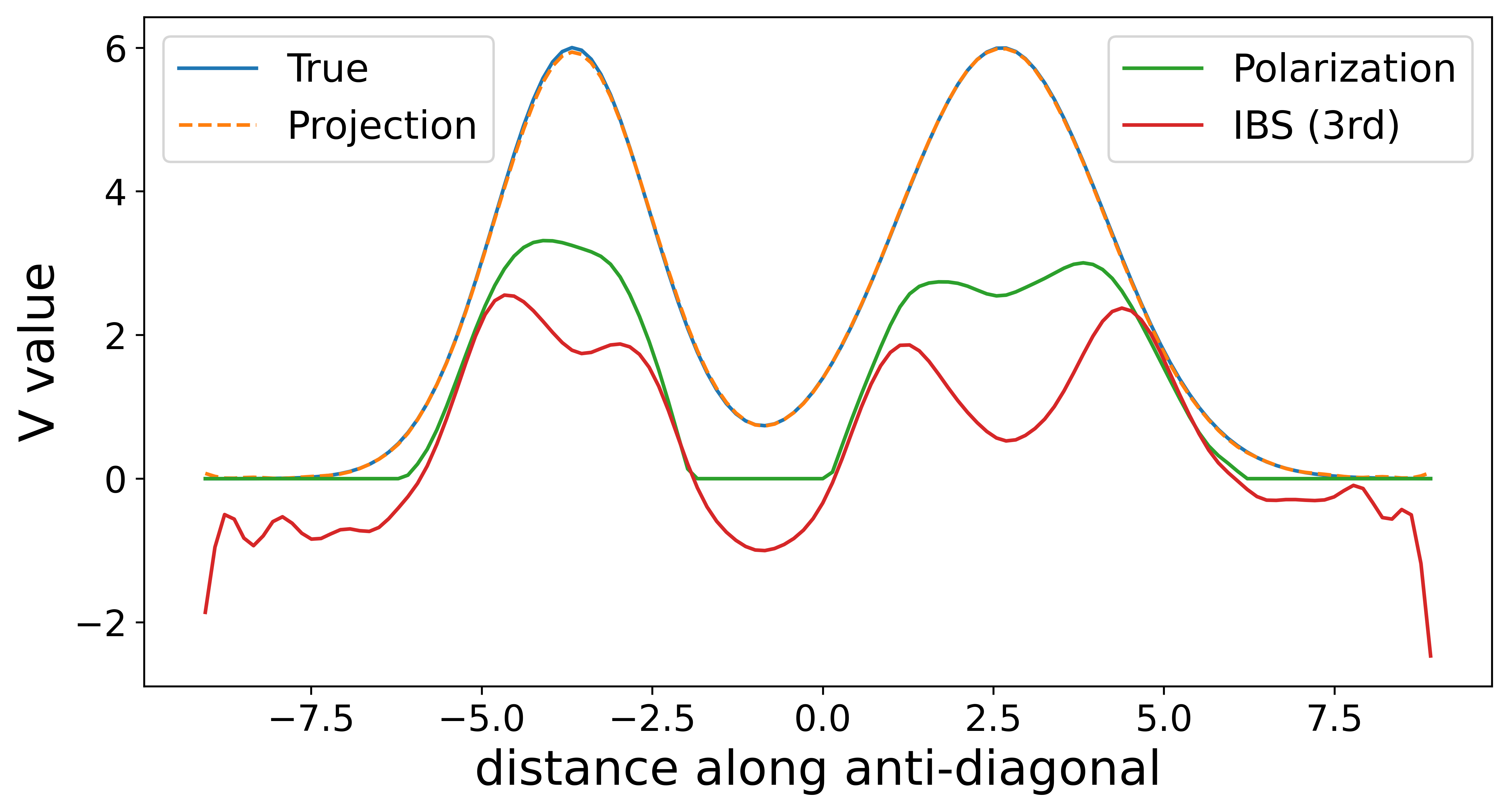
Figure 9: Reconstruction of Km4 Using Phase Data for high-contrast disk under Fourier method.
Figure 10: Reconstruction of Km5 Using Phaseless Data for high-contrast disk under Fourier method.
Implications, Limitations, and Future Directions
The results demonstrate that:
- IBS is robust for low-contrast potentials with phaseless data.
- Increased potential contrast reduces IBS convergence radius and algorithm stability.
- Phaseless scattered-field data are empirically superior to phaseless total field due to improved phase recoverability via polarization.
- Loss of phase imposes a strict limit on attainable resolution and accuracy.
- Recursive and Fourier-based algorithms are critically important for computational tractability and stability.
Figure 11: Reconstruction of Km6 Using Phase Data for low-contrast Gaussian mixture under Fourier method.
Figure 12: Reconstruction of Km7 Using Phaseless Data for high-contrast Gaussian mixture under Fourier method.
Practically, these frameworks are relevant for imaging modalities where phase detection is impossible, e.g., optical or X-ray scattering and certain remote sensing applications. Theoretically, the analysis of IBS convergence and non-uniqueness extends understanding in the inverse problems literature.
Future developments are likely to address:
- Extension of phaseless IBS to elasticity and nonlocal wave equations.
- Refined phase recovery from minimal polarization experiments.
- Integration of regularization, uncertainty quantification, and multi-frequency data to stabilize high-contrast reconstructions.
- Application to three-dimensional and non-smooth scattering domains.
Conclusion
This paper establishes rigorous reconstruction strategies for inverse scattering with phaseless data, analyzing the convergence, stability, and numerical performance of the inverse Born series and Fourier-based methods. The polarization-based approach for scattered-field phaseless data alleviates some limitations inherent to phaseless total-field reconstructions, yielding improved accuracy and stability. All methods are validated against a suite of synthetic numerical experiments, demonstrating strong results for low-contrast potentials and highlighting intrinsic failure modes for high-contrast scattering. The framework, with its comprehensive algorithmic and theoretical developments, forms a foundation for future advances in phaseless inverse scattering across physics and engineering domains.

