- The paper introduces a SIM-aided framework that leverages multiport network theory for accurate near-field channel and localization estimation.
- The paper employs analog-domain dimensionality reduction via optimized SIM projections to significantly reduce RF chain requirements while maintaining performance.
- The paper analytically links SIM approximation errors to estimation bounds, demonstrating near-ideal performance in practical 6G ISAC scenarios.
SIM-Aided Near-Field Channel and Localization Estimation via Multiport Network Theory
Introduction and Problem Setting
The progression toward 6G wireless networks, characterized by expanded use of mmWave/THz bands and Extremely Large-Scale Antenna Arrays (ELAA), necessitates new paradigms for channel estimation and localization, especially in the near field where spherical wavefronts provide both angular and range information. Fully-digital ELAA deployments are impractical at scale due to their complexity and excessive RF chain requirements. Stacked Intelligent Metasurfaces (SIMs) offer analog-domain, wave-based dimensionality reduction, lowering the number of required RF chains while aiming to preserve spatial channel information essential for integrated sensing and communications (ISAC).
This work presents a rigorous electromagnetic framework for SIM-aided near-field channel and localization estimation leveraging Multiport Network Theory. The proposed methodology addresses mutual coupling and non-unilateral inter-layer propagation, presenting an indirect estimation architecture where the SIM is optimized for analog spatial projection onto a subspace identified using prior localization information. Analytical characterization of SIM approximation errors and their impact on channel estimation and localization accuracy are rigorously derived, leading to practical and physically consistent performance bounds.
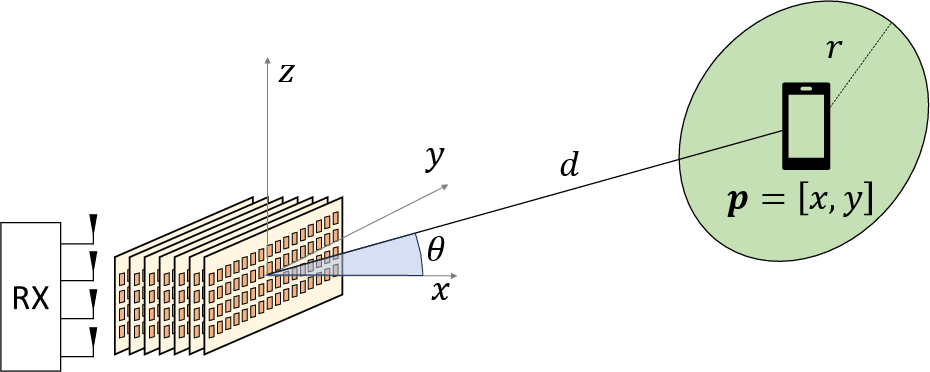
Figure 1: Communication scenario showing the SIM-aided receiver, diffractive layers, and transmitting node in near-field configuration with environmental electromagnetic interference.
Electromagnetically Consistent SIM Modeling
A distinguishing aspect of this work is the utilization of a physically-grounded multiport network model for SIM characterization, circumventing idealizations prevalent in prior art. Each SIM comprises Q diffractive layers, each with K unit cells modeled via a $2KQ$-port impedance network (ZSS for structural coupling, ZS(η) for tunable phase shifts). The SIM’s action is an analog-domain linear mapping, optimally configured to approximate a target projection UH derived from the dominant eigenmodes of the channel covariance matrix, themselves computable from prior spatial PDFs. The optimization over tunable parameters η is efficiently performed using gradient-based routines due to the model’s differentiability.
Channel and Position Estimation Strategies
Channel estimation is cast in the MMSE (and reduced-subspace LS) framework, exploiting a reduced-dimensional analog projection V=UH (or a practical SIM approximation thereof). The estimator’s sufficiency is ensured by U’s columns spanning the relevant subspace informed by channel spatial statistics. When SIMs can only approximate the ideal V, deterministic mismatches K0 are explicitly folded into the analysis.
Position estimation leverages the underlying spherical wave propagation model, with the Fisher Information Matrix analytically computed from the channel Jacobian with respect to spatial and nuisance parameters K1. The derived Position Error Bound (PEB) provides a lower bound on achievable localization accuracy, fully accounting for hardware-imposed dimensionality reduction and SIM physical constraints.
The authors analyze the sensitivity of channel and localization estimation performance to the SIM's ability to approximate the ideal subspace projection. Two quantitative metrics—the relative Frobenius mismatch and the effective subspace mismatch—are defined in terms of the deterministic error K2. Perturbation theory yields tight upper bounds on the condition number and eigenvalues of the key Gramian matrix K3, and thus on the MSE degradation factor of the RS-LS estimator:
K4
where K5 is the subspace mismatch. This analytic result formally links the physical accuracy of SIM approximation to estimator performance and informs hardware design tolerances.
Numerical Results
Comprehensive simulations validate the proposed framework in a realistic near-field configuration with a SIM comprising K6 layers and K7, K8 elements per layer (totaling 1792 tunable parameters), operating at 28 GHz. A receiver with K9 output ports realizes an RF chain reduction by over an order of magnitude compared to a $2KQ$0 fully-digital MIMO baseline. SNR, shadowing, array geometry, and prior spatial uncertainty are all carefully parameterized.
The results demonstrate that, despite reducing the number of RF chains from 64 to 6, SIM-based receivers optimized with a subspace mismatch threshold $2KQ$1 achieve channel and localization performance near-indistinguishable from ideal digital-domain projections over practical ranges and angles.
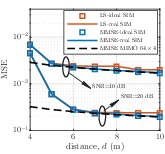
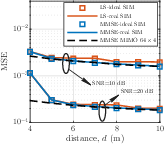
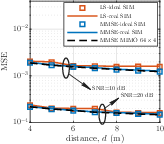
Figure 2: MSE as a function of distance for varying angles, showing negligible performance loss for practical SIMs compared to ideal subspace projections and fully digital baselines (SNR and angle-parameterized).
In all cases, performance loss relative to a fully digital MMSE estimator is only evident at extremely short distances, where the effective channel rank exceeds the output dimension. Otherwise, SIM-MMSE and SIM-RS-LS match the fully-digital solution.
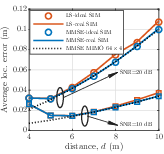
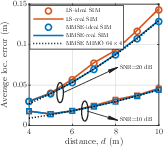
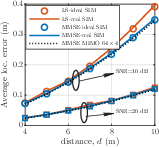
Figure 3: Localization error versus distance and incident angle, confirming high localization accuracy through SIM-based dimensionality reduction even in the presence of practical approximation errors.
Similarly, near-field localization accuracy (assessed by PEB) is preserved. The results confirm the theoretical claim that the essential curvature and phase information remains accessible post SIM-based analog compression.
Theoretical and Practical Implications
The principal theoretical contribution is the introduction of a multiport network-based, electromagnetically consistent estimation framework for SIM-assisted systems that quantifies the trade-off between hardware simplification (via analog subspace projection) and channel/localization performance. By bridging electromagnetic modeling with statistical estimation theory, the paper makes a case for aggressively reducing RF chain counts without incurring substantial performance penalties, provided SIM subspace mismatch remains controlled.
Practically, these findings advocate SIM deployment as a scalable, energy-efficient enabler for massive ISAC in 6G and beyond, particularly where near-field operation is essential. The work also provides analytic tools to select SIM hardware parameters, output dimensionality, and design tolerances based on strict performance criteria, directly impacting implementation in complex environments inundated by electromagnetic interference. This performance predictability is critical for practical system design and verification.
Future Research Directions
Several avenues are natural extensions of this work: joint transmitter-receiver SIM optimization, non-line-of-sight and multipath channel modeling, robust estimator development under model mismatches, adaptive subspace tracking with time-varying user locations, and experimental validation using hardware demonstrators. Integration with emerging neuromorphic or nonlinear metasurface designs could further relax hardware constraints.
Conclusion
The paper establishes a rigorous methodology for SIM-aided near-field channel and localization estimation under practical electromagnetic constraints. By analytically characterizing the impact of analog subspace projection errors on estimation bounds, the work enables dramatic reductions in receiver hardware complexity without compromising core ISAC functionalities. These findings substantiate SIMs as a foundational technology for 6G-scale large-aperture sensing, with direct relevance for both theory and application.