- The paper demonstrates enhanced magneto-optical modulation using silicon nanodisk metasurfaces, achieving up to a 1.5% transmission modulation at Mie resonances and the anapole state.
- Experimental measurements and RCWA simulations validate strong field localization and angular robustness, ensuring efficient light–matter interaction under circularly polarized excitation.
- Multipolar interference leading to the anapole state produces enhanced energy storage and reduced scattering, significantly outperforming bare garnet films.
Introduction
The paper investigates the enhancement of magneto-optical (MO) intensity effects in an all-dielectric metasurface that preserves the helicity of incident light. The metasurface is composed of silicon nanodisks arrayed atop a magnetic garnet film (Dy:CeYIG/YIG), enabling strong field confinement at optical Mie-type resonances and the nonradiating anapole state. By leveraging localized resonant excitation, the work demonstrates increased magneto-optical transmission modulation under circularly polarized excitation, both at the ED/MD dipole modes and in the spectral domain of the anapole feature.
The theoretical motivation is predicated on the fact that bulk MO materials require macroscopic volumes or high magnetic fields to achieve substantial light–matter interaction, hence the attractiveness of photonic nanostructures that concentrate electromagnetic fields at subwavelength scales and enable efficient modal engineering. All-dielectric nanophotonics, particularly using high-index semiconductor (e.g., Si, Ge) structures, offers multipolar resonances with low loss and coherent control, which are pivotal in enhancing MO responses.
The fabricated metasurface consists of a 2D square lattice of Si nanodisks (period 500 nm, radius 160 nm, height 117 nm) on a Dy:CeYIG garnet film. Due to the high refractive index of silicon, the nanodisks support pronounced Mie resonances: magnetic dipole (MD), electric dipole (ED), and the anapole state. The metasurface is characterized under circularly polarized excitation.
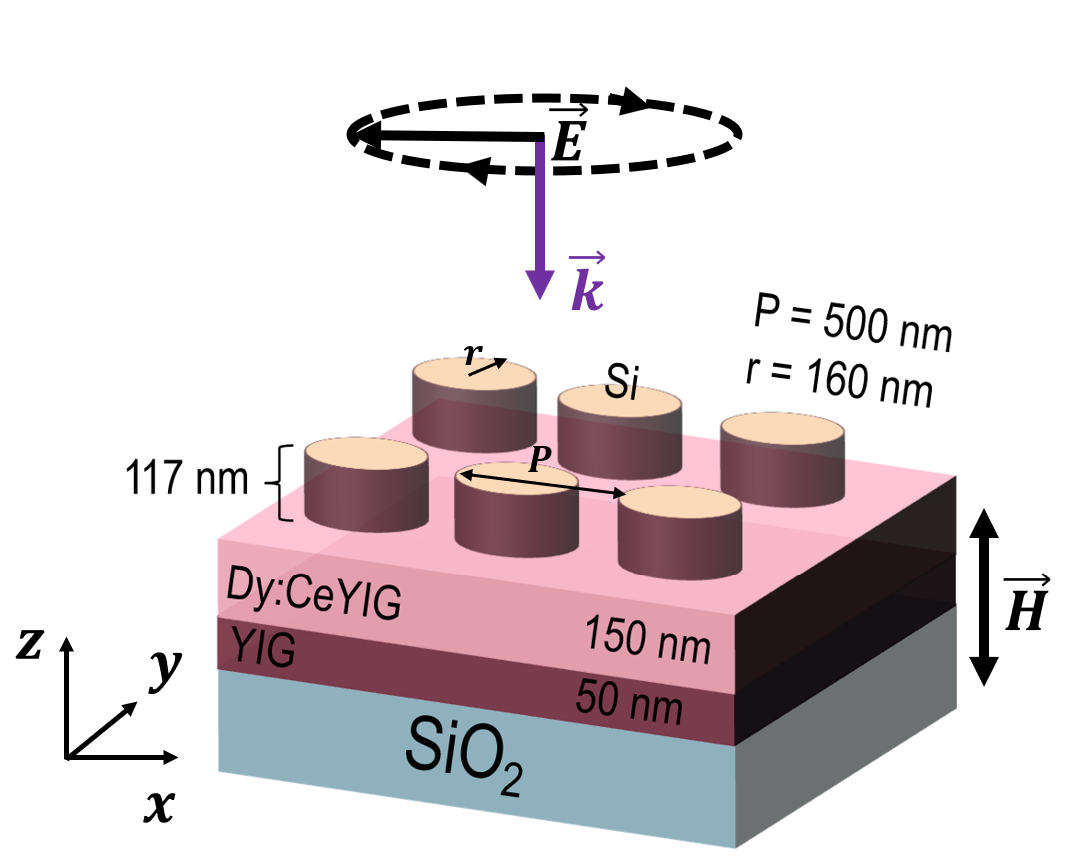
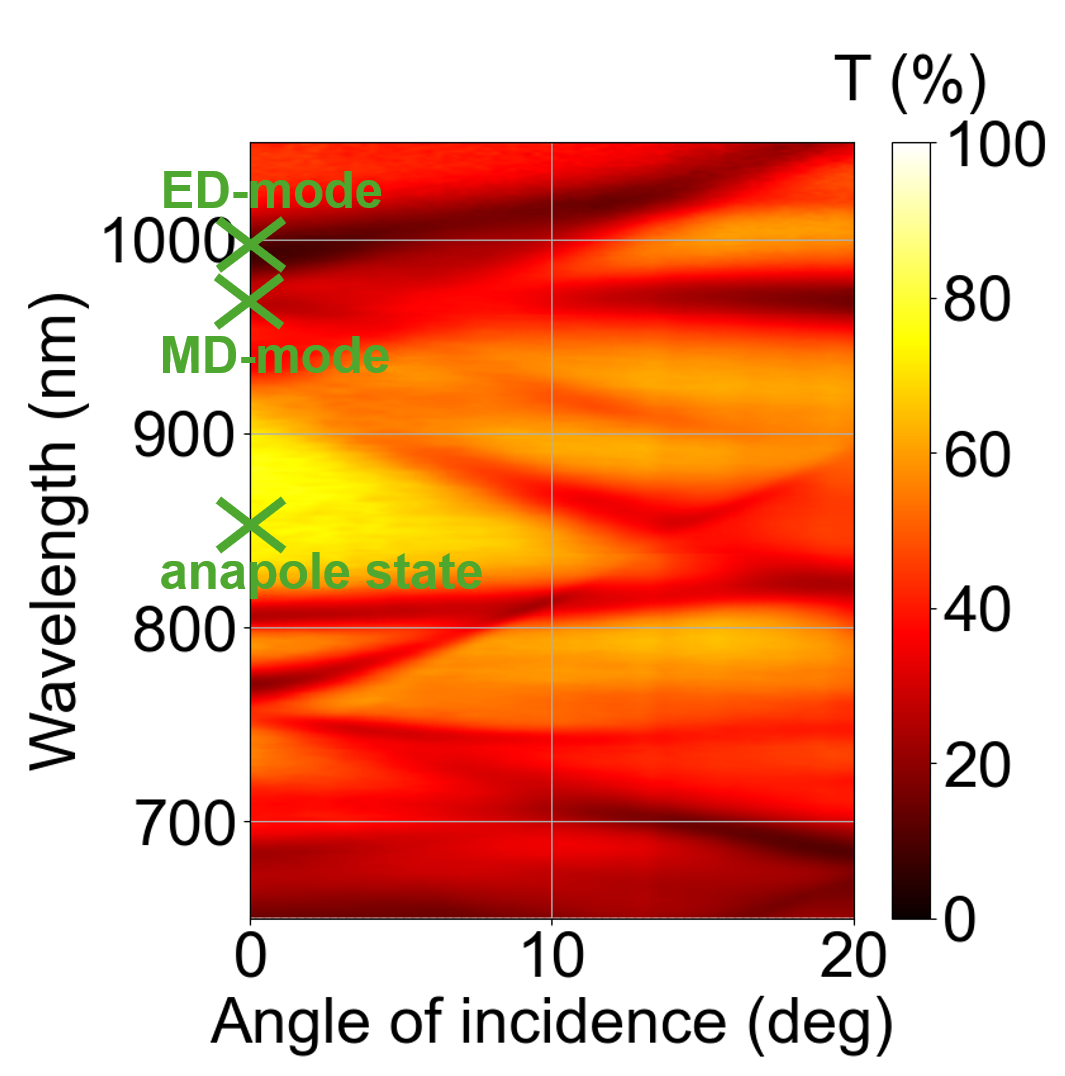
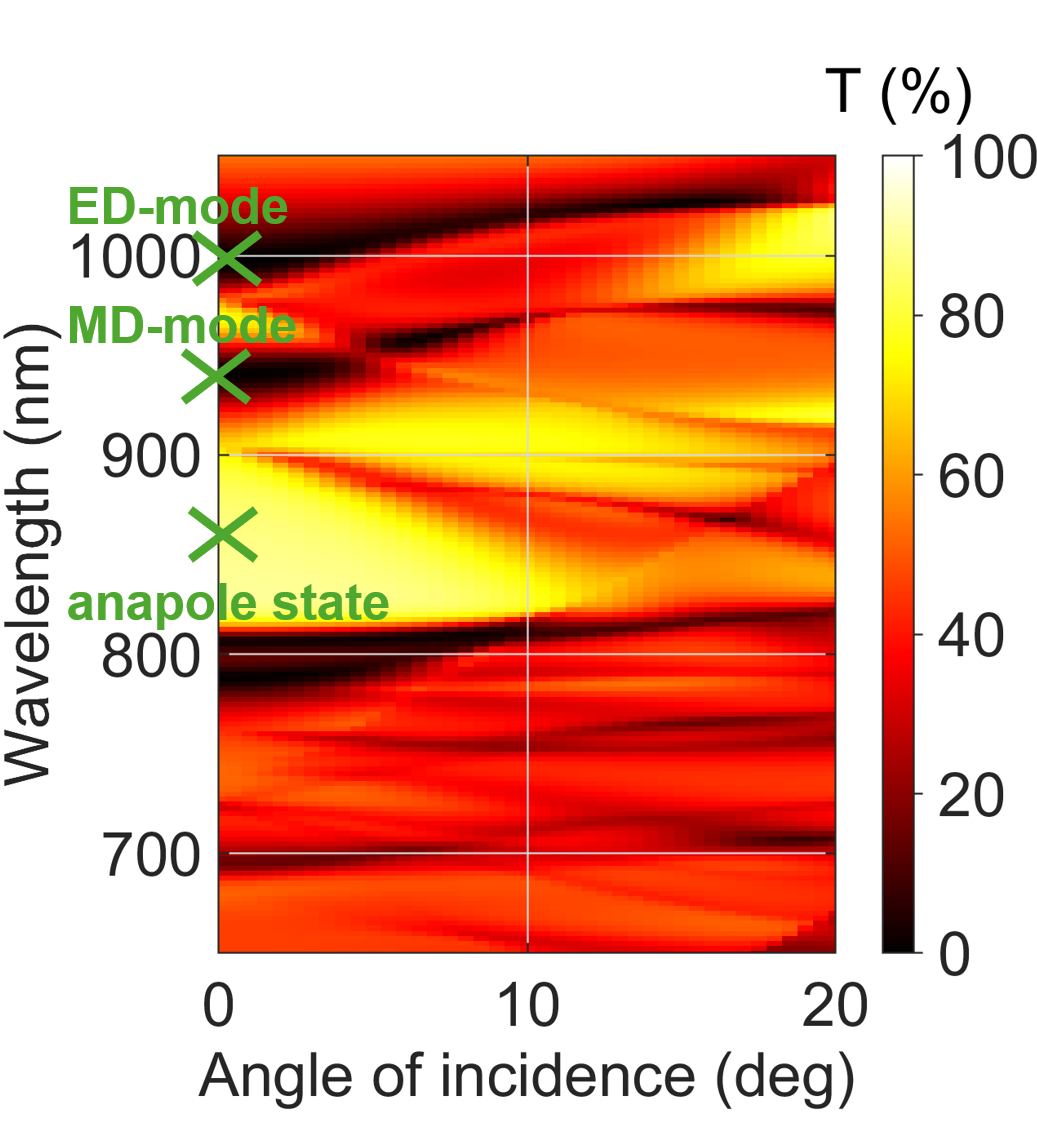
Figure 1: Scheme and angle-resolved transmission spectra of the metasurface; green labels mark ED, MD, and anapole spectral positions.
Angle-resolved experimental and simulated transmission spectra display broad minima at MD (≈956 nm) and ED (≈997 nm), and a transmission maximum at the anapole state (≈839 nm). Fresnel reflections at interfaces constrain transmission to ~89% at the anapole resonance. Modal analysis using field maps and multipole decomposition corroborates that the anapole is associated with destructive interference between the electric and toroidal dipoles, yielding suppressed scattering and strong field concentration inside the nanodisk.
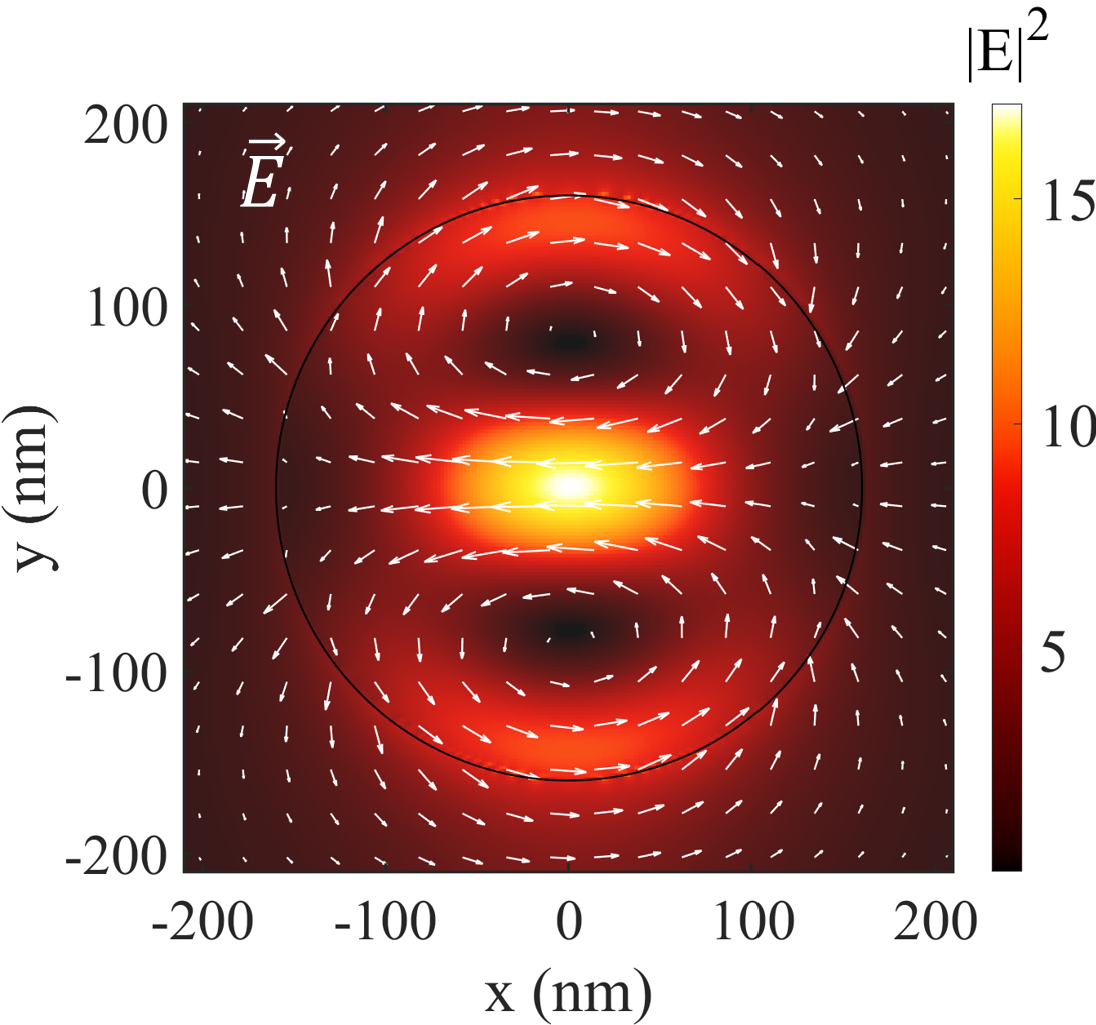
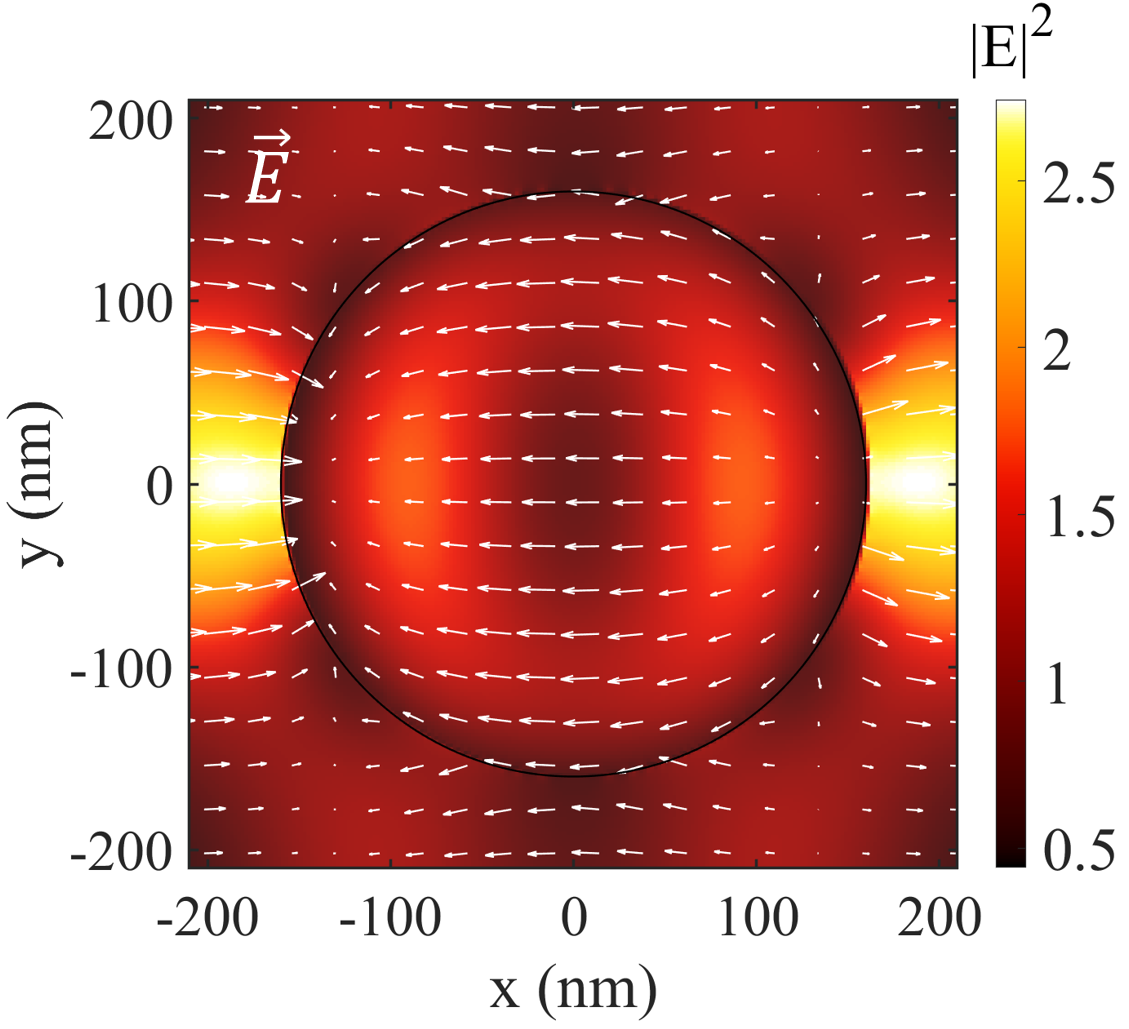
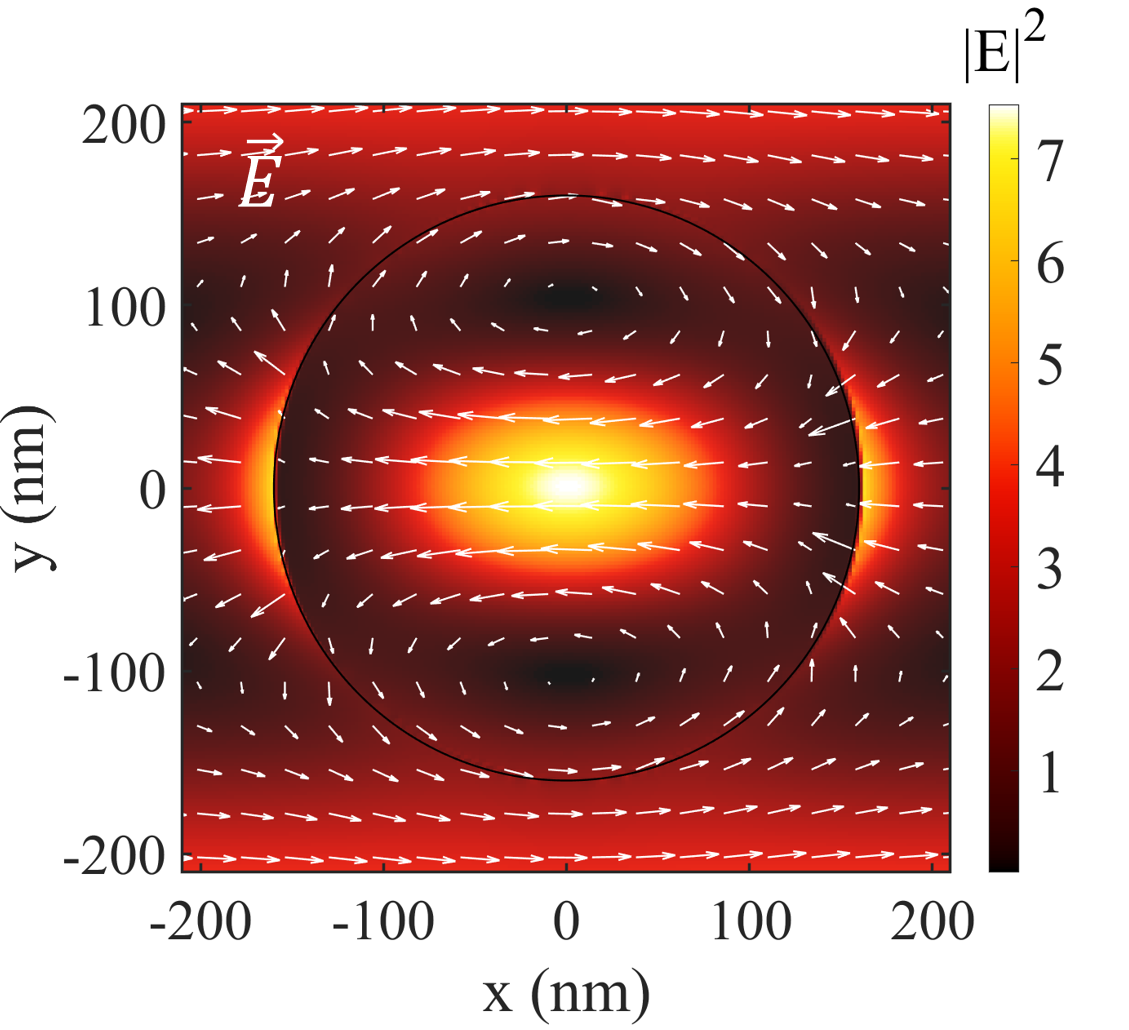
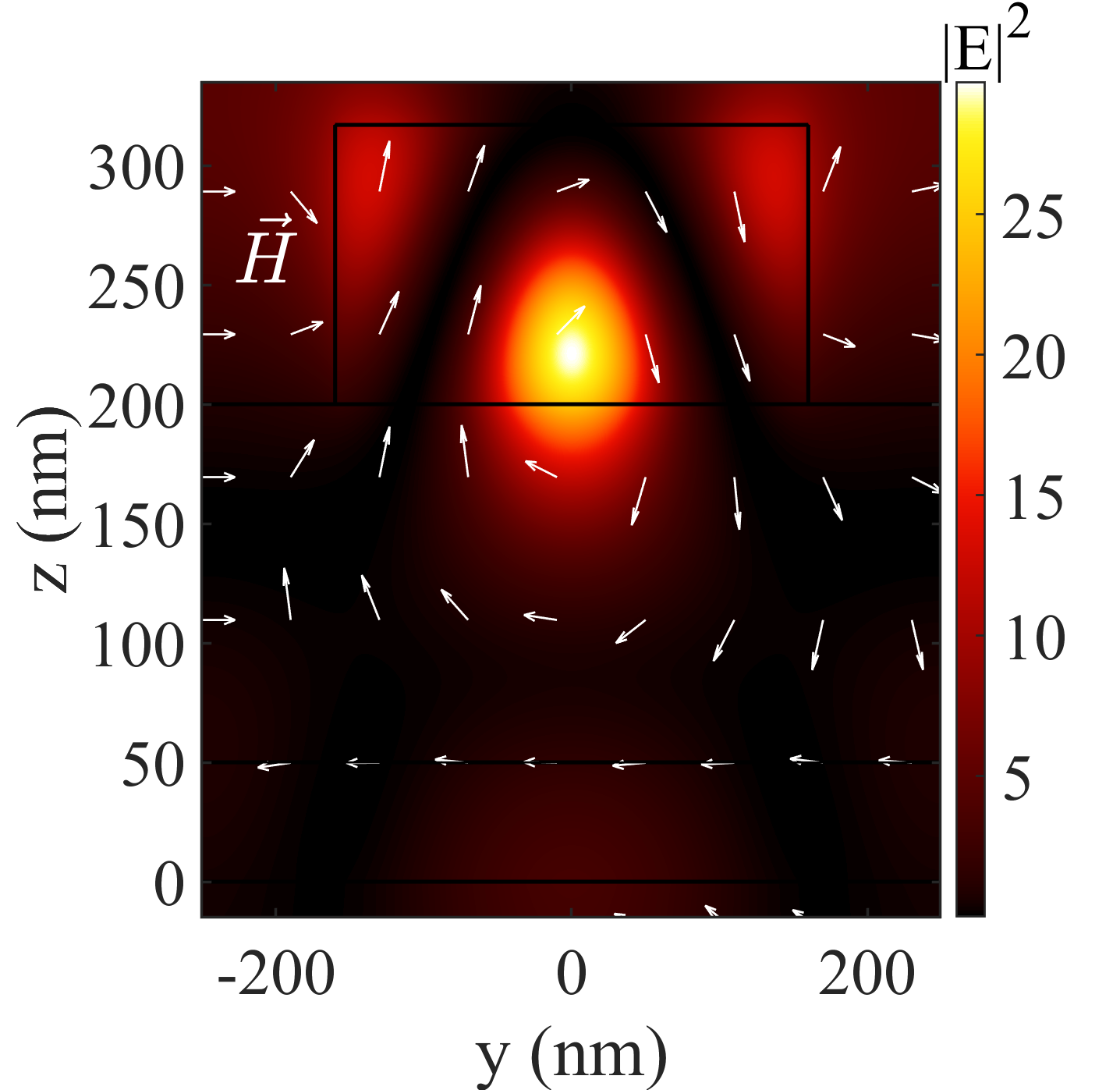
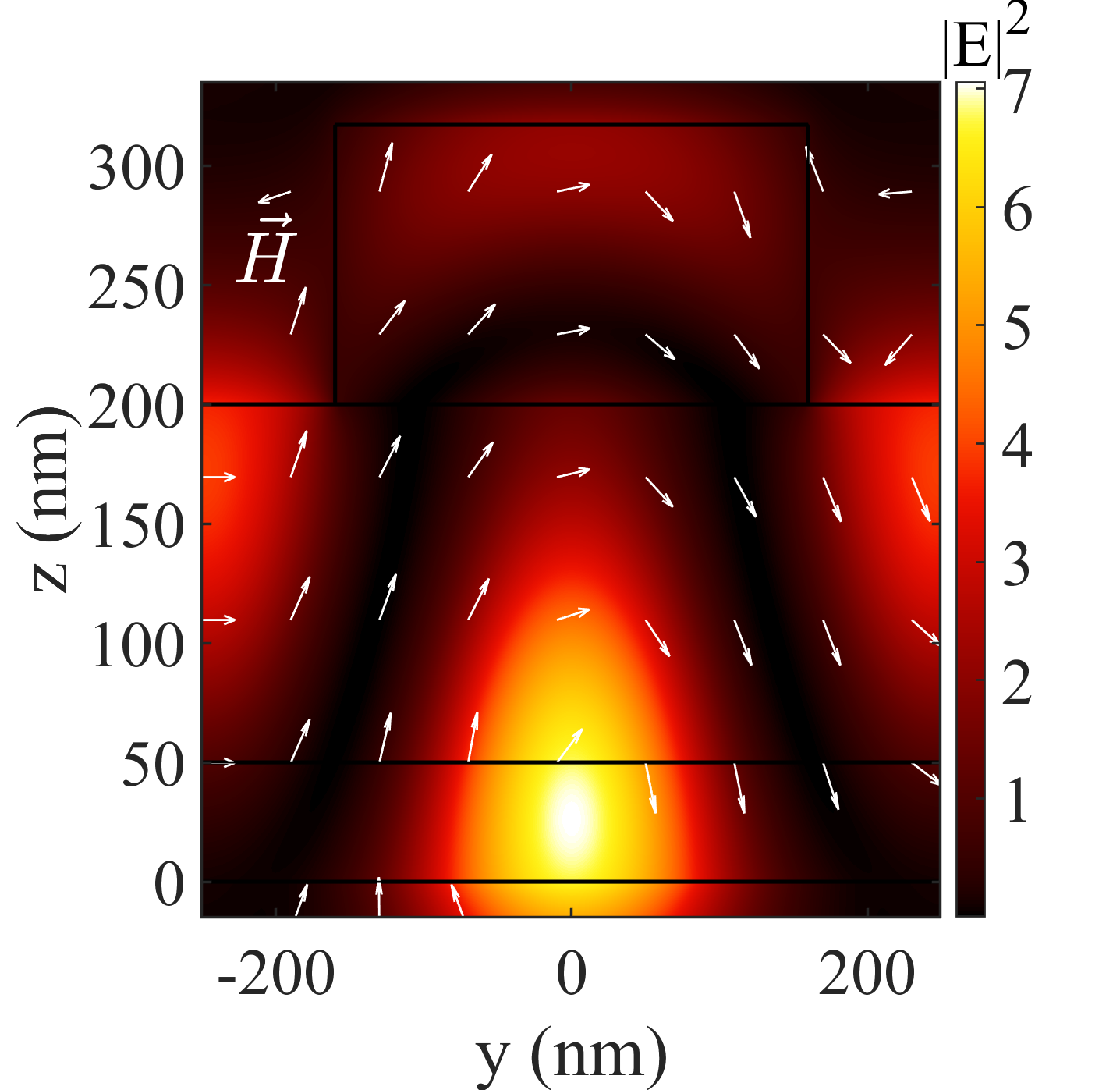
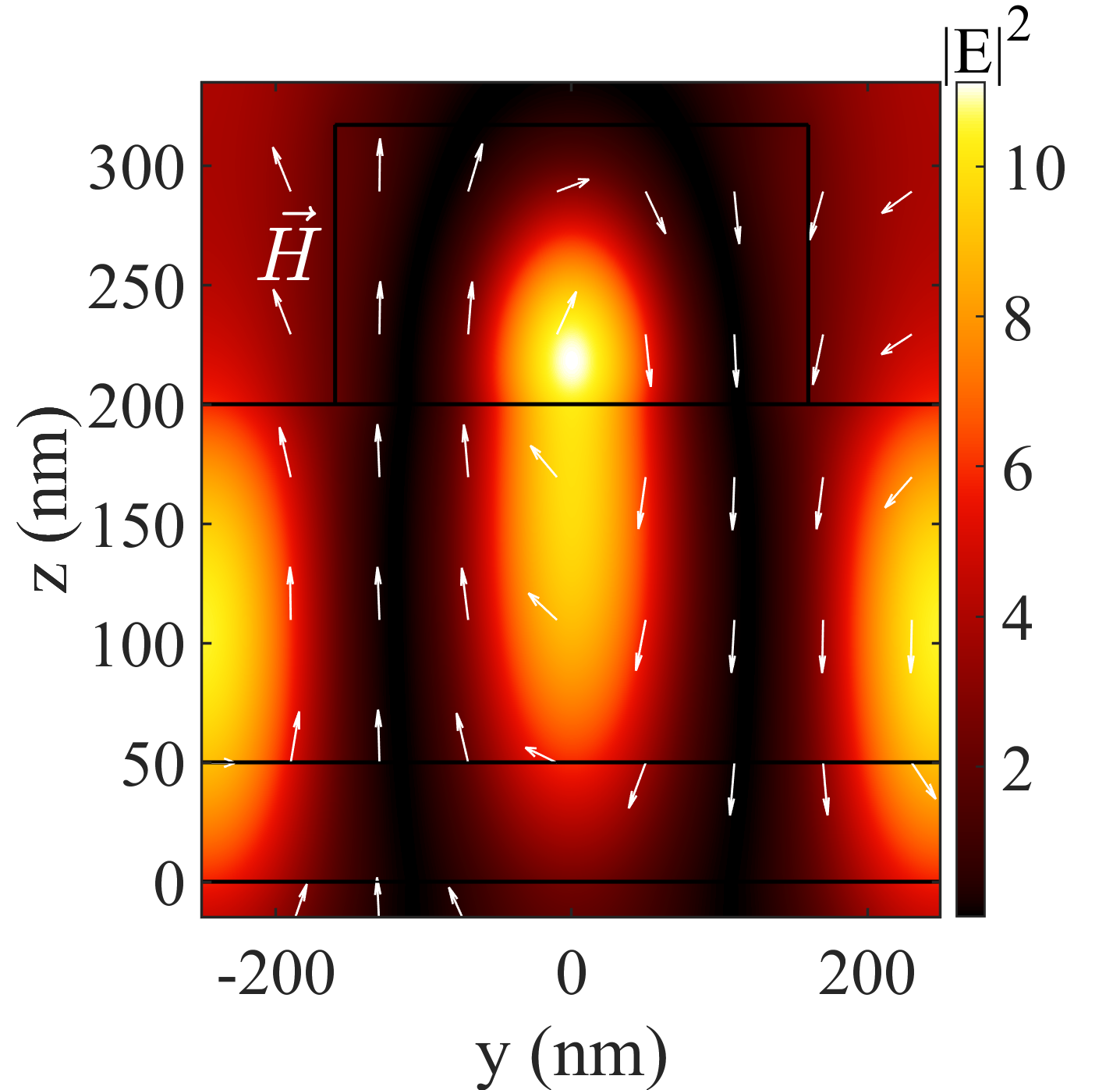
Figure 2: Electric-field distributions for MD, ED, and the anapole state, showing pronounced localization for the anapole inside the nanodisk, as opposed to extended fields for the dipole modes.
Magneto-Optical Intensity Enhancement
The key magneto-optical metric is the normalized transmission modulation δ, defined as:
δ=T(σ+,+Mz)+T(σ+,−Mz)T(σ+,+Mz)−T(σ+,−Mz)
where T is the transmission for right-handed circular polarization and reversed magnetization.
Experimental measurement of δ(λ) for the metasurface and a reference bare Dy:CeYIG film shows the metasurface achieves a factor of 2–3 enhancement at MD and ED resonances (peak δ≈1.5% vs 0.5% for the film), and a maximum δ increased by ~32% in the anapole spectral region, with transmission maintained at ~80%.
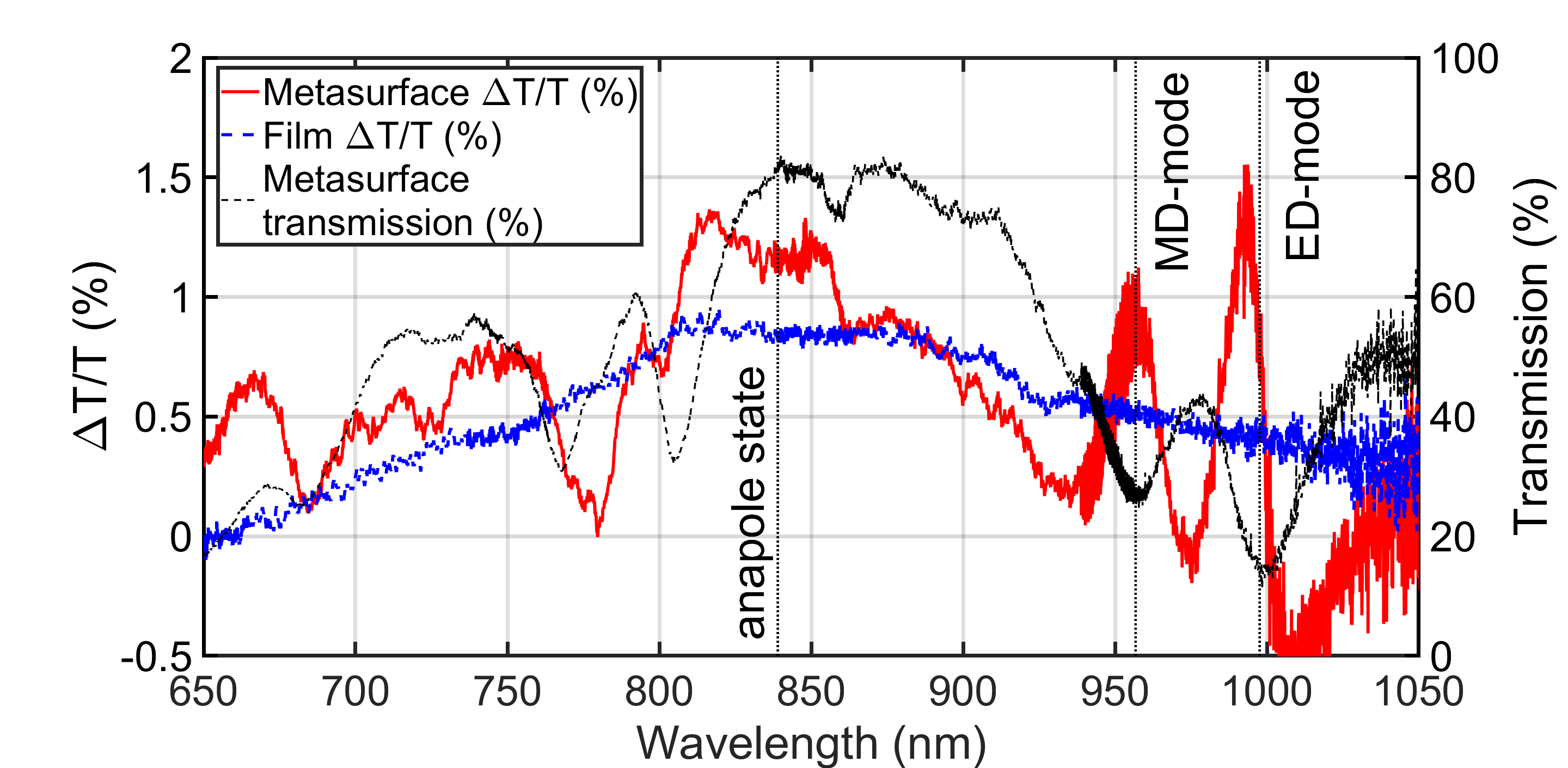
Figure 3: Normalized magneto-optical intensity effect δ of the metasurface and bare film, showing substantial enhancement at Mie resonances and the anapole state.
The enhancement arises from field localization in the magnetic layer, which amplifies magnetization-induced absorption for circularly polarized light. Notably, the strongest δ coincides with the anapole condition, where radiative losses are suppressed and energy storage inside the nanodisk is maximized.
Angle-resolved experiments (and RCWA simulations) reveal that the enhanced δ in the anapole window persists over broad incidence angles, proving robustness against geometrical misalignment and supporting practical device applications.
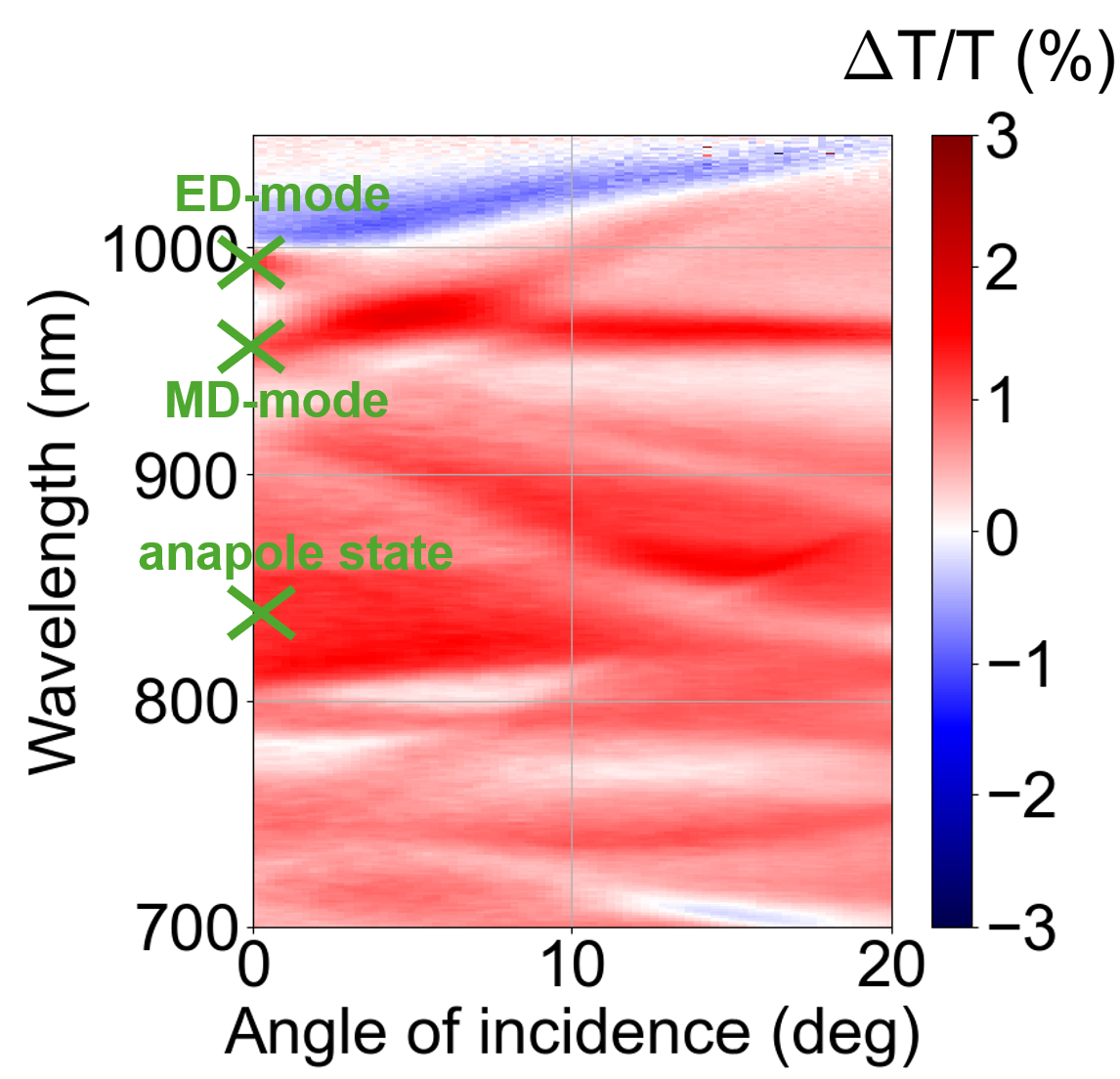
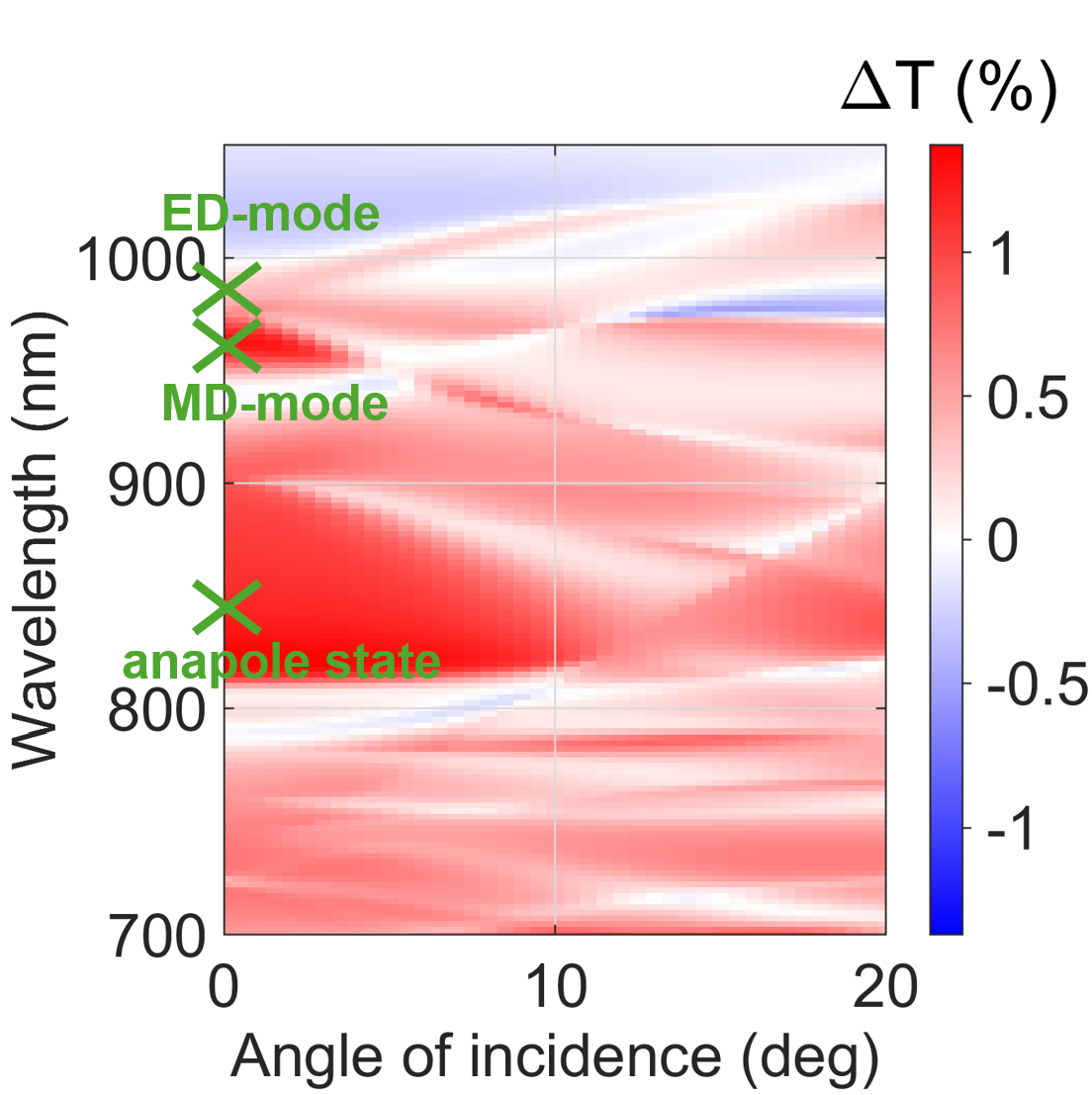
Figure 4: Angle-resolved magneto-optical transmission modulation, confirming the persistence of enhanced δ=T(σ+,+Mz)+T(σ+,−Mz)T(σ+,+Mz)−T(σ+,−Mz)0 across incidence angles near the anapole.
Material Dispersion and Modal Analysis
The SI, Dy:CeYIG, and YIG dielectric permittivities and magneto-optical gyration parameters are characterized spectroscopically, with these values used in both analytical and RCWA models. Modal dispersion analysis confirms the positions of guided modes and the resonance loci governing the metasurface response.
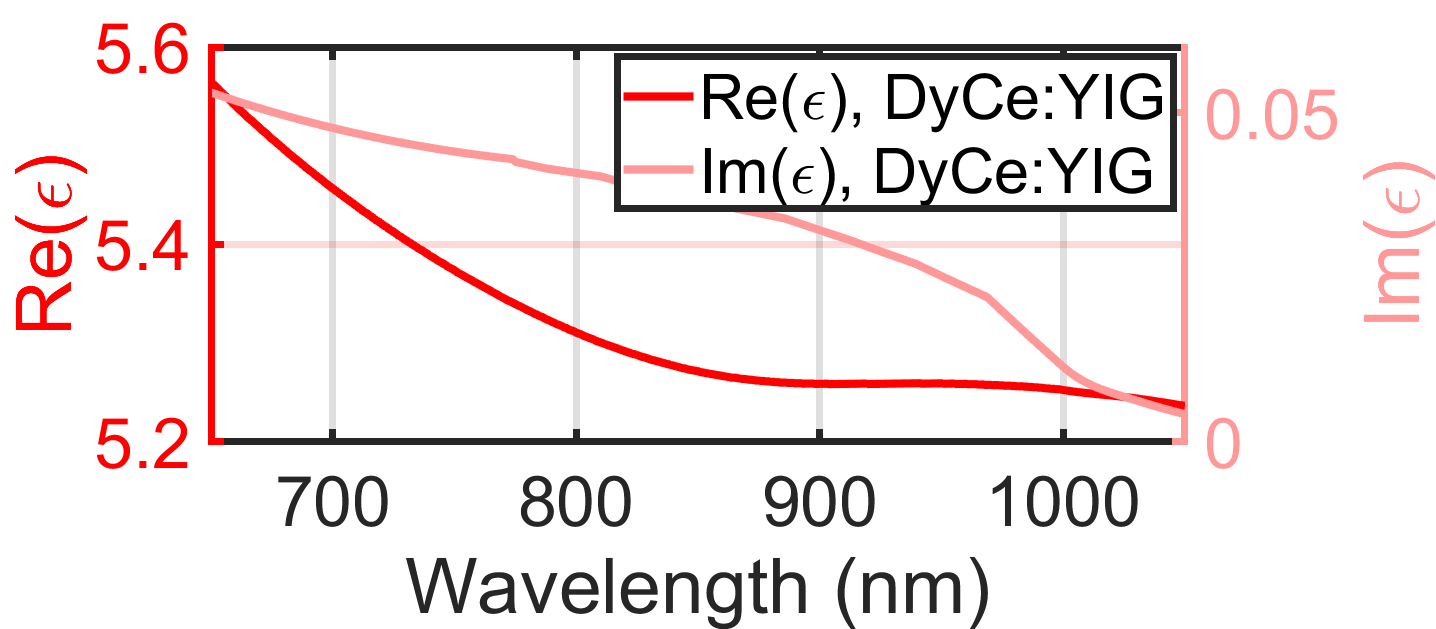
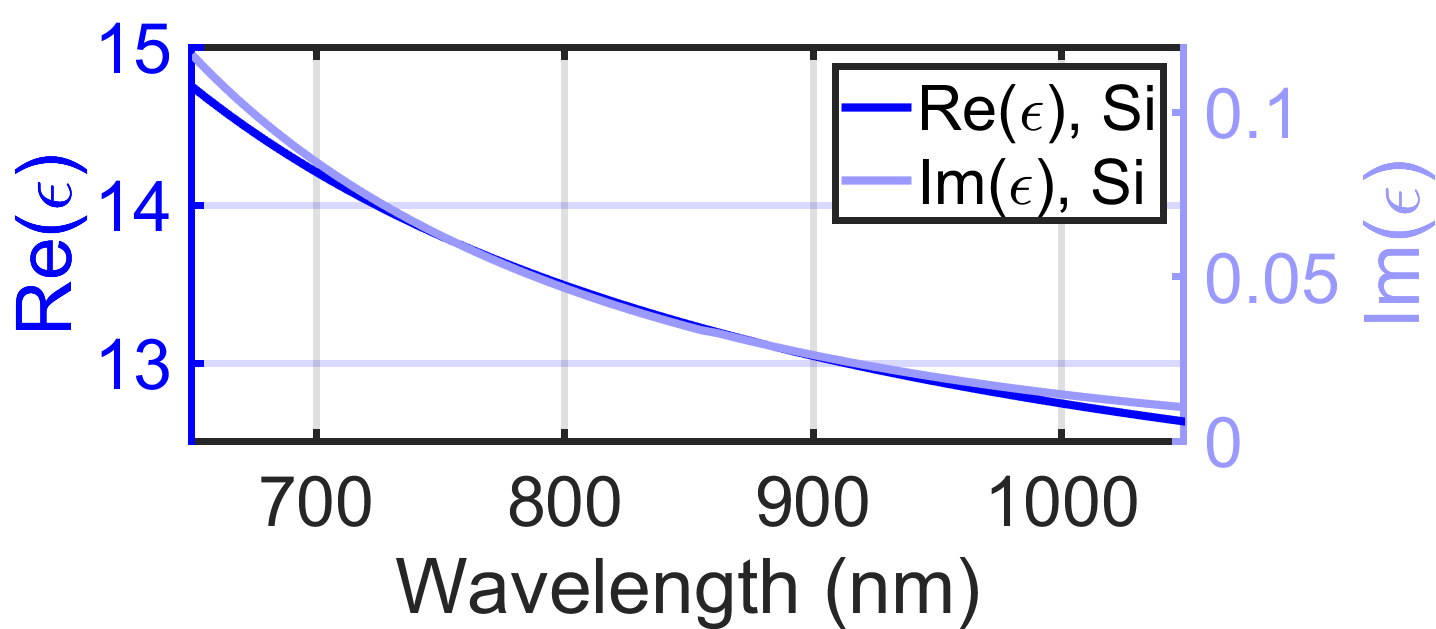
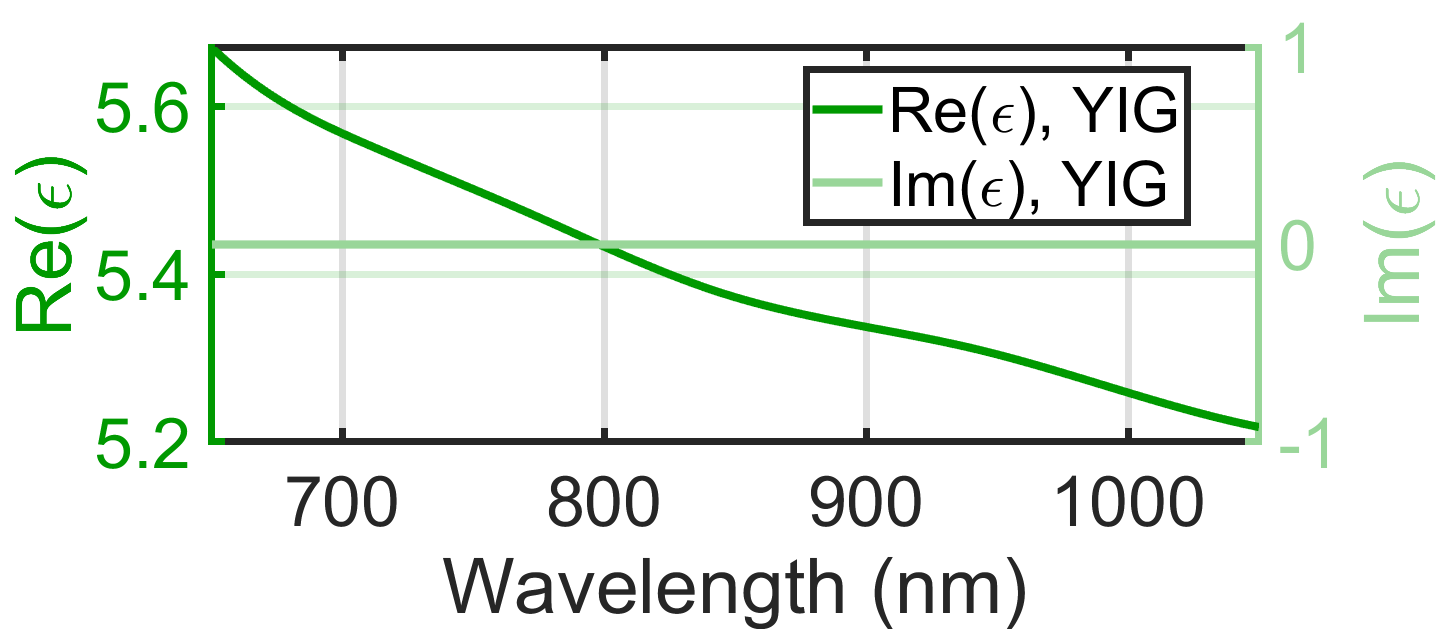
Figure 5: Spectral dispersion of the complex dielectric permittivity for Dy:CeYIG, silicon, and YIG.
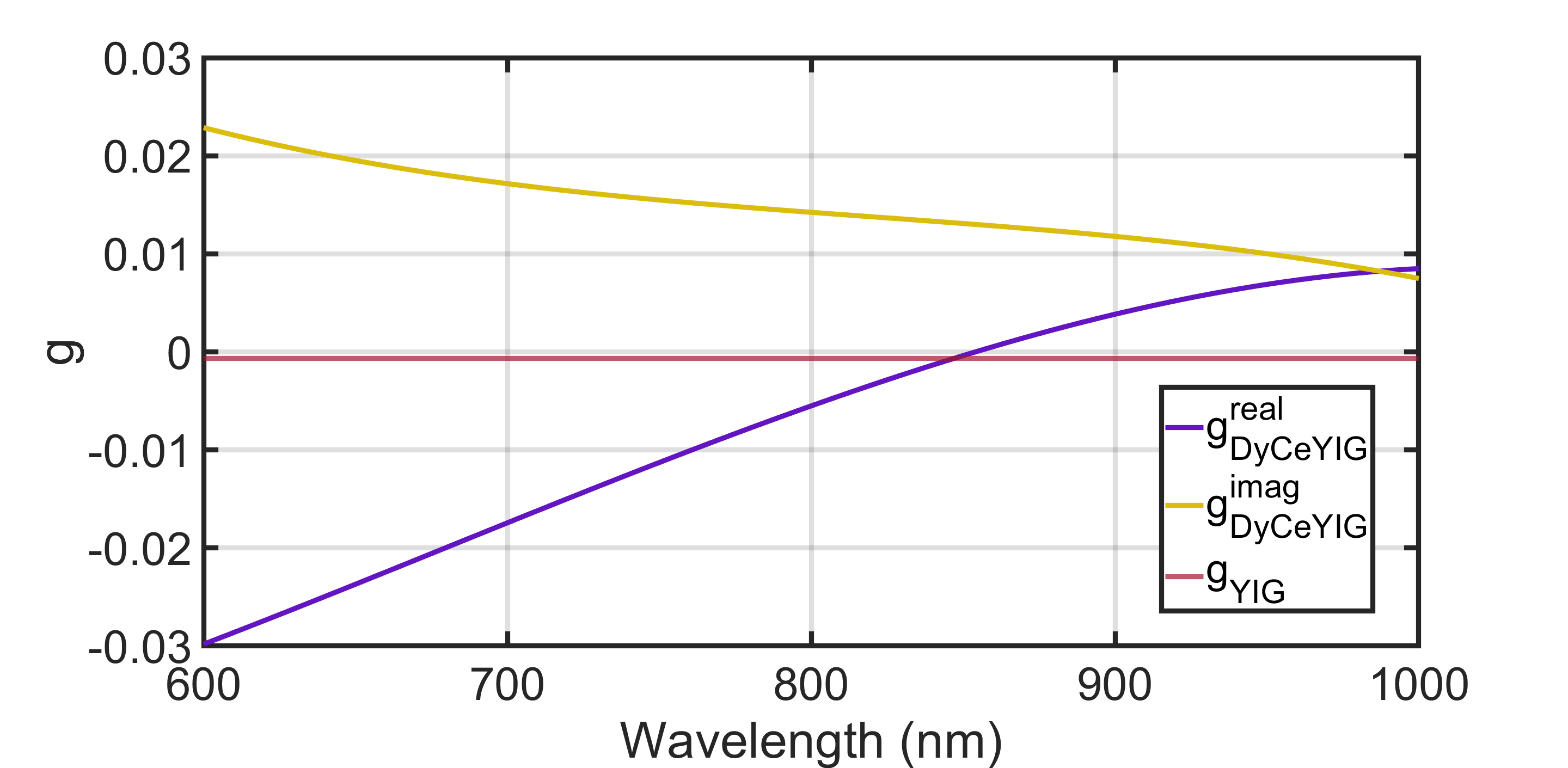
Figure 6: Spectral dispersion of the gyration δ=T(σ+,+Mz)+T(σ+,−Mz)T(σ+,+Mz)−T(σ+,−Mz)1 used in simulations and MO calculations.
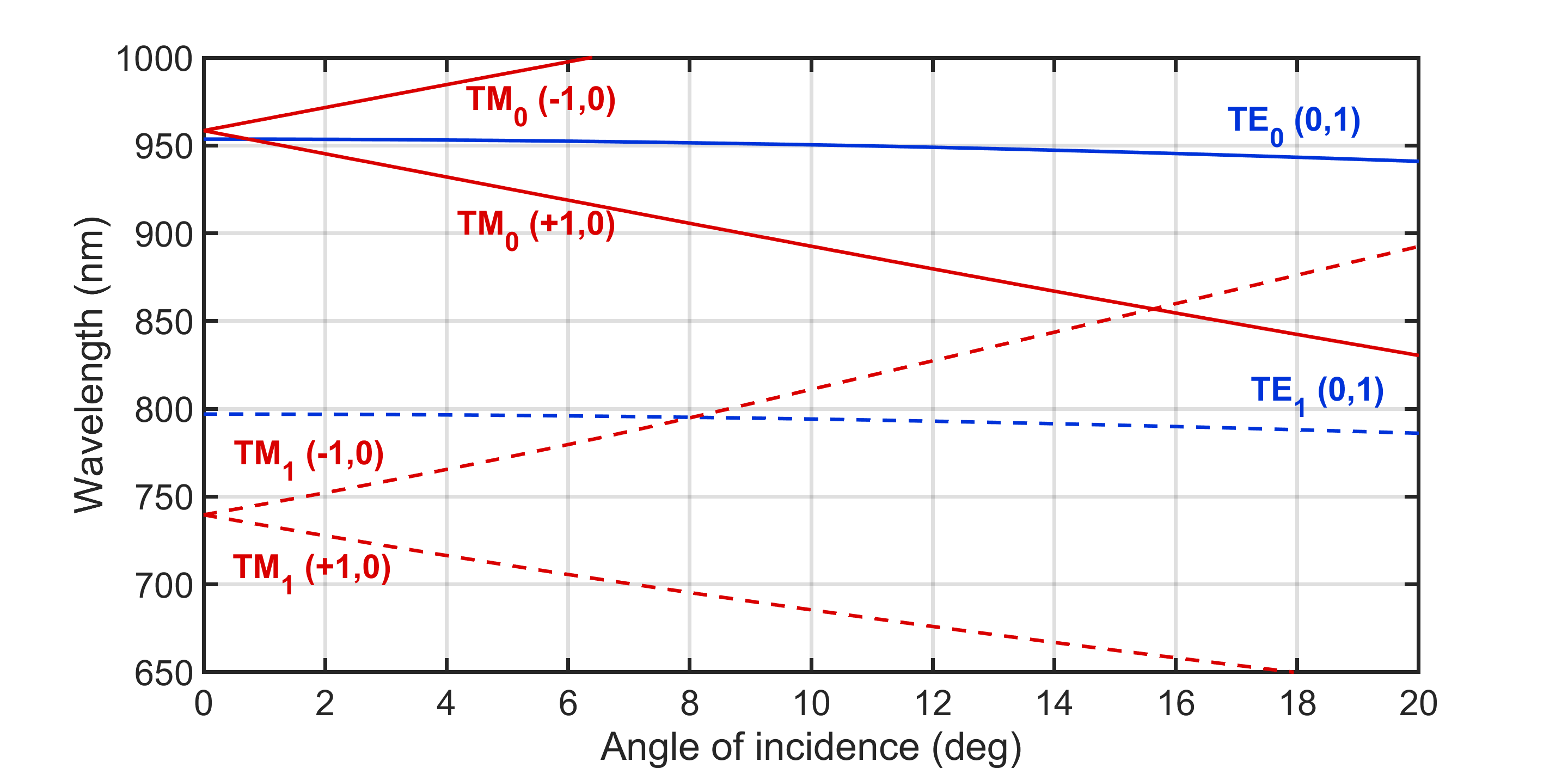
Figure 7: Calculated modal dispersion (TE/TM guided modes), showing the wavelengths of resonant excitation.
Anapole State Verification
The excitation condition for the radiationless anapole state is validated via multipole calculations, demonstrating exact compensation between the electric dipole δ=T(σ+,+Mz)+T(σ+,−Mz)T(σ+,+Mz)−T(σ+,−Mz)2 and the toroidal dipole δ=T(σ+,+Mz)+T(σ+,−Mz)T(σ+,+Mz)−T(σ+,−Mz)3 near 803 nm (for isolated disks), closely matching the experimentally identified anapole feature.
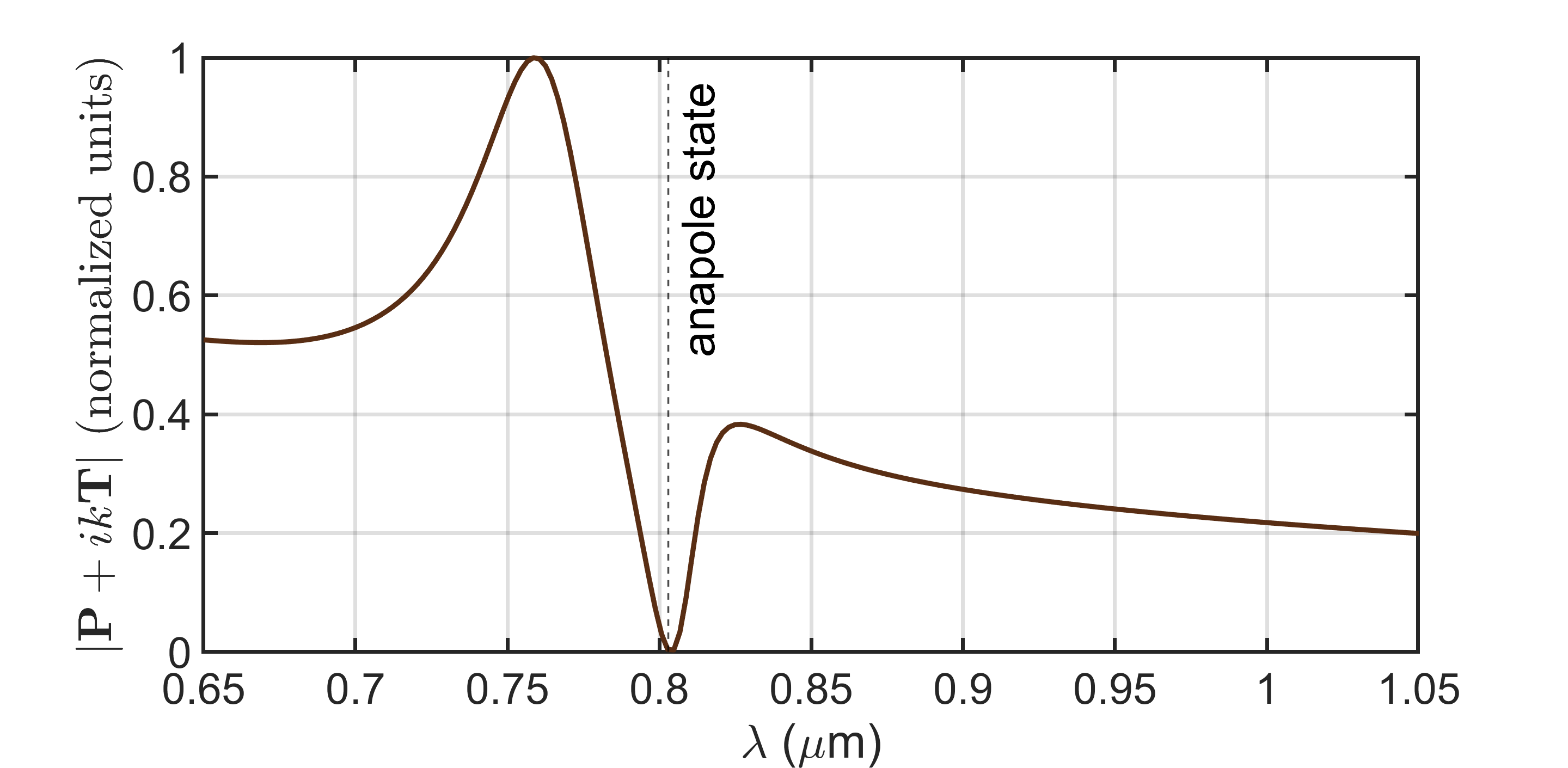
Figure 8: Spectral dependence of δ=T(σ+,+Mz)+T(σ+,−Mz)T(σ+,+Mz)−T(σ+,−Mz)4, with a minimum indicating the anapole condition.
Faraday and Kerr Effects
The standard MO effects (Faraday rotation in transmission, Kerr in reflection geometry) are characterized, but the paper emphasizes that the MO intensity enhancement at the anapole does not arise from increased rotation effects. Faraday rotation peaks at MD resonances, not the anapole, due to the nature of photon dwell time versus field localization.
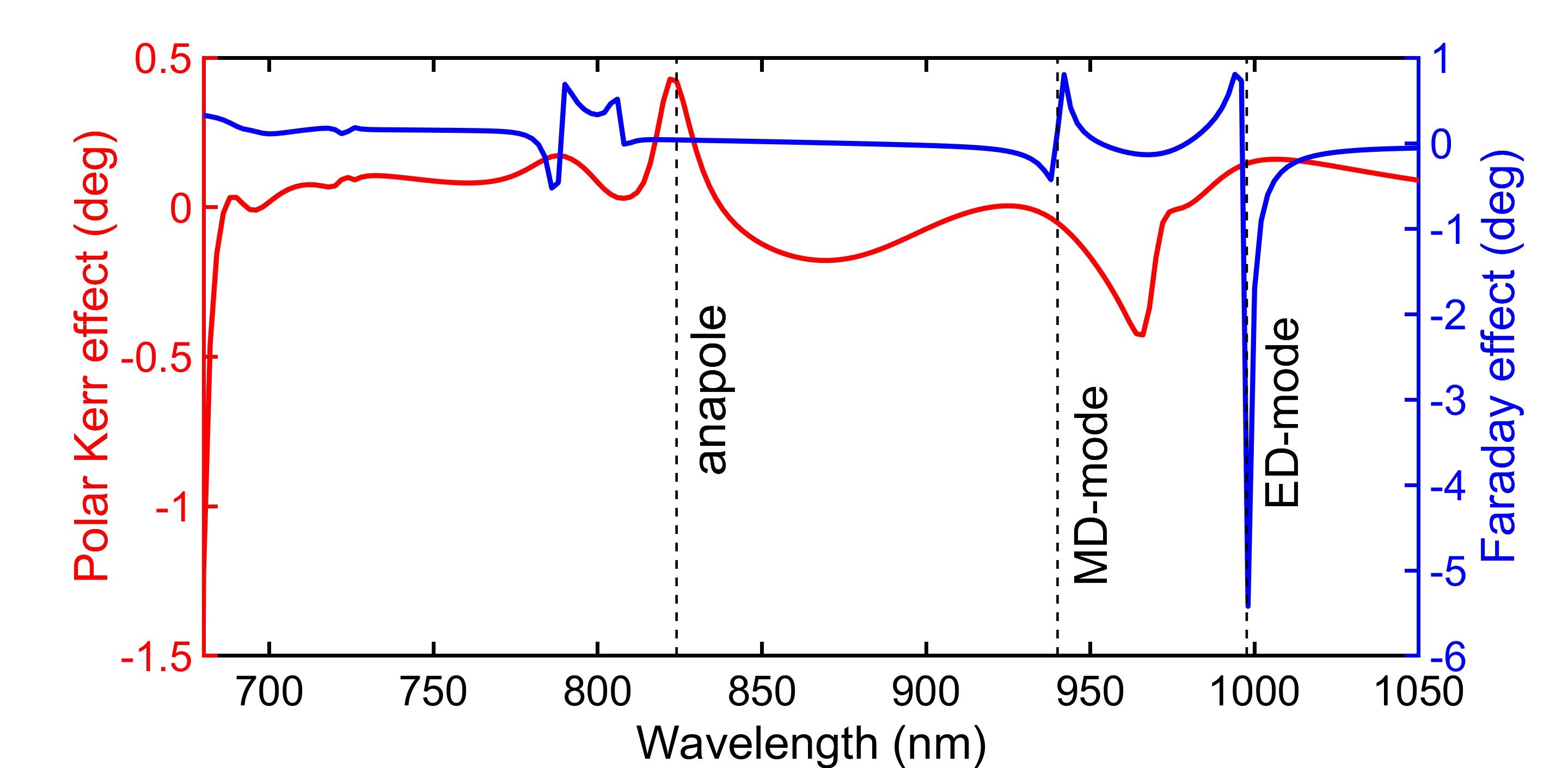
Figure 9: Faraday and polar Kerr rotation spectra, with maxima at dipole resonances—not at the anapole wavelength.
Implications and Perspectives
The achieved MO intensity enhancement at Mie resonances and especially at the anapole state, with sustained high transmission and angular robustness, demonstrates a significant pathway for integrated MO photonic devices. The metasurface strategy enables compact, efficient, helicity-preserving MO modulators, isolators, and sensors for applications in telecommunication, quantum photonics, and spintronics.
Theoretical implications include the delineation of modal versus interference-based enhancement mechanisms (anapole vs dipole resonances), offering a toolset for further MO nanoengineering in all-dielectric architectures. Future developments will likely explore higher-order anapole states, nonlinear MO effects, tunable resonance engineering, and integration with chiral, topological, or quantum materials for multifunctional MO photonic platforms.
Conclusion
The study presents a comprehensive experimental and numerical analysis of an all-dielectric MO metasurface, revealing enhanced MO intensity effects at both Mie resonances and the anapole feature. The metasurface achieves a normalized transmission modulation exceeding that of a bare garnet film by a factor of 2–3 at dipole modes and by more than 30% in the anapole domain, with high optical transmission and angular tolerance. The results provide an efficient platform for MO intensity modulation of circularly polarized light and underscore the importance of modal and interference enhancement in metasurface-based magnetophotonics (2605.23730).

