- The paper introduces TPTNs that overcome RTN limitations by enforcing local isometries and computational covariance in holographic models.
- It demonstrates that twirling perfect tensors generates flat entanglement spectra, exactly reproducing the Ryu-Takayanagi formula in large bond dimensions.
- The paper outlines implications for quantum circuit complexity and error correction, suggesting novel routes for experimental quantum simulations.
Twirled Perfect Tensor Networks and Computational Covariance in Holography
Introduction and Context
The manuscript introduces a new class of tensor networks—Twirled Perfect Tensor Networks (TPTNs)—to address structural challenges in modeling quantum complexity and entanglement properties of holographic states, especially those pertaining to the black hole interior and the so-called Python’s Lunch Conjecture (PLC). The work systematically examines the limitations of random tensor networks (RTNs) in capturing essential aspects of gravitational holography and presents TPTNs as generic, universal, and computationally covariant tensor networks that resolve significant obstacles in earlier holographic models.
At the core of the motivation is the need for tensor network models that can simultaneously capture the combinatorial (entropic), error-correcting, and complexity-theoretic features expected from the AdS/CFT correspondence, particularly when modeling regions such as the black hole interior that exhibit geometric obstructions (i.e., "python's lunches") to entanglement wedge reconstruction.
The Python's Lunch Conjecture and Complexity
The PLC formalizes a sharp prediction relating the quantum circuit complexity required to reconstruct information enclosed by "python's lunches"—regions in the entanglement wedge beyond a constriction (outermost quantum extremal surface, QES). The conjecture asserts that for suitable bulk geometries, the minimal gate complexity scales exponentially with the bulge-constriction area difference (in gravitational units):
$\mathcal{C}_\mathrm{PLC} \sim \exp\left(\frac{S_\mathrm{gen}(X^b_\A) - S_\mathrm{gen}(X^c_\A)}{2}\right)$
This result emerges from circuit constructions involving Grover-type amplitude amplification over isometric extensions of local maps in toy tensor networks.
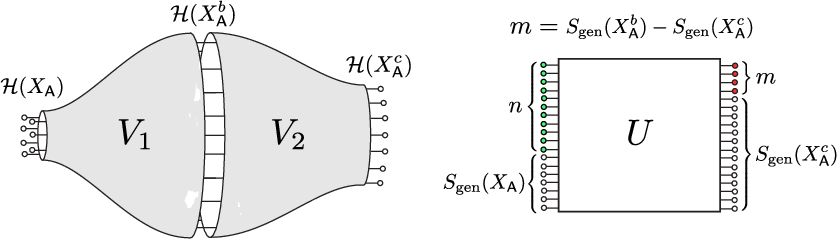
Figure 1: Tensor network model of a python's lunch with isometric factors V1, V2 mapping the minimal, bulge, and constriction QES; also shows the postselection structure for reconstructing the interior.
A critical assumption in this estimate is that all local isometries in the contraction path are of low complexity—the exponential circuit scaling arises solely from postselection upon crossing the bulge, with all other operations assumed computationally simple. However, this is violated by generic RTNs, in which the complexity can be dominated by locally nonisometric regions even when the number of output legs always exceeds inputs along a contraction foliation.
Locality, Computational Covariance, and the Need for TPTNs
The analysis demonstrates that locality alone is insufficient to guarantee the PLC complexity scaling. For example, even if a random tensor network is everywhere locally expanding, the global map is typically maximally complex due to extensive entropy in the minimal cut, unless local tensors are perfect in the sense of absolute maximal entanglement (AME)—a stringent algebraic property.
This breakdown is formalized by the notion of computational covariance. A network is computationally covariant if any (everywhere non-contracting) foliation admits local contractions via low-complexity (subexponential in bond dimension) maps, isolating all exponential computational cost in postselection events alone:
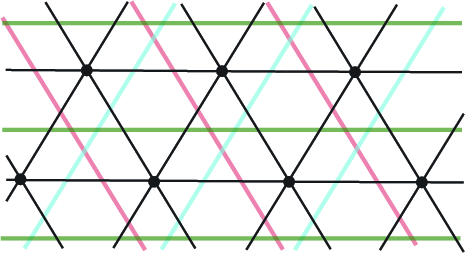
Figure 2: A computationally covariant TN admits efficient unitary maps for any foliation (color-coded);
local moves are always simple.
Crucially, this condition is not generic in RTNs, which normally lack isometric structure in all contraction directions. Instead, only twirled perfect tensors—i.e., perfect (AME) tensors subjected to local Haar-random (or k-design) twirling unitaries—satisfy both the computational covariance and circuit universality needed for holographic applications.
Definition and Properties of TPTNs
A TPTN is constructed by placing perfect tensors (AME states) at the vertices of a planar tensor graph, with each leg acted upon by independent random unitaries. Contracting these with maximally entangled bonds renders the full network generic and universal, but, due to the AME property, all local tensor contractions (along any bipartition where the number of outputs exceeds or equals inputs) are exactly isometric or unitary.
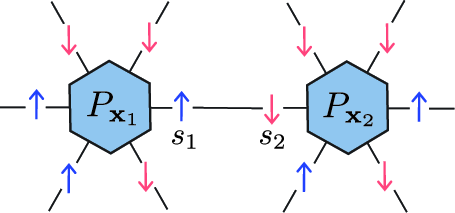
Figure 3: TPTN built from twirled HaPPY stabilizer states, with non-stabilizer structure and local randomness ensuring universality and computational covariance.
Key features:
- Saturates the Ryu-Takayanagi formula: For any boundary subregion, the entanglement entropy is given by the minimal cut in the large bond dimension limit.
- Computational covariance: All everywhere non-contracting foliations can be implemented with low-complexity isometries, isolating complexity costs to the bulge-to-constriction postselection.
- Universality: Local twirling lifts the Clifford gate restriction present in stabilizer perfect tensors, so TPTNs can generate arbitrary quantum states (pending bond dimension and design order).
- Holographic quantum error correction: TPTNs inherit QEC properties from their underlying perfect tensor combinatorics, now with generic state structure.
Random Tensor Networks: Failure Modes
The detailed statistical mechanics and random matrix analysis establishes that RTNs, even with local expansion, generally fail to be isometric in trace norm—leading eigenvalue distributions (Marchenko–Pastur) saturate only at double the input legs, i.e., m>2n rather than the naive m>n for isometry. Thus, local expansions in RTNs do not guarantee globally simple contractions; the polar isometric part of the RTN map is usually maximally complex unless highly fine-tuned.
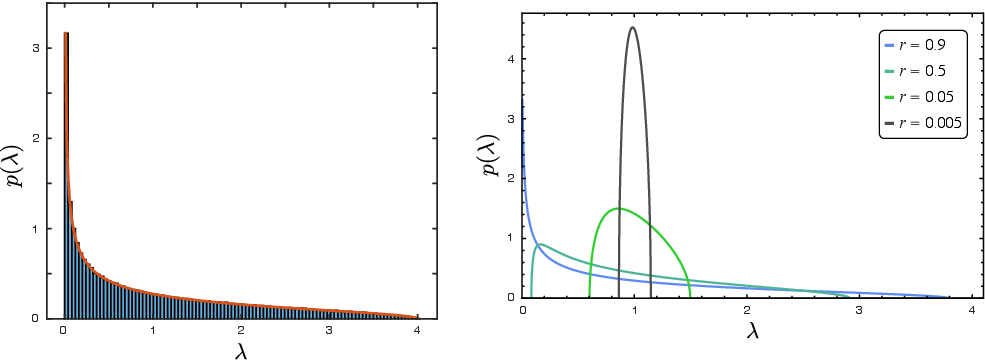
Figure 4: Distribution of R†R eigenvalues—random tensor maps are far from isometries except in exceptional scaling regimes; isometries require special structure.
Approaches to recover isometry on restricted (alpha-bit code) subspaces can ameliorate this, but the polar isometry remains complex unless the code has small enough support.
TPTNs replicate the statistical mechanics spin model derivation that underpins RTN models: tracing out boundary subregions, the calculation of Rényi or von Neumann entropies reduces (in the large bond dimension limit) to the free energy of a classical spin model (e.g., Ising or Sym(n)-valued spins) subjected to prescribed pinning on the region boundary.
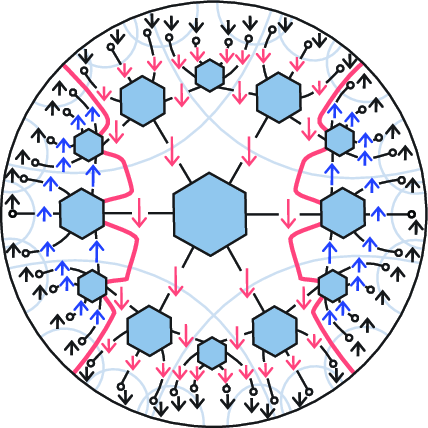
Figure 5: Effective statistical mechanics model for TPTN purity; domain wall crossing gives the RT surface as the minimal entanglement path, ensuring the lattice RT formula holds.
This ensures that even with random twirls, the AME structure of TPTNs ensures a rigid domain wall and thus a flat entanglement spectrum for subregions—unlike generic stabilizer or RTN models, which can fail dramatically for disconnected or irregular boundaries.
Discrete Obstructions and Foliation Cost
While the covariance property ensures the postselection cost along any non-contracting foliation is the only source of exponential complexity, additional cost arises in discrete TNs from locally shrinking moves—when a cut decreases the number of legs at a vertex, postselecting those degrees of freedom inflicts an extra complexity penalty not present in continuum gravity. This penalty, quantified as the cumulative number of locally postselected legs, is strictly a discretization effect and is argued to vanish in continuum geometries, where mean curvature flow permits everywhere area-increasing foliations between QESs.
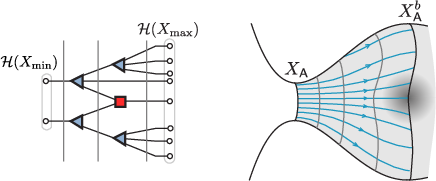
Figure 6: Locally shrinking moves (left) in discrete TNs require postselection, increasing complexity beyond the PLC prediction; continuum geometry (right) lacks such obstructions due to mean curvature flow.
Numerical Results and Comparison
Comparisons with MERA, MPS, and Markov constructions confirm that for homogeneous, spatially extensive python’s lunch setups (e.g., planar black branes), the PLC predicts complexity scaling sub-extensively with system size, in contrast to naive TN models whose complexity scales with volume unless one leverages short-range correlated structure.
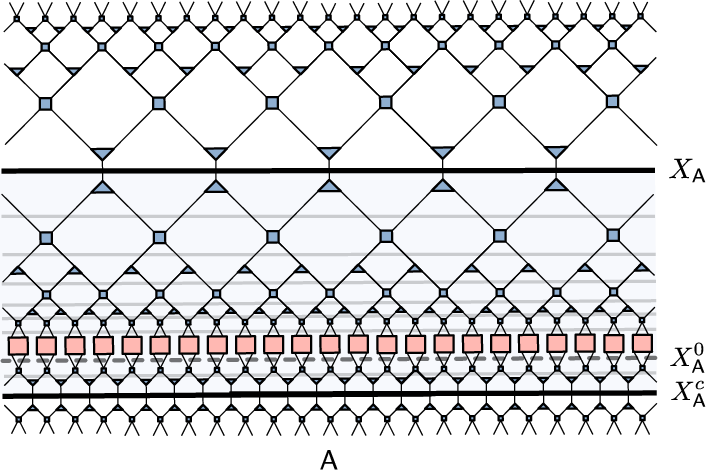
Figure 7: For a planar geometry, naive MERA contraction fails to saturate the non-extensive PLC complexity unless further structure—such as a TPTN/MPS with appropriate factoring—is imposed.
Implications and Future Directions
- TPTNs provide state ensembles with flat entanglement spectra and rigorous covariance, suitable not only for quantum gravity but potentially for designing families of maximally entangled or scramble-prone quantum circuits and codes.
- For black hole interiors, TPTNs supply network models whose entanglement and complexity match gravity-inspired expectations, including proper accounting of area-law surface orderings (RT/QES) and exponential circuit complexity in "hard" regions (the lunch).
- Discrete TN models should always account for the additional cost of locally shrinking foliations, but this is absent in continuum models, supporting the physical correctness of continuum PLC scaling.
- Extensions include experimental testability of TPTN states in near-term quantum devices and rigorous analysis of their design order and universality for more general boundary states.
Conclusion
The work establishes that to achieve both holographic entanglement structure and the correct complexity-theoretic (PLC) scaling in tensor network models, one must employ a class such as TPTNs: networks of perfect tensors twirled by generic unitaries. These models precisely match the geometric, quantum information-theoretic, and computational constraints expected from gravitational holography, providing a robust foundation for both theoretical investigations and potential quantum simulation studies.