- The paper establishes that the localization length scales as ξ ∼ Δ^(-1/d_w), deviating from the traditional Δ^(-1/2) law observed in periodic systems.
- It employs a heat kernel representation and exact diagonalization to connect the anomalous diffusion exponent d_w with the fractal geometry of the photonic bath.
- The findings highlight that engineering fractal photonic baths can provide a novel regime for controlling quantum light-matter interactions.
Atom-Photon Bound States in Fractal Photonic Lattices: Anomalous Localization and Diffusion
Introduction
The study "Atom-Photon Bound States in Fractal Photonic Lattices: Localization Length and Anomalous Diffusion" (2605.23625) provides a comprehensive analysis of single-emitter bound states in self-similar, fractal photonic lattices. In contrast to conventional periodic systems, fractal photonic lattices lack translational invariance, have non-integer Hausdorff dimension, and support anomalous diffusion. The paper establishes a connection between the localization properties of atom-photon bound states and the fundamental transport exponents of the underlying fractal geometry, principally the walk dimension dw. The study employs analytic arguments based on the heat kernel representation of the bath Green's function and validates key predictions through exact diagonalization on canonical fractal graphs.
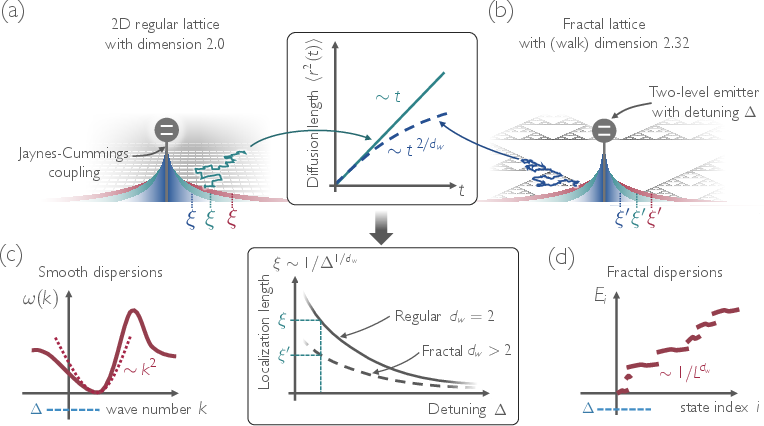
Figure 1: Illustration of atom-photon bound states for emitters in regular and fractal lattices; in regular arrays, ξ∼Δ−1/2 due to quadratic band edge dispersion, while in fractals, the localization exponent is controlled by the walk dimension as ξ∼Δ−1/dw (dw≈2.32 for Sierpiński gaskets).
From Periodic to Fractal Photonic Baths
Atom-photon bound states in periodic photonic baths are understood within band theory; localization length ξ diverges near the photonic band edge with ξ∼Δ−1/2, where Δ describes the detuning from the lower edge and the scaling exponent is set by the quadratic dispersion (dw=2) near the band edge. This effective mass picture is invalidated for fractal lattices, where momentum space is ill-defined due to the absence of translation symmetry, and exciton- or photon transport exhibits subdiffusive behavior.
Key distinctions arise in fractals, such as Sierpiński gaskets and carpets:
- Finitely ramified (nested) fractals: Removable by excising a finite set of sites at any scale.
- Infinitely ramified fractals: Remain globally connected regardless of finite removals, e.g., Sierpiński carpets.
Self-similarity and varying local connectivity introduce new transport exponents beyond the fractal (Hausdorff) dimension. Notably, the walk dimension dw (characterizing anomalous diffusion: ⟨r2(t)⟩∼t2/dw) and the spectral dimension ξ∼Δ−1/20 (controlling the density of states and return probability scaling).
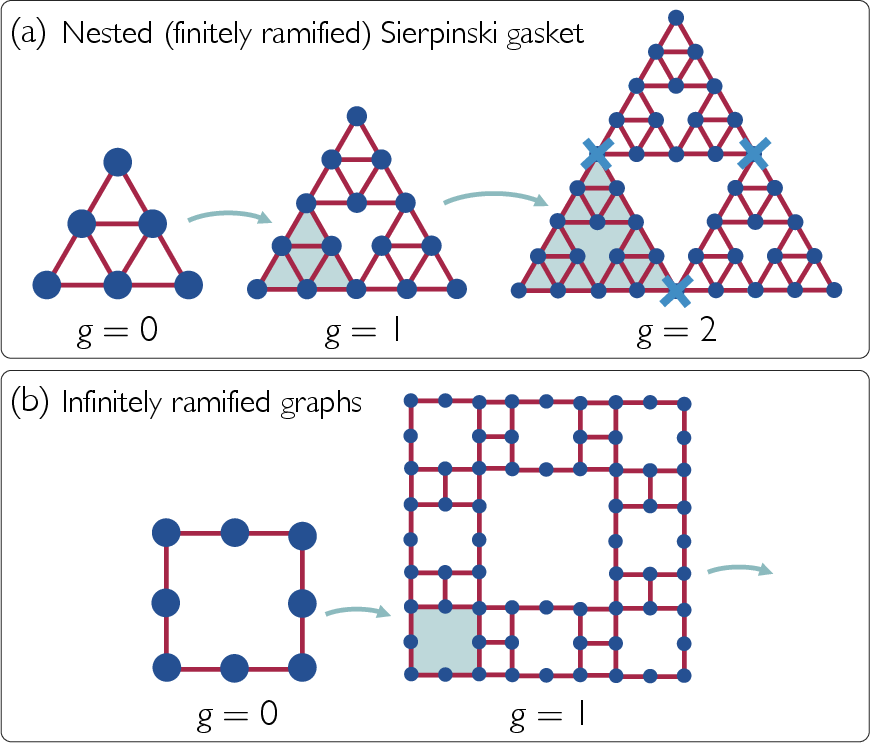
Figure 2: Generational construction of nested finitely ramified (a) and infinitely ramified (b) self-similar photonic graphs, such as Sierpiński gaskets and carpets.
Analytical Framework: Green's Function via Heat Kernel
The crucial analytic step is expressing the photonic Green's function at the bound state energy as a Laplace transform of the heat kernel, ξ∼Δ−1/21, for the underlying graph. This enables leveraging known rigorous bounds for diffusion on fractals. The far-field asymptotic of the bound state is then controlled by the heat-kernel's long-time and large-distance decay:
ξ∼Δ−1/22
The principal result is that the localization length diverges as
ξ∼Δ−1/23
in the limit of vanishing detuning, where ξ∼Δ−1/24 is the random-walk dimension specific to the fractal. This scaling law persists universally for all Laplacian-like Hamiltonians on self-similar graphs, in contrast to the effective mass law in periodic systems.
For the near-field (short-distance) regime, the bound state displays additional algebraic corrections controlled by ξ∼Δ−1/25 (ξ∼Δ−1/26 being the fractal dimension), leading to
ξ∼Δ−1/27
This scaling aligns with first-passage and resistance scaling in classical transport for finitely ramified fractals, while deviations occur for infinitely ramified structures.
Numerical Results: Validation and Characterization
The analytic predictions are systematically validated via exact diagonalization for a suite of fractal and reference lattices, employing boundary-coupled emitters to resolve localization directly from the asymptotic exponential decay.
- The localization length for all analyzed fractals accurately follows ξ∼Δ−1/28, in agreement with theoretical ξ∼Δ−1/29 values (e.g., ξ∼Δ−1/dw0 for Sierpiński gasket ξ∼Δ−1/dw1), demonstrating that the transport exponent governs the tail behavior of the bound state.
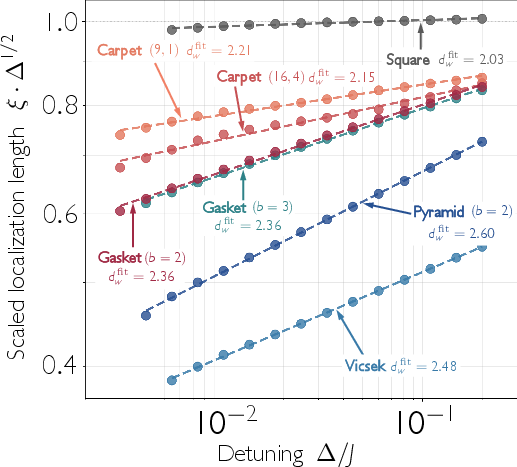
Figure 3: The numerical localization length, rescaled as ξ∼Δ−1/dw2, reveals systematic deviation from flatness (periodic-lattice benchmark), confirming the fractal power law ξ∼Δ−1/dw3.
- Near-field analysis exposes that for nested, finitely ramified fractals, the amplitude difference displays power-law scaling as predicted by resistance exponent ξ∼Δ−1/dw4, whereas infinitely ramified structures, e.g., Sierpiński carpets, deviate and align more closely with the marginal two-dimensional logarithmic case.
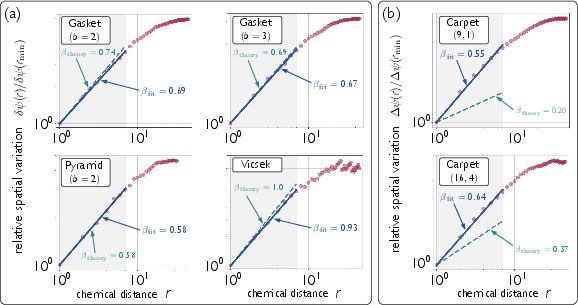
Figure 4: Near-field scaling of amplitude differences, showing algebraic scaling for nested fractals in quantitative agreement with theoretical ξ∼Δ−1/dw5, and systematic deviations for Sierpiński carpets.
Implications and Future Directions
This study articulates that, in structured baths with fractal geometry, the relevant control parameters for atom-photon bound state localization are no longer band curvature or effective mass but the anomalous transport exponents ξ∼Δ−1/dw6 (and to a lesser extent ξ∼Δ−1/dw7, ξ∼Δ−1/dw8). This insight substantially broadens the design space for quantum photonic environments: By engineering a fractal bath, one can control the spatial extent and decay profiles of light-matter bound states in a manner inaccessible to periodic band-structure engineering.
Potential future research directions include:
- Analysis of many-emitter interactions, effective spin models, and non-Gaussian photonic baths in fractal geometries.
- Exploring disorder and decoherence effects atop self-similar backgrounds.
- Experimental realization with femtosecond-laser-written waveguide arrays or superconducting circuits engineered to support fractal connectivity patterns.
- Generalization to other non-periodic or hyperbolic bath structures, and exploration of topologically protected states in these settings.
The methodology using real-space heat kernel analysis circumvents limitations posed by the lack of translational invariance and should be extensible to other complex graph-based quantum systems.
Conclusion
The findings of (2605.23625) demonstrate that the localization properties of single-excitation atom-photon bound states in fractal photonic lattices are tightly governed by the anomalous diffusion exponent ξ∼Δ−1/dw9 intrinsic to the self-similar geometry. The localization length scales as dw≈2.320, in contrast to the standard dw≈2.321 law in periodic systems, and the near-field profile encodes further signatures of the geometry, substantiated by both analytical and numerical evidence. This work positions fractal photonic environments as a distinct and tunable regime for quantum light-matter interaction, with implications for the design of long-range, coherent quantum emitters, and the programmable shaping of electromagnetic environment at the quantum level.

