Published 22 May 2026 in quant-ph and cond-mat.mes-hall | (2605.23613v1)
Abstract: We formulate non-Hermitian Landau levels in two-dimensional systems under a complex perpendicular magnetic field. In the symmetric gauge, we derive their discretely spaced, highly degenerate complex spectra and biorthogonal eigenstates, and clarify the role of non-unitary gauge transformations. A non-Hermitian Harper-Hofstadter lattice model confirms the continuum theory and reveals Gaussian wave packet dynamics governed by semiclassical equations with a complex Lorentz force, pointing to possible experimental realizations of complex magnetic fields.
The paper introduces non-Hermitian Landau levels with discretely spaced, biorthogonal eigenstates under complex magnetic fields.
It demonstrates that gauge transformations become non-unitary, critically affecting wavefunction square-integrability and spectral degeneracy.
Analytical and numerical methods confirm unique lattice dynamics, including spiral wave packet motion and edge-related phenomena.
Non-Hermitian Landau Levels: Complex Magnetic Fields and Quantum Structure
Theoretical Formulation of Non-Hermitian Landau Quantization
The paper presents a rigorous extension of Landau quantization to two-dimensional systems under complex-valued magnetic fields, developing the structure of non-Hermitian Landau levels. In the symmetric gauge, the Hamiltonian features complex-valued cyclotron frequency ωc=mcqB, resulting in discretely spaced, highly degenerate complex energy spectra ϵn=ℏωc(n+21). The eigenbasis requires biorthogonalization: right eigenstates ∣n,m⟩R and left eigenstates ∣n,m⟩L are constructed using non-unitary ladder operators, with proper normalization ensuring square-integrability only when Re(B)>0.
Angular momentum commutes with the Hamiltonian, allowing simultaneous diagonalization. Each eigenstate is uniquely indexed by the Landau level n and angular momentum quantum number m. Analytical wavefunctions are provided, parametrized by a complex magnetic length ac=cℏ/(qB), which is essential not just for localization but also for the biorthogonality relations.
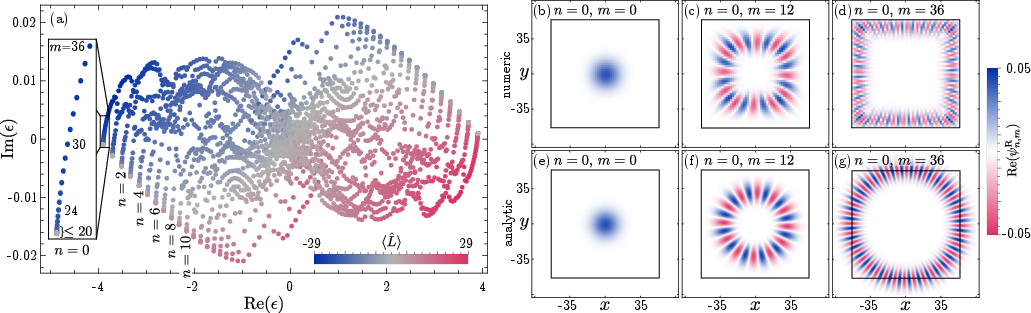
Figure 1: Eigenvalue distribution and spatial profiles of eigenstates for the non-Hermitian Harper-Hofstadter model with B=0.1−0.001i, confirming discrete complex Landau structure and edge effects.
Gauge Dependence and Physicality of Complex Fields
The analysis underscores that gauge transformations, generally unitary for Hermitian systems, become non-unitary with complex magnetic fields. Transformations from symmetric to Landau gauge may yield wavefunctions that lose square-integrability unless Re(B)>∣Im(B)∣. This explicit breakdown of standard gauge invariance leads to physical consequences: localization, spectral degeneracies, and edge behaviors depend on gauge choice. The necessity to specify gauge in discussing non-Hermitian magnetic models is quantitatively justified.
Lattice Realization: Harper-Hofstadter Model
Numerical diagonalization of the non-Hermitian Harper-Hofstadter model on a ϵn=ℏωc(n+21)0 square lattice substantiates the continuum theory. In the resolved regime (ϵn=ℏωc(n+21)1), eigenvalues cluster near ϵn=ℏωc(n+21)2 with clear angular momentum-dependent degeneracy. Edge-induced non-reciprocal amplification (for ϵn=ℏωc(n+21)3) or damping (for ϵn=ℏωc(n+21)4) emerges, producing eigenvalue arcs that spiral inwards—absent in Hermitian models. Finite-size effects primarily manifest at large angular momentum, breaking the analyticity of the spectrum as detailed in Figure 1. Correlation between continuum and lattice eigenstates confirms the analytic biorthogonal wavefunctions only as long as states do not extend beyond the lattice boundary.
Semiclassical Dynamics and Complex Lorentz Forces
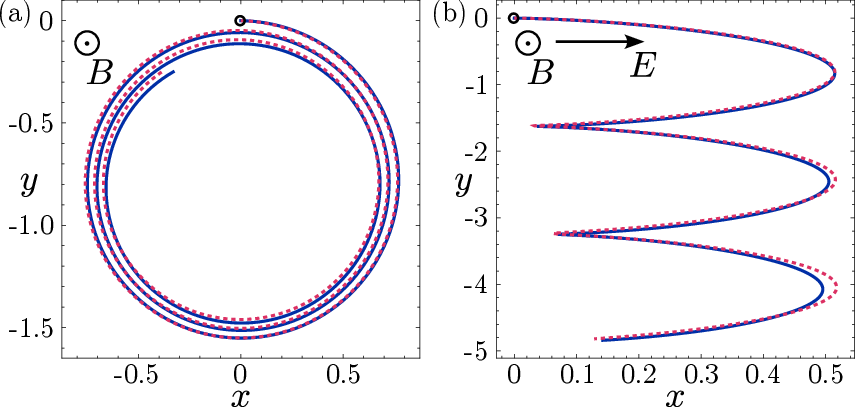
Wave packet evolution in the non-Hermitian regime is dominated by the semiclassical equations of motion incorporating a complex-valued Lorentz force. For finite initial momentum, center-of-mass trajectories spiral, modulated by the imaginary component of ϵn=ℏωc(n+21)5: inwards spiraling for ϵn=ℏωc(n+21)6 (damping), outwards for ϵn=ℏωc(n+21)7 (gain). These behaviors are confirmed numerically, and traced analytically to a complex-frequency harmonic oscillator model.
Figure 2: Center-of-mass trajectories for Gaussian wave packets in complex magnetic fields; spiral or skipping orbits follow the modified semiclassical equations, with strong agreement between numerics and analytics.
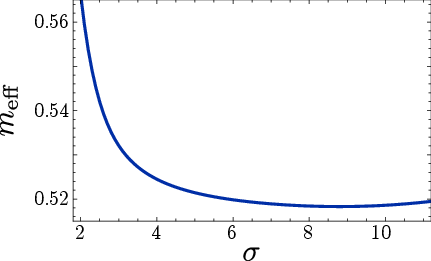
With applied in-plane electric fields, trajectories become "skipping" in direction and amplitude, consistent with analytic solutions. Deviations are attributed predominantly to the width-dependent effective mass of the wave packet, as verified in supplemental simulations.
Practical Implications and Experimental Prospects
The existence and analytic structure of non-Hermitian Landau levels enable direct predictions for spectral and dynamical observables in dissipative quantum platforms. Non-Hermitian lattice models can be realized in topoelectric circuits, acoustic, plasmonic, or optical metasurfaces, and driven ultracold atomic systems where complex-valued adiabatic potentials generate effective magnetic fields with loss-induced non-Hermiticity. The Landau level quantization and wave packet dynamics under complex fields can be spectroscopically resolved and tracked in these platforms.
Moreover, the construction of many-body states (e.g., non-Hermitian Laughlin states) is facilitated, underpinning prospective non-Hermitian fractional topological phases. Theoretical boundaries remain: the exhaustion of the spectrum by discrete Landau levels in the complex regime versus a possible continuous spectrum is not strictly proven. Further gauge exploration and rigorous spectral completeness analysis are warranted.
Figure 3: Effective mass ϵn=ℏωc(n+21)8 variation with wave packet width, impacting semiclassical dynamics in finite lattices.
Conclusion
This work establishes the analytic and numerical foundation for non-Hermitian Landau quantization in complex magnetic fields, with precise biorthogonal eigenstructure, modified gauge theory, and observable signatures in lattice realizations. The results provide not just a methodological extension to non-Hermitian quantum systems, but also set the stage for experimental demonstration and theoretical exploration of many-body non-Hermitian topological phases and dissipative quantum dynamics. Continued inquiry into gauge-dependent spectra, wave packet localization, and the rigorous formulation of spectral completeness is expected to deepen the understanding of non-Hermitian quantum mechanics and its condensed matter realizations.
“Emergent Mind helps me see which AI papers have caught fire online.”
Philip
Creator, AI Explained on YouTube
Sign up for free to explore the frontiers of research
Discover trending papers, chat with arXiv, and track the latest research shaping the future of science and technology.Discover trending papers, chat with arXiv, and more.