Minimal Trade-off and Optimal Measurement for Multiparameter Quantum Estimation
Published 22 May 2026 in quant-ph | (2605.23514v1)
Abstract: A fundamental challenge in multiparameter quantum estimation arises from the incompatibility of optimal measurements for different parameters, leading to intricate precision trade-offs that obscure the understanding of ultimate quantum limits. Here, we present an approach that precisely quantifies these trade-offs for an arbitrary number of parameters encoded in pure quantum states. Our approach not only derives tight analytical bounds for the trade-offs induced by measurement incompatibility but also provides a systematic methodology to design optimal measurement strategies that saturate these limits. To demonstrate the practical significance of our findings, we apply our framework to quantum radar and obtain a refined Arthurs-Kelly relation that characterizes the ultimate performance for the simultaneous estimation of range and velocity with any given amount of entanglement. This showcases the transformative potential of our findings for a wide range of applications in quantum metrology, sensing, and beyond.
The paper introduces a tight analytical framework quantifying precision trade-offs due to measurement incompatibility using the CFIM and QFIM.
It develops a systematic procedure employing Gram-Schmidt orthogonalization to construct optimal measurement bases that saturate derived bounds.
The application to quantum radar demonstrates simultaneous range and velocity estimation with refined uncertainty bounds using entangled biphoton states.
Minimal Trade-off and Optimal Measurement in Multiparameter Quantum Estimation
Introduction
Multiparameter quantum estimation plays a central role in quantum metrology, quantum sensing, and quantum information science, yet is fundamentally constrained by measurement incompatibility due to the non-commutativity of optimal observables associated with different parameters. The paper "Minimal Trade-off and Optimal Measurement for Multiparameter Quantum Estimation" (2605.23514) introduces a tight analytical framework for quantifying precision trade-offs imposed by this incompatibility and presents constructive procedures for generating optimal measurement strategies that saturate the derived limits. The theoretical developments are further demonstrated in the context of quantum radar, revealing new attainable bounds for simultaneous range and velocity estimation utilizing entangled biphoton states.
Measurement Incompatibility and Analytical Trade-off Bound
The precision attainable in multiparameter quantum estimation is limited by the incompatibility between the optimal measurements for each parameter, a uniquely quantum phenomenon stemming from the non-commutativity of SLDs. The paper formalizes this constraint using the classical Fisher information matrix (CFIM) and quantum Fisher information matrix (QFIM), establishing the gap Γ=Tr(FQ−1FC) as a measure of trade-off, where Γ≤n and n is the number of parameters.
A key result is an explicit tight analytical bound: Γ≤n−21q=1∑n(1−1−∣λq∣2)
where λq are eigenvalues of FQ−21FImFQ−21, with FIm encoding the incompatibility (Berry curvature) of parameter observables. This bound is asymptotically tight for pure states and encompasses known results (e.g., Gill-Massar bound for fully incompatible cases) as special cases. If FIm=0 (commutative SLDs), Γ=n and QCRB is saturable; otherwise, a nonzero gap quantifies the inherent trade-off.
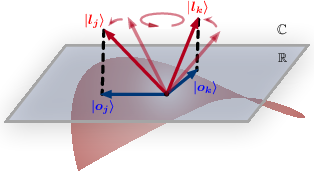
Figure 1: Geometric interpretation of incompatibility: vectors associated with SLD observables cannot be simultaneously rotated into the real subspace due to their mutual non-commutativity, quantifying the measurement-induced precision trade-off.
Systematic Construction of Optimal Measurement Strategies
The formalism delivers a constructive procedure for designing projective measurements that saturate the bound. Optimal measurement bases are constructed via Gram-Schmidt orthogonalization of vectors derived from the state and optimal commuting observables, followed by real basis selection and unitary transformation. This procedure accommodates infinitely many optimal measurements, permitting robustness to experimental noise by tailoring the measurement probability distribution.
The analytical insight provided by the geometric picture clarifies that measurement incompatibility corresponds to the impossibility of representing all SLD-associated vectors as real simultaneously. Optimal measurement strategies rotate each as close as possible to real, minimizing the sum of imaginary components and therefore the precision gap.
Application: Quantum Radar—Simultaneous Estimation of Range and Velocity
The practical significance of the theoretical framework is demonstrated in quantum radar, specifically the simultaneous estimation of range and velocity using entangled biphoton states. Prior bounds, such as those derived from QCRB, are unattainable due to violated weak commutativity, and previous techniques provided only limiting-case results for no-entanglement and perfect entanglement.
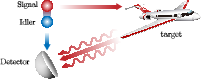
Figure 2: Schematic of quantum radar employing entangled biphoton states for joint range and velocity estimation; range and velocity are encoded in time-of-flight and Doppler shift.
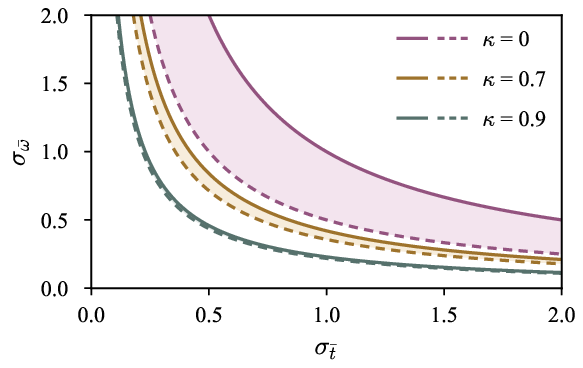
The paper quantifies the attainable minimum product of variances for range and velocity estimation as: σtˉσωˉ≥1+κ1−κ2=1+κ1−κ
where Γ≤n0 denotes the degree of biphoton entanglement. This refined Arthurs-Kelly relation closes the gap for all Γ≤n1, unifying previously known bounds: the standard Arthurs-Kelly (Γ≤n2) and the ideal entangled case (Γ≤n3). The construction demonstrates that optimal measurements for intermediate entanglement are implementable via projective measurements in finite-dimensional subspaces, offering adaptability to realistic quantum radar platforms.
Figure 3: Achievable uncertainty relations for quantum radar as a function of entanglement parameter Γ≤n4; solid curves show tight bounds, dashed curves denote QCRB-derived bounds, and shaded regions indicate unattainable domains due to incompatibility.
Implications and Future Directions
The formal analytical trade-off provides unprecedented clarity on fundamental limits for multiparameter quantum estimation, with direct implications for quantum metrology, quantum sensing, and applications such as quantum radar, gyroscopes, and imaging. The abundance of optimal measurement strategies enables adaptability and robustness to practical noise environments and hardware constraints. Theoretical implications extend to the geometric understanding of quantum estimation and the structure of attainable bounds in both pure and mixed state scenarios, which may catalyze new developments in quantum measurement design and precision optimization.
Future advancements may include generalizations to mixed states, noise-adaptive measurement construction, and integration of control-enhanced estimation protocols. The geometric and analytical framework may further inform the study of singular quantum information matrices, adaptive sequential measurement strategies, and the role of incompatibility in quantum statistical inference.
Conclusion
The paper establishes a tight analytical trade-off for multiparameter quantum estimation under measurement incompatibility, accompanied by systematic construction of optimal measurement strategies and rigorous application to quantum radar. The results delineate the ultimate attainable bounds and provide theoretical foundations for designing practical measurement protocols that maximize precision, fundamentally advancing the landscape of multiparameter quantum metrology.