- The paper presents a computationally efficient ETA gap scheduling method that guarantees safe separation under heterogeneous speed and distance constraints.
- It derives conservative spatiotemporal bounds using extreme speed profiles to contain all admissible vehicle trajectories within safety thresholds.
- Numerical evaluations show that ETA-based scheduling improves vehicle throughput and flow stability while preventing collisions in high-density UAM operations.
Safety-Assured Arrival Scheduling in Sequential UAM Corridor Sections under Speed and Separation Constraints
Motivation and Problem Definition
The study addresses critical safety and throughput bottlenecks posed by Urban Air Mobility (UAM) as the paradigm shifts toward scalable corridor-based aerial operations in metropolitan environments. Unlike prior UAM corridor design literature focused on geometric layouts, routing, or high-level airspace taxonomies, this work tackles the fine-grained, waypoint-level inter-vehicle longitudinal separation required for practical high-density corridor operations. The paper formalizes the ETA gap scheduling problem at Constrained Waypoints (CWPs) for sequential corridor sections with heterogeneous speed limits, under the constraint that the minimal separation distance never falls below a prescribed safety threshold (safeD) for any admissible vehicle trajectory.
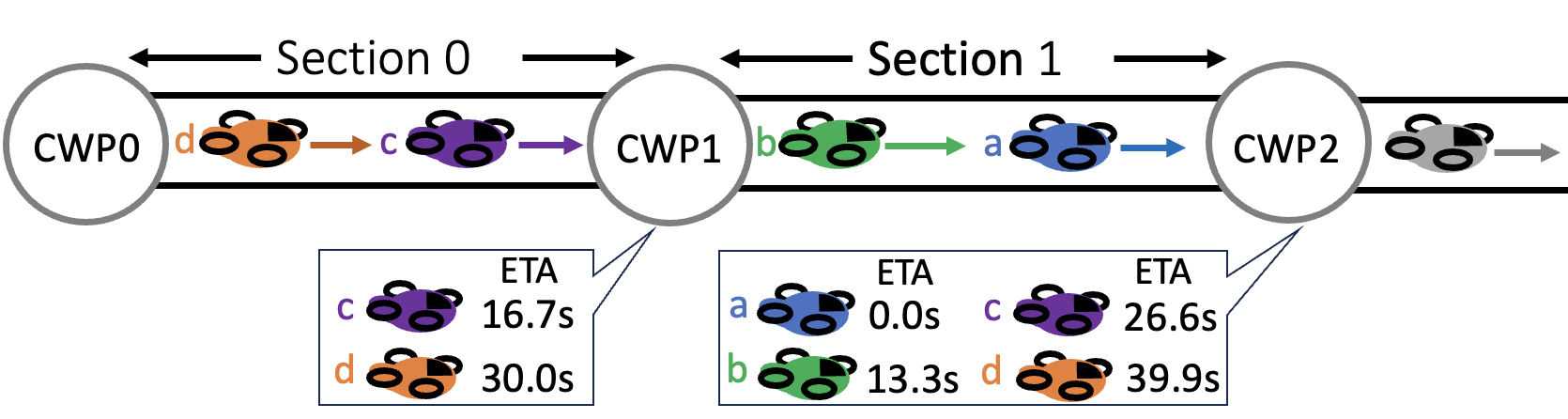
Figure 1: A UAM corridor network with ETAs at CWPs, illustrating sequential corridor sections and constrained waypoint coordination.
Analytical Framework and Spatiotemporal Bounds
The vehicle motion is modeled as one-dimensional kinematics constrained by corridor-specific speed limits and fixed section travel times, establishing a discretized yet generalizable abstraction of UAM operations. The authors derive conservative spatiotemporal envelope bounds for all admissible trajectories using two extreme speed profiles—minimum-to-maximum and maximum-to-minimum switches—which allows for bounding the leader and follower vehicle positions throughout the corridor. These profiles are constructed to account for instantaneous speed transitions, and their critical points provide a reduced set of time instants for verifying separation constraints. Formal proofs establish that all legitimate vehicle trajectories reside within these bounds, ensuring the applicability of the derived ETA-gap conditions regardless of the vehicles' actual speed modulation strategies.
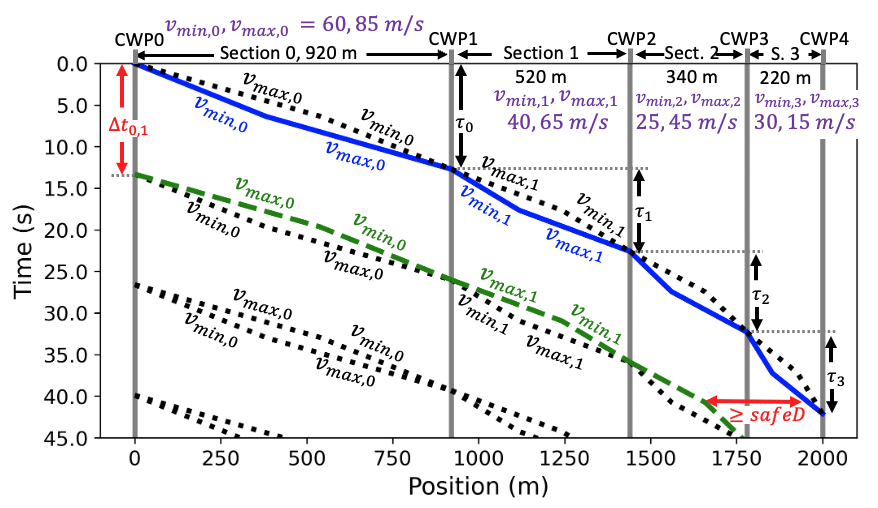
Figure 2: Conservative spatiotemporal bounds of vehicle trajectories under prescribed speed limits, demonstrating the containment of all admissible movement profiles.
ETA Gap Computation Methodology
The safety-assured ETA gap is efficiently obtained by checking separation only at the finite critical points where the trajectory bounds change slope, reducing the verification problem from continuous to discrete. This methodology yields a computationally tractable optimization problem for determining the minimal ETA gap, taking into account corridor section lengths, speed limits, and the required safety distance. The approach guarantees that all inter-vehicle separation requirements are met for any admissible kinematic trajectory, with the resulting ETA gap substantially smaller than the conservative "enter-after-leader-exits" approach. The paper’s key lemma and theorems establish sufficiency of the ETA gap derived by this reduced problem, enabling practical deployment in digital ETA-scheduling and traffic management systems.
Numerical Evaluation and Throughput Analysis
Simulation experiments are conducted in a decreasing-speed corridor scenario—a representative operationally challenging configuration where traffic density may increase downstream due to speed compression. The results demonstrate that the proposed ETA-gap policy consistently prevents all collisions and ensures a minimum separation of safeD across a wide range of values (100–1200 m). The minimum ETA gap required increases monotonically with safeD, but sub-linearly for larger safety distances.
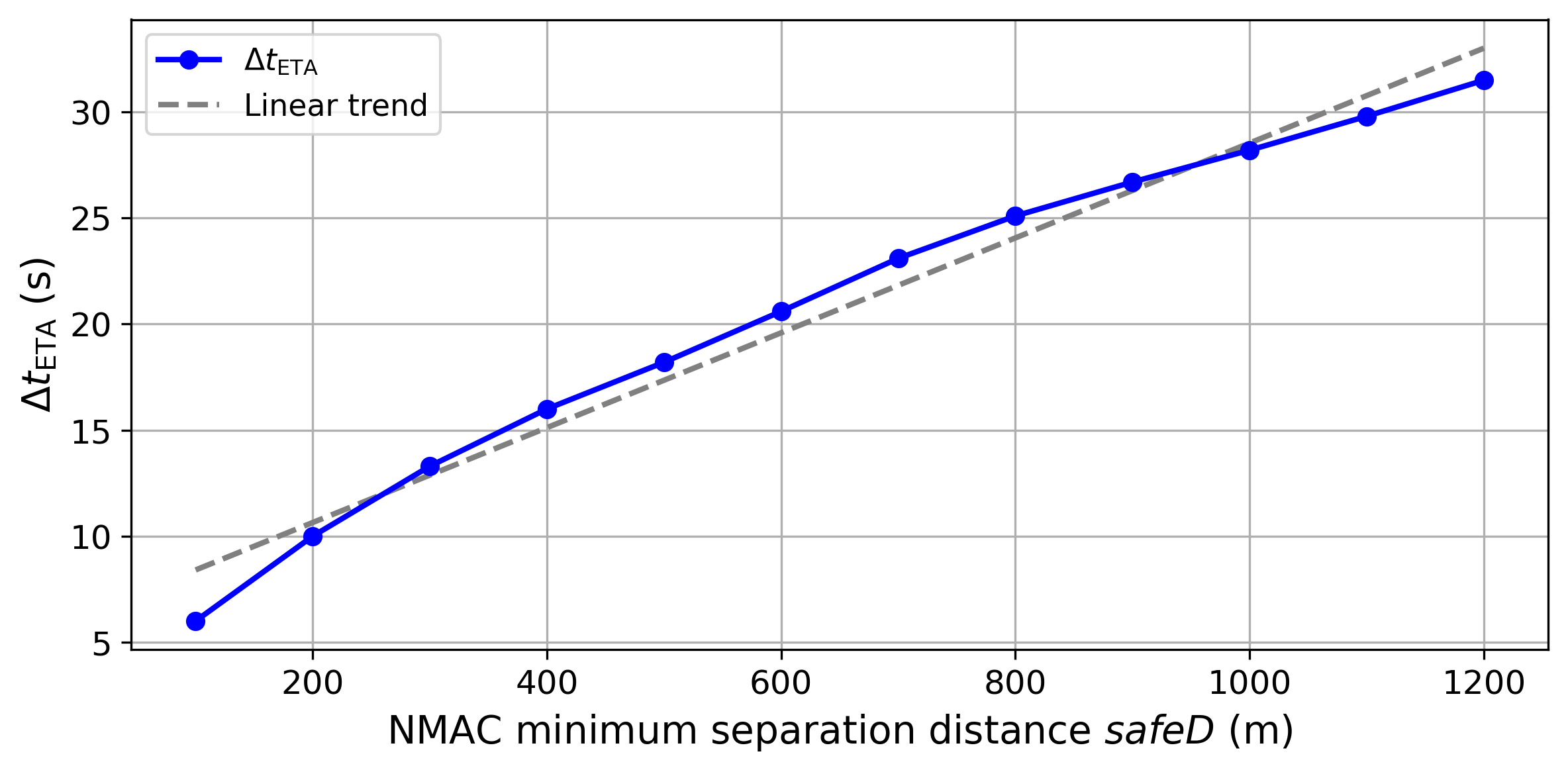
Figure 3: Relationship between safeD and the computed ETA gap, showing monotonic but diminishing growth.
ETA-based scheduling dramatically improves safe vehicle throughput and flow stability compared to unscheduled operations, which experience congestion and collisions at moderate to small separation distances.
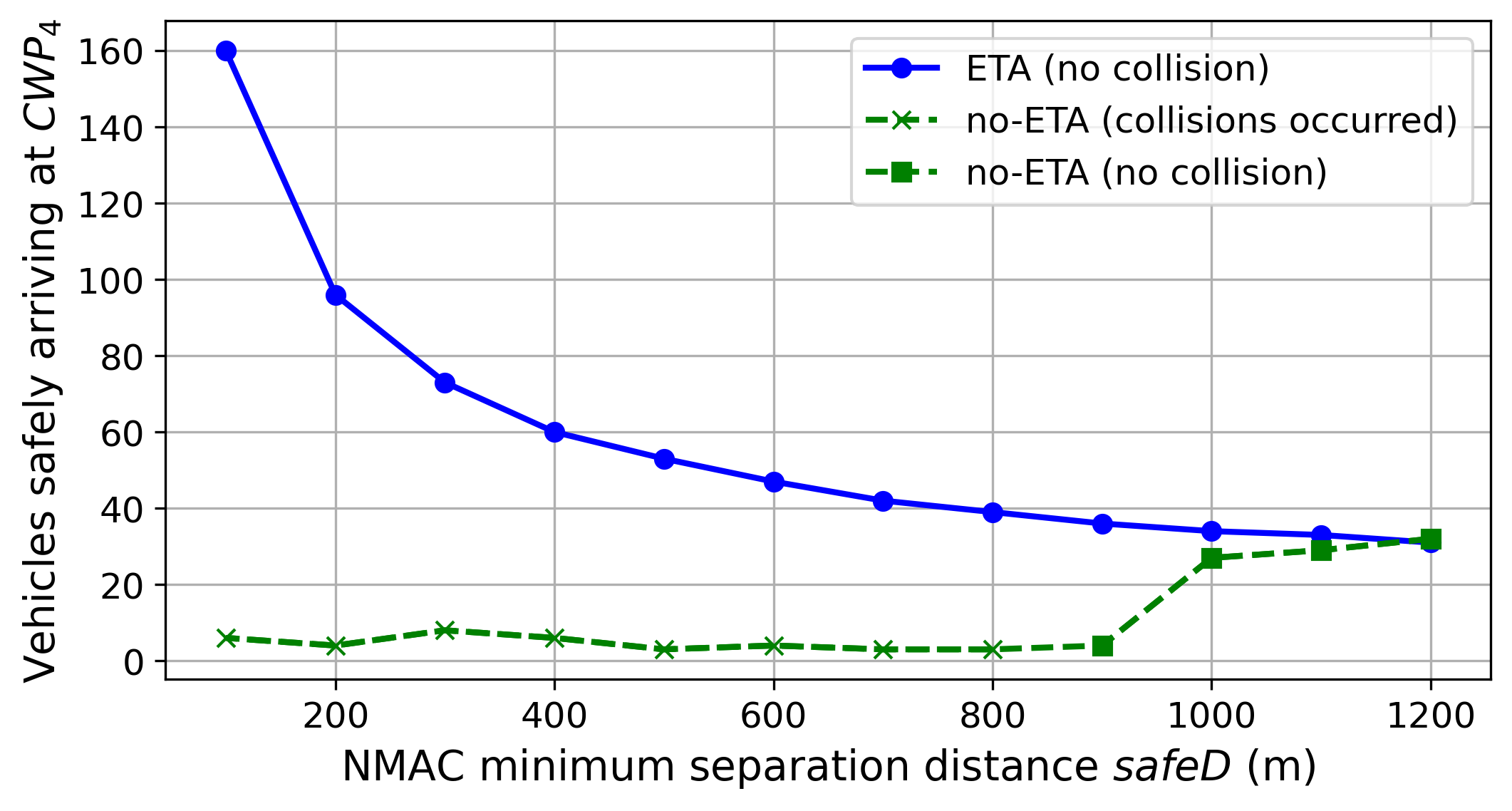
Figure 4: Number of vehicles successfully arriving at CWP4 versus safeD, highlighting throughput and collision outcomes for ETA-based and unscheduled operations.
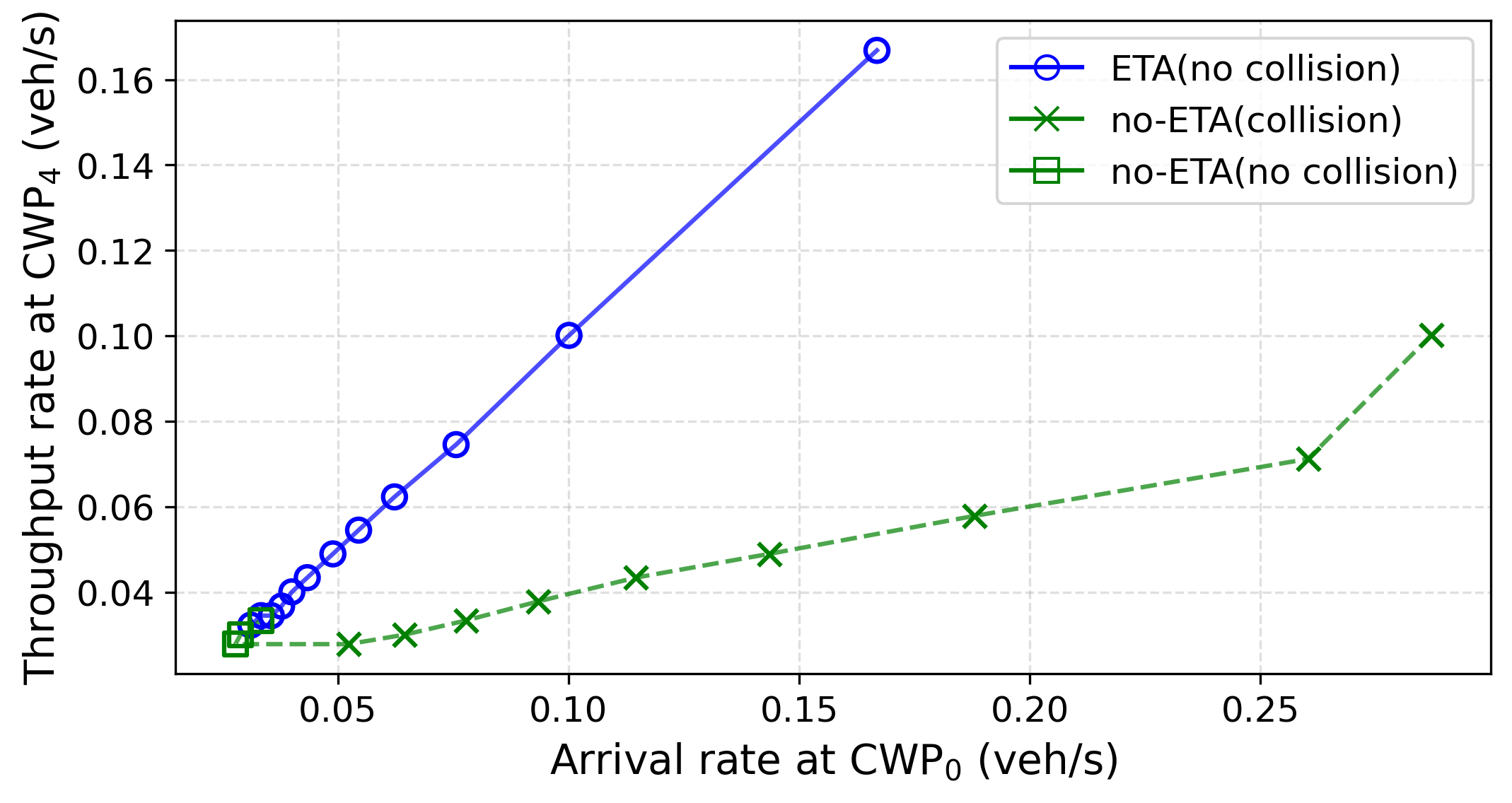
Figure 5: Arrival rate at CWP0 versus throughput rate at CWP4, underscoring efficient flow scaling under ETA-gap scheduling.
The spatiotemporal trajectory visualization shows uniform, collision-free flow under ETA coordination, compared to reactive braking and localized congestion under unscheduled (no-ETA) entry patterns.
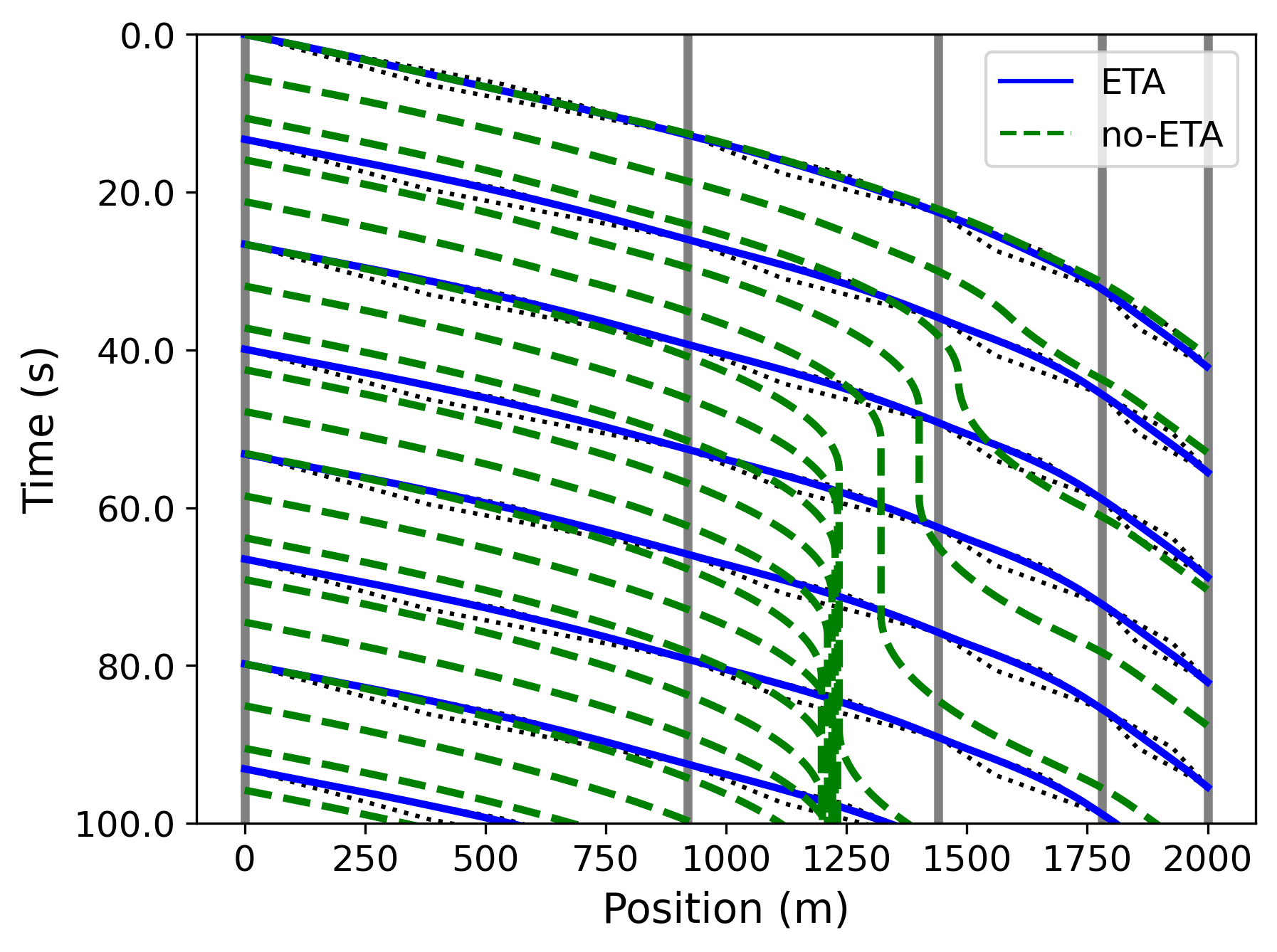
Figure 6: Spatiotemporal trajectories for safeD=300 m under both ETA-gap and unscheduled modes; ETA scheduling yields stable flow envelopes and collision avoidance.
Theoretical and Practical Implications
The study offers a systematic procedure suitable for integration into future digital air traffic management architectures. The computational efficiency and generality of the ETA gap condition facilitate its adoption in scalable multi-section corridor networks, supporting both operational safety and design evaluation. Corridors can be evaluated and refined based on their induced ETA gaps as a measure of latent capacity or bottleneck risk. The methodology also serves as a foundation for robust admission control policies and further theoretical exploration into mixed speed-profile corridors, heterogenous vehicle dynamics, and uncertainty buffering in ETA assignments.
Directions for Future Research
Further exploration could target:
- Extension to corridors with variable travel times per vehicle or section.
- Incorporation of longitudinal dynamic constraints (e.g., jerk, actuator delays).
- Systematic sensitivity studies over corridor geometries, speed limits, and vehicle-following parameters.
- Robust ETA scheduling under tracking error uncertainty and merging traffic.
- Integration with higher-fidelity vehicle dynamics and simulation-based corridor optimization.
Conclusion
This paper delineates a formal safety-assured arrival scheduling model for sequential UAM corridor operations under speed and separation constraints. By constructing conservative spatiotemporal bounds and reducing safety verification to finite critical points, the study achieves scalable, computationally efficient ETA scheduling with demonstrated gains in throughput and safety compared to unscheduled operations. The methodological advances provide a robust foundation for digital ETA-coordination as a central component of air traffic management in urban air mobility systems.