- The paper proposes EF-LIC which eliminates entropy coding through innovative vector quantization and context-conditioned decorrelation.
- It achieves over 55% BD-rate improvements and up to 67.86% bitrate reduction on standard datasets compared to competitive methods.
- The framework offers an order-of-magnitude speed increase in encoding/decoding, facilitating accelerator-friendly deployment and real-time use.
Efficient Learned Image Compression without Entropy Coding: A Technical Review
Introduction and Context
"Efficient Learned Image Compression without Entropy Coding" (2605.23323) addresses the latency bottleneck imposed by entropy coding in state-of-the-art learned image compression (LIC) systems. Conventional LIC pipelines rely on context models and entropy coding (e.g., rANS, arithmetic coding) to exploit both statistical and correlation redundancy, but entropy coding is inherently sequential and yields unfavorable runtime characteristics on accelerator hardware. This paper proposes EF-LIC, a novel framework for entropy-coding-free neural image compression that achieves minimum redundancy through architectural and algorithmic innovations in vector quantization and context-conditioned decorrelation.
Methodology
Architectural Overview
EF-LIC achieves image compression without entropy coding by combining two central techniques: unconstrained vector quantization (VQ) for statistical decorrelation and a context-conditioned autoregressive transform for removing inter-latent dependence, both operating fully in the representation domain and designed for high parallelizability.
A schematic comparison with baseline approaches (VQ-only, entropy-coded LIC, EF-LIC) reveals the following (Figure 1):
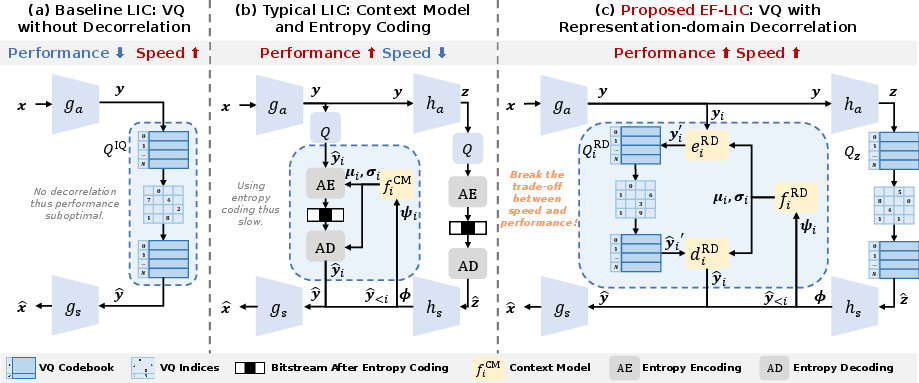
Figure 1: (a) VQ-only baseline is fast but loses efficiency due to lack of inter-latent decorrelation. (b) Typical LIC with context model and entropy coding. (c) EF-LIC, which employs context-conditional transformation before VQ, completely eliminating entropy coding.
The system encodes an image to a latent representation using an analysis transform followed by segmentation into groups; each group undergoes context-conditioned affine transformation, and is then discretized with group-wise RVQ. To support multi-rate operation, EF-LIC leverages a family of RVQ modules with varying numbers of codebooks.
The end-to-end architecture is highly accelerator (GPU/TPU)-friendly since all coding operations are parallelizable, in stark contrast to sequential entropy coding in classical LIC frameworks.
Statistical Redundancy Removal via Maximum-Entropy VQ
By transmitting the indices from unconstrained (i.e., uniformized) VQ in fixed-length codes, the approach guarantees that the encoded representations asymptotically attain the maximum entropy bound as training converges. The authors prove that, under distortion-optimal quantization, the normalized entropy gap vanishes (ΔH→0), and therefore the statistical redundancy is negligible without explicit entropy coding. This is enhanced by empirical evidence that ΔH is tightly constrained in practice by the proposed training protocol.
Correlation Redundancy Removal: Representation-Domain Decorrelation
Typical entropy-coded LIC systems use probability-domain context modeling for autoregressive entropy reduction. EF-LIC replaces this with representation-domain decorrelation: each group of latents is reparameterized with context extracted from preceding groups and side information (a hyperprior), followed by group-wise VQ. Theoretical results show that this domain shift preserves or improves the achievable rate-distortion trade-off relative to independent quantization.
A key theorem establishes that, given sufficiently flexible autoregressive transformations and codebooks, the representation-domain approach is guaranteed to match the performance of optimal entropy-coded LIC, up to an arbitrarily small overhead controlled by the index entropy gap.
Multi-Rate and Implementation Details
By construction, EF-LIC enables multi-rate operation via grouped RVQ, supports efficient bitstream packing (i.e., concatenation of fixed-length indices), and eliminates the requirement for device-synchronized entropy models. The architecture details are visualized (Figure 2).
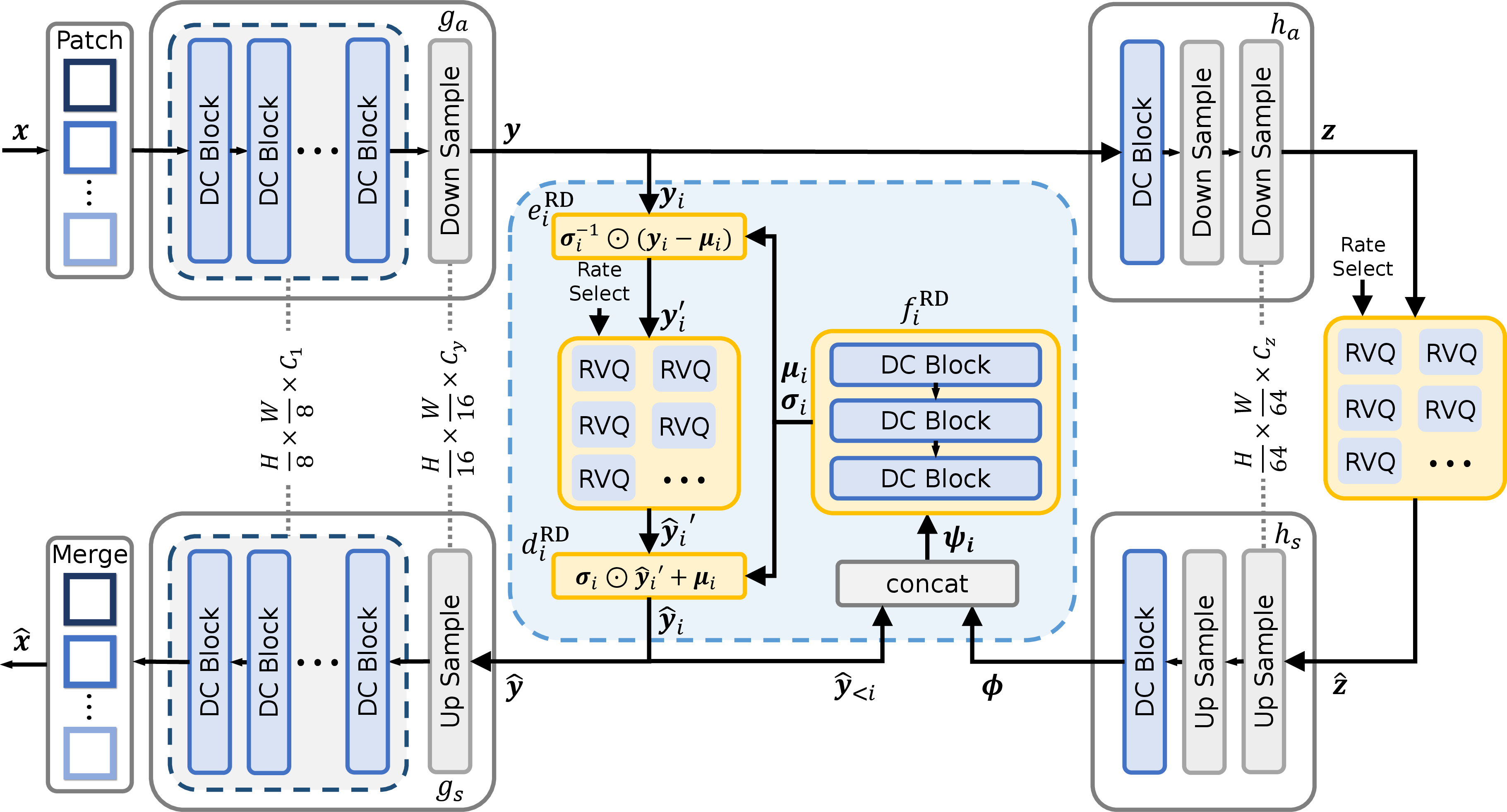
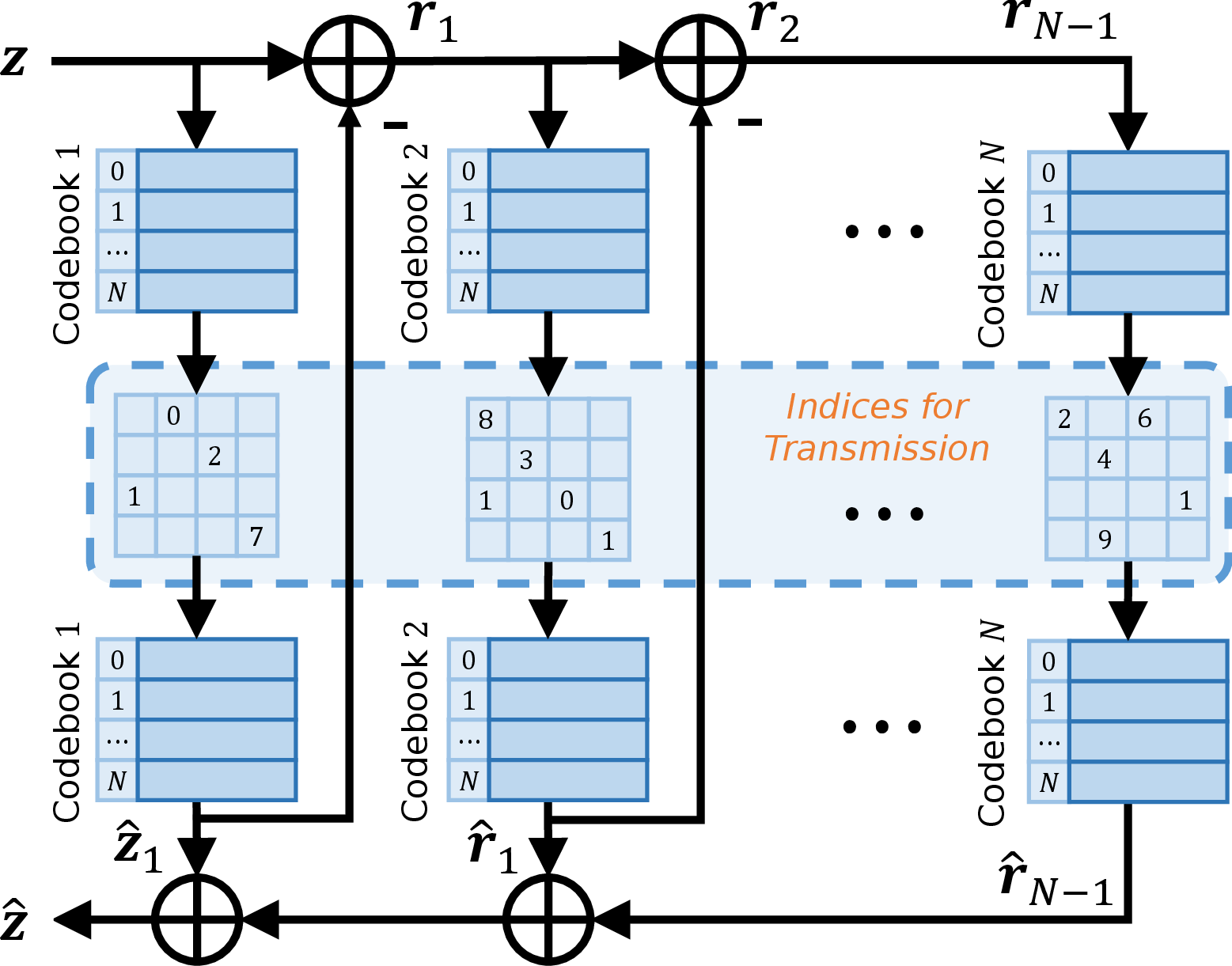
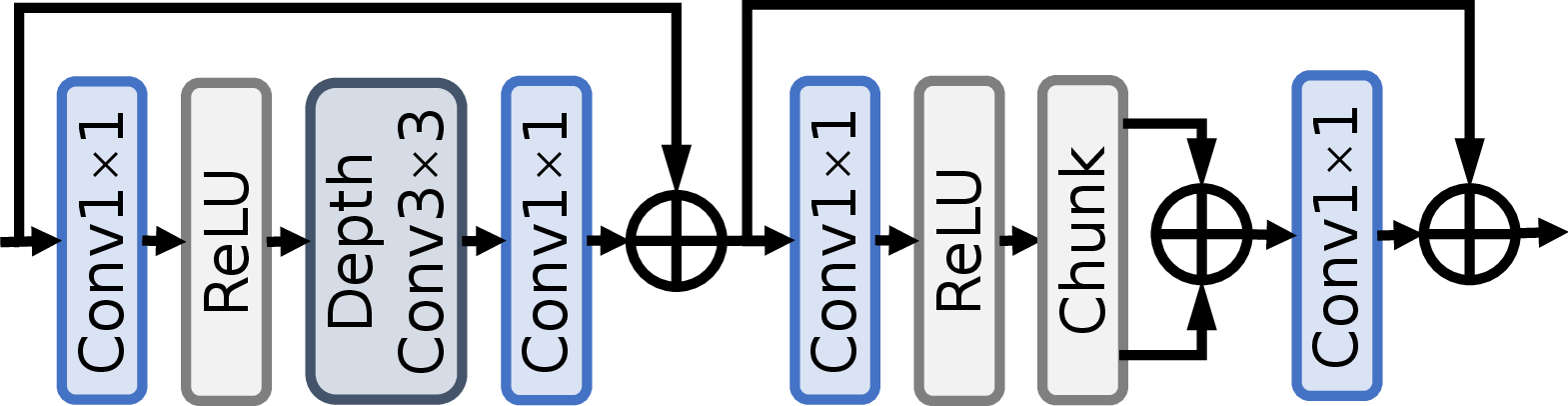
Figure 2: Block-level implementation of EF-LIC, illustrating the pipeline from image analysis to quantization and bitstream output.
Experimental Results
Compression Efficacy and Latency
A comprehensive benchmark on standard datasets (Kodak, Tecnick, DIV2K, CLIC2020) compares EF-LIC to traditional codecs (VTM), pixel-domain optimized LICs (LIC-HPCM, DCVC-RT), GAN-based models (HiFiC, MS-ILLM), advanced VQ-based models, and diffusion-based codecs.
Results show that EF-LIC achieves up to 67.86% bitrate reduction relative to MS-ILLM for equal LPIPS on Kodak (Figure 3). Across all datasets and at operating points of practical interest, EF-LIC exhibits a >55% improvement in BD-rate over state-of-the-art generative codecs.
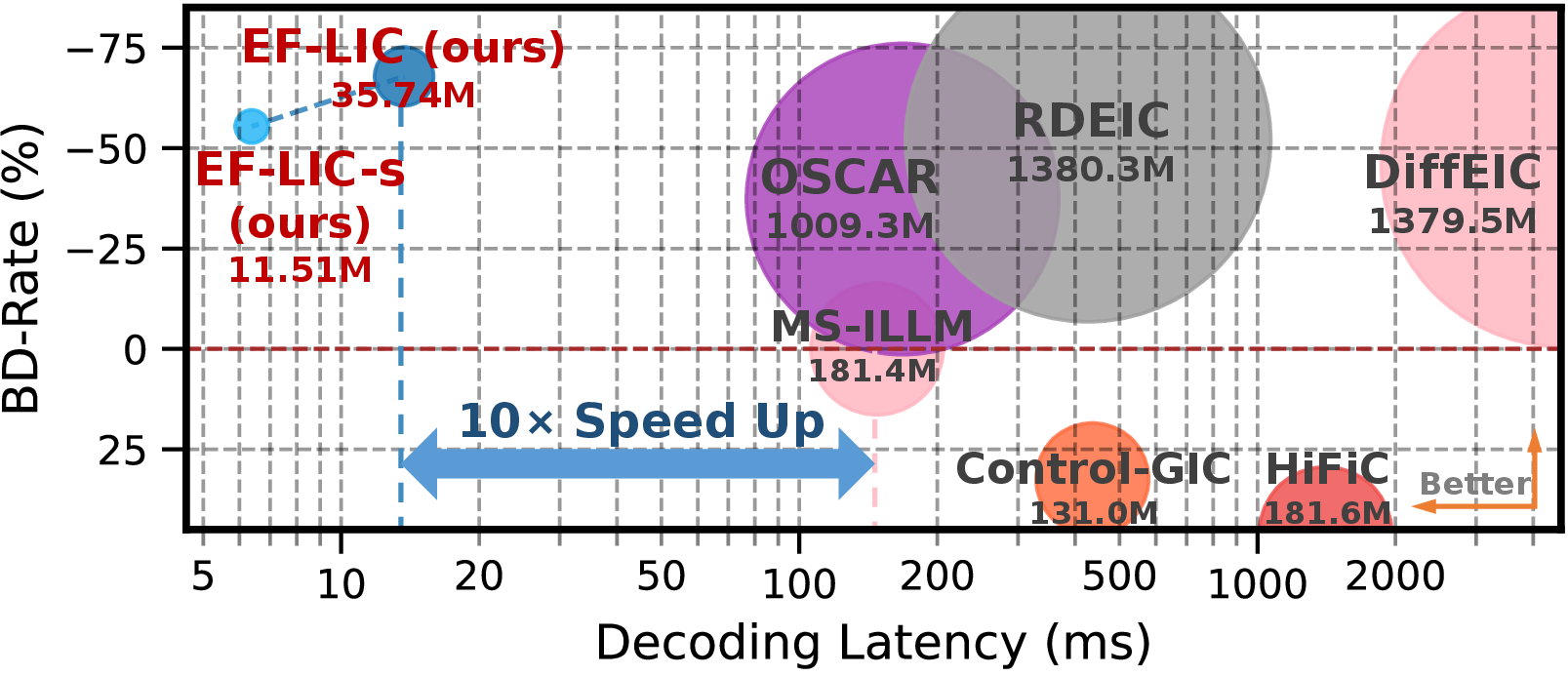
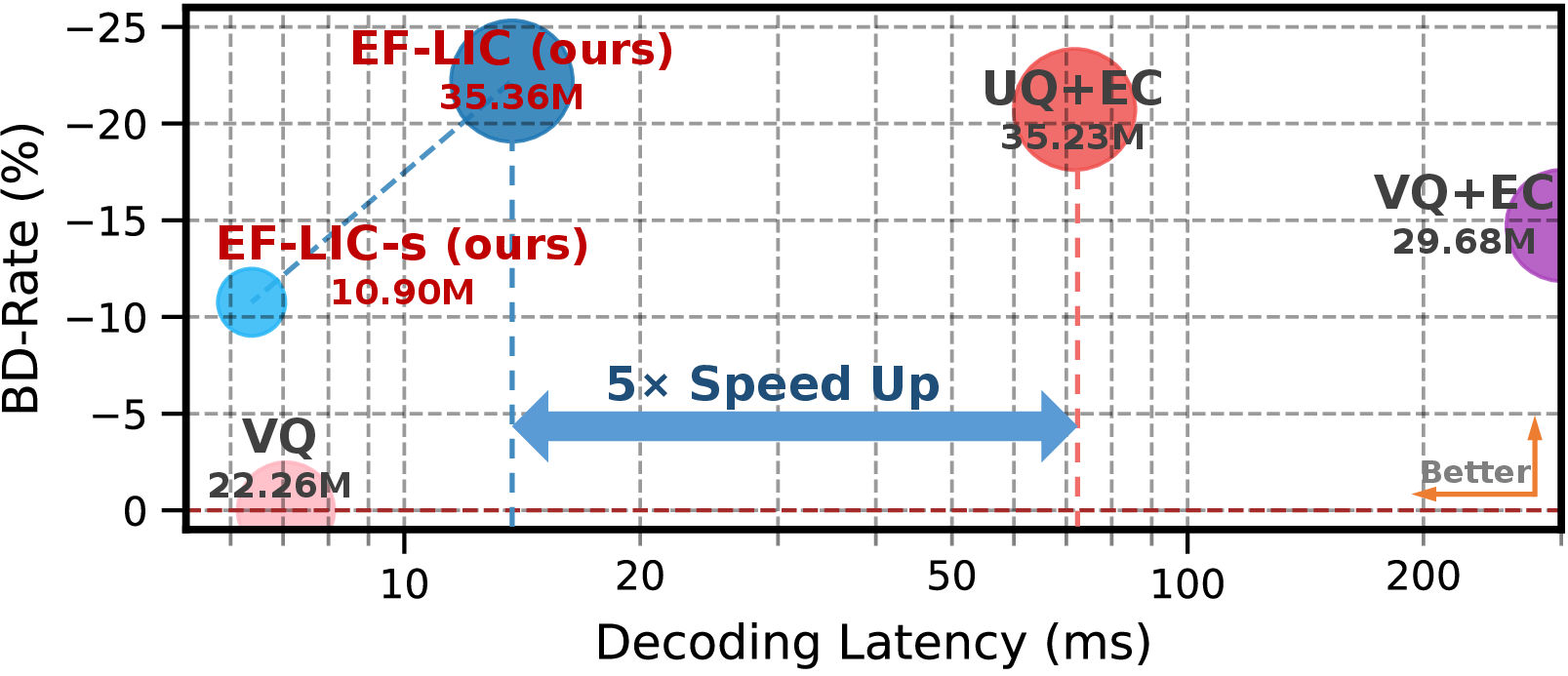
Figure 3: LPIPS-based rate-distortion performance comparison between EF-LIC and entropy-coded LICs on Kodak.
Visualization of reconstructions demonstrates that EF-LIC achieves superior perceptual quality (lower LPIPS, improved texture and structure preservation) compared to competitive baselines at equivalent bitrates (Figure 4).
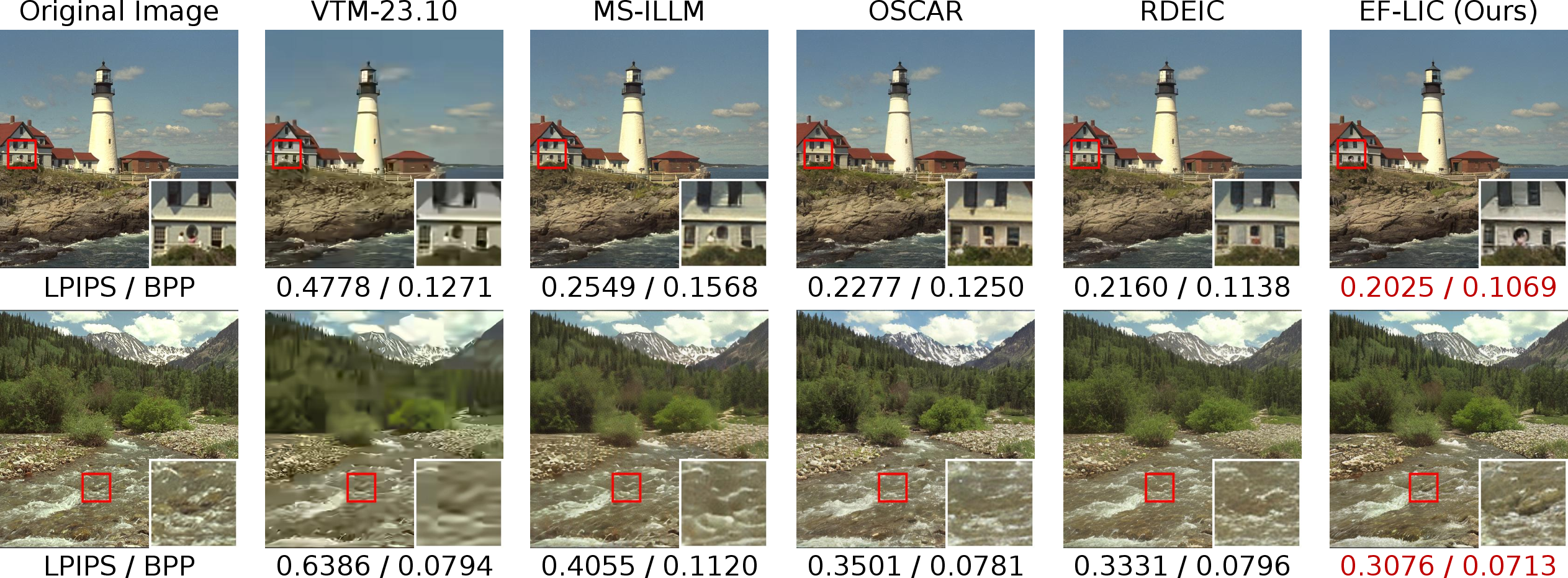
Figure 4: Visual comparison highlighting perceptual gains of EF-LIC (lower LPIPS/BPP) over baselines.
Rate-distortion curves on all datasets using both LPIPS and DISTS exhibit that the proposed approach consistently yields compression curves closer to the origin, signifying better perceptual quality at lower bitrates (Figure 5).
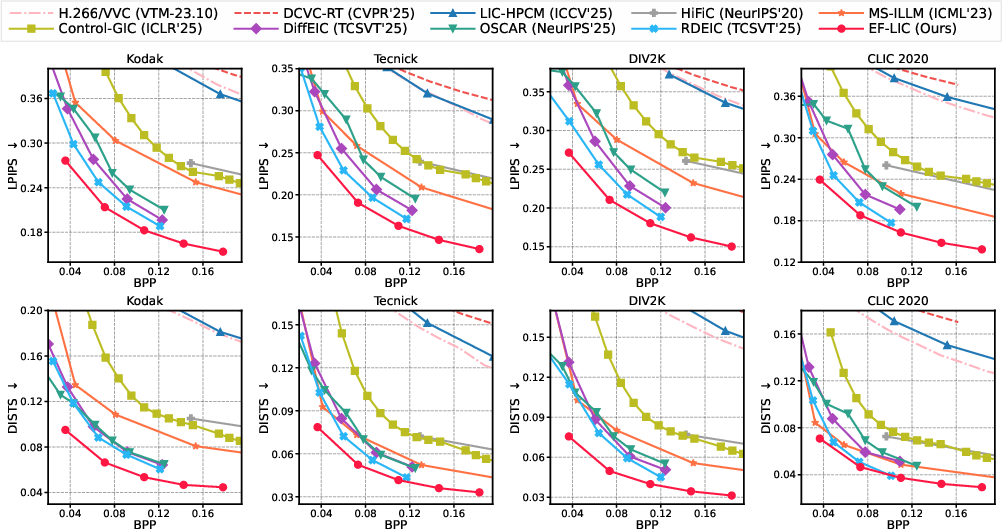
Figure 5: R--D curves on multiple datasets, confirming cross-dataset compression efficacy in both LPIPS and DISTS.
Ablation Studies
Ablation demonstrates that EF-LIC's representation-domain decorrelation is the source of its efficiency gain, reducing BD-rate by 22.2% over the VQ-only baseline. Reconfiguring codebook sizes and decorrelating later latent groups further enhances performance as measured by visual metrics, confirming the theoretical analysis.
Inference and Deployment Characteristics
EF-LIC provides an order-of-magnitude improvement in encoding and decoding speed over MS-ILLM, with 9×/ 10× acceleration respectively. It outperforms one-step diffusion-based codecs (e.g., OSCAR) while being 10× faster in decoding. The entire pipeline is exportable as a device-portable ONNX/TorchScript model, removing the necessity for hybrid CPU/GPU runtime and facilitating deployment on embedded devices and smartphones.
Practical and Theoretical Implications
Eliminating entropy coding removes the core source of sequential operations and the dependency on synchronized probabilistic models between encoder and decoder. Thus, it addresses the determinism and floating-point sensitivity issues encountered when deploying traditional entropy-coded LIC in heterogeneous hardware environments.
Theoretically, EF-LIC validates that both primary sources of redundancy (statistical, correlation) can be handled entirely in the quantization and representation domain, closing the rate-distortion gap to entropy-coded methods and establishing information-theoretic optimality for entropy-coding-free transform models.
Limitations and Future Directions
Some aspects remain underexplored:
- Manual design of codebook sizes for RVQ modules may be suboptimal; automated architecture search or adaptive mechanisms could further improve performance.
- RVQ search, while more efficient than entropy coding, still presents a modest computational bottleneck at extreme resolutions; further optimizations or hardware-specific implementations are viable directions.
- Although EF-LIC performs strongly in perceptual metrics (LPIPS, DISTS), pixel-wise distortion (e.g., PSNR) is comparatively less competitive, echoing the limitations of VQ-based codecs when prioritized for fidelity-to-original.
Future research may focus on hybridizing with diffusion or transformer-based models, further automating quantizer design, and extending the technique to video or cross-modal codecs.
Conclusion
EF-LIC demonstrates that neural image compression matching the state-of-the-art perceptual quality can be achieved without any entropy coding, closing the performance gap via maximum-entropy VQ and representation-domain decorrelation. This architectural shift enables an order-of-magnitude reduction in runtime and unlocks robust deployability on portable and accelerator-centric hardware, with implications for both theory and the deployment of next-generation image codecs in high-throughput or on-device settings.

