- The paper introduces a joint optimization framework that couples deployment and privileged-view models to prevent negative transfer from noisy or weak privileged information.
- It leverages additional unlabeled paired data and adaptive interpolation to balance robust supervised learning with pseudo-labeling strategies.
- Empirical results across regression and classification tasks demonstrate superior performance over Two-Stage methods, especially in high-dimensional, noise-prone settings.
Problem Setting and Motivation
The paper "Coupled Training with Privileged Information and Unlabeled Data" (2605.23268) addresses a nuanced semi-supervised learning scenario: models may access privileged information W solely during training, alongside primary features X and labels Y. At test time, only X is available. Furthermore, a substantial amount of training data includes W without labels. This situation arises in medical and industrial prediction, transfer learning, and distribution shift contexts. The objective is to leverage W during training to improve the final prediction function f(X), robustly minimizing distributional risk while avoiding negative transfer when W is weak or noisy.
Limitations of Two-Stage Approaches
The prevalent Two-Stage approach first trains a rich-view model g on (X,W), then uses X0 to generate pseudo-labels for unlabeled samples, which are subsequently used to train the deployment model X1 on X2. However, when X3 provides weak signal, errors from X4 are inherited by X5, resulting in performance degradation relative to supervised learning on X6 alone. Negative transfer arises particularly when the privileged view X7 introduces high-dimensional nuisance variation or is only marginally informative.
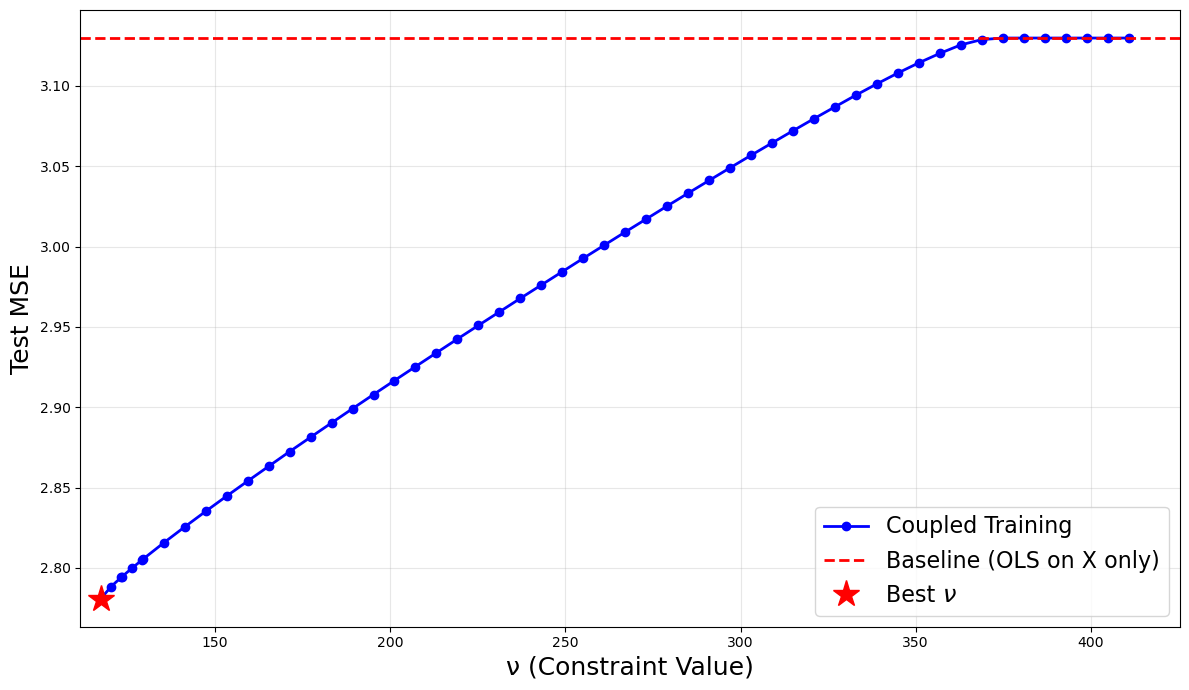
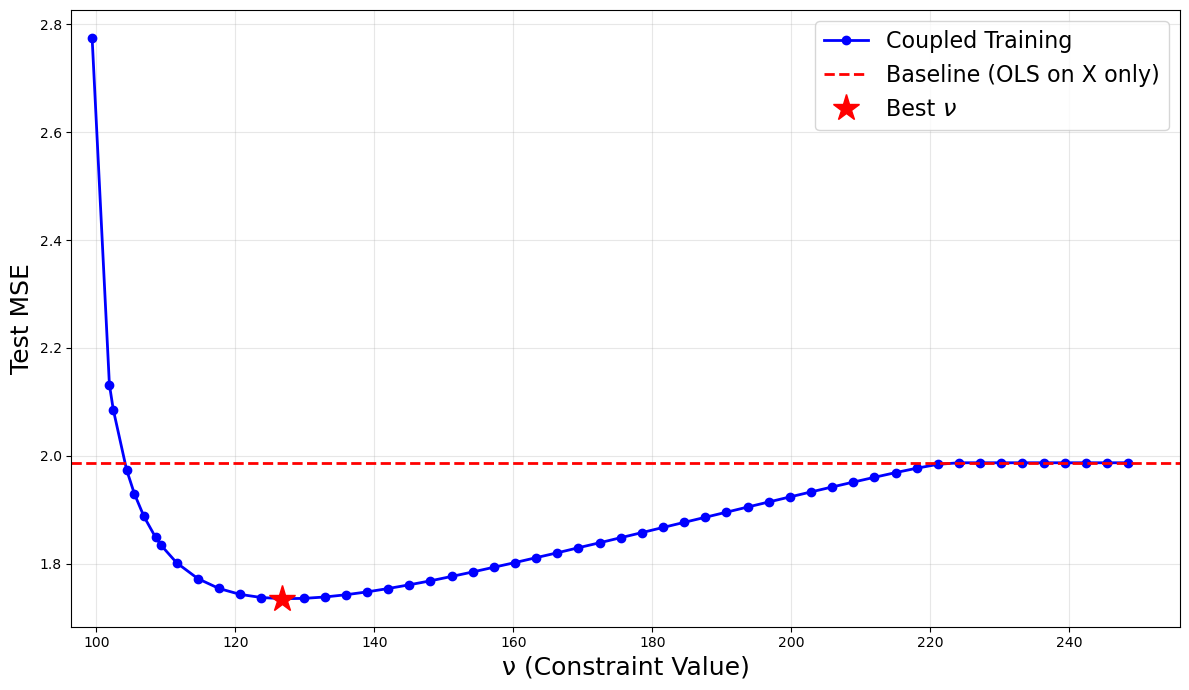
Figure 1: Strong privileged signal (large X8).
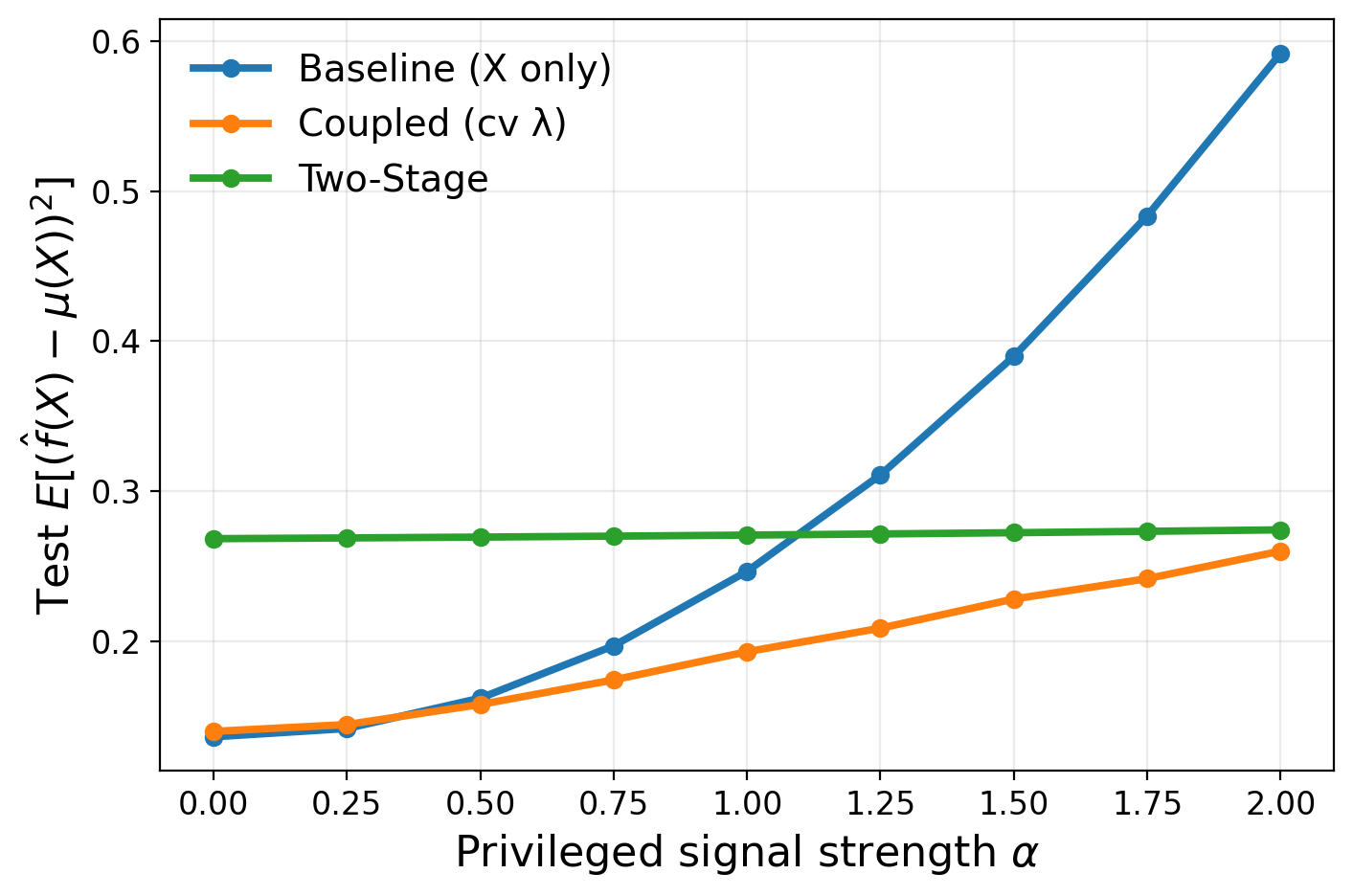
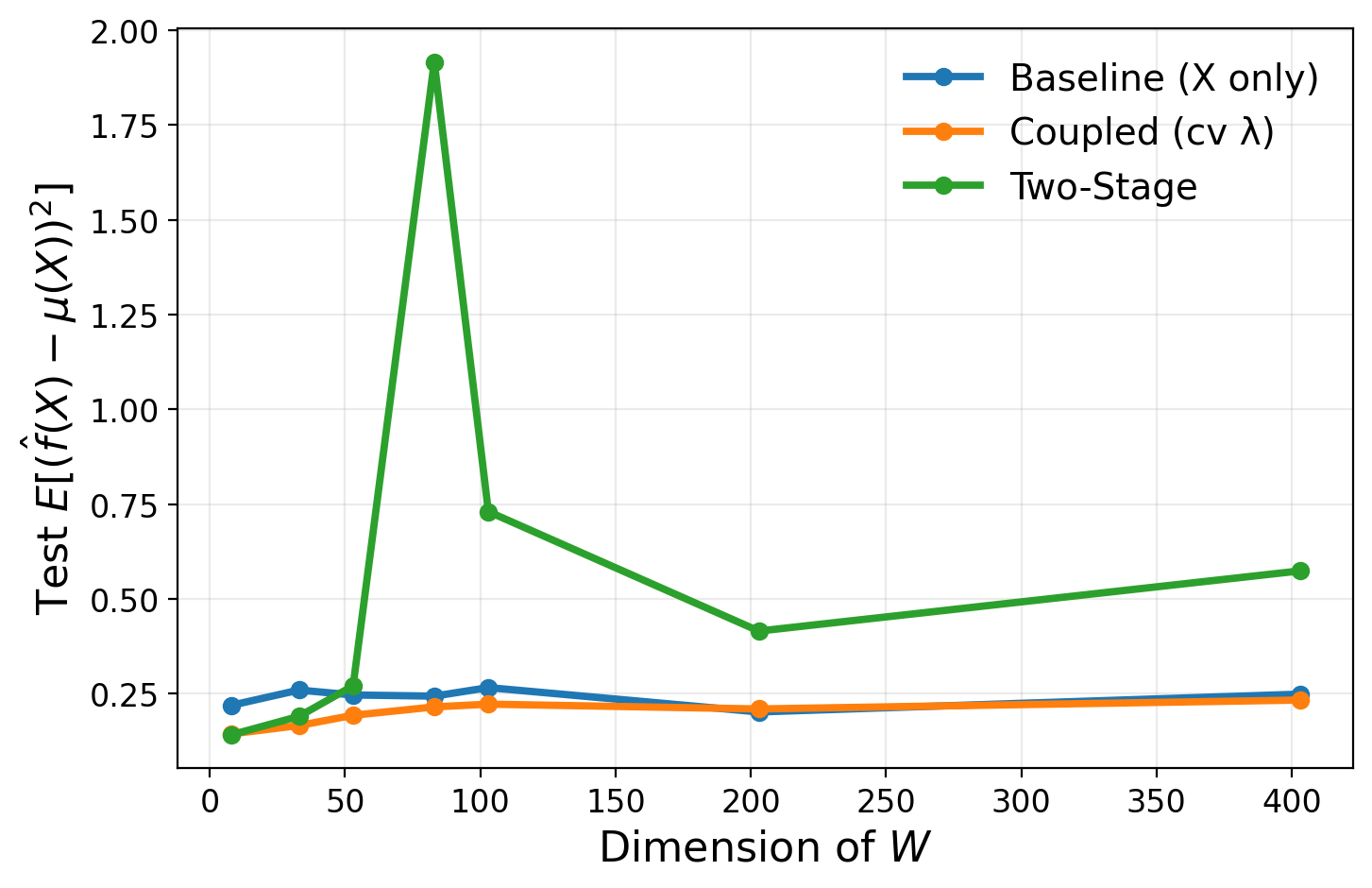
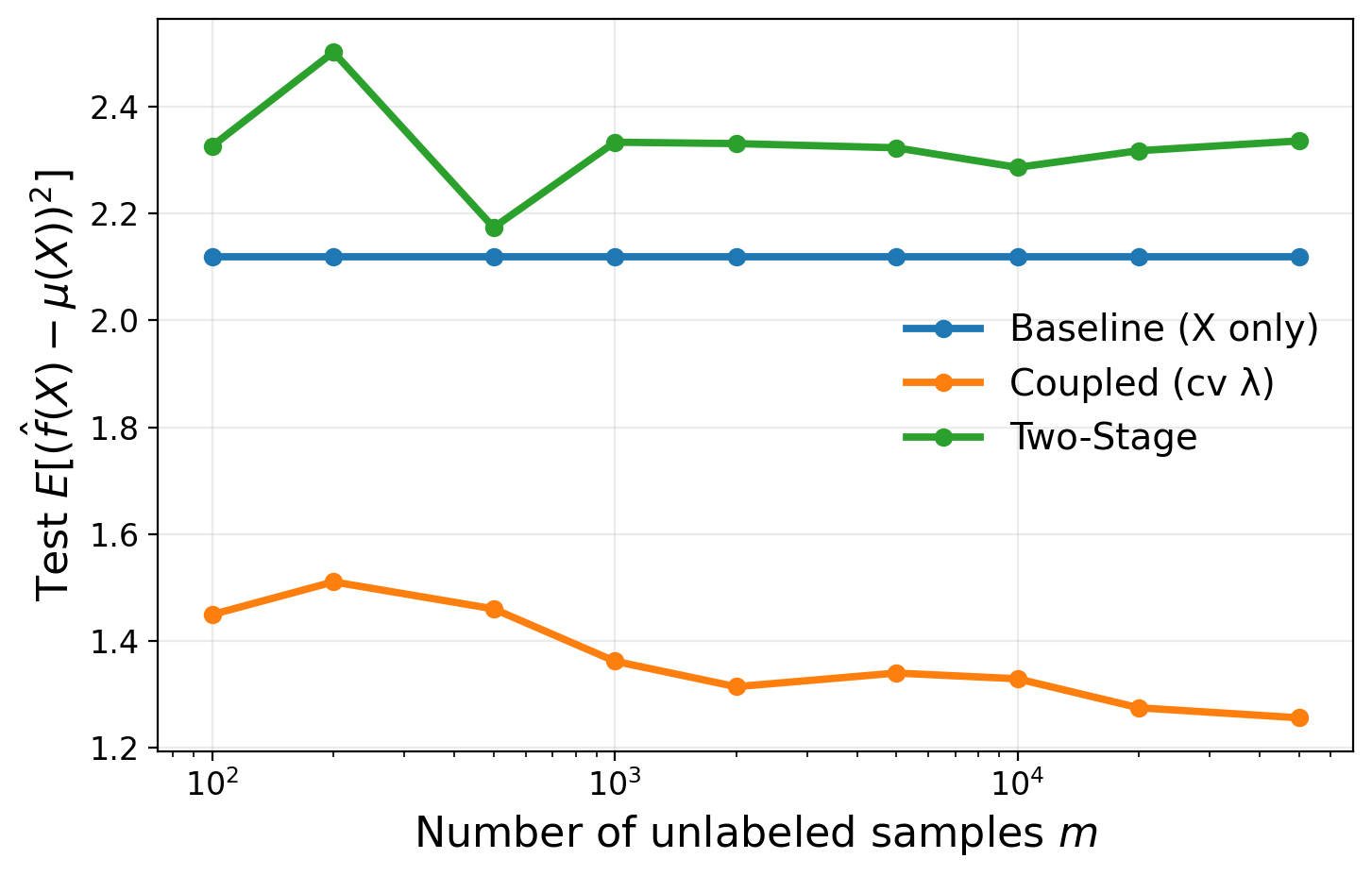
Figure 2: Privileged signal strength X9.
These figures demonstrate how aggressive knowledge transfer via Y0 benefits the deployment model Y1 when privileged signal is strong, but degrades when signal is weak—underscoring the necessity for adaptive methods.
Coupled Training Framework
The paper proposes a coupled training framework, which jointly optimizes Y2 and Y3, instead of treating Y4 as a fixed teacher. The algorithm alternates between updating Y5 using current pseudo-responses from Y6, and recalibrating Y7 to agree with Y8 over the unlabeled set, bounded by a constraint parameter Y9 (or equivalently, penalized via a Lagrangian X0). This coupling adaptively regulates the influence of privileged information, interpolating between supervised learning (large X1 or small X2) and Two-Stage pseudo-labeling (small X3 or large X4).
Theoretical Guarantees
The authors rigorously analyze risk bounds for the proposed method. They show the population minimizers X5 solve fixed-point equations: X6 projects onto the regression target averaged over the joint model, and X7 interpolates between the deployment target and rich-view regression, weighted by X8.
Correlation-controlled risk bounds are derived, demonstrating the excess prediction error depends multiplicatively on the statistical complexity of the joint function class and a correlation coefficient X9 that quantifies the alignment between the errors of W0 and W1. When privileged information is uncorrelated with deployment error, the bound tightens; when highly correlated, the gain diminishes, recovering the labeled-only scenario.
High-Dimensional and Dictionary-Based Extension
A practical alternating forward selection (AFS) algorithm is developed for high-dimensional settings, constructing W2 and W3 as sparse expansions over dictionary elements. The AFS procedure achieves provable sublinear objective decay, and time complexity W4, offering substantial savings over naive blockwise selection.
Empirical Results
Comprehensive experiments are conducted on synthetic controls, regression (Parkinson's Telemonitoring), and classification (Bank Marketing). The results validate several key claims:
- Coupled Training outperforms both Two-Stage and labeled-only baselines when privileged signal is noisy or weak.
- The method exhibits stability against increasing nuisance dimensions in W5 (which degrade Two-Stage).
- Performance improves with additional unlabeled paired W6 data.
- For real-world datasets, Coupled Training consistently achieves lower test error and Brier scores than Two-Stage pseudo-labeling, generalized distillation, and SVM+ baselines.
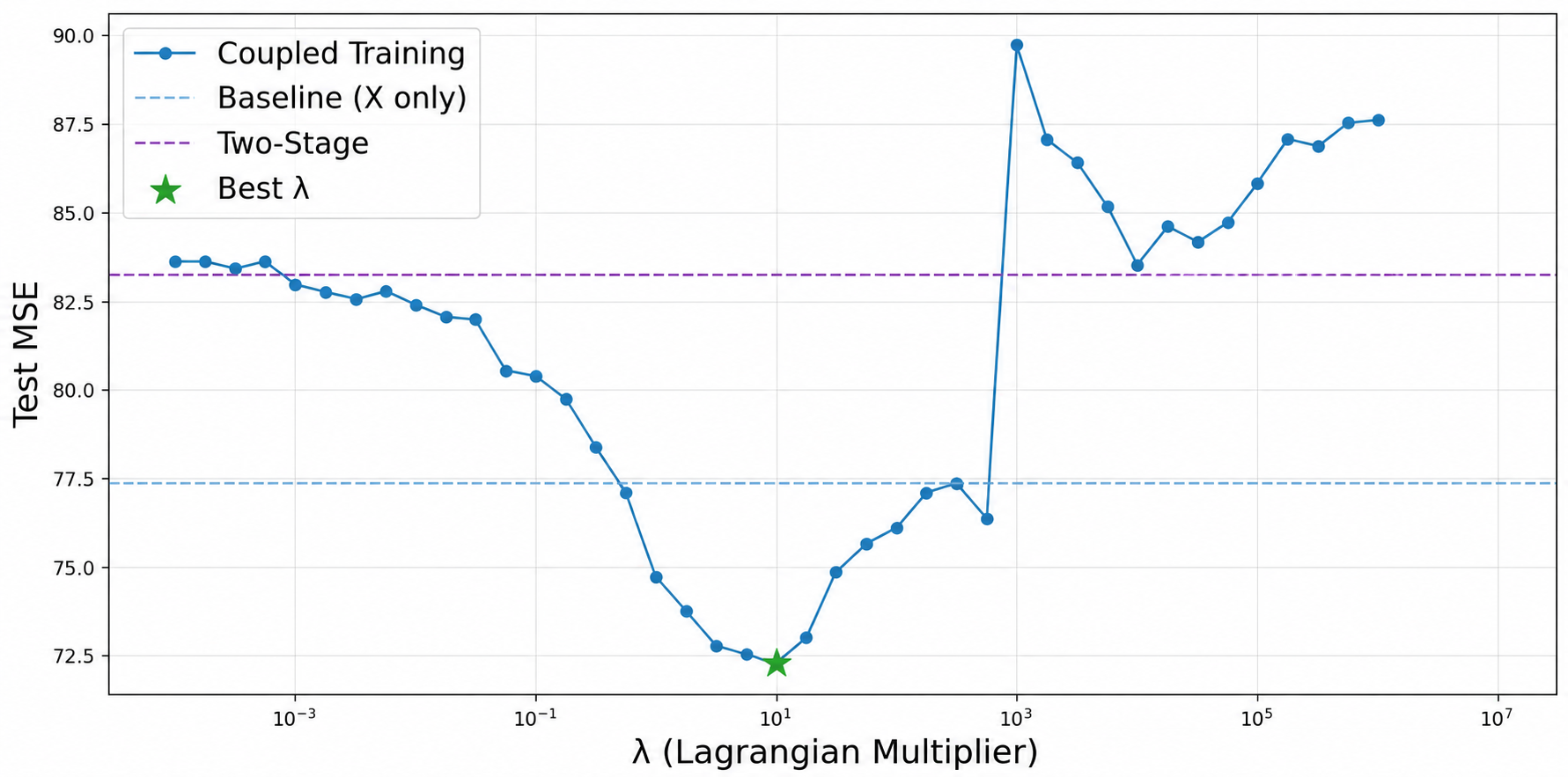
Figure 3: Parkinson's dataset. Test MSE versus W7.
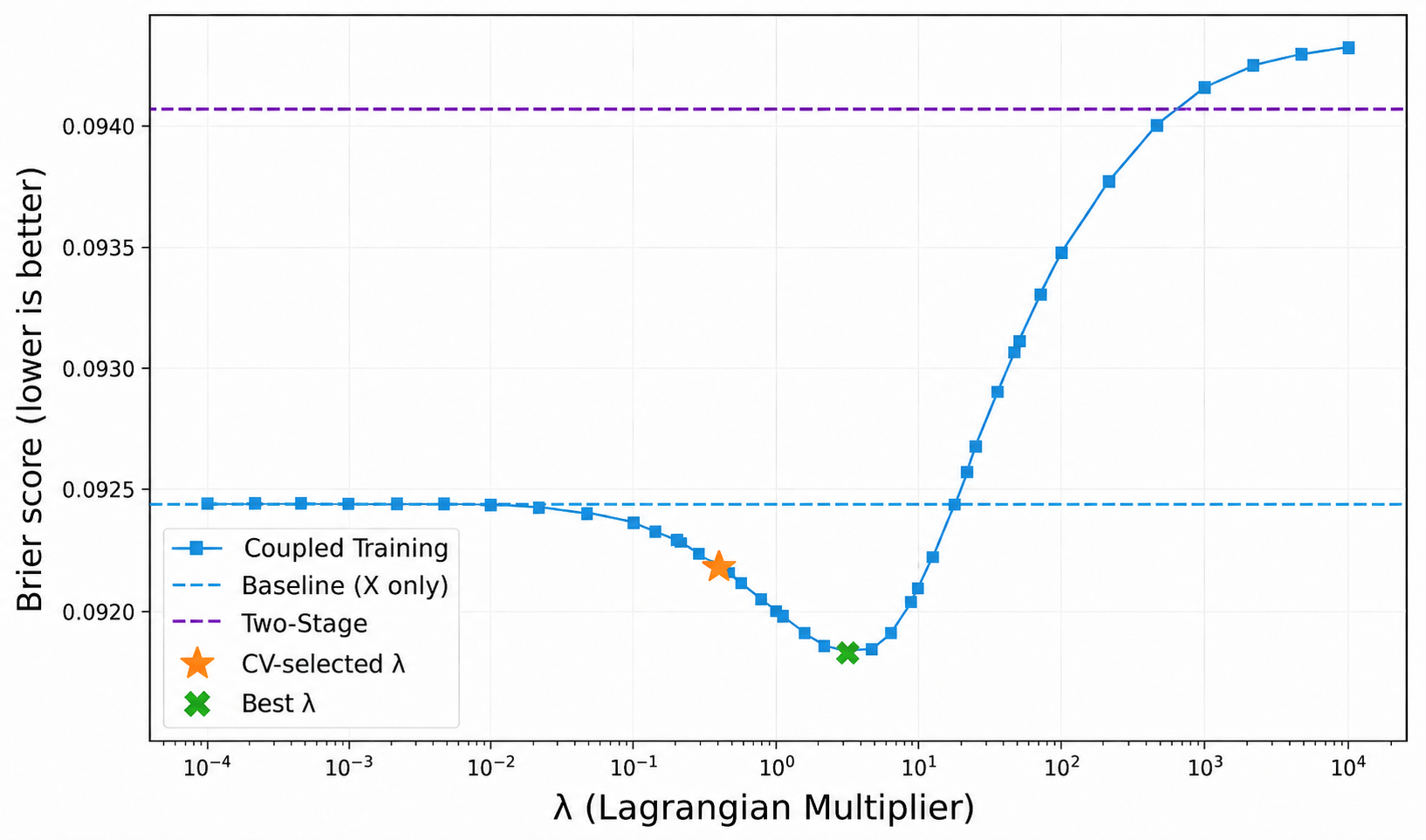
Figure 4: Bank Marketing dataset. Holdout Brier score versus W8.
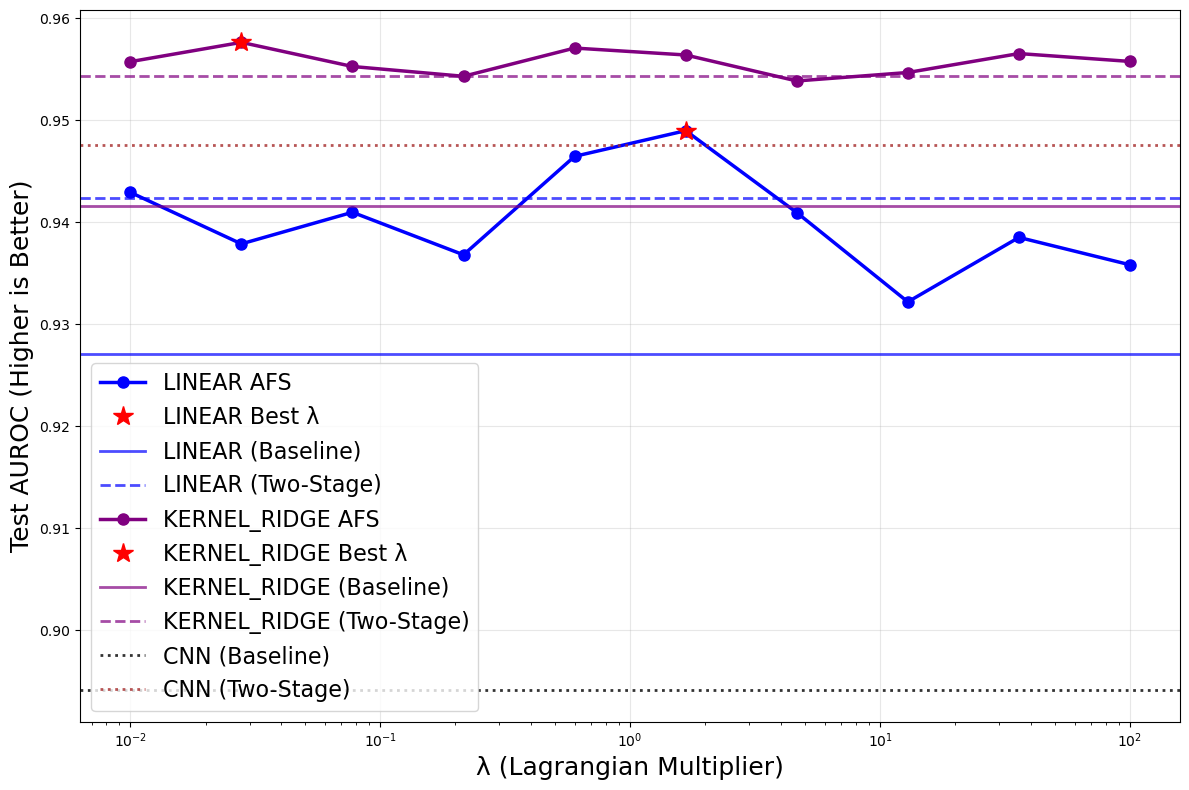
Figure 5: PneumoniaMNIST. Test AUROC versus W9 for Algorithm 1.
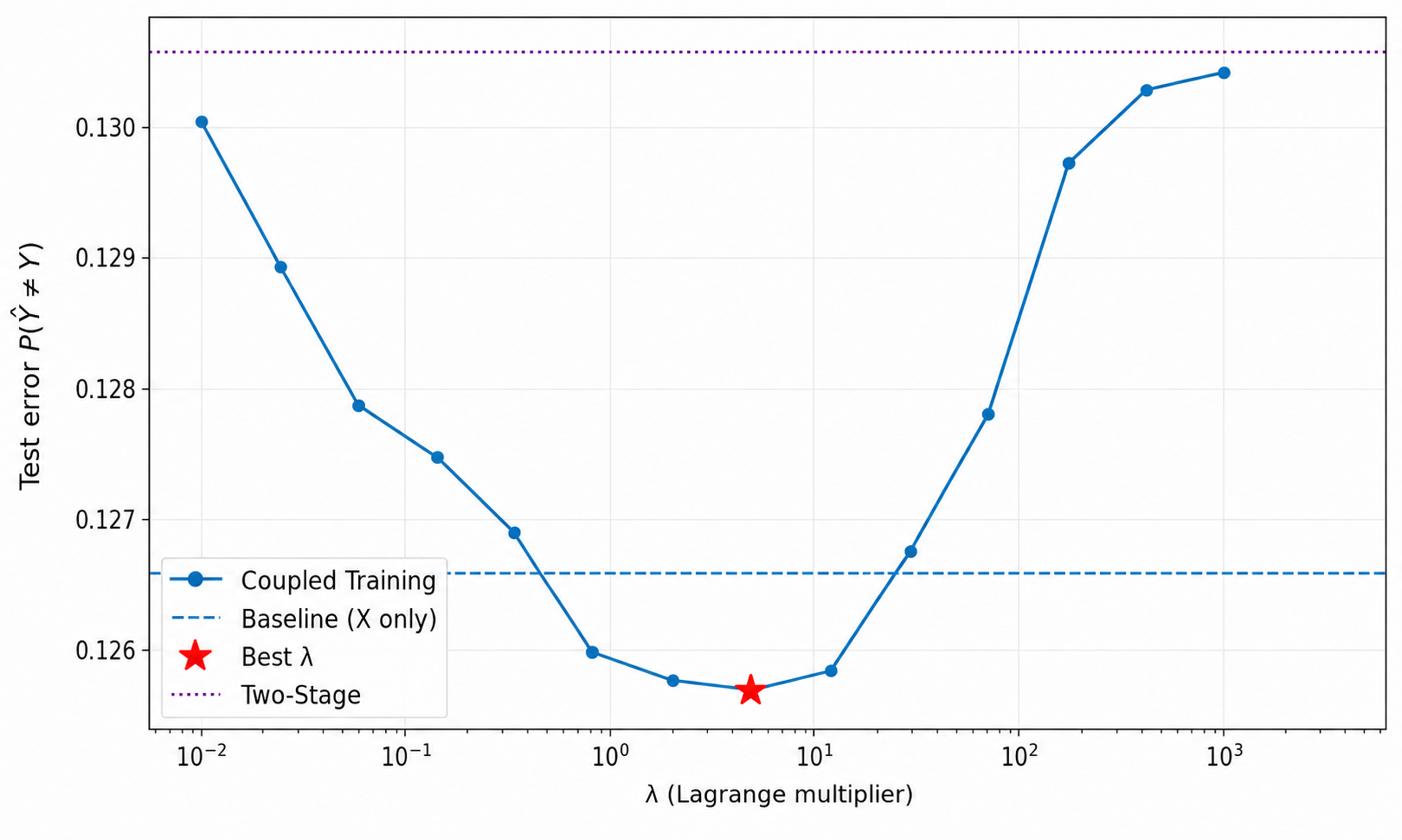
Figure 6: Synthetic binary classification diagnostic. Test 0–1 error for the cross-entropy analogue of Coupled Training as a function of W0, averaged over seeds W1.
Empirical U-shaped curves with respect to W2 are observed, as predicted by theory: neither extreme (pure supervised or pure pseudo-labeling) is universally optimal, and adaptive interpolation is required.
Practical and Theoretical Implications
Theoretical results and empirical findings imply that joint optimization of deployment and privileged-view models allows robust exploitation of privileged information, even when it is noisy or high-dimensional. This is critical in real-world high-stakes domains (medicine, finance) where privileged test-time access is infeasible, and labeled training data are scarce.
The coupled framework generalizes classical LUPI, agreeing-style SSL, and dictionary-based greedy optimization, providing a unifying methodology with statistical guarantees.
Future Directions
Key avenues for future methodological and theoretical work include:
- Extension to non-square loss functions and general classification regimes.
- Handling semi-paired data, misspecification, and distributional shift.
- Development of practical proxies for the correlation coefficient W3 to guide tuning of W4.
- Broader deployment in high-dimensional nonlinear and tree-based models, as well as cross-domain transfer learning and multi-modal settings.
Conclusion
This paper advances semi-supervised privileged learning by introducing a coupled training framework, theoretically characterizing its robustness to negative transfer, and empirically demonstrating its superiority in diverse settings. The dictionary-based high-dimensional extension makes it practically viable at scale. The methodology reconciles several disparate strands of SSL/LUPI research, providing a principled approach for leveraging privileged information when available, but avoiding overreliance when it is unreliable. Robust interpolation between labeled-only and pseudo-labeling regimes emerges both in theory and practice, with clear implications for future adaptive learning systems in AI.