Published 22 May 2026 in hep-ph and cond-mat.quant-gas | (2605.23206v1)
Abstract: We study Bose-star formation in a Yukawa-Schrödinger-Poisson (YSP) system. A finite interaction range suppresses the infrared kinetic relaxation responsible for Bose-star condensation, modifying both the equilibrium Bose-star structure and the condensation timescale. We derive a screened kinetic condensation formula in which the ordinary gravitational Coulomb logarithm is replaced by a finite Yukawa transport logarithm. Static YSP solutions show that Yukawa screening broadens the Bose-star density profile relative to the ordinary Newtonian soliton. Fully dynamical pseudospectral simulations with homogeneous and isotropic initial conditions demonstrate that Yukawa screening systematically delays Bose-star condensation, in good agreement with the screened kinetic prediction after fitting a single overall normalization parameter.
The paper demonstrates that Yukawa screening broadens static soliton cores by suppressing long-range gravitational interactions.
It develops a modified kinetic condensation timescale using a transport logarithm to incorporate finite-range screening effects.
Numerical simulations validate the analytical predictions, showing delayed condensation and matching broadened density profiles.
Yukawa-Screened Bose-Star Condensation: Static Structures and Kinetic Formation Delays
Introduction
The condensation and nonlinear dynamics of self-gravitating bosonic dark matter in the Bose-star regime have been extensively investigated under Newtonian gravity. However, multiple physical scenarios motivate finite-range modifications to gravitational interactions—realized, for instance, via dynamically generated Yukawa screening in the presence of a mediator mass or additional short-range forces in the dark sector. This work systematically explores Bose-star condensation within a Yukawa-Schrödinger-Poisson (YSP) framework, quantifying both static and kinetic modifications induced by finite-range interaction screening.
Theoretical Framework: Formulation of the YSP System
The YSP model consists of a nonrelativistic scalar field ψ interacting via an attractive potential Φ under Yukawa (rather than pure Newtonian) screening. The dimensionless YSP equations are:
i∂tψ=−21∇2ψ+Φψ,(∇2−μY2)Φ=∣ψ∣2−n,
where all quantities are normalized with respect to the characteristic boson mass, typical velocity v0, and gravitational coupling. The Yukawa parameter μY corresponds to the mediator mass and regulates the spatial range of the attractive potential.
Static Solutions: Modification of Solitonic Structure
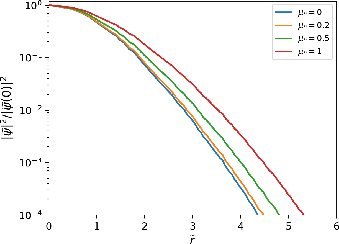
The static YSP model admits solitonic ground-state solutions analogous to the familiar Schrödinger-Poisson case, but the presence of Yukawa screening fundamentally alters the equilibrium structure. The use of imaginary-time relaxation allows precise mapping of the resultant density profiles for varying μY. The primary consequence of screening is a systematic broadening of the soliton core for fixed central density, due to suppression of long-range attractive forces at r≫μY−1.
Figure 1: Static YSP Bose-star profiles with various screening masses μY, normalized to common central density. Larger μY values yield much broader structures, as the self-gravitational potential becomes increasingly short-ranged.
This demonstrates that Yukawa-screened Bose stars differ observably from Newtonian solitons, particularly at large radii.
Kinetic Condensation: Analytical Predictions for the Screened Regime
Bose-star formation out of a virialized bosonic gas is governed by infrared kinetic relaxation, which, under Newtonian interactions, yields a condensation timescale τgr∝v6/(G2n2ln(mvR)). Yukawa screening regularizes the small-angle divergence in the gravitational scattering kernel, and the corresponding rate dependence is encapsulated in a modified transport "Yukawa logarithm,"
Φ0
The resulting kinetic condensation time is
Φ1
where Φ2 is an Φ3 normalization coefficient. This formula approaches the standard unscreened result as Φ4, but increases rapidly when the screening length becomes comparable to or smaller than the system scale Φ5 or de Broglie scale Φ6, reflecting suppressed IR relaxation.
Numerical Simulation Results
Morphology and Temporal Evolution
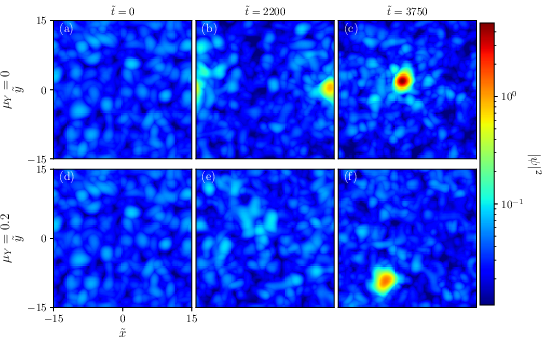
Fully dynamical pseudospectral simulations in three-dimensional periodic volumes were performed to investigate Bose-star formation for varying Φ7. The initial particle distributions are narrow-shell momentum ensembles randomized in phase, emulating homogeneous and isotropic initial conditions. Snapshots of the projected density fields elucidate the formation sequence:
Figure 2: Projected density evolution for Φ8, Φ9. Yukawa screening (i∂tψ=−21∇2ψ+Φψ,(∇2−μY2)Φ=∣ψ∣2−n,0) significantly delays and broadens core condensation compared to the unscreened case (i∂tψ=−21∇2ψ+Φψ,(∇2−μY2)Φ=∣ψ∣2−n,1).
The condensation occurs promptly for purely gravitational interactions, but is systematically retarded and spatially diffused as the screening mass increases.
Profile Comparison
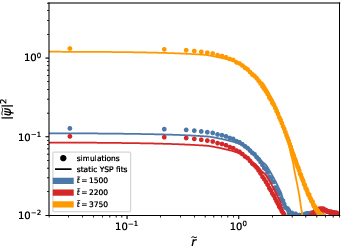
The spherically averaged density profile at late times is directly compared to static YSP ground-state solutions:
Figure 3: Spherically averaged density profiles during evolution (i∂tψ=−21∇2ψ+Φψ,(∇2−μY2)Φ=∣ψ∣2−n,2) compared to static soliton. The condensed object's profile at late times precisely matches the broadened ground-state solution for i∂tψ=−21∇2ψ+Φψ,(∇2−μY2)Φ=∣ψ∣2−n,3.
This serves as conclusive evidence that kinetic relaxation, though delayed and weakened by screening, still drives condensation into stationary YSP solitons.
Quantitative Analysis of Condensation Onset
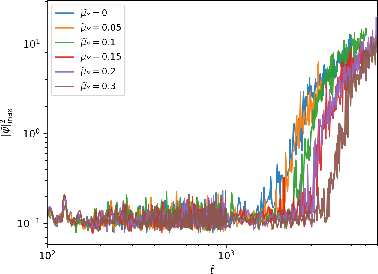
The evolution of the maximum density provides a robust criterion to extract the condensation time:
Figure 4: Maximum density versus time for multiple i∂tψ=−21∇2ψ+Φψ,(∇2−μY2)Φ=∣ψ∣2−n,4. Increasing the screening systematically delays condensation.
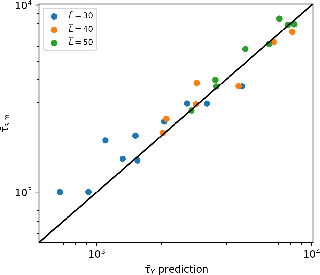
Condensation times extracted across a range of box sizes, masses, and screening parameters are then compared to the analytic kinetic prediction:
Figure 5: Simulation-extracted condensation times compared to Yukawa-screened kinetic prediction. Across parameters, data collapses on the i∂tψ=−21∇2ψ+Φψ,(∇2−μY2)Φ=∣ψ∣2−n,5 curve after a single overall normalization is fit (i∂tψ=−21∇2ψ+Φψ,(∇2−μY2)Φ=∣ψ∣2−n,6).
Strong numerical agreement validates the Yukawa-logarithm modification and confirms that finite-range interactions constitute a major suppression to kinetic Bose star formation.
Implications and Future Directions
The results rigorously establish that any finite-range modification—e.g., those expected from light mediators or screening sectors—will significantly postpone Bose-star condensation and systematically alter the resultant soliton's density structure. This has direct relevance for sub-galactic structure formation in axion and ultralight scalar DM scenarios with additional forces, as kinetic relaxation governs both the core growth timescale and central densities.
From a theoretical perspective, the analytic transport formalism developed here generalizes the Coulomb logarithm to arbitrary screening scales, enabling controlled predictions in a diverse set of dark sector models. Practically, this framework can be extended to:
Cosmological settings: Embedding the YSP condensation delay in structure formation models across redshift.
Vector/Complex boson systems: Polarization and self-interaction effects in screened regimes may further delay or inhibit core growth and alter core mergers.
High-resolution merger, accretion, and nonlinear instability studies: The time-delayed relaxation predicts fewer and less dense solitons at fixed cosmic age for sufficiently strong screening.
Conclusion
This study systematically quantifies the impact of Yukawa screening on both the static profiles and the dynamical condensation timescale of Bose stars. The principal findings are: (1) Yukawa screening broadens the static equilibrium profiles, (2) kinetic relaxation and condensation into solitonic Bose stars is systematically delayed by screening, and (3) the condensation delay is quantitatively predicted by substituting the Coulomb logarithm with a transport logarithm accounting for the finite interaction range, matching direct numerical simulation results after fitting a single normalization parameter. These results highlight the strong sensitivity of wave-DM soliton condensation to short-range dark sector physics, motivating further study on the implications for astrophysical core densities, formation histories, and the role of new interactions in wave dark matter phenomenology.