Operationalizing Individual Fairness via Gradient Descent and Bradley-Terry Models
Published 22 May 2026 in stat.ML, cs.LG, math.ST, and stat.ME | (2605.23145v1)
Abstract: Individual fairness, the notion that "similar individuals should be treated similarly," provides a strong and flexible fairness guarantee for algorithmic decision makers. However, a barrier to implementing individual fairness in practice is the difficulty of learning the similarity metric over individuals. In this work, we present an algorithm for learning a Mahalanobis similarity metric from triplet queries of the form "is individual i more similar to individual j or k?" We work in the standard Bradley-Terry model for pairwise comparisons. Our algorithm consists of a spectral initialization step followed by gradient descent. We provide extensive theoretical guarantees on our algorithm, showing that it converges quickly to the ground truth metric despite the non-convexity of the loss in our model. Because our focus is on fairness, we also show that individual fairness with respect to an estimated metric is sufficient to achieve similar fairness with respect to the true metric. We also discuss potential applications of our work to AI model tuning. Finally, we present experimental results that demonstrate the convergence of our algorithm and the fairness performance of downstream fair predictors trained on our estimated metric.
The paper introduces a novel two-step estimator that combines spectral initialization with gradient descent to learn a task-specific Mahalanobis metric for individual fairness.
The methodology achieves provable recovery of the true metric with guarantees such as O((n log n)^(-1/2)) spectral convergence and subsequent fairness transfer for downstream classifiers.
Extensive experiments on synthetic and real-world data demonstrate that classifiers using the estimated metric maintain nearly identical fairness measures compared to those using the true metric.
Operationalizing Individual Fairness via Triplet Queries and Bradley-Terry Models
Introduction and Motivation
The principle of individual fairness posits that "similar individuals should be treated similarly," formalized via a latent task-specific similarity metric. While this notion provides strong guarantees compared to group/class-based fairness, its practical realization is largely limited by the challenge of eliciting or learning the relevant similarity metric for individuals. The paper "Operationalizing Individual Fairness via Gradient Descent and Bradley-Terry Models" (2605.23145) proposes an operational methodology for learning a Mahalanobis metric underlying individual fairness, using human-elicited triplet comparisons structured via the Bradley-Terry model. The results provide both algorithmic and theoretical foundations for provably learning such metrics, followed by fairness analysis for downstream classifiers leveraging the estimated metric.
Problem Formulation
Given individuals represented as xi∈Rp, the approach seeks to learn a Mahalanobis distance dK⋆(xi,xj)=(xi−xj)⊤K⋆(xi−xj) parameterized by a rank-r positive semi-definite matrix K⋆ (r<p), based on data from triplet queries of the form: "Is xi more similar to xj or xk?" The response yt∈{−1,1} for triplet t=(i,j,k) is stochastic, following the Bradley-Terry model:
dK⋆(xi,xj)=(xi−xj)⊤K⋆(xi−xj)0
where dK⋆(xi,xj)=(xi−xj)⊤K⋆(xi−xj)1 indicates preference for dK⋆(xi,xj)=(xi−xj)⊤K⋆(xi−xj)2 as being closer to dK⋆(xi,xj)=(xi−xj)⊤K⋆(xi−xj)3. This learning-from-comparisons setup leverages the realistic psychological ease and higher reliability of triplet judgments, as opposed to direct numerical similarity or distance estimates.
Algorithmic Approach
The proposed algorithm comprises a two-step estimator for dK⋆(xi,xj)=(xi−xj)⊤K⋆(xi−xj)4:
Spectral Initialization: The pairwise Mahalanobis distances are estimated via the RankCentrality algorithm, treating triplet responses as a Markov chain over pairs. The stationary distribution approximates relative distances up to an additive constant. After appropriate centering, a generalized eigenproblem reconstructs an initial Mahalanobis matrix estimate.
Gradient Descent Refinement: Using the established spectral initialization, the negative log-likelihood function for the Bradley-Terry model is minimized via gradient descent on dK⋆(xi,xj)=(xi−xj)⊤K⋆(xi−xj)5 in dK⋆(xi,xj)=(xi−xj)⊤K⋆(xi−xj)6:
dK⋆(xi,xj)=(xi−xj)⊤K⋆(xi−xj)7
where dK⋆(xi,xj)=(xi−xj)⊤K⋆(xi−xj)8 encodes the quadratic difference structure on the triplet. Non-convexity issues are addressed by proving local strong convexity and smoothness conditions of the loss near dK⋆(xi,xj)=(xi−xj)⊤K⋆(xi−xj)9, and by controlling overall optimization via the quality of the spectral initialization.
Theoretical Guarantees
The core theoretical contributions are formal recovery and fairness transfer results:
Spectral Consistency: The initialization procedure generates an estimator within r0 of r1 (or r2) in spectral norm, up to rotation.
Nonconvex Convergence: Gradient descent with properly tuned step size, initialized sufficiently close to r3, converges linearly in the number of iterations to the true r4. The analysis leverages tools from high-dimensional statistics and nonconvex optimization for matrix factorization.
Fairness Transfer: Any classifier r5 that is r6-individually fair relative to the estimated r7 is also r8-individually fair with respect to the true r9, where the K⋆0 term decays exponentially in the number of iterations. This implies operational fairness guarantees for downstream models using only the learned metric.
Experimental Evaluation
The method was evaluated on both synthetic high-dimensional datasets and real-world benchmarks (including ACS Employment, Credit Card Default, and CDC Diabetes). The key empirical findings:
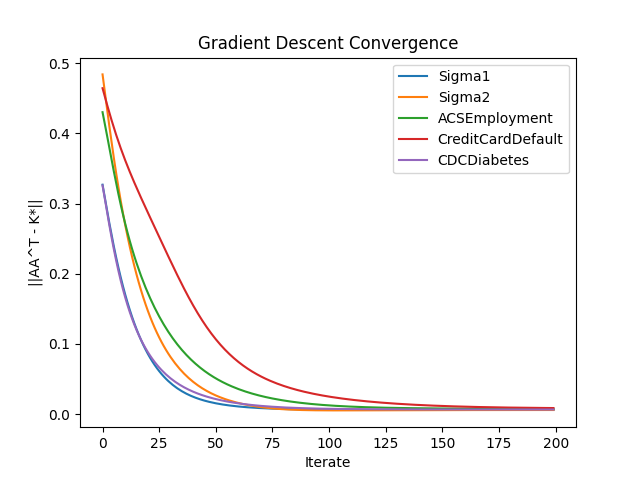
Rapid Convergence: Gradient descent on the post-spectral-initialization loss rapidly achieves convergence to the true Mahalanobis metric, as measured by spectral distance.
Figure 1: Left panel—distance between the estimated and true Mahalanobis metric during optimization; Right panel—fairness metric of downstream classifier with respect to true and estimated metrics.
Downstream Fairness Preservation: Classifiers (trained with the established SenSeI approach) optimized for individual fairness with respect to the estimated fairness metric achieve nearly identical fairness (as measured by the K⋆1 statistic from [maity2021statistical]) with respect to the unavailable true metric—the difference never exceeds one percent in all reported experiments.
Robustness across domains: Results hold across multiple synthetic data regimes and diverse real datasets, substantiating theoretical stability claims and relevance for high-dimensional, real-world settings.
Implications and Future Directions
Practical Implications
The methodology removes a key bottleneck in individual fairness: the elicitation and operationalization of a task-relevant similarity metric. By providing a practical, stochastic-noise-tolerant mechanism for learning a Mahalanobis distance from psychologically accessible triplet queries, this work enables the deployment of individually fair models in settings where direct metric specification is infeasible (e.g., personalized medicine, criminal justice risk scores).
The reliance solely on triplet queries, obviating the need for absolute distance or similarity scoring, supports more faithful elicitation of domain knowledge, reduces expert burden, and enables systematic auditing for fairness.
Theoretical Implications
Leveraging the standard Bradley-Terry model, together with matrix completion and nonconvex low-rank optimization theory, the results provides a rigorous statistical learning theory for metric elicitation via ordinal data, extending recent advances in statistical ranking and matrix recovery to the fairness domain. The analysis outlines conditions under which nonconvex optimization can be provably effective, further tying together fairness research with contemporary tools from high-dimensional statistics.
AI Alignment and RLHF Connections
The approach has direct relevance for human preference modeling in AI alignment pipelines, such as reward modeling in RLHF, where feedback in the form of triplet or higher-order distance comparisons is technologically or cognitively natural (see, e.g., robotics, visual representation alignment, and few-shot learning literature). A rigorous, noise-tolerant estimator of human-derived similarity functions, compatible with downstream fairness or alignment constraints, can enhance the reliability and transparency of RLHF systems.
Conclusion
This work formalizes and resolves the operational challenge of learning individual fairness metrics from feasible human input, placing the task onto a robust algorithmic and statistical foundation by combining spectral and gradient procedures under the Bradley-Terry preference model. Empirical and theoretical results jointly establish strong metric recovery and downstream fairness guarantees in both synthetic and real-world scenarios. The approach facilitates practical implementation of individual fairness, provides guarantees for fairness transfer, and suggests fruitful avenues for extending RLHF/AI alignment via preference modeling based on human comparison data. Future directions include integration with broader RLHF chains, extension to beyond-Mahalanobis metrics, and exploration of fairness under more flexible or domain-adapted similarity models.