- The paper shows that initial-state entanglement robustly supports macroscopic cluster formation in the false-vacuum decay dynamics of the 2D Ising model using tensor network simulations.
- It reveals that the interplay between surface tension, nucleation energetics, and dimensional geometry is critical in suppressing stochastic fragmentation.
- The paper implies that structured quantum correlations offer passive protection against local errors, paving the way for more stable quantum simulation protocols.
Entanglement-Facilitated Macroscopic Cluster Formation in Quantum Many-Body Dynamics
Introduction
The focal point of this paper is the preservation of global information in quantum many-body systems via passive dynamical mechanisms. The authors analyze the influence of initial-state entanglement on cluster formation and persistence in the false-vacuum (FV) decay dynamics of the 2D transverse-field longitudinal Ising model (TFLIM). Whereas classical approaches have typically relied on active error correction or have used simple product initial states, this work demonstrates that structured quantum correlations in the initial state suppress fragmentation, promote macroscopic connectivity, and facilitate sustained information protection. The interplay between dimensionality, nucleation energetics, and initial entanglement is rigorously dissected through tensor network simulations, with detailed analysis of dynamical observables and cluster distributions.
Model and Energy Landscape
The system investigated is the 2D TFLIM, defined by the Hamiltonian:
H=−J⟨ij⟩∑SizSjz−gi∑Six−hi∑Siz,
where J=1 (ferromagnetic Ising coupling), g (transverse field), and h (longitudinal field). The primary phenomenon under study is FV decay after a sudden inversion of the longitudinal field, placing the system in a metastable configuration. Two classes of initial states are considered: (1) product states ∣ψ0⟩=i⨂∣↓⟩i, and (2) correlated FV states, prepared as the DMRG ground state before quench. The energy landscape, analyzed via the Hamming distance from the TV state, is shown to have a double-well structure in 2D, with the metastable FV well characterized by energy levels V−nΔl.
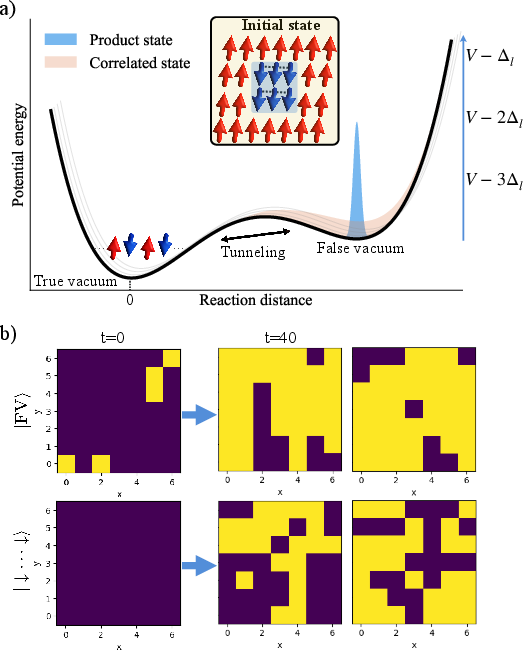
Figure 1: The energy landscape of FV decay in the 2D Ising model and real-space spin snapshots, illustrating the persistence of macroscopic clusters for entangled FV initial states and rapid fragmentation for product states.
In this landscape, the product state is localized at a fixed Hamming distance, lacking domain-wall fluctuations necessary to probe metastable regions. The correlated FV state, a coherent superposition over many configurations, exhibits broadened Hamming support, enabling sampling near nucleation barriers. This structural difference is pivotal for subsequent dynamics.
Surface-Volume Competition and Dimensionality
In 2D, the energetics of bubble nucleation involve a competition between surface tension σ and bulk energy-density difference Δϵ, yielding a critical radius Rc=σ/Δϵ. Only bubbles exceeding Rc are energetically favored to expand; subcritical bubbles collapse. This nucleation barrier is absent in 1D, where bubble expansion is monotonically favorable without energetic penalties. The presence of a nucleation barrier in 2D is shown to be a key factor, allowing initial entanglement to suppress stochastic fragmentation and encourage system-size connectivity.
Real-Time Quench Dynamics
Non-equilibrium dynamics after quench are quantified by magnetization J=10 and return probability J=11. Simulations demonstrate that correlated FV states exhibit substantially prolonged coherence and suppressed fragmentation relative to product states. The quantum Fisher information, proportional to the variance of total longitudinal magnetization, displays an early spike, evidencing dynamical generation of macroscopic correlations.
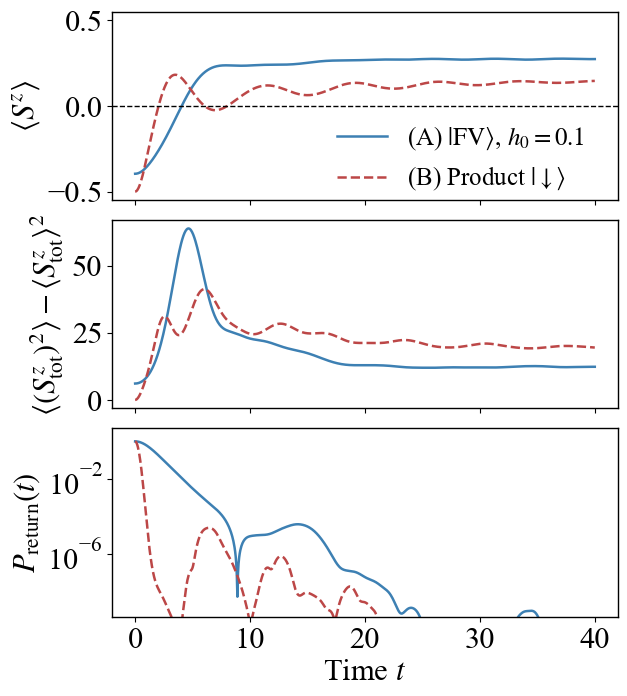
Figure 2: Real-time quench dynamics on a J=12 lattice, highlighting suppressed decay of J=13 and enhanced longitudinal magnetization fluctuations for entangled FV states.
Geometry and Decay Pathways
First-passage times J=14 for significant coherence loss reveal marked geometry-dependence for correlated FV initial states in 2D, with enhanced metastability near weak longitudinal fields, unlike product states which exhibit geometry-independent decay. The correlation structure in the initial state, not just the entanglement entropy, is shown to play a decisive role in the metastable regime.
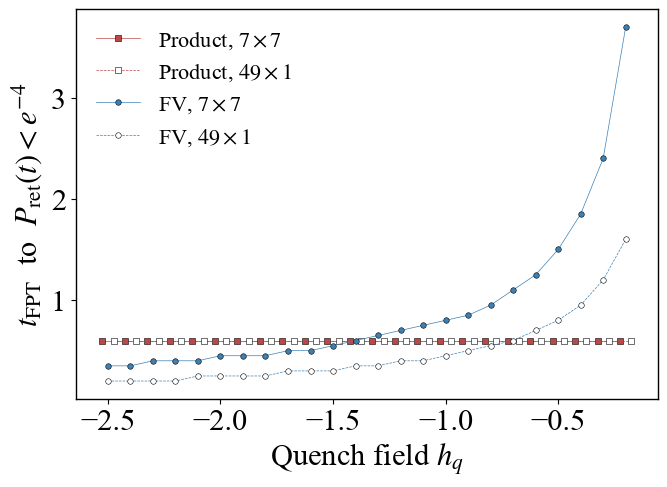
Figure 3: Comparison of first-passage times J=15 for return probability decay across 1D and 2D geometries, demonstrating dimensional sensitivity for FV initial states.
Cluster Statistics and Macroscopic Connectivity
To probe spatial protection of global information, the largest-cluster distribution J=16 and cluster-number densities J=17 are analyzed. Entangled FV states rapidly accumulate probability at large J=18, signifying macroscopic cluster formation, while product states remain fragmented. Comparison with excited and random MPS states (with comparable entropy) shows only FV and low-lying eigenstates sustain system-size clusters; random entangled states fail to do so, confirming that cluster stability derives from correlation structure rather than mere large entanglement entropy.
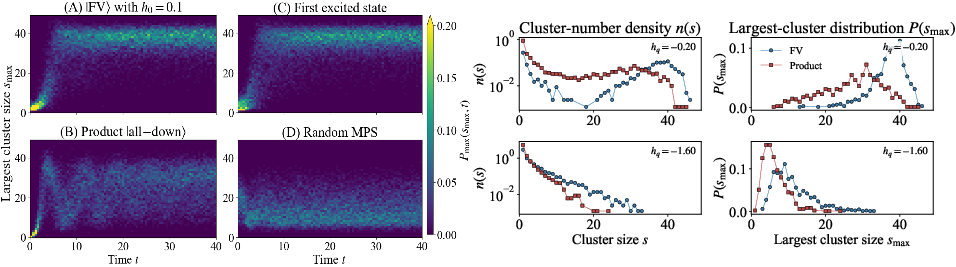
Figure 4: Time evolution of J=19 and cluster observables, revealing robust system-size clusters and percolation signatures for FV initial states.
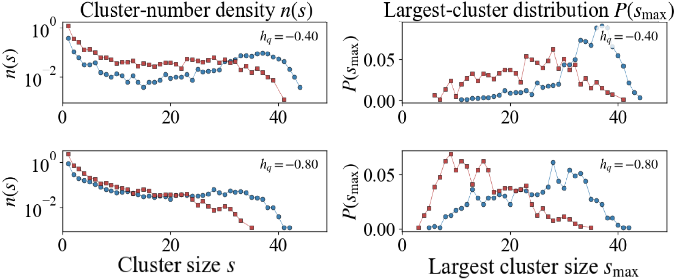
Figure 5: Cluster statistics for varying g0, reinforcing the advantage of entangled FV states in sustaining large clusters regardless of the quench strength.
Scaling and Practical Implications
The results are consistent across lattice sizes, with transient coherence and magnetization signatures persistent in larger systems. Quench dynamics for the ground and excited FV eigenstates are distinguishable from product-state evolution, substantiating a hierarchy of stability associated with the degree and structure of initial correlations.
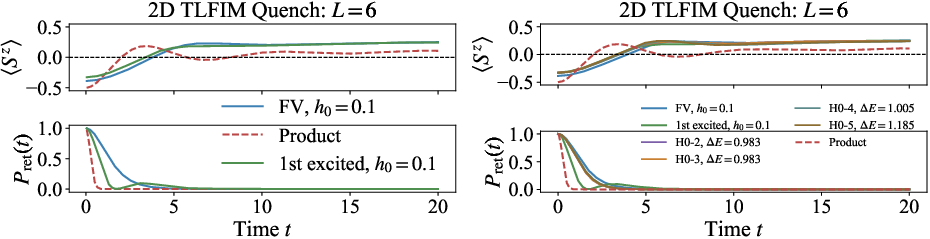
Figure 6: Quench dynamics for various initial states, illustrating stability hierarchy and the role of FV excitations in cluster protection.
These findings have significant implications for quantum information storage in quantum simulators. The passive protection mechanism conferred by initial-state entanglement, particularly in higher-dimensional lattices, reduces susceptibility to local errors and fragmentation. The cluster statistics are classically hard to compute for large systems, but accessible in digital quantum devices via projective measurements, drawing analogies to quantum sampling problems.
Conclusion
This paper establishes a rigorous connection between initial-state entanglement and macroscopic cluster preservation in 2D quantum many-body dynamics, highlighting the structural—not merely entropic—nature of global information protection. Dimensionality, nucleation barriers, and correlation structure jointly determine metastability and the survival of system-size connectivity after quench. The theoretical and practical consequences extend to the design of quantum simulators capable of sustaining long-range correlations via controlled initialisation, and to the exploration of classically-hard sampling regimes in quantum computation. Future developments could leverage active feedback protocols in tandem with structured entanglement to engineer persistent macroscopic information and investigate scaling laws for cluster observables in even larger and higher-dimensional systems.