- The paper introduces ROQAM, a novel quantum algorithm that computes full functional Green's functions efficiently using Arnoldi iterations.
- It leverages orthogonal polynomial techniques to maintain numerical robustness and significantly reduce quantum resource requirements compared to QSVT-based methods.
- The methodology offers improved precision‐error tradeoffs and extends to finite-temperature regimes via the thermofield double formalism.
Robust Quantum Arnoldi Method for Green's Function Estimation
Introduction
The quantum simulation of Green's functions (GFs) is a critical bottleneck in applying quantum computing to quantum many-body physics, condensed matter, and materials science. Traditional strategies often return only point estimates, while practical applications demand functional representations over intervals of frequency or complex domains for spectral and dynamical analysis. This paper introduces the robust quantum Arnoldi method (ROQAM) for efficiently obtaining functional approximations of GFs on a quantum computer. ROQAM leverages orthogonal polynomial approaches to maintain stability and accuracy, even under finite-precision constraints, and provides substantial improvement in quantum resource requirements over singular value transformation (QSVT)-based methods.
Methodological Framework
Arnoldi Iteration and Functional GF Estimation
The ROQAM adapts the classical Arnoldi method—an algorithmic generalization of Lanczos for non-Hermitian matrices—to quantum simulation. By repeatedly estimating expectation values ⟨χ0∣Ul∣χ0⟩ using a quantum computer and passing these to a classical post-processing step, the full functional form of GF can be reconstructed efficiently.
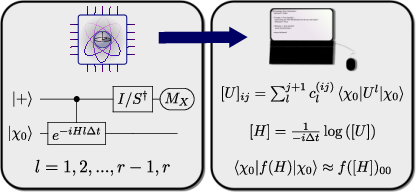
Figure 1: Protocol of the quantum Arnoldi method: a quantum computer measures autocorrelations ⟨χ0∣Ul∣χ0⟩, constructing [U] that is further processed into [H], enabling functional GF estimation.
The orthogonal polynomial formulation preserves the upper-Hessenberg structure of projected matrices, thereby ensuring numerical robustness. This approach allows the matrix function f(H) to be evaluated through Arnoldi quadrature in a compact subspace, with tight error upper bounds arising from polynomial approximation theory.
Resource Implications and Finite-Precision Handling
The principal quantum operations required by ROQAM are the estimation of autocorrelation functions of the time-evolution unitary U(Δt), avoiding the exponential scaling in block-encoding factors encountered in QSVT-based implementations. Notably, as Arnoldi iteration depth increases, the quantum precision required for matrix-element estimation decreases, leading to further savings.
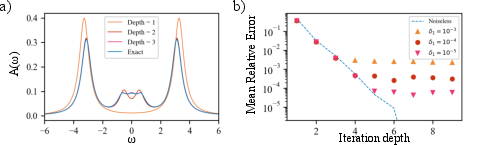
Figure 2: Convergence of the spectral function for SIAM with increasing Arnoldi iteration depth; finite precision induces an error floor, while deep iterations are advantageous until noise dominates.
ROQAM's structure naturally supports a hierarchy of error budgets, in which individual expectation values ⟨χ0∣Ul∣χ0⟩ can be estimated with precision proportional to their frequency of appearance across iterates, counteracting the complexity of high powers Ul.
Comparative Resource Analysis
Empirical resource benchmarks show ROQAM's advantage in logical T-gate cost versus QSVT matrix inversion for estimating spectral functions on impurity models. For small instances, ROQAM achieves order-of-magnitude lower gate counts, delivers functional estimates for the entire frequency interval, and circumvents the need for frequency-specific QSVT circuits.
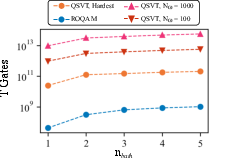
Figure 3: Aggregate T-gate counts for spectral function estimation in SIAM (1–5 bath sites): ROQAM is significantly more efficient compared to QSVT, especially at maximal frequencies.
Numerical Results and Stability Analysis
SIAM Spectral Function Estimation
Applying ROQAM to SIAM instances at metallic regime and low bath orbital count, functional spectral estimation converges rapidly for moderate broadening parameters γ. The choice of ⟨χ0∣Ul∣χ0⟩0 is critical: too small values transform ROQAM into an eigensolver for resolving individual poles, while higher values lose spectral detail, necessitating problem-specific heuristics.
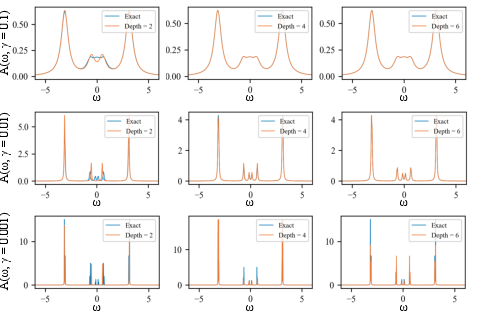
Figure 4: Convergence of SIAM spectral function (n_bath = 4) with varying broadening parameter ⟨χ0∣Ul∣χ0⟩1; lower ⟨χ0∣Ul∣χ0⟩2 demands deeper iterations for pole resolution.
Error Scaling and Noise Analysis
In the noiseless regime, iteration depth correlates with error reduction in functional GF estimation. Lower broadening leads to plateauing error profiles until all relevant eigenvalues are resolved; imaginary axis estimation yields fast convergence due to analytic smoothness. Finite sampling precision induces a bias; errors track the noiseless curve until a noise floor is reached, after which further iteration is ineffective.
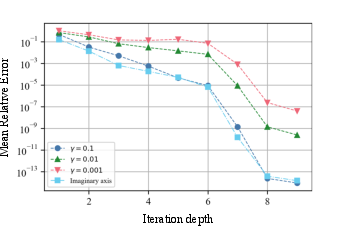
Figure 5: Mean relative error versus Arnoldi iteration depth for various ⟨χ0∣Ul∣χ0⟩3; small ⟨χ0∣Ul∣χ0⟩4 requires locating all spectral peaks before error improves.
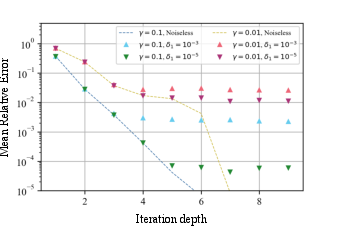
Figure 6: ROQAM error versus iteration depth under finite-precision; estimator error follows noiseless bounds until saturating at the noise-determined floor.
Artifacts such as low-depth deviations (non-Hermitian ⟨χ0∣Ul∣χ0⟩5 leading to spurious poles or sign reversals) are addressed either by projecting ⟨χ0∣Ul∣χ0⟩6 to its nearest unitary or ⟨χ0∣Ul∣χ0⟩7 to its nearest Hermitian, restoring physical structure as iteration depth increases.
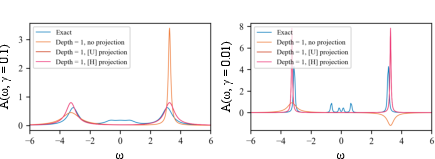
Figure 7: Example of low-depth artifacts: spectral function distortion and incorrect sign near poles, resolved at higher iteration depth or by matrix projection.
Timestep and Subnormalization Factor Optimization
Optimal selection of ⟨χ0∣Ul∣χ0⟩8 is critical for balancing aliasing constraints and error amplification. Too small ⟨χ0∣Ul∣χ0⟩9 increases norm loss in Arnoldi vectors, amplifying noise; too large [U]0 causes aliasing and invalid matrix logarithm recovery of [U]1.
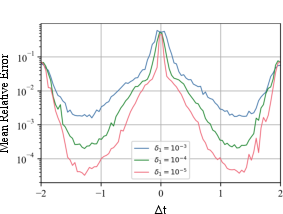
Figure 8: Error dependence on [U]2 for SIAM: sharp error amplification near zero and aliasing threshold, with optimal [U]3 away from both regimes.
Subnormalization factor [U]4 in block-encoding contexts is efficiently neutralized by rescaling [U]5, reinforcing the suitability of time-evolution operator-based approaches over direct block-encoding or qubitized walk operators.
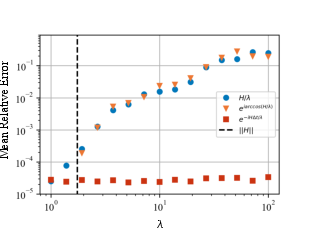
Figure 9: Error scaling with block-encoding [U]6: only time-evolution operator rescaling cancels adverse effects, other approaches yield exponential error growth.
Error Budget Strategies
ROQAM enables variable error budget allocation (uniform, frequency-based scaling, or aggressive proportional schemes), all yielding minimal impact on estimator performance.
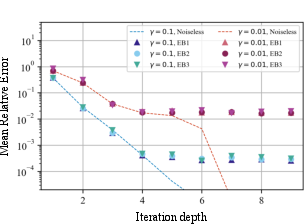
Figure 10: Comparison of adaptive error budgets across Arnoldi iterates: functional estimator precision is robust to aggressive scaling of sampling errors.
Extension to Finite-Temperature Green's Functions
ROQAM generalizes efficiently to finite temperature via the thermofield double (TFD) formalism, constructing a pure state vectorization of thermal density matrices. Functional thermal GF estimation is attainable from a single Krylov subspace, using [U]7 as the generator in the Arnoldi iteration, obviating the need for stochastic trace sampling or multiple subspaces.
Implications and Future Directions
ROQAM provides a scalable, robust, and resource-efficient quantum algorithm for functional GF estimation, with deep implications for quantum simulation, DMFT, and strongly correlated electron theory. The orthogonal polynomial structure maintains numerical stability and algorithmic tractability even under noisy quantum measurements, a necessity for practical implementation on finite-capacity quantum devices. The approach is extensible to other matrix-function computations, response functions, and potentially high-energy density physics applications.
Current limitations include the absence of tight a priori bounds for parameter selection (e.g., iteration depth, sampling precision, timestep), necessitating heuristic strategies. Furthermore, rigorous backward stability proofs for noisy iterative Arnoldi methods remain an open theoretical question, motivating future research in quantum algorithmic stability and error analysis.
Conclusion
ROQAM advances the state-of-the-art in quantum Green's function estimation by combining numerical robustness, functional versatility, and resource efficiency. Its formal foundations in the theory of orthogonal polynomials and Krylov subspace projections guarantee stability, while its practical realization circumvents the quantum resource bottlenecks inherent in previous QSVT-based methods. The broad applicability to zero and finite-temperature regimes endorses ROQAM as a principal tool for quantum many-body simulation and related computational physics challenges (2605.22920).

