Sample-efficient benchmarking of shallow all-to-all random quantum circuits
Published 21 May 2026 in quant-ph | (2605.22909v1)
Abstract: Random circuit sampling (RCS) remains one of the most competitive frameworks for demonstrating quantum advantage in near-term noisy intermediate-scale quantum (NISQ) hardware. Unfortunately, absent error-correction, existing benchmarks to characterize these experiments, like linear cross-entropy, have been classically spoofed due to noise. Because of this, there are interesting regimes, like shallow-depth random quantum circuits, where sampling is plausibly classically intractable, but no existing benchmark can distinguish between a noisy quantum computer and an adversarial classical spoofer. In this paper, we demonstrate that the nonlinear cross-entropy provides a sample-efficient benchmark for shallow-depth all-to-all random quantum circuits whose score cleanly separates noisy quantum computers from state-of-the-art classical spoofers, even in the presence of depolarizing noise. Further, we develop a binary classifier based on the notion of heavy output generation that features logarithmic sample complexity at short depth. Our evidence comes from exact analytic expressions for all-to-all Brownian circuit ensembles derived using replica tricks, and numerical simulations that corroborate these results for discrete Haar-random unitary circuits.
The paper introduces sample-efficient benchmarks that distinguish noisy quantum samplers from classical spoofers using shallow all-to-all circuit architectures.
It employs analytical techniques based on Brownian random circuit ensembles to derive exact metrics like nonlinear XEB and a HOG classifier with logarithmic sample complexity.
Empirical validations confirm that these methods robustly certify quantum advantage, guiding scalable experiments on NISQ platforms.
Sample-Efficient Verification of Quantum Advantage with Shallow All-to-All Random Quantum Circuits
Introduction and Motivation
The development of scalable quantum processors has positioned random circuit sampling (RCS) as a key approach for demonstrating quantum computational advantage, particularly in the near-term, noisy intermediate-scale quantum (NISQ) regime. Verification of genuine quantum advantage is complicated by the challenge of distinguishing noisy quantum hardware from classically tractable spoofers, especially when considering shallow circuit depths that are theoretically classically hard to sample but lack robust benchmarks immune to classical spoofing. The work in "Sample-efficient benchmarking of shallow all-to-all random quantum circuits" (2605.22909) introduces analytical and practical benchmarks capable of reliably distinguishing noisy quantum samplers from known classical spoofing strategies in shallow all-to-all circuit architectures, crucially with favorable (∼logarithmic) sample complexity.
Brownian Random Circuit Ensemble and Analytical Techniques
The paper develops its analytic framework around all-to-all Brownian random circuits, which serve as a tractable proxy for ensembles of deep random quantum circuits with full connectivity. Brownian circuits are modeled as continuous-time stochastic evolutions of n-qubit systems under time-dependent two-qubit interactions drawn from Gaussian white noise. This is formalized by the Hamiltonian evolution:
U=t∏exp−ij<k,α,β∑Jjkαβ(t)σjασkβdt,

where Jjkαβ(t) are i.i.d Gaussian variables and the total evolution time, set by circuit depth βJ, is tunable. Analytical tractability is enabled by mapping the evaluation of moments and cross-entropies of circuit output distributions onto a quantum statistical mechanics problem via the Choi-Jamiołkowski isomorphism (Figure 1):
Figure 1: The Choi-Jamiołkowski isomorphism maps the random circuit sampling problem onto a thermal partition function problem, facilitating analytical calculations using replica techniques.
This mapping leverages large-n mean-field methods to calculate arbitrary moments and replicated partition functions, circumventing the intractability faced by conventional Haar-random circuit models at high moments or in the presence of noise.
Output Distribution Characterization and Convergence
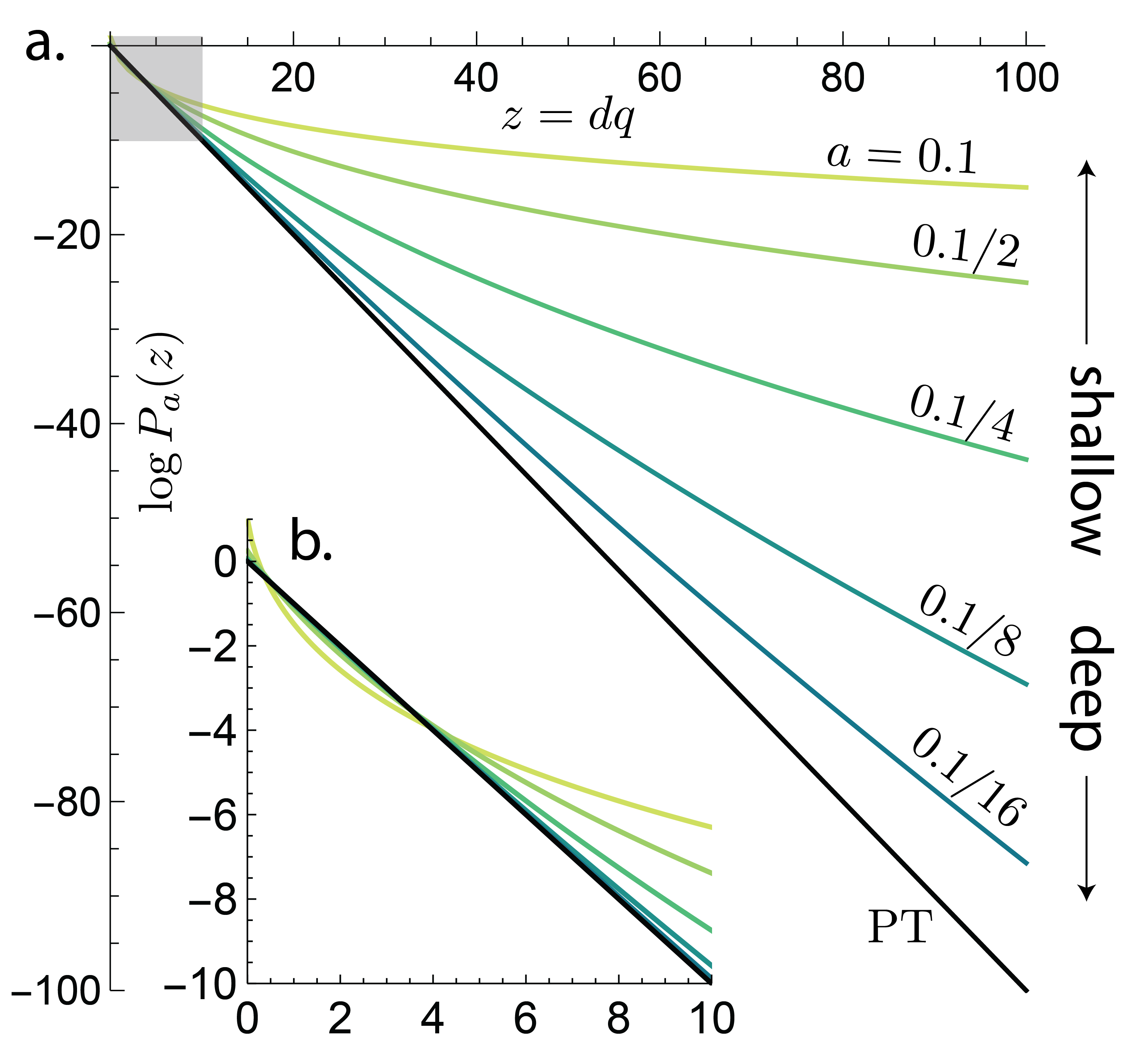
By computing the full family of output probability distributions Pa(q) as a function of circuit depth a=e−12βJ, the analysis shows that at increasing depth, these distributions converge rapidly to the Porter-Thomas law as expected of the Haar ensemble. Notably, the output bitstring probabilities retain distinguishable structure at sublogarithmic depths—structure exploited for benchmarking:
Figure 2: Brownian circuit output distributions Pa(z) for n=100 qubits show smooth convergence to the Porter-Thomas law as depth increases from shallow (yellow) to deep (dark green), connecting finite-depth sampling to the Haar random ensemble.
Nonlinear Cross-Entropy Benchmarking and Sample Complexity
The central technical contribution is an exact expression for the ensemble-averaged nonlinear cross-entropy (XEB), including its variance, at arbitrary depth and under single-qubit depolarizing noise:
n0
where n1 denotes the binary entropy and n2 is the depolarizing noise rate. The corresponding variance is also derived:
n3
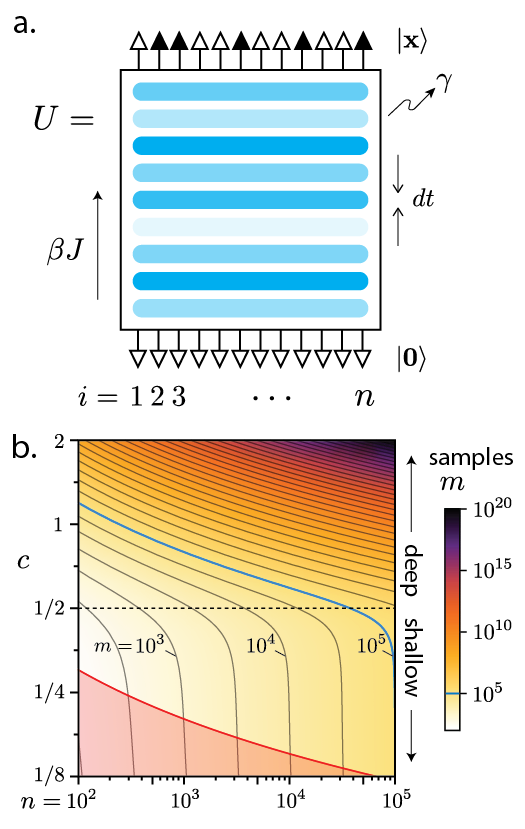
These expressions show that in the shallow-depth, all-to-all regime, the signal (quantum advantage) term remains robust and the estimator is sample-efficient—with the required number of circuit samples scaling only polynomially with n4. The critical distinction is that, for these circuits, nonlinear XEB cannot be efficiently spoofed by known classical algorithms, unlike the linear XEB whose vulnerability at shallow depths is now well documented [barak2020spoofing, gao2024limitations].
Figure 3: (a) Brownian circuits with tunable depth and noise; (b) Required samples to estimate nonlinear XEB as a function of system size and depth; shallow depth requires only polynomially many samples up to the crossover at n5 (n6).
Heavy Output Generation (HOG) Classifier: Logarithmic Sample Complexity
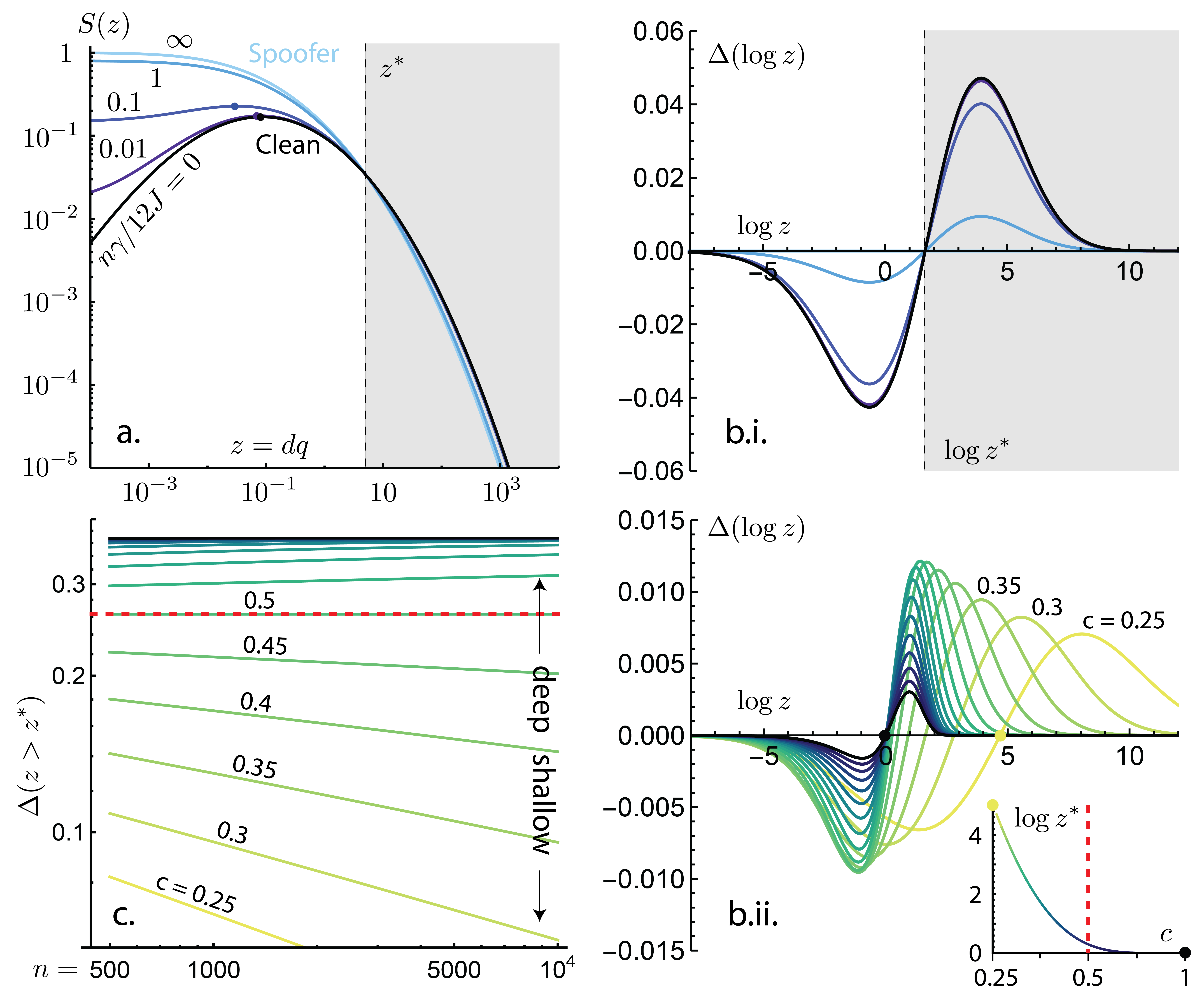
Beyond nonlinear XEB, the paper introduces a binary HOG classifier to distinguish a quantum sampler from a classical spoofer using only a single sample, achieving logarithmic sample complexity with respect to system size. This classifier operates by computing for each bitstring sample the scaled ideal probability n7 and assessing its position relative to an analytically determined threshold n8. Clean quantum circuits yield a surplus of high-score bitstrings ("score repulsion"), while classical spoofers lack this property:
Figure 4: The HOG classifier’s score distributions n9 across noise rates; clean quantum circuits (black) produce heavier tails, enabling robust discrimination from classical spoofers (light blue) even with a single sample.
A central result is that, for logarithmic circuit depth, the probability gap U=t∏exp−ij<k,α,β∑Jjkαβ(t)σjασkβdt,0 between quantum and classical distributions remains bounded away from zero, so that U=t∏exp−ij<k,α,β∑Jjkαβ(t)σjασkβdt,1 samples suffice for reliable discrimination.
Empirical Validation and Regime-Specific Findings
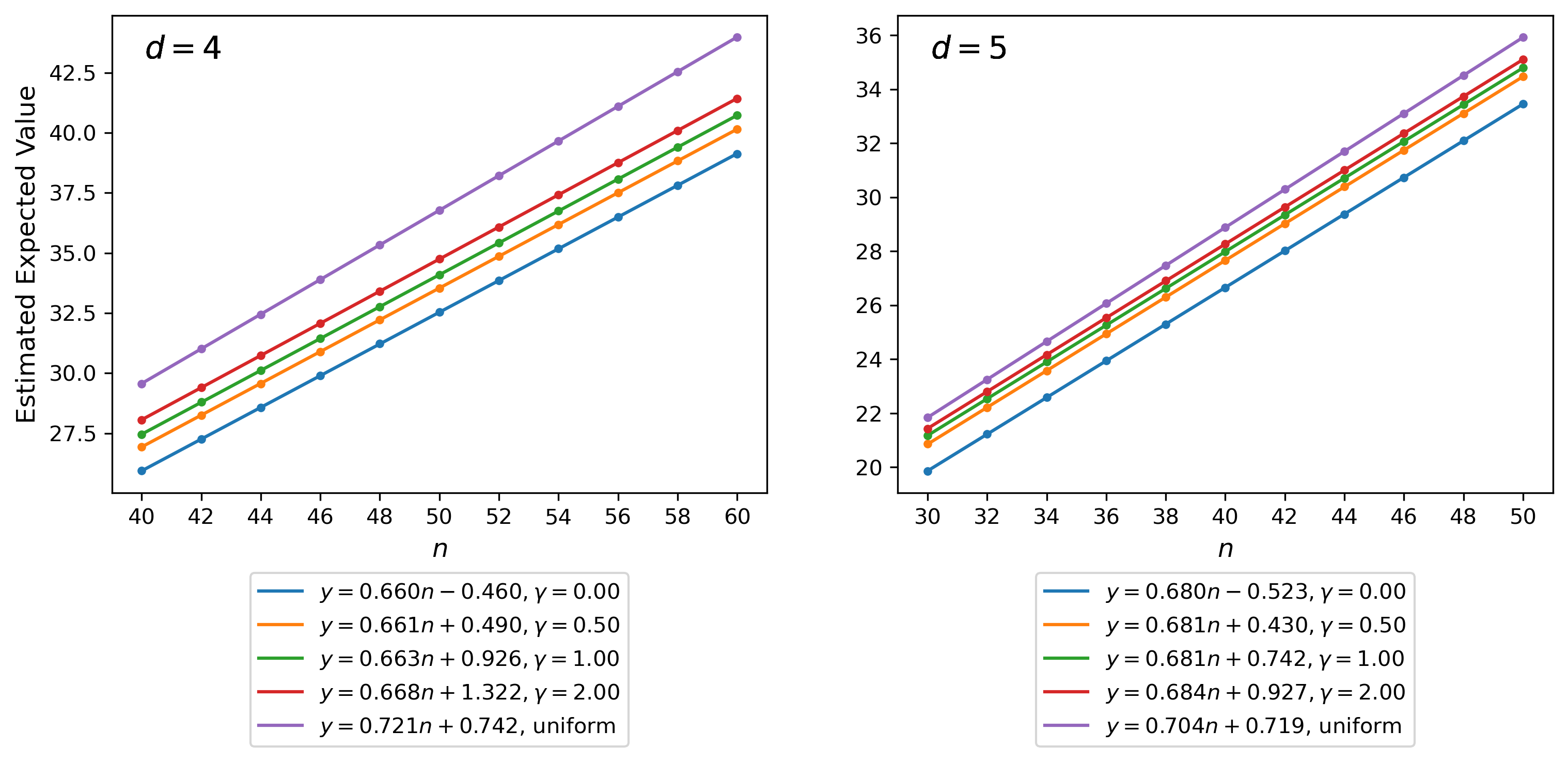
The analytical predictions for output distributions and nonlinear XEB statistics are validated against extensive numerical simulations of Haar-random all-to-all circuits (Figures 6, 7, 8, 9). The scaling of XEB mean and variance with circuit depth and noise rate matches Brownian predictions for circuit depths U=t∏exp−ij<k,α,β∑Jjkαβ(t)σjασkβdt,2, while deviations are observed at very shallow depths where the mean-field/Brownian approximations break down.
Figure 5: Numerically estimated nonlinear XEB scores as functions of system size for Haar-random all-to-all circuits; slopes match Brownian predictions for U=t∏exp−ij<k,α,β∑Jjkαβ(t)σjασkβdt,3, supporting analytical claims.
Comparison with 1D Random Circuits and Implications for Benchmarking
The analysis is extended to 1D brickwork architectures, revealing that the favorable sample-efficiency properties of Brownian all-to-all circuits do not directly carry over. In 1D, slopes of XEB vs. U=t∏exp−ij<k,α,β∑Jjkαβ(t)σjασkβdt,4 remain U=t∏exp−ij<k,α,β∑Jjkαβ(t)σjασkβdt,5-dependent even for moderate depths, emphasizing the architectural specificity of these findings.
Experimental and Theoretical Implications
This work motivates the use of shallow, all-to-all RCS benchmarking experiments—directly compatible with leading neutral atom and trapped-ion platforms, which possess inherent all-to-all or dynamically reconfigurable connectivity. The derived benchmarks afford:
Robust certification of quantum advantage against state-of-the-art classical spoofers, even under physically realistic noise models, without requiring deep circuits.
Sample efficiency: Nonlinear XEB and HOG achieve favorable scaling with system size, making practical benchmarking of near-term quantum devices feasible.
Architectural guidance: The effectiveness of these benchmarks is tied to highly nonlocal circuit architectures, underscoring their relevance for emerging hardware.
The analysis lays a theoretical foundation for future extensions, including benchmarking with different noise models (e.g., non-unital channels), generalization to other sampling-based protocols (e.g., Bell sampling), and refinements for short-depth dynamics.
Conclusion
This work establishes rigorous, analytically tractable, and sample-efficient benchmarks for verifying quantum advantage in shallow all-to-all random quantum circuits, exploiting the structure of Brownian circuit ensembles and reconciling quantum statistical mechanics with circuit complexity. Nonlinear XEB and HOG classifiers not only distinguish robustly against leading classical spoofing strategies but do so with practical sample requirements, thereby resolving a key bottleneck for experimental demonstrations of quantum advantage in nonlocal NISQ architectures. The results open several avenues for theoretical refinement and experimental deployment in scalable quantum computing platforms.