- The paper introduces a unified vision-language model that interleaves action execution with sparse, structured reasoning at critical navigation nodes.
- It leverages an automatic, annotation-free data engine to supervise high-quality reasoning outputs using multimodal simulation data.
- Experimental results reveal improved robustness, interpretability, and sim-to-real generalization across challenging vision-language navigation benchmarks.
Self-Aware Reasoning for Vision-Language Navigation: An Expert Analysis of AwareVLN
Introduction
The AwareVLN framework presents a formally principled solution for Vision-and-Language Navigation (VLN) by integrating explicit self-aware reasoning into a unified vision-LLM. Unlike traditional end-to-end VLM-based VLN methods that map multimodal inputs directly to actions and lack explainable reasoning, AwareVLN introduces sparse and structured reflection at critical navigation nodes. This architecture enables the agent not only to follow instructions but to maintain robust alignment with navigational progress and adaptively correct errors, yielding improved generalization and explainability under both simulation and real-world deployment.
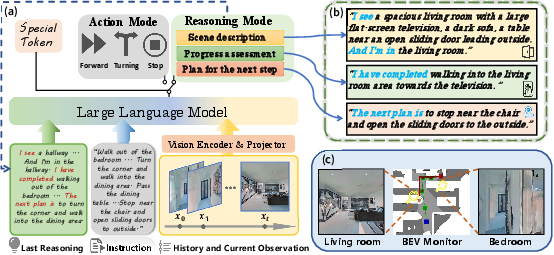
Figure 1: AwareVLN architecture comprising unified action prediction and self-reflective reasoning modules, with causal and sparse multi-dimensional reasoning triggered at task-relevant nodes.
Technical Approach
Unified Reason-Act Vision-LLM
AwareVLN utilizes a single vision-LLM that interleaves action generation with structured reasoning. The input consists of navigation instructions I, RGB observation sequences Ot, and previous reasoning output R, temporally grounded via relative positional encoding. The model predicts either an [ACT] or [REASON] token at each timestep; [REASON] leads to textual output describing the scene context, progress assessment, and the next-step plan. This sparse triggering avoids computational inefficiency and prevents reasoning from becoming superficial or merely decorative.
The reasoning process is activated at three key conditions:
- Subtask Completion: Recognizes successful fulfillment of instruction segments and plans subsequent navigation steps.
- Path Deviation: Detects spatial inconsistencies, interprets navigation errors, and guides correction.
- Stopping Error: Identifies misaligned terminal states and adjusts goal localization.
The model’s output format follows a triplet structure, enforcing explicit reasoning, which confers strong interpretability and facilitates learning robust navigation policies.
Automatic Data Engine for Reasoning Supervision
Scalable annotation-free reasoning supervision is critical for training self-aware agents. The automatic data engine leverages the Habitat simulator’s semantic and waypoint information to detect reasoning nodes corresponding to subtask boundaries, route deviations, and terminal offsets. Rich multimodal context—for each key node—is fed into a generic VLM (e.g., Qwen-VL-Max) via a progressive prompting strategy, producing structured reasoning outputs with causal interpretation.
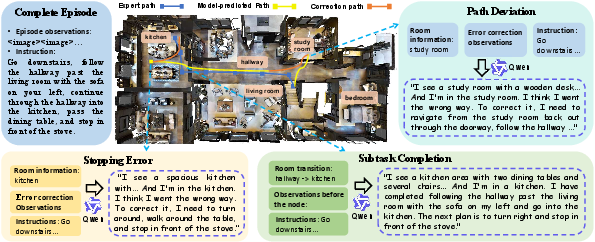
Figure 2: Automatic data engine workflow identifies key reasoning nodes and generates high-quality structured reasoning supervision using multimodal context.
This approach yields diverse supervision, covering subtask completion, error recognition, and recovery behavior. Both ground-truth following and DAgger-based trajectories are incorporated to provide coverage over correct and erroneous behaviors.
Experimental Results
Simulation Benchmarks
On R2R-CE and RxR-CE continuous navigation benchmarks, AwareVLN demonstrates superior performance with only monocular RGB input, outperforming all strong baselines—including those employing extra sensory modalities such as depth, panoramic views, and odometry. AwareVLN achieves NE=4.02, SR=65.4%, SPL=55.1% on R2R-CE Val-Unseen and NE=3.95, SR=67.6%, SPL=56.1% on RxR-CE Val-Unseen. These scores reflect significant improvements over previous methods, especially those not reliant on simulator pre-trained waypoint predictors.
Real-World Deployment
AwareVLN attains strong sim-to-real transfer across diverse real-world environments. The agent, trained only in simulation, accurately completes complex multi-room navigation tasks and maintains self-aware reasoning for error correction and subtask planning.
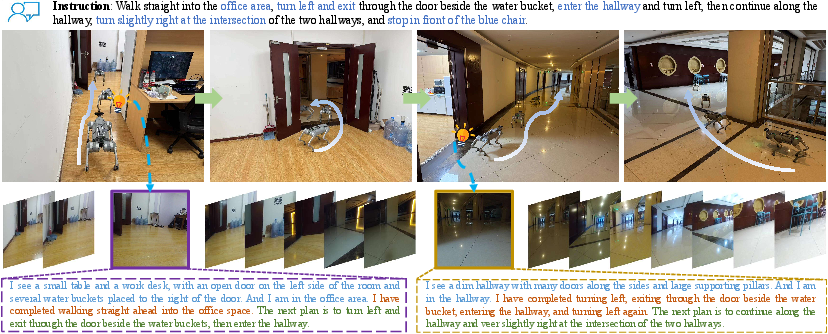
Figure 3: Deployment of AwareVLN on quadruped robot shows precise self-aware reasoning and robust generalization to real-world VLN tasks.
Qualitative and Supervisory Insights
Rollout visualizations illustrate the model's structured reasoning translating into robust navigation, with recovery from path deviations and coherent task segmentation.
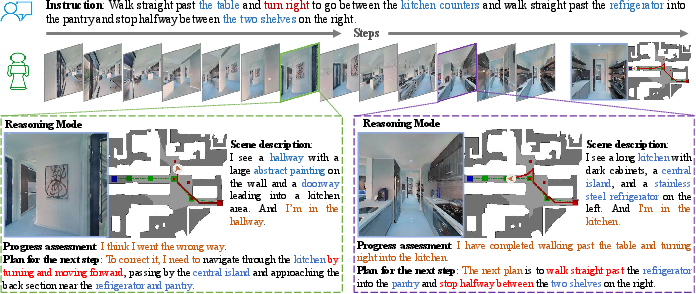
Figure 4: Simulation rollout: agent detects incorrect interpretation of 'turn right', triggers reasoning, corrects trajectory, and re-plans following subtask completion.
Supervisory examples further validate the reasoning pipeline, showcasing nuanced error interpretation and recovery planning.
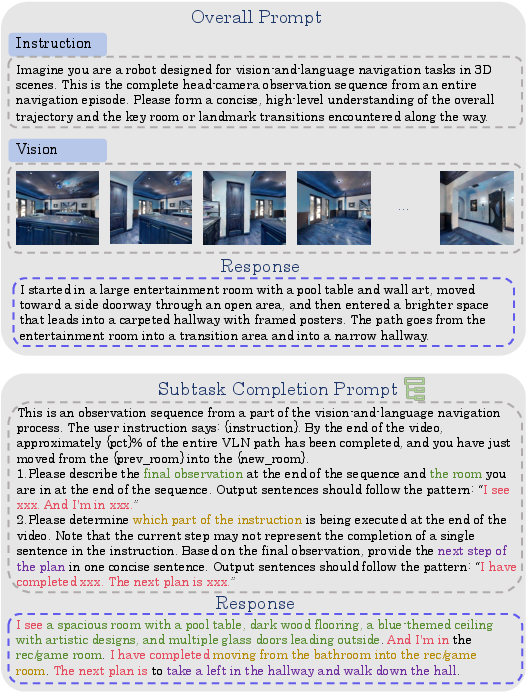
Figure 5: Multi-turn reasoning supervision: global episode understanding and localized reasoning for subtask completion.
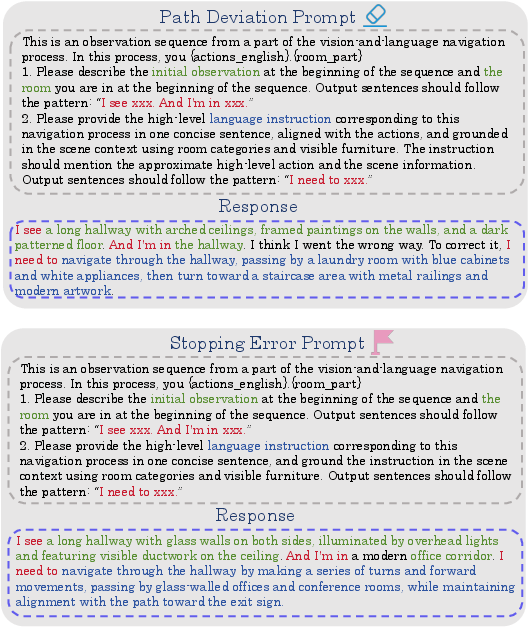
Figure 6: Multi-turn reasoning for error nodes: causal recovery planning and stopping error interpretation.
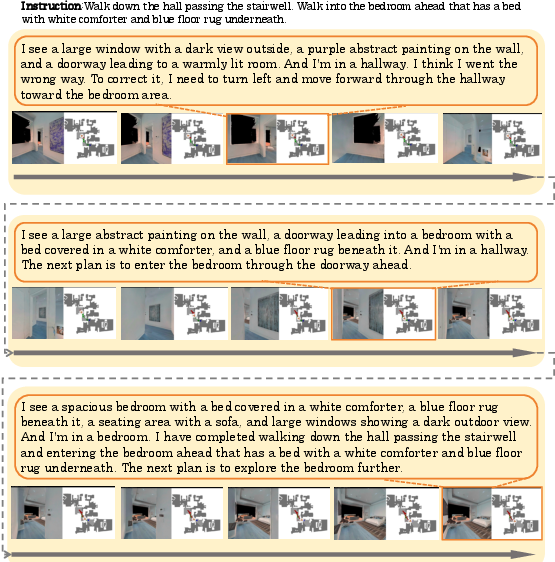
Figure 7: Automatically collected trajectory: agent generates structured reasoning outputs aligned with evolving visual scene and navigation instruction.
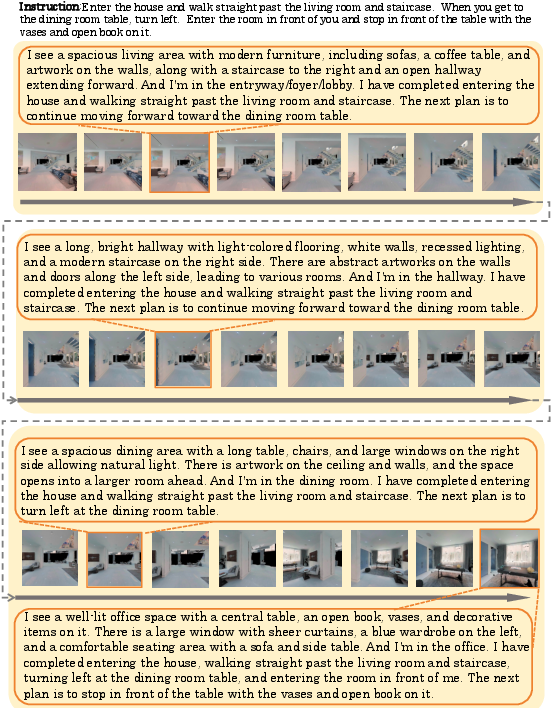
Figure 8: Training trajectory: agent reasons across multiple room transitions, demonstrating spatial awareness and subtask boundary detection.
Ablations and Architectural Design Choices
Ablation studies show the critical contribution of each reasoning node type: subtask completion is most significant for performance, followed by path deviation recognition and stopping-error analysis. Sparse reasoning, orchestrated by explicit special tokens, provides the most effective schedule—dense per-frame reasoning degrades both efficiency and navigation accuracy. The unified architecture, as opposed to dual-system or joint-output methods, enables mutually reinforcing learning between reasoning and acting.
Implications and Future Directions
Practically, AwareVLN’s architecture offers strong deployment scalability and sim-to-real generalization, obviating the need for 3D sensing or manual annotation while conferring interpretability. Theoretically, the triplet-based structured reasoning establishes a paradigm for integrating causal self-awareness into embodied AI. The framework lays groundwork for further exploration of robust monocular RGB-based 3D scene representations, improved spatial grounding, and generalization to novel task domains such as manipulation or open-world navigation.
Advancements could include:
- Hierarchical reasoning schedules tuned via online progress assessment.
- Leveraging richer multimodal fusion for more accurate spatial understanding.
- Direct application to other embodied AI domains requiring integrated perception-reasoning-planning cycles.
Conclusion
AwareVLN systematically elevates Vision-and-Language Navigation by embedding explicit self-awareness and structured reasoning in a unified vision-language-action model. The framework’s sparse, causally triggered reasoning at progress-relevant nodes provides robust navigation, explainable decision traces, and superior generalization—validated across simulation and real-world settings. The methodology and supervisory engine are broadly extensible, portending significant advances in interpretable embodied AI and compositional planning agents (2605.22816).