- The paper rigorously formulates PBH formation as a first-crossing problem, highlighting the limitations of Carr’s cumulative formula.
- It employs numerical simulations using Cholesky decomposition to capture colored noise and validate analytic variances across different window functions.
- The study reveals that the choice of coarse-graining window critically impacts the PBH mass function, especially in the underexplored low-mass tail.
Introduction and Motivation
This work provides a systematic and quantitative analysis of primordial black hole (PBH) formation within the excursion-set framework, focusing on the role of correlated (colored) stochastic noise and the impact of different coarse-graining window functions on both the probability of PBH formation and the resultant PBH mass function. The analysis is motivated by the need for reliable theoretical predictions of PBH abundance and mass spectra, especially given increasingly tight constraints from cosmological observations. The authors emphasize the inadequacy of traditional analytic estimates—specifically Carr's cumulative formula—for capturing non-Markovian and cloud-in-cloud effects inherent to the PBH formation process, particularly when realistic, smooth window functions are used.
The study formulates PBH formation as a first-crossing problem in excursion-set theory, where the coarse-grained density contrast δ(τ) (at smoothing scale τ) is driven by correlated noise determined by the underlying primordial power spectrum and the chosen window function. The stochastic process for δ(τ),
dτdδ=ξ(τ),
exhibits colored noise; the noise covariance is analytically derived for each window function under a localized Gaussian power spectrum. Three window types are systematically compared:
- Fourier-space top-hat window: Discontinuous, produces both uncorrelated (Markovian) and correlated (non-Markovian) noise components.
- Gaussian window: Smooth, yields fully correlated noise across scales, encoding strong non-Markovianity.
- Real-space top-hat window: Requires special handling due to slow Fourier decay and the necessity of a transfer function for numerical tractability.
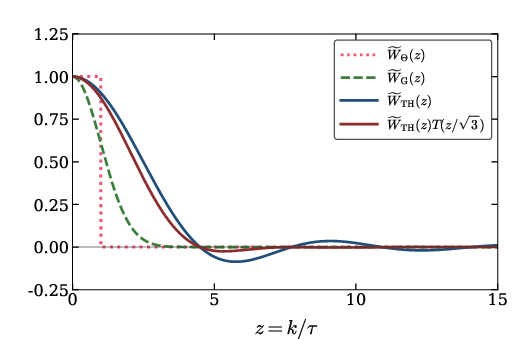
Figure 1: The window functions often considered in the literature: Fourier-space top-hat window function (orange dotted), Gaussian window function (green dashed), and real-space top-hat window function (blue solid and wine-red solid).
The noise covariance's analytical structure determines the degree of non-Markovianity and the cloud-in-cloud correction, clarifying when the standard “factor two” of standard excursion-set calculations applies or fails for PBH formation.
Numerical Construction of Stochastic Trajectories
The authors employ high-statistics numerical generation of noise trajectories via Cholesky decomposition of the analytic covariance matrices, with careful grid selection for τ. This enables robust evaluation of both the distribution of δ(τ) and the first threshold-crossing statistics for PBH formation. Ensemble statistics agree with the analytic variances, validating the numerics.
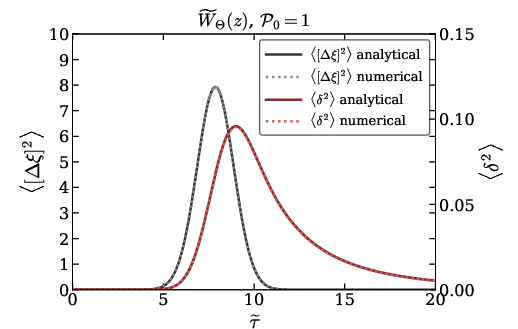
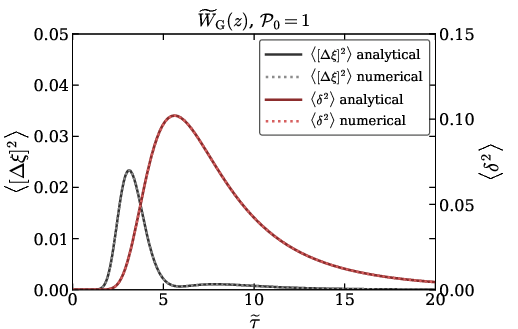
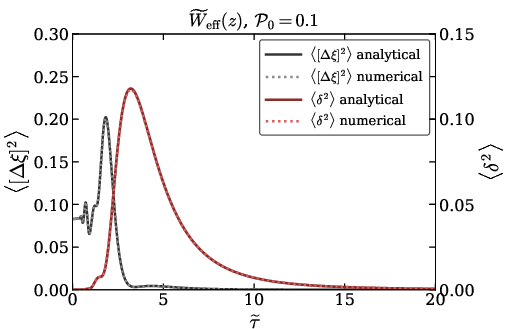
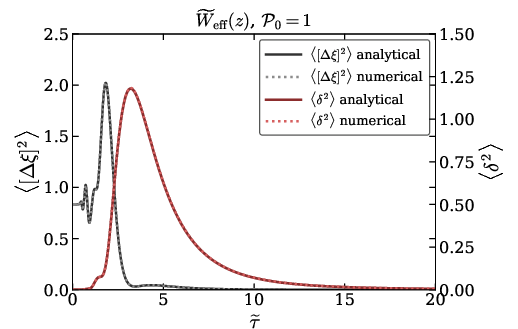
Figure 2: Variances of the density contrast δ and the noise ξ for the three kinds of window functions, Fourier-space top-hat (top left), Gaussian (top right), real-space top-hat with the transfer function (bottom).
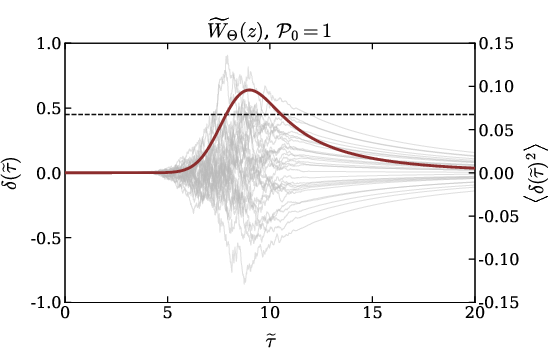
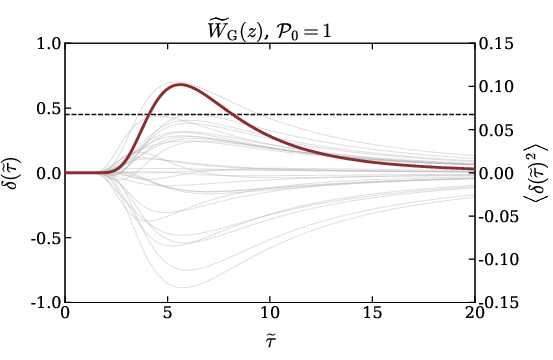
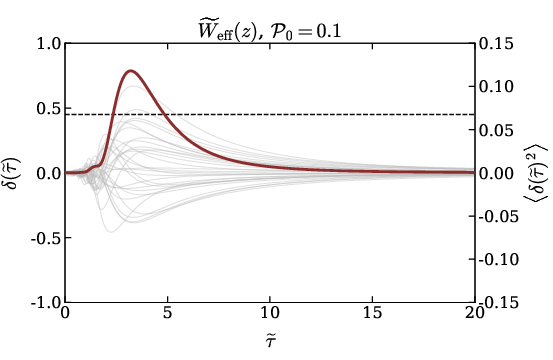
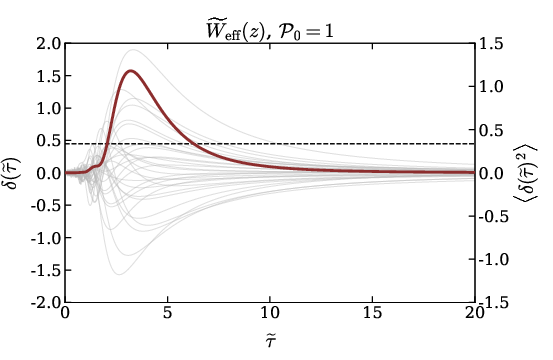
Figure 3: Twenty sample stochastic trajectories of the density contrast, coarse-grained by the three kinds of window functions, Fourier-space top-hat (top left), Gaussian (top right), and real-space top-hat (bottom).
The first-crossing probability is decomposed as β(τ)=P1(τ)+P2(τ), where P1 is the probability that τ0 first crosses the collapse threshold at scale τ1, and τ2 records events where the crossing occurred at larger scales. Notably:
- Markovian case (τ3): τ4 near the characteristic scale; Carr’s formula (analytic Gaussian approach) matches the sum up to the “factor two.”
- Non-Markovian/smooth-windows (τ5, τ6): τ7 is subdominant at the scale where the mass function peaks, but significant in the low-mass (large-τ8) tail.
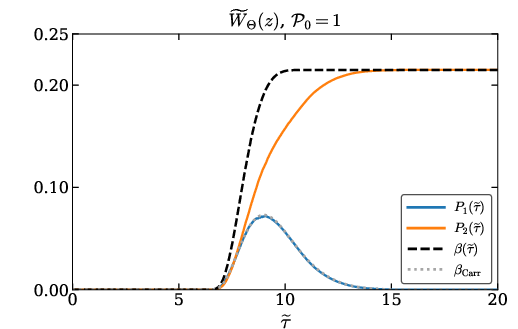
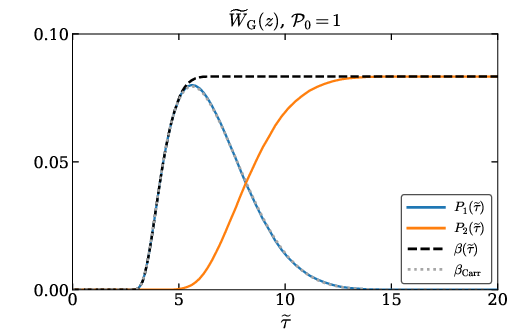
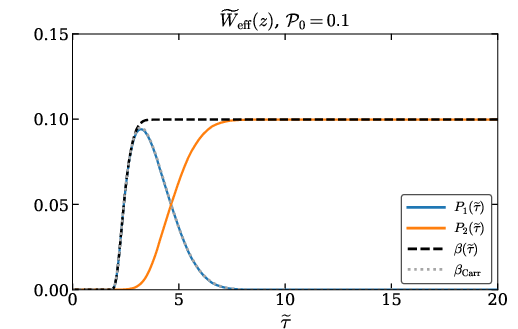
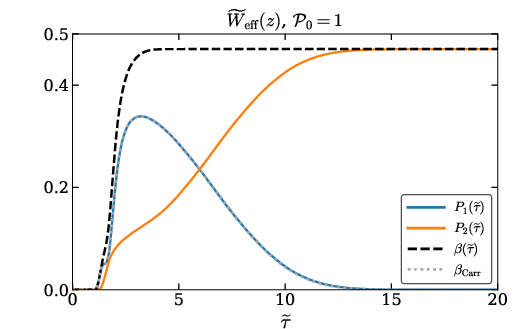
Figure 4: Excursion-set probabilities for the three kinds of window functions, Fourier-space top-hat (top left), Gaussian (top right), real-space top-hat (bottom).
Derivatives of the probabilities reveal τ9’s crucial role in enforcing the non-negativity of the mass function in non-Markovian cases.
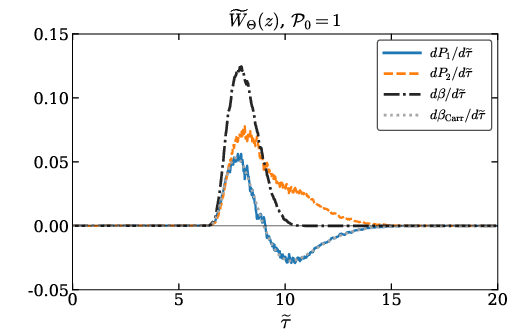
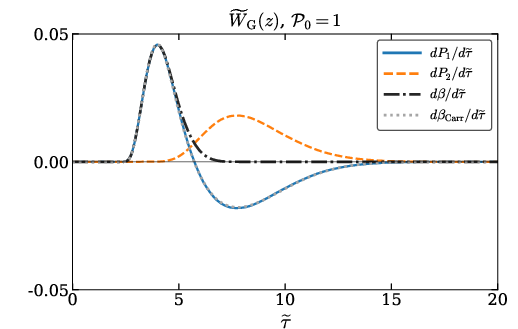
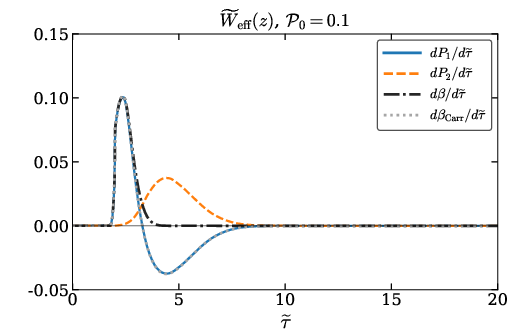
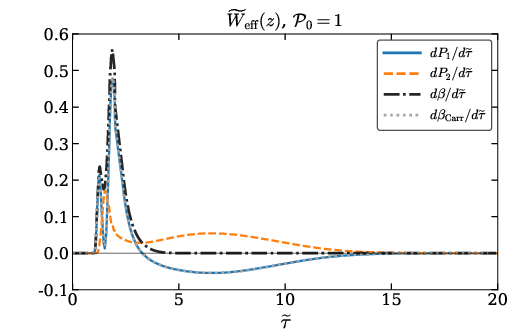
Figure 5: Derivatives of the excursion-set probabilities for the three kinds of window functions, highlighting window-dependent structure and the necessity of δ(τ)0 to maintain non-negative PBH mass functions in non-Markovian settings.
PBH Mass Function: Window Function Dependence and Comparison with Analytic Estimates
The coarse-graining scale δ(τ)1 is mapped to PBH mass via the standard horizon-mass relation during radiation domination. The final mass function is thus reconstructed as:
δ(τ)2
- Agreement near the peak: For smooth windows, Carr’s analytic estimate (δ(τ)3 only) is a reliable proxy for the excursion-set mass function near the maximum.
- Deviation in low-mass tail: The low-mass portion is systematically underestimated by Carr’s formula unless the full excursion-set probability is used, manifesting the importance of scale correlations and δ(τ)4 events.
- Window effects: The position and shape of the mass function peak are sensitive to window function choice. Smooth windows lead to a shift toward higher masses and a suppression of the low-mass tail.
- Oscillatory features: The real-space top-hat window with transfer function introduces oscillatory, multi-modal structure into the mass function when the input spectrum amplitude is large.
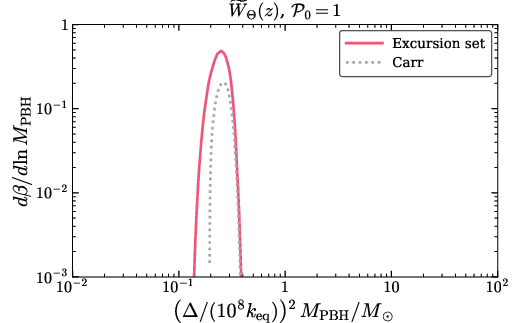
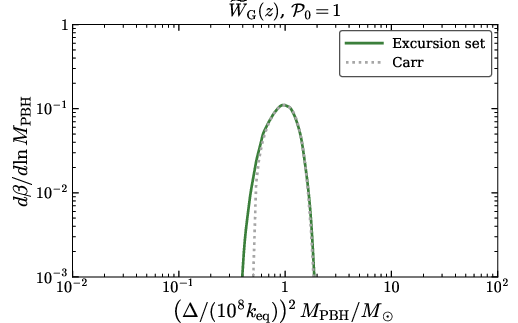
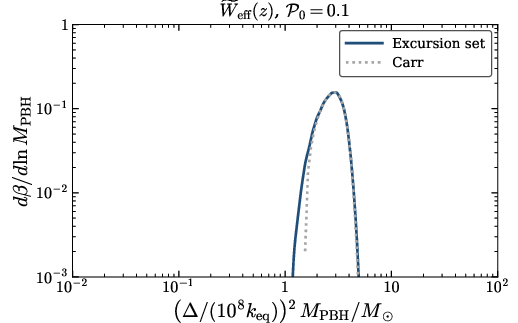
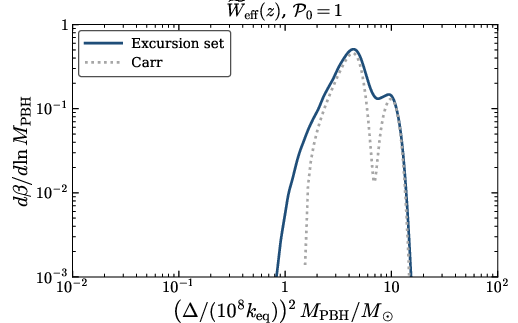
Figure 6: The derivative mass fractions of PBHs formed from the density contrast, coarse-grained by the three kinds of window functions; the role of δ(τ)5 is significant in the low-mass regime and for Markovian windows.
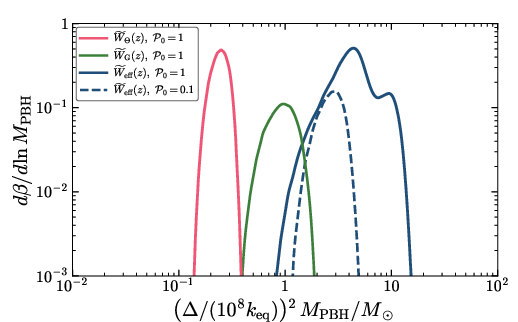
Figure 7: Comparison of numerical mass functions obtained with different coarse-graining windows. Distinct peak positions and tail behaviors are induced by the window choice, with deviations from Carr's analytic prediction being largest for the Markovian case.
Implications and Future Prospects
These results yield several high-level implications:
- Mass function modeling: Accurate PBH mass function predictions require explicit modeling of non-Markovian noise and correct treatment of window functions; analytic Gaussian approximations can only be justified near the characteristic scale for smooth windows.
- Sensitivity to window choice: Observational constraints on PBHs—especially in the low-mass regime—are acutely sensitive to the smoothing prescription, underscoring the need for standardized analyses or careful theoretical justification of window choice in the literature.
- Theoretical consistency: The excursion-set approach generalizes peak statistics, resolving cloud-in-cloud ambiguities except in the Markovian regime, and provides a path-forward for incorporating non-Gaussianity and alternative collapse criteria.
- Numerics and transfer functions: Sufficient numerical care, including the correct application of transfer functions for slowly-decaying windows, is essential to prevent unphysical divergences and artifacts in the stochastic modeling.
Further development could involve systematic inclusion of non-Gaussian primordial statistics, refined treatment of critical collapse, and joint Bayesian analysis with gravitational-wave data to infer allowable window and spectrum combinations.
Conclusion
This study rigorously establishes the necessity of accounting for colored noise and window function dependence in PBH formation theory via the excursion-set framework. Carr’s classical formula accurately captures PBH abundance only near the peak mass and only for smooth Fourier-space windows, while the low-mass tail and discontinuous windows necessitate full stochastic treatment. The mass spectrum’s sensitivity to the smoothing prescription and noise correlation structure implies that theoretical and observational PBH studies must explicitly specify and justify these choices. This formalism provides a robust basis for future theoretical and phenomenological explorations into the cosmological consequences of PBH formation.

