Understanding Data Temporality Impact on Large Language Models Pre-training
Abstract: LLMs are typically trained on shuffled corpora, yielding models whose knowledge is frozen at train time and whose temporal grounding remains poorly understood. In this work, we study the impact of pre-training dynamics on the acquisition of time-sensitive factual knowledge, focusing specifically on data ordering. Our main contributions are twofold. First, we introduce a comprehensive benchmark of over 7,000 temporally grounded questions and an evaluation protocol that enables analysis of whether models correctly associate facts with their corresponding time periods. Second, we pretrain 6B-parameter models on temporally ordered Common Crawl snapshots and compare them against standard shuffled pre-training. Our results show that sequentially trained models match shuffled baselines on general language understanding and common knowledge while consistently exhibiting more up-to-date and temporally precise knowledge. Temporally ordered pre-training yields improved factual freshness, while shuffled pre-training peaks on older data, possibly due to increased factual repetition. These findings, along with the release of our code at https://github.com/kyutai-labs/kairos , checkpoints, and datasets at https://huggingface.co/collections/kyutai/kairos provide a foundation for future research on continual learning for LLMs.


Paper Prompts
Sign up for free to create and run prompts on this paper using GPT-5.
Top Community Prompts
Explain it Like I'm 14
Understanding “Understanding Data Temporality Impact on LLMs Pre-training”
1) Big idea in simple terms
This paper asks a down-to-earth question: if you teach a LLM using internet text, does it matter whether you show it the text in random order or in the actual order it appeared over time (like reading the news year by year)? The authors find that training in real time order helps the model remember newer facts better, making it more “up-to-date.”
2) What questions are the researchers trying to answer?
The authors focus on three easy-to-grasp questions:
- Does the order of training data over time change what facts a model knows about specific years?
- Can training on text in chronological order make a model better at answering questions about recent events?
- Can we measure how “fresh” a model’s knowledge is (for example, who was a team’s coach in 2024 vs. 2019)?
3) How did they study it? (Methods in everyday language)
Think of training a model like teaching a student with a giant stack of web pages (Common Crawl). There are two teaching styles:
- Shuffled training: Mix all the pages from different years together, like shuffling a big deck of flashcards. The model sees everything in a random order.
- Sequential training: Feed the pages in time order, like reading the internet year by year (2018, then 2019, … up to 2025).
The team did the following:
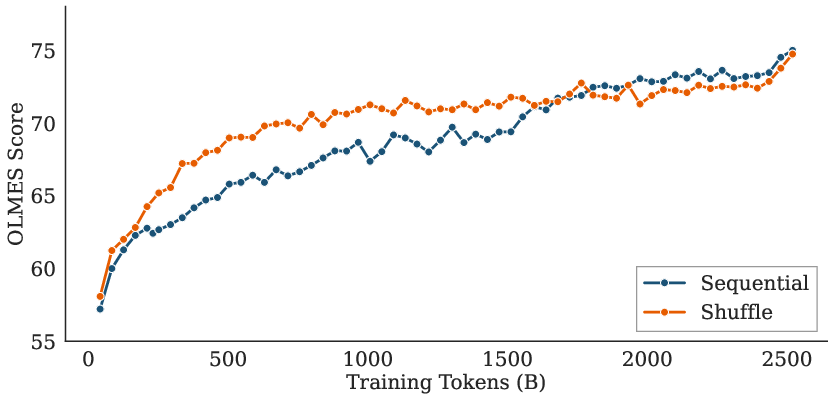
- They trained two models with the same size (about 6 billion parameters) and the same total amount of reading (about 2.5 trillion tokens, which is a huge amount of text).
- One model read shuffled data from 2020–2024; the other read data in order from 2018 to 2025.
- To fairly compare them, they matched checkpoints by “how much they’d read” (so progress wasn’t just about more data).
To test how well the models know time-specific facts, they built a benchmark called KairosQA:
- They pulled facts with dates from Wikidata (for example, “Who was the head coach of the Charlotte Hornets in 2024?”).
- They filtered and cleaned these so the questions would be clear and meaningful, ending with over 7,000 time-grounded questions.
- They tested models in two ways:
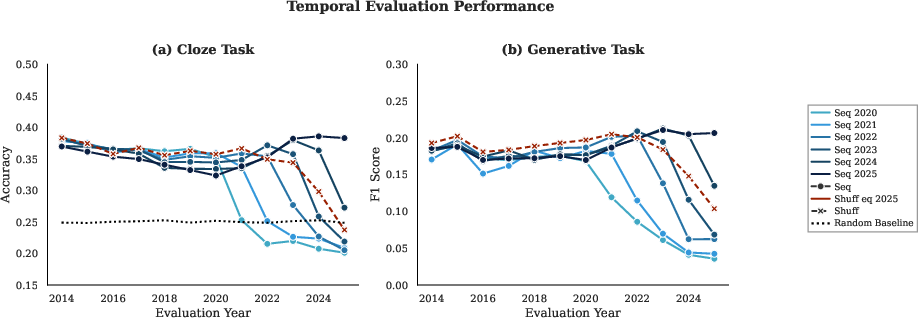
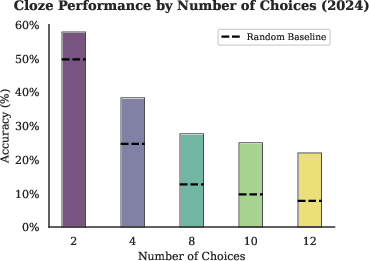
- Cloze/ranking: the model picks the right answer from a small set of choices. (This checks if the model knows the fact when given realistic options, including “tricky” distractors from other years.)
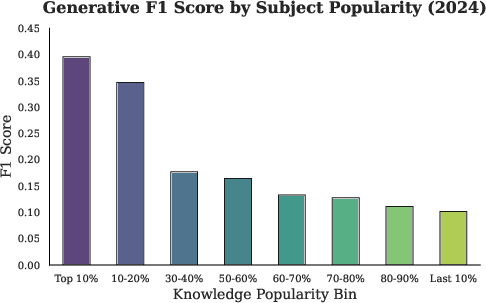
- Free-text generation: the model writes the answer on its own. (They score how close the model’s answer is to the real one, using F1, a standard accuracy measure.)
They also checked general language ability using a standard benchmark (OLMES) to ensure the new training method didn’t hurt overall skills.
A helpful analogy:
- Shuffled training = learning history from a pile of notecards thrown in random order.
- Sequential training = learning history by reading a timeline year by year.
4) What did they find, and why does it matter?
Main results:
- General skills are not worse: The model trained in time order performs just as well as the shuffled model on overall language tasks by the end of training.
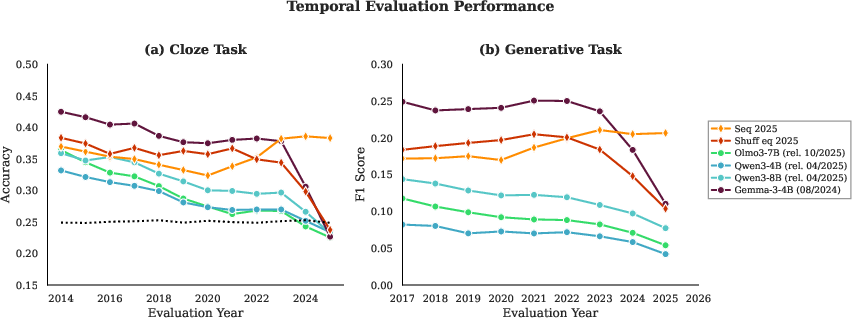
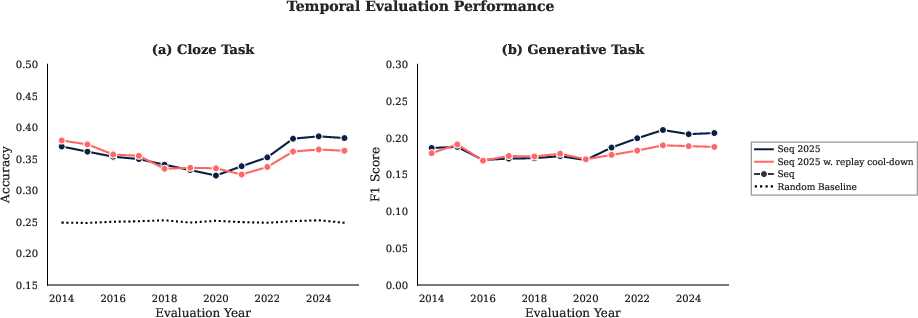
- Fresher knowledge: The sequential model is much better at answering questions about recent years (like 2023–2024). It shows a clear “recency peak” — it’s strongest near its latest training year.
- Shuffled models lag on recent facts: Even with newer data mixed in, shuffled models tended to be best on older facts and got worse on recent ones, likely because older facts are repeated more often across web snapshots and are “louder” in the data.
- Trade-off: The sequential model can forget some older facts as it learns newer ones. However, it still stays strong on recent information, which many real users care most about.
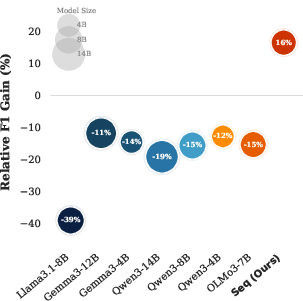
- Not just their model: Many open-source models (even bigger ones) showed the same pattern as the shuffled baseline — good on older facts, weaker on fresh ones.
- The test is robust: Their multiple-choice questions used realistic distractors (answers correct for other years), so the test really checks time awareness rather than simple guessing.
- Popular topics are easier: The model answers are more accurate for well-known subjects (popular teams, people, or organizations) than for obscure ones — likely because popular topics appear more often in training.
Why this matters:
- If you want a model that knows the latest facts (like who won an award last year or who currently leads a company), how you feed it data over time makes a big difference.
- Many current LLMs are “behind” on recent knowledge because of shuffled training pipelines.
5) What’s the impact and what comes next?
Implications:
- Training order is a powerful and simple lever: feeding data chronologically helps LLMs stay current without hurting general abilities.
- Real-world benefit: News agencies, customer support, and any app needing up-to-date facts can get fresher answers using time-ordered pre-training.
- Open resources: The authors are releasing their code, checkpoints, and the KairosQA dataset so others can build and test time-aware models.
Future directions:
- Combine recency with memory: The main challenge now is keeping new facts fresh without forgetting older ones. The authors suggest exploring time-aware architectures or training tricks that remember “when” a fact comes from.
- Continual learning: Building models that can be updated regularly in a stable way (without wiping out old knowledge) is a key next step.
In short: Teaching a LLM in the order the world actually happened makes it better at remembering what’s new. The paper shows this clearly and provides tools for others to push this idea further.
Knowledge Gaps
Knowledge gaps, limitations, and open questions
Below is a concise list of what remains uncertain or unexplored, framed to guide concrete follow-up work.
- Causal role of ordering vs. content differences: disentangle temporal ordering from year-to-year data quality, domain mix, and duplication by training on identical per-year shards (same content) under different orders and mixes.
- Baseline asymmetry: train a shuffled baseline on exactly the 2018–2025 corpus and a sequential model on exactly 2020–2024 to symmetrically control for temporal ranges and verify that effects are not artifacts of window mismatch.
- Quantify factual repetition: measure per-year repetition/exposure counts of the evaluated facts and correlate with performance to test the “older facts are more repeated” hypothesis.
- Exposure-to-accuracy mapping: compute, for each KairosQA item and year, the number of pre-training mentions and model accuracy; determine minimal exposures needed for acquisition and retention under each curriculum.
- Catastrophic forgetting characterization: report standard continual-learning metrics (backward/forward transfer, forgetting curves) across years, not just qualitative trends; identify which relations/entities are most forgotten.
- Forgetting mitigation strategies: systematically compare replay, elastic weight consolidation, adapters, time-aware MoE, and mixed-order schedules at fixed compute to reduce loss of older knowledge.
- Curriculum granularity and schedules: test month-level vs. year-level ordering, sliding-window interleaving, non-uniform mixing (e.g., p% recent + q% replay), and schedule hyperparameters to optimize freshness–retention trade-offs.
- Scaling laws: replicate results across model sizes (e.g., 1B–70B) to determine whether recency gains and forgetting scale with parameters and context length.
- Instruction tuning and RLHF: assess whether temporal benefits persist or change after SFT/RLHF and whether formatting competence (MCF vs. CF) interacts with temporal alignment.
- Multilingual effects: analyze temporal alignment by language (beyond 24 European languages), including low-resource languages, to detect language-specific gains or regressions.
- Domain drift controls: hold domain proportions fixed across years (or explicitly manipulate them) to isolate domain-shift effects from temporal ordering effects.
- Snapshot quality audit: systematically quantify per-year readability, duplication, domain composition, toxicity, and noise; extend beyond a single cool-down swap to multiple cross-year swaps.
- Time-aware representations: evaluate architectural/objective variants (timestamp tokens, temporal embeddings, time-conditioned losses) against pure sequential ordering for improved freshness without forgetting.
- Broader, realistic evaluation: test on news/entity-update tasks, KGC with timestamps, and open-ended questions without explicit year to measure implicit temporal inference.
- KairosQA coverage bias: expand beyond popularity-biased, sports/awards-heavy relations to underrepresented domains, long-tail entities, and properties with different change dynamics (including slow/rare updates).
- Answer normalization and judging: use alias lists, entity linking, and LLM-as-judge for generative evaluation; report confidence intervals and significance tests to quantify uncertainty.
- Distractor robustness: include adversarial and out-of-neighborhood distractors; verify that models are not exploiting heuristics like “most recent among options.”
- Decontamination checks: measure overlap between pre-training data and KairosQA items (including exact strings and paraphrases), and audit for leakage due to GPT-4o/Claude-assisted question generation.
- Real-world recency risk: evaluate whether induced recency bias increases susceptibility to recent misinformation or rumor amplification; assess regional and topical fairness over time.
- Compute–data efficiency: quantify early-phase inefficiency of sequential training, compute overhead of replay/continual methods, and the Pareto frontier between freshness and cost.
- Reproducibility assets: release exact snapshot IDs, per-year token counts, filtering settings per language/year, and per-item exposure statistics to enable precise replication.
- Mechanistic insights: probe internal representations for time-conditioned neurons/heads and perform causal tracing to understand how temporal facts are stored and updated.
- Retrieval synergy: test whether timestamped retrieval (RAG) complements sequential pre-training and whether gains are additive or redundant.
- Temporal granularity and complexity: extend from yearly facts to monthly/daily granularity, intervals (start–end), and multi-hop temporal reasoning; handle “no valid holder this year” cases.
Practical Applications
Immediate Applications
Below are concrete, deployable uses that leverage the paper’s findings, tools, and training/evaluation methods.
- Bold application: Sequential pre-training for fresher base models
- Sectors: software, media, search, finance, sports/entertainment, enterprise AI
- What: Adopt chronologically ordered pre-training on web snapshots (or domain-specific corpora) to bias models toward more up-to-date factual knowledge without sacrificing general capabilities.
- Tools/workflows: Use the released dactory pipeline (language ID, deduplication with Bloom filters, domain-weighted quality scoring) and the chronological curriculum with yearly checkpoints; apply the “branching cooldown” to produce converged checkpoints.
- Dependencies/assumptions: Requires access to time-stamped corpora and sufficient compute; quality of older snapshots may be lower and slows mid-training; modest forgetting of older facts must be accepted or mitigated.
- Bold application: Temporal model selection and versioning in MLOps
- Sectors: enterprise AI, software, compliance
- What: Treat model checkpoints as “as-of-year” artifacts and select the checkpoint whose cutoff best matches the application’s knowledge horizon (e.g., deploy a 2024 checkpoint for news summarization).
- Tools/workflows: Tag and catalog yearly checkpoints; integrate temporal selection into deployment pipelines; monitor with “freshness” regression tests.
- Dependencies/assumptions: Needs consistent snapshot cadence and metadata; downstream evaluation must confirm that the chosen cutoff aligns with user needs.
- Bold application: Procurement and QA using KairosQA
- Sectors: industry, government, academia
- What: Use KairosQA to benchmark the temporal alignment and factual freshness of vendor/base models during model selection, alongside existing general benchmarks.
- Tools/workflows: Run both cloze (ranking) and generative F1 evaluations; incorporate length-normalized log-probabilities for cloze scoring as in the paper; add pass/fail thresholds by year.
- Dependencies/assumptions: Current KairosQA is dominated by sports/awards and popular entities; extend to domain-specific temporal facts for your use case.
- Bold application: Risk management for time-sensitive deployments
- Sectors: finance, legal, customer support, media
- What: Recognize that shuffled pre-training yields effective knowledge horizons lagging behind data cutoffs; update risk registers and disclosure language accordingly.
- Tools/workflows: Add “temporal freshness” checks (KairosQA year slices) to go/no-go gates; introduce fallback workflows (retrieval, human review) on recency-critical queries.
- Dependencies/assumptions: Requires governance approval and integration with existing evaluation suites; must calibrate thresholds by business impact.
- Bold application: Date-aware answering in LLM applications
- Sectors: search, customer support, education, media
- What: Add explicit year in prompts and UI (e.g., “as of 2024”), route recency-critical questions to sequential models, and display “as-of” disclaimers calibrated by KairosQA scores.
- Tools/workflows: Temporal prompting patterns; router that detects time-sensitive intents; fallback to retrieval when the question targets years beyond the model’s checkpoint.
- Dependencies/assumptions: Requires intent detection and routing; must maintain an index of model cutoffs and per-year performance.
- Bold application: Continual pre-training with recency bias + replay
- Sectors: enterprise AI, software
- What: Use sequential curricula to incorporate new data and add replay of older slices to mitigate forgetting (as suggested by the paper’s trade-off analysis).
- Tools/workflows: Yearly or quarterly ingest; replay buffers for key past years; domain upsampling near the end of training.
- Dependencies/assumptions: Compute budgets for periodic updates; data versioning by year; replay requires careful tuning to avoid recency degradation.
- Bold application: Retrieval-Augmented Generation tuned for time
- Sectors: healthcare (non-clinical info), finance, legal, software documentation
- What: Pair sequentially pre-trained bases with retrieval indexes that prioritize recent documents for time-sensitive questions while retaining older sources for historical queries.
- Tools/workflows: Temporal scoring in retrieval; query routing by target year; answer attribution with “effective date.”
- Dependencies/assumptions: High-quality, time-stamped retrieval corpora; guardrails for hallucinations; regulatory review in high-stakes domains.
- Bold application: Domain-adapted sequential pre-training
- Sectors: finance (corporate events), legal (statute updates), software (API changes), sports/media
- What: Build domain-specific sequential corpora (e.g., legal gazettes, SEC filings, release notes) to capture evolving facts and roles (e.g., CEOs, statutes, API behavior).
- Tools/workflows: Domain scrapers with temporal metadata; adapted KairosQA-style benchmarks for the domain; checkpoint release per calendar period.
- Dependencies/assumptions: Availability and licensing of domain data; requires curation to ensure reliable timestamps.
- Bold application: Model cards with temporal metrics
- Sectors: policy, industry standards, enterprise governance
- What: Include KairosQA-like “freshness curves” and knowledge horizon summaries in model cards and internal documentation.
- Tools/workflows: Automated pipeline to produce per-year cloze and generative scores; visualizations akin to those in the paper.
- Dependencies/assumptions: Agreement on standardized temporal benchmarks; maintenance over model lifecycle.
- Bold application: Academic experiments on forgetting and recency
- Sectors: academia
- What: Use the released sequential and shuffled checkpoints to investigate catastrophic forgetting, continual learning strategies, and time-aware architectures.
- Tools/workflows: Reproduce branching cooldown, run ablations with snapshot quality controls, and evaluate with KairosQA/TAQA.
- Dependencies/assumptions: Access to compute; awareness that Common Crawl snapshot quality varies by year.
Long-Term Applications
The following opportunities need additional research, scaling, data infrastructure, or standardization to be production-ready.
- Bold application: Time-aware model architectures
- Sectors: software, enterprise AI
- What: Incorporate explicit temporal embeddings/adapters or time-aware Mixture-of-Experts to store and retrieve facts by their valid time, reducing forgetting while preserving recency gains.
- Tools/products: TiMoE-like modules; dual-head or gated layers by time; temporal memory banks.
- Dependencies/assumptions: Research on stability/efficiency at larger scales; training data with reliable timestamps; careful evaluation against forgetting.
- Bold application: Regulatory-grade “temporal alignment” standards
- Sectors: policy, regulated industries (healthcare, finance, transportation)
- What: Establish standardized freshness metrics (e.g., KairosQA-family scores) for high-risk AI systems and minimum acceptable recency by domain.
- Tools/products: Certification suites, compliance dashboards, audit logs with per-year accuracy.
- Dependencies/assumptions: Consensus across regulators/standards bodies; domain-appropriate temporal datasets beyond sports/awards.
- Bold application: Continuous-update base models with SLAs on freshness
- Sectors: enterprise AI, search, media
- What: Operate monthly or quarterly sequential pre-training pipelines with replay to maintain both recency and historical fidelity; publish a “freshness SLA” (e.g., ≥X% KairosQA score for last N months).
- Tools/products: MLOps for temporal data versioning and snapshot quality monitoring; automated checkpoint promotion.
- Dependencies/assumptions: Sustained compute budgets; robust data pipelines and monitoring; mitigation of distribution shift and drift.
- Bold application: Domain-specific temporal benchmarks and marketplaces
- Sectors: healthcare, legal, finance, software
- What: Extend KairosQA methodology to domain corpora (e.g., drug approvals, statutes, corporate events, API changes) and curate time-stamped datasets as purchasable training/eval assets.
- Tools/products: Curated benchmark suites per sector; data marketplaces offering quality-scored, time-indexed corpora.
- Dependencies/assumptions: Licensing and provenance; domain expertise for question generation and validation; strong governance.
- Bold application: “As-of-date” assistants with calibrated confidence
- Sectors: consumer AI, enterprise productivity, education
- What: Assistants that state “as of <date>” automatically, backed by models evaluated on temporal benchmarks; dynamically choose retrieval or human escalation when beyond the knowledge horizon.
- Tools/products: Intent detectors for temporal questions; confidence calibration tied to per-year scores; UX for “effective date” display.
- Dependencies/assumptions: Reliable temporal performance estimation; user acceptance of explicit date disclaimers.
- Bold application: Knowledge management with bi-temporal consistency
- Sectors: enterprise knowledge bases, legal/records
- What: Systems that maintain both the time facts were true and the time they were learned by the model, supporting “what was known when” queries and audits.
- Tools/products: Bi-temporal storage schemas; training logs linking tokens to ingest timestamps; query planners that respect validity intervals.
- Dependencies/assumptions: Architectural changes for provenance capture; privacy/compliance considerations.
- Bold application: Cross-lingual temporal freshness
- Sectors: global products, public sector
- What: Expand sequential curricula and benchmarks to multiple languages, ensuring recency improvements transfer across locales.
- Tools/products: Multilingual KairosQA variants; language-specific quality filters and snapshot analyses.
- Dependencies/assumptions: Balanced multilingual time-stamped data; addressing uneven snapshot quality across languages.
- Bold application: Hybrid RAG + time-aware pre-training at scale
- Sectors: healthcare (clinical knowledge), finance (trading), legal (case law)
- What: Architectures that unify time-aware base models with recency-weighted retrieval and temporal consistency checks for high-stakes decision support.
- Tools/products: Temporal retrieval indices; contradiction/validity detectors; explainability reports with effective dates and citations.
- Dependencies/assumptions: Strong curation and validation of sources; strict governance and human-in-the-loop review.
- Bold application: Compression/distillation that preserves temporal strata
- Sectors: edge AI, mobile, robotics
- What: Distill large, time-aware models into smaller ones while preserving both recent and historical knowledge, possibly via time-conditioned distillation.
- Tools/products: Time-conditioned teacher-student training; evaluation against per-year benchmarks.
- Dependencies/assumptions: New loss functions and curricula; ensuring on-device constraints are met without collapsing temporal fidelity.
- Bold application: Web and content standards with temporal annotations
- Sectors: web publishing, libraries/archives
- What: Encourage publishers to expose machine-readable publication/update dates and validity intervals to improve training and retrieval quality.
- Tools/products: Schema extensions; best-practice guides; crawler support for temporal metadata.
- Dependencies/assumptions: Ecosystem adoption; incentives for publishers.
Notes on feasibility across applications:
- The paper’s gains are demonstrated on 6B-parameter models trained on Common Crawl; scaling to larger models and specialized domains should be validated.
- Snapshot quality varies by year; monitoring and curation materially affect outcomes.
- Sequential pre-training introduces a recency–forgetting trade-off; long-term solutions likely require architectural innovations and/or replay.
Glossary
- AdamW: An optimizer variant of Adam with decoupled weight decay that improves generalization during training. "We utilize the AdamW \cite{loshchilov2018decoupled} optimizer with a Warmup-Stable-Decay scheduler, peaking at a learning rate of ."
- Bloom filter: A space-efficient probabilistic data structure for membership tests that can yield false positives, used here to detect duplicates. "To mitigate redundancy, we apply a Bloom filter to detect duplicate lines and discard paragraphs where novel content constitutes less than ."
- branching cooldown strategy: A checkpoint finalization procedure that branches from the main run and applies a short learning-rate decay for stable comparisons. "To ensure rigorous convergence comparisons at intermediate stages, we employ a branching cooldown strategy."
- cloze formulation (CF): A fill-in-the-blank evaluation approach that scores the likelihood of candidate answers without relying on multiple-choice formatting. "Following the OLMES benchmark~\citep{olmes}, we adopt the cloze formulation (CF)~\citep{fewshotlearners}."
- Common Crawl snapshots: Periodic web-scale data releases from Common Crawl used as the source corpus for pre-training. "We construct our training corpus from multiple Common Crawl snapshots processed through a rigorous multi-stage filtering pipeline using an open-source repository, dactory."
- context length: The maximum sequence length (in tokens) that the model processes in a single forward pass. "Training proceeds for steps with a global batch size of 4.2M tokens and a context length of $4096$, totaling 2.5T tokens."
- cosine decay: A learning-rate scheduling technique where the rate decreases following a cosine curve. "checkpoints are finalized by branching off the main run and applying a $30,000$-step cosine decay to a learning rate of ."
- data curriculum: The deliberate ordering or scheduling of training data to shape learning dynamics and outcomes. "This ensures that any performance divergence is attributable strictly to data curriculum rather than model capacity."
- deduplication: The process of removing duplicate content from datasets to reduce redundancy and overfitting. "combining quality filtering \cite{touvron2023llamaopenefficientfoundation, li2024datacomplm} with deduplication \cite{lee-etal-2022-deduplicating}, the ordering of data during pre-training remains under-explored."
- distribution shifts: Changes in the data distribution over time that can affect model performance and adaptation. "This allows the model to stabilize its representation of the ``pre-2020'' world before adapting to the distribution shifts present in later snapshots."
- fastText: A library for efficient text classification and language identification used in data filtering and quality scoring. "For quality control, we train language-specific fastText classifiers across seven domains to compute a weighted aggregate quality score."
- F1 score: The harmonic mean of precision and recall; commonly used to evaluate QA systems’ generated answers. "we evaluate the generated responses using a normalized F1 score, following standard QA evaluation protocols~\citep{rajpurkar-etal-2016-squad}."
- Generative setting: An evaluation mode where the model produces free-form answers rather than ranking predefined options. "we complement the CF evaluation with a generative setting."
- Grouped-Query Attention: An attention mechanism variant where multiple query heads share grouped key/value projections for efficiency. "The architecture incorporates Grouped-Query Attention with 4 key-value heads, RoPE positional embeddings, and SwiGLU activations."
- KairosQA: A time-sensitive question-answering benchmark introduced to assess temporal grounding and knowledge freshness in LLMs. "This process results in KairosQA, a temporally grounded question-answering dataset designed to evaluate the temporal reasoning capabilities of LLMs."
- knowledge horizon: The effective temporal span of facts a model can accurately recall relative to its training data. "revealing a gap between the training dataset horizon and the modelâs effective knowledge horizon."
- MMLU: The Massive Multitask Language Understanding benchmark that evaluates broad knowledge and reasoning across many subjects. "We observe this distinction clearly on MMLU~\citep{hendrycks2021measuring}, where standard evaluation metrics (i.e., scoring the probability of option labels
A',B', etc.) show a sudden discontinuity in accuracyâoccurring around $200$B tokens for the shuffled baseline and $400$B tokens for the sequential model" - multiple-choice format (MCF): An evaluation setup requiring the model to select among labeled options (A/B/C/D), testing format adherence. "the emergence of the model's ability to adhere to the multiple-choice format (MCF), which eventually yields higher accuracy than the CF."
- non-stationary: Refers to data whose properties (e.g., quality or density) change over time rather than remaining constant. "non-stationary variations in data quality or density across different years."
- OLMES benchmark: A standardized suite for evaluating language modeling and general knowledge capabilities. "we rely on the OLMES benchmark \cite{olmes}, which covers a broad range of tasks and provides a precise, reproducible evaluation setup."
- OpenRouter: A service that routes API requests to different LLMs, used here to access GPT-4o mini for question generation. "We then generate diverse multiple-choice questions using GPT-4o mini via OpenRouter,"
- popularity proxy metric: A quantitative signal (e.g., Wikipedia page views) used to prioritize widely known entities and reduce noise. "we incorporate a popularity proxy metric based on Wikipedia page views."
- recency bias: A learned preference emphasizing more recent information, improving freshness but potentially risking older knowledge. "our sequential approach successfully induces the recency bias necessary for factual freshness."
- RoPE positional embeddings: Rotary positional encodings that enable relative position representation in attention mechanisms. "The architecture incorporates Grouped-Query Attention with 4 key-value heads, RoPE positional embeddings, and SwiGLU activations."
- sequential pre-training: Training on data in chronological order to better align learned knowledge with time, instead of shuffling. "While both approaches yield comparable performance on general-purpose language tasks, sequential pre-training consistently leads to more temporally up-to-date knowledge as underlined in Fig.~\ref{fig:first_page_blob_fig}."
- stationary distribution: A data distribution that does not change over time, simplifying learning dynamics during training. "The \textcolor{orange}{Shuffle baseline} exhibits higher efficiency in the mid-training phase, likely due to the stationary distribution of the data."
- subjectârelationâobject triplets: Knowledge-graph triples that encode a factual statement linking entities via a relation. "From Wikidata, we extract subjectârelationâobject triplets associated with specific years, each serving as a single data sample."
- SwiGLU activations: An activation function combining Swish and Gated Linear Units to improve Transformer performance. "The architecture incorporates Grouped-Query Attention with 4 key-value heads, RoPE positional embeddings, and SwiGLU activations."
- temporal alignment: The degree to which a model’s answers correctly reflect the intended time period for a fact. "To evaluate the temporal alignment of our models, we construct a QA dataset centered on facts that evolve over time"
- temporal cutoff: The latest time point covered by the training data beyond which the model lacks knowledge. "LLMs cannot reliably answer questions about events occurring after the temporal cutoff of their training data."
- temporal prompting: Prompting that explicitly includes time references to elicit the correct time-specific facts. "we observe improvements when applying explicit temporal prompting and time-sensitive in-context examples"
- token budget: A fixed total number of tokens allocated for training or evaluation to ensure fair comparisons. "and compare their performance at a fixed token budget across a range of evaluations."
- Warmup-Stable-Decay scheduler: A learning-rate schedule with an initial warmup, a stable phase, and a final decay to aid convergence. "We utilize the AdamW \cite{loshchilov2018decoupled} optimizer with a Warmup-Stable-Decay scheduler, peaking at a learning rate of ."
- Wikidata: A structured, time-annotated knowledge base used to source facts for temporal QA. "We use Wikidata as our primary source due to its large scale, open availability, and explicit temporal annotations."
- in-context examples: Examples included within the prompt to steer model behavior during inference without parameter updates. "Under the standard protocol, without explicit year stated in the prompt and using time-insensitive in-context examples, models performance remain low"
Collections
Sign up for free to add this paper to one or more collections.

