- The paper introduces the DERP model, which simplifies percolation analysis in directed networks using a message-passing algorithm to yield exact threshold computations.
- The paper demonstrates that network directionality, by preventing backtracking, facilitates closed-form solutions for critical phenomena in locally tree-like structures.
- The paper shows that increasing the transmission range (R) significantly lowers percolation thresholds, with degree correlations critically influencing scaling behavior in both uncorrelated and maximally correlated networks.
Directed Extended-Range Percolation: Analytical Simplification and Critical Phenomena in Directed Networks
Introduction
This paper presents the Directed Extended-Range Percolation (DERP) model, generalizing the extended-range percolation framework to directed networks with non-reciprocal edges. DERP is motivated by practical scenarios such as quantum communication networks, where transmission between trusted nodes is possible via directed paths of length no greater than R, and intermediate nodes may act as relays independent of their trust status. In contrast to standard intuition that network directionality increases percolation complexity, the authors demonstrate that in the context of extended-range connectivity, directionality actually facilitates analytical tractability by suppressing backtracking.
DERP distinguishes itself by allowing trusted nodes to connect through chains of untrusted relays, constrained by a maximum path length R. The absence of reciprocal links in directed networks impedes backtracking, substantially simplifying the recursive message-passing equations relative to undirected ERP, where connectivity within range R requires complex tracking of return paths. The derived message-passing algorithm yields exact analytic solutions for locally tree-like structures, capturing the formation and sizes of the In-Giant Component (IGC), Out-Giant Component (OGC), and the Strongly Connected Giant Component (SCGC).
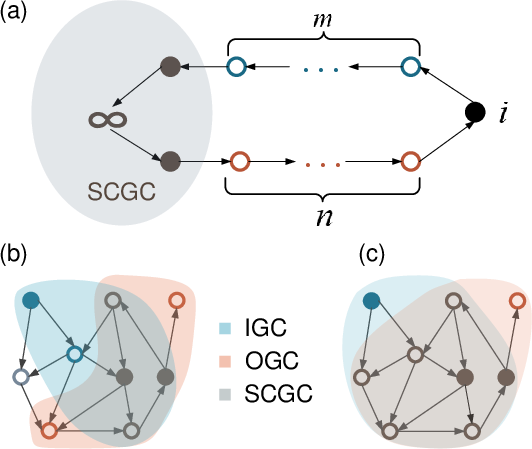
Figure 1: DERP connectivity mechanism in directed networks, with network components expanding as R increases.
The message passing formulation exploits two transmission channels: direct connection via trusted nodes (p) and extended transmission through untrusted relay nodes ($1-p$). Untrusted nodes, instead of acting as blockages, facilitate long-range message propagation up to range R—a departure from traditional site percolation logic.
Exact Percolation Threshold and Critical Indices
The analytical framework yields closed-form expressions for the DERP percolation threshold. Extensive Monte Carlo simulations confirm the accuracy of the message-passing predictions for both random and real-world directed networks.
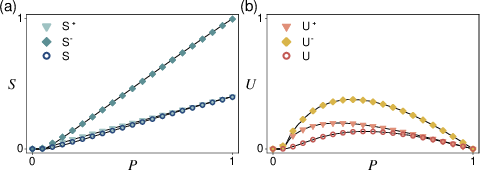
Figure 2: Simulation and theoretical fits for DERP in real-world p2p networks, exhibiting excellent correspondence for order parameter dynamics.
The linearized equations close to criticality reveal that the percolation threshold pc and associated order parameter scaling critically depend on the degree distributions and their correlations. Specifically, for locally tree-like random directed networks, the threshold is determined by the maximal eigenvalue of a block-structured matrix derived from the non-backtracking operator, linking analytic solvability directly to the network's branching factor.
The paper rigorously examines DERP on two network classes:
- Uncorrelated (UC) directed networks: In-degree and out-degree are independent.
- Maximally Correlated (MC) directed networks: In-degree matches out-degree for each node.
In UC networks, the percolation threshold remains finite for all finite R, and critical exponents persistently display mean-field behavior, even for power-law degree distributions. In MC networks, the threshold and scaling behavior are dictated by the degree distribution exponent γ. Scale-free MC networks (R0) exhibit a vanishing threshold (R1) and anomalous critical exponents for R2.
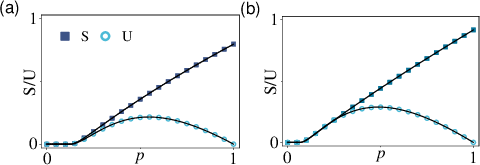
Figure 3: Comparative DERP dynamics for UC vs. MC networks (Poisson degrees, R3): degree correlation impacts both threshold and scaling.
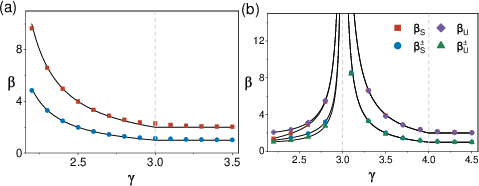
Figure 4: Variation of the critical exponent R4 as a function of the power-law exponent R5 for R6; mean-field vs. anomalous transitions.
Numerical validation using local effective exponent methods further substantiates theoretical claims. Plateaus in simulation-derived exponents coincide with analytic predictions, confirming scaling regimes and finite-size effects.
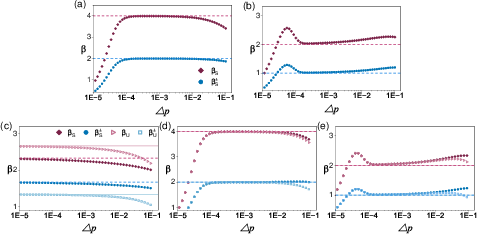
Figure 5: Critical exponent extraction in UC and MC networks; plateaus identify true scaling exponents, validating theory.
Robustness Enhancement via Interaction Range
DERP parametrizes robustness enhancement through R7. As R8 increases, even sparse networks attain substantially lower percolation thresholds, with connectivity among trusted nodes extended efficiently via relay chains. Analytical and simulation results confirm exponential decay of R9 with increasing R0 for large branching ratios.
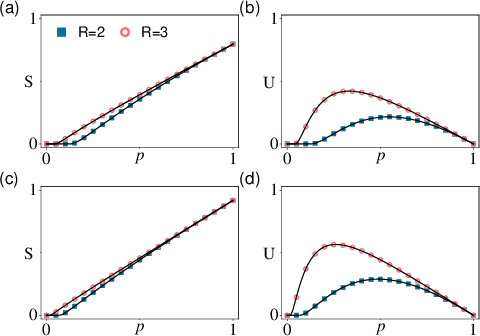
Figure 6: Impact of interaction range R1 on DERP dynamics in directed Poisson networks; both trusted and untrusted node fractions in SCGC are amplified with R2.
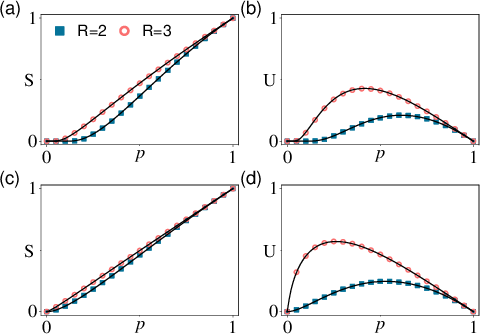
Figure 7: DERP in scale-free networks: both UC and MC structures exhibit range-dependent order parameter transitions as a function of R3.
Implications and Future Directions
DERP provides a practically relevant percolation framework for directed network applications such as quantum communication, where the coherence range is limited, and relay nodes are integral. The simplified message-passing structure supports exact threshold computations and facilitates design and reliability analysis for networked systems with extended-range requirements.
Theoretically, the model impacts the understanding of phase transitions in directed systems, emphasizing the decisive role of degree correlations and path length constraints in determining criticality. The findings motivate further study of non-backtracking mechanisms, degree-correlation-induced anomalous scaling, and design of robust communication protocols in directed heterogeneous media.
Conclusion
The Directed Extended-Range Percolation model overturns conventional expectations regarding directionality in network percolation, presenting a scenario in which analytical complexity is reduced rather than heightened. The model's flexible connectivity definitions enable both exact threshold and critical exponent computations for a wide spectrum of network types, highlighting the profound influence of degree correlations. DERP's practical and theoretical advances set the stage for further explorations into directed connectivity, critical phenomena, and robust network design.