Dynamics of Binary System around a Supermassive Black Hole :Binary Scattering and Eccentric vZLK Oscillations
Published 21 May 2026 in gr-qc, astro-ph.GA, and astro-ph.HE | (2605.22525v1)
Abstract: We study the dynamics of a binary orbiting a supermassive black hole (SMBH), focusing on both binary scattering in unbound orbits and eccentric von Zeipel-Lidov-Kozai (vZLK) oscillations in bound orbits. The motion is described in a local inertial frame in Kerr spacetime, where tidal effects are encoded in the Riemann curvature. For unbound (parabolic and hyperbolic) orbits, we identify four scattering regimes-adiabatic, tidally affected, chaotic, and disruptive-depending on the binary semi-major axis. As the binary becomes softer, tidal interactions near periapsis lead to strong eccentricity excitation, large changes in the orbital parameters, and eventually chaotic behavior or tidal disruption, with a sensitive dependence on the argument of periapsis. For eccentric bound (elliptic) orbits, the vZLK mechanism differs qualitatively from the standard one, although the z-component of the angular momentum in the local inertial frame remains approximately conserved. The evolution proceeds on a dynamical timescale and exhibits step-like changes driven by repeated periapsis passages, which can be interpreted as a sequence of scattering events. We refer to this behavior as scattering-type vZLK oscillations. The rotation of the SMBH also modifies the oscillation profiles, although its effect is less significant than the dependence on the initial orbital parameters. These results suggest a unified picture of periapsis-driven tidal dynamics in galactic nuclei.
The paper presents a unified framework distinguishing four scattering regimes (adiabatic, tidally affected, chaotic, disruptive) based on binary parameters near SMBHs.
It employs numerical experiments within Kerr spacetime to reveal impulsive, step-wise vZLK oscillations induced by strong periapsis tidal interactions.
Findings suggest that tidal encounters can trigger significant eccentricity growth, potentially accelerating gravitational-wave merger rates in galactic nuclei.
Dynamics of Binary Systems Around Supermassive Black Holes: Regimes of Scattering and Scattering-Driven vZLK Oscillations
Introduction and Theoretical Background
This work provides a comprehensive investigation of the dynamics of binary systems orbiting a supermassive black hole (SMBH), focusing on two major phenomena: binary scattering for unbound orbits (parabolic and hyperbolic) and the eccentric von Zeipel–Lidov–Kozai (vZLK) mechanism for bound eccentric orbits. The analysis is developed within the local inertial frame in Kerr spacetime, wherein tidal couplings from the SMBH are encapsulated via the spacetime Riemann tensor. The binary's internal dynamics are treated Newtonianly, justified under the assumption of compactness and limited tidal distortion, with parameters carefully chosen to avoid relativistic disruption and merger during the encounter.
The essential novelty arises from exploring the dynamical transitions between scattering regimes and the perturbatively distinct vZLK modes induced by strong, localized periapsis tidal interactions. Uniquely, the analysis moves beyond the secular approximation, which averages over orbital timescales and fails in the presence of strong periapsis passages or moderate orbital eccentricities.
Classification of Scattering Regimes and Tidal Effects
The numerical experiments delineate four distinct regimes of binary-SMBH scattering, parameterized primarily by the binary's initial semi-major axis (softness/hardness) and periapsis radius with respect to the SMBH:
Adiabatic Scattering (A): Hard binaries, with small semi-major axes, experience negligible changes in orbital parameters post-pass, being insensitive to the periapsis argument.
Tidally Affected Scattering (T): For intermediate semi-major axes, smooth and moderate excitation of orbital eccentricity and shrinkage of the semi-major axis occur, with continuous dependence on the argument of periapsis.
Chaotic Scattering (C): In the regime approaching the dynamical and chaotic stability limits, strong tidal perturbations induce stochastic, sensitive dependence on initial conditions with possibly significant changes in eccentricity, including increase or even shrinkage of the semi-major axis and angular momentum.
Disruptive Scattering (D): For sufficiently soft binaries (large initial semi-major axis), tidal forces during periapsis passage lead to complete binary disruption.
The transitions between these regimes are quantitatively mapped by tracking the final (post-encounter) orbital elements as functions of the initial semi-major axis and periapsis argument, unveiling complex and non-linear parameter dependence. Tidal effects become especially pronounced for orbits coplanar with the SMBH's equatorial plane, where the tidal tensor is maximized. Rotation of the SMBH (Kerr parameter) induces further modulation—prograde orbits display enhanced tidal effects and retrograde orbits are comparatively protected—though this effect is subdominant to initial orbital configuration except for nearly circular inner binaries.
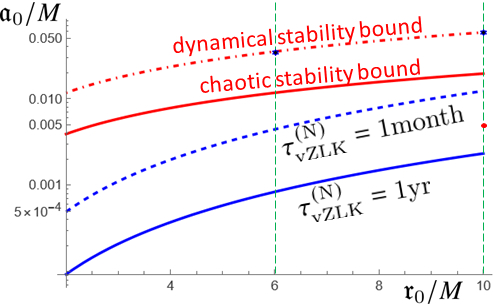
Figure 1: Dynamical and chaotic stability boundaries as functions of orbital parameters. The vZLK oscillation timescales for month and year periods are superimposed.
Final Orbital Parameter Distributions
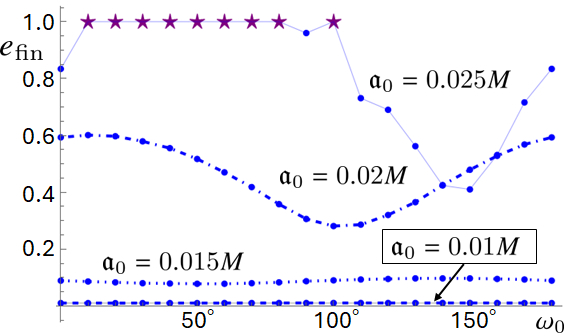
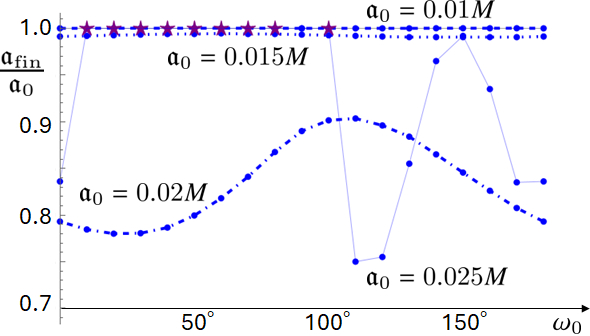
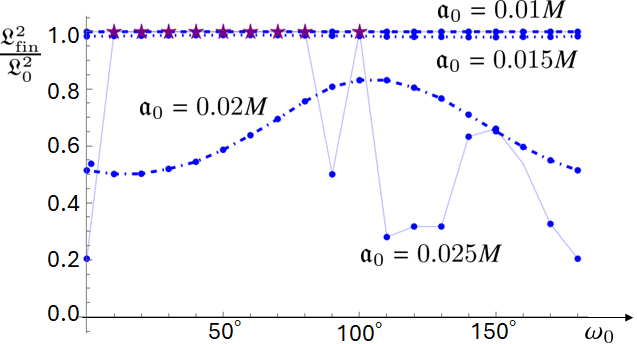
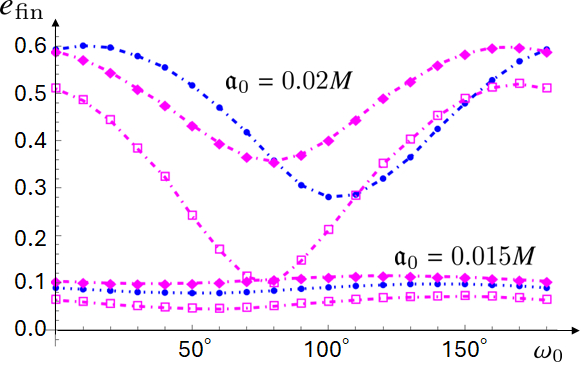
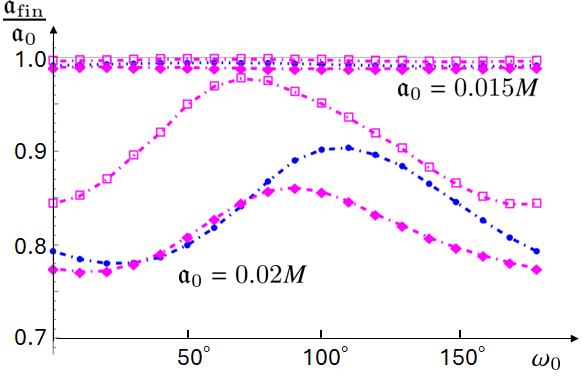
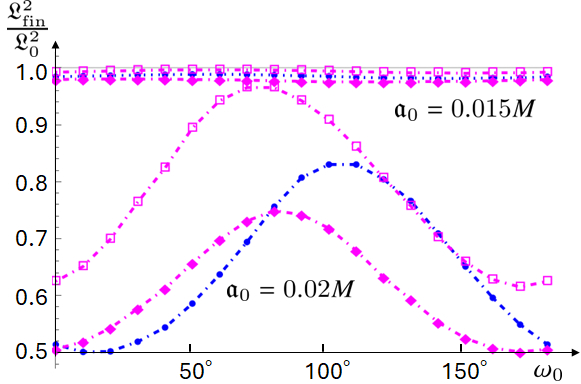
Detailed sweeps over initial conditions demonstrate the sensitivity of the final orbital state to periapsis geometry, especially in the chaotic regime. For nearly circular initial binaries, the post-scattering eccentricities can be significantly excited contingent on specific periapsis arguments, while for initially eccentric binaries, the post-scattering orbital parameters display strong stochastic variability.
Figure 2: Final orbital parameters (eccentricity, normalized semi-major axis, normalized angular momentum squared) post-scattering for representative values of initial semi-major axes across the various regimes as functions of periapsis argument.
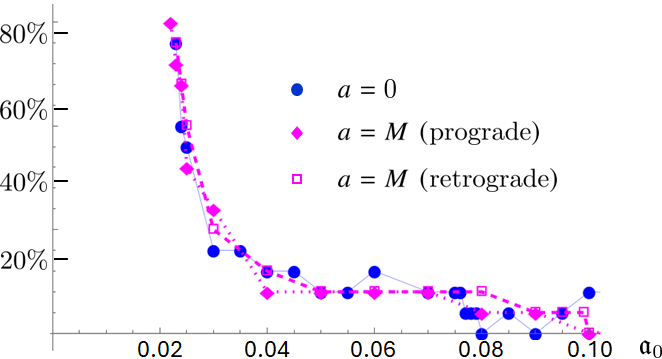
The fraction of binaries that remain bound post-scattering decreases sharply with increasing initial semi-major axis but displays a non-trivial tail up to the chaotic stability boundary, emphasizing the statistical likelihood of binary survival in galactic nuclei under repeated weak encounters.
Figure 4: Survival fraction of binaries as a function of their semi-major axis reveals a rapid decline and long tail, largely independent of SMBH spin or orbital inclination for the investigated parameter space.
Inclination and Relativity: Geometry and SMBH Spin Effects
Inclined orbits with respect to the SMBH equator have reduced tidal couplings; thus, the enhancement of eccentricity and potential for disruption is suppressed compared to coplanar configurations. The spin of the SMBH modulates these effects, introducing asymmetry between prograde and retrograde configurations. However, this modulation diminishes for eccentric binaries due to dominance of the periapsis passage geometry over the integrated frame-dragging effects.
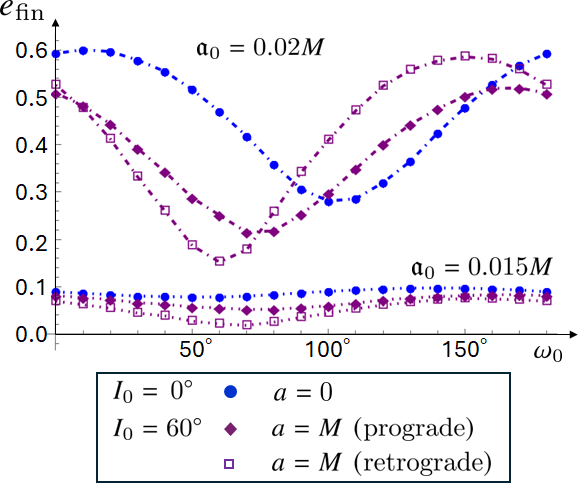
Figure 6: Comparative impact of Schwarzschild (non-spinning) and extreme Kerr SMBH (maximal spinning) metrics on the final binary orbital parameters after scattering, for both prograde and retrograde cases.
Bound systems on eccentric outer orbits (the typical scenario in galactic nuclei) do not experience continuous secular vZLK oscillations. Instead, the vZLK mechanism is activated impulsively at each close periapsis passage, manifesting as step-wise (scattering-driven) evolution of binary eccentricity and inclination. The main features are as follows:
Step-Like Oscillation: The inner binary’s eccentricity is altered predominantly at periapsis passages (rather than smoothly), with the exchange between inclination and eccentricity remaining guided by approximate conservation of the z-component of angular momentum in the local inertial frame.
Shortened vZLK Timescales: For high-eccentricity outer orbits, the effective vZLK timescale is shortened to the dynamical time, contrasting sharply with the much longer timescales expected under secular evolution.
Transition to Chaos: For sufficiently soft binaries or higher eccentricities, the vZLK oscillations lose regularity, displaying cycle-to-cycle variability and sensitivity to initial conditions—fully consistent with chaotic scattering previously observed in the unbound regime.
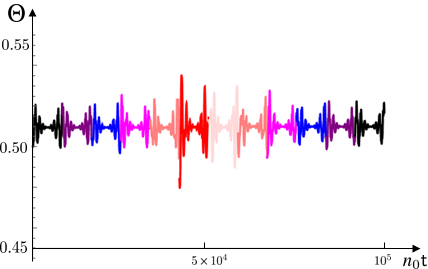
Figure 8: Within a single vZLK cycle, the evolution of the "conserved" quantity Θ≡1−e2cosI shows only modest deviations, evidencing approximate integral conservation despite impulsive tidal forcing.
SMBH Spin, Relativistic Corrections, and Future Prospects
The impact of SMBH rotation on step-wise vZLK oscillations remains minor except very close to the ISCO, and the key dynamical effect persists across both Schwarzschild and Kerr backgrounds due to the dominant geometric term from the mass-monopole tidal field.
Figure 5: Comparison of maximum eccentricity growth for coplanar binaries in Schwarzschild spacetime and inclined binaries around an extreme Kerr black hole, confirming the subdominant role of SMBH spin outside ISCO.
Analytical mapping to post-Newtonian corrections and dissipative effects (GW emission, binary hardening) is deferred but identified as necessary for quantitatively predicting merger rates and GW sources from such systems. The observed impulsive excitation of eccentricity likely catalyzes increased merger rates by fast-tracking binaries into the gravitational-radiation dominated regime following a sequence of periapsis tidally driven vZLK cycles or scatterings.
Conclusion
This work synthesizes binary–SMBH interaction dynamics into a unified framework capturing the full spectrum from single-passage (scattering) tidal perturbations to repeated impulsive vZLK oscillations driven by an eccentric bound trajectory. A four-fold classification of interaction regimes is presented, with transitions occurring as the internal binding energy of the binary is reduced. Step-wise and chaotic vZLK modes are established as the governing dynamics for eccentric outer orbits in galactic nuclei, with strong implications for the distribution of binary parameters entering the gravitational-wave-driven inspiral channel.
Empirically, the results support the prospect of increased GW merger rates in galactic nuclei due to these mechanisms, with potential signatures including merger events with high eccentricity and stochastic orientation distributions. Future extensions—incorporating full relativistic tidal effects, dissipative processes, and more complete parameter surveys—are compulsory for detailed GW event population modeling.
Key Figures Included:
Figure 1: Stability boundaries and timescales
Figure 2: Final parameter sweeps post-scattering
Figure 4: Survival statistics for binaries
Figure 6: Effect of Kerr spin on scattering
Figure 8: Conservation of z-component of angular momentum
Figure 5: Interplay between inclination and SMBH spin in the vZLK regime
“Emergent Mind helps me see which AI papers have caught fire online.”
Philip
Creator, AI Explained on YouTube
Sign up for free to explore the frontiers of research
Discover trending papers, chat with arXiv, and track the latest research shaping the future of science and technology.Discover trending papers, chat with arXiv, and more.